Play Store testers for 14-day Android closed testing in Bangladesh
Secure Play Store testers in Bangladesh for 14-day Google Play closed testing. Our 12 real testers meet Play Console requirements and help you go live fast.
Launching an app in today's crowded digital marketplace often feels like trying to board a moving train, and Google's strict policy updates haven't made it any easier. If you are a developer looking to publish your Android application, you are now faced with a mandatory checkpoint that can make or break your launch: the Google Play Closed Testing phase. Think of this phase as a rigorous visa interview for your app. Google wants to see if your creation can survive the real world before letting it loose on millions of users. For developers eyeing the vibrant, rapidly growing market in Bangladesh, getting authentic Play Store testers is not just a simple box to check, it is a massive strategic necessity. With its massive mobile-first population, Bangladesh offers incredible potential for new apps, but only if they function flawlessly on local networks and diverse devices. Finding reliable people who can commit to the strict requirement of continuous testing is where most indie developers and startups hit a brick wall.
Why the Bangladesh Market Changes the Game for App Testing
Testing an app is never a one-size-fits-all process. When you focus on a specific region like Bangladesh, you are dealing with unique challenges and opportunities. The mobile landscape here is incredibly diverse. Users rely on a huge variety of Android devices, from budget-friendly smartphones to high-end flagship models.
This hardware diversity means your app must be highly optimized. A bug that goes unnoticed on a brand new device might completely crash an older phone. Authentic local testers help you catch these specific issues before Google's automated systems flag them.
Furthermore, network conditions can vary wildly. While major cities enjoy high-speed internet, other areas might still rely on fluctuating mobile data connections. Your app needs to handle offline states, slow loading times, and data dropouts gracefully. Real human testers in Bangladesh will quickly let you know if your app eats up too much data or fails to load under less than ideal conditions.
Navigating the Google Play Closed Testing Requirements
Google introduced new rules to clean up the Play Store and ensure only high-quality apps make it to the public. The core of this update is the mandatory testing phase. While the numbers can sometimes feel confusing, the goal is simple. You need a dedicated group of people to use your app consistently.
The concept of getting 12 Testers for 14 Days is often discussed in development circles as a benchmark for focused, intense testing sprints. While Google's official baseline for new personal developer accounts specifically mentions 20 testers, securing a highly active core group of 12 testers for 14 days is a proven strategy to ensure deep, meaningful engagement.
These testers cannot just download the app and forget about it. They need to open it, interact with its features, and keep it installed for the entire duration. If Google's algorithm detects that your testers are inactive or uninstalling the app early, your application for production access will be firmly rejected.
The Danger of Fake Testing Services
Many frustrated developers turn to cheap online services that promise instant approvals. This is a massive mistake. Google's detection algorithms are incredibly smart and constantly evolving. They track device IDs, IP addresses, session lengths, and interaction patterns.
If you buy a service that uses automated bots or click farms to simulate your Play Store Closed Testing, you risk losing your entire developer account. A lifetime ban from the Play Console is a heavy price to pay for trying to cut corners.
Authentic Human Testers
Real users install your app on their personal, everyday devices. They open the app at random times, use different features, and generate natural usage data. Their feedback is genuine and helps you fix real bugs. Google's systems recognize this organic behavior and look favorably upon your production application.
Automated Bot Services
Bots use emulators or device farms located in a single room. They follow predictable patterns, clicking the exact same buttons at the exact same intervals. They do not leave meaningful feedback or test complex user flows. Google easily spots these patterns, resulting in immediate app rejection and possible account termination.
How Real Feedback Shapes Your Success
During your Google Play Closed Testing phase, feedback is just as important as the daily active usage metrics. Google requires you to summarize the feedback you received and explain how you acted on it when you apply for production access.
Having testers from Bangladesh gives you a massive advantage here. They can provide culturally relevant feedback, point out localization errors, and suggest features that make sense for the local market. This level of detail proves to Google that you took the testing phase seriously.
It is not enough to just say "the app works great." You need detailed reports on crashes, UI confusion, battery drain, and overall user satisfaction. When you work with real people, gathering this data becomes a natural part of the conversation.
Struggling with the 14-Day Testing Requirement?
Skip the hassle of recruiting unreliable testers. Our professional fleet of real Android devices guarantees Google Play compliance in exactly 14 days. Zero bots. Zero emulators. 100% production approval guarantee.
Understanding the 12 Testers for 14 Days Strategy
You might wonder why developers focus so heavily on the specific numbers and days. The truth is, managing a massive group of testers can become a full-time job. By focusing on a hyper-engaged core group, such as the 12 Testers for 14 Days model, you ensure high-quality interactions rather than surface-level metrics.
| Feature | Large Unmanaged Group | Core Focused Group (12 Testers) | Bots and Farms |
|---|---|---|---|
| Engagement Rate | Often drops below 30% after day three | Stays above 90% for the full 14 days | Faked metrics, easily detected |
| Feedback Quality | Generic, short, mostly unhelpful comments | Detailed bug reports and UX suggestions | Non-existent or machine generated |
| Management Effort | Exhausting, requires constant follow-ups | Manageable, allows for personal communication | Zero effort, but maximum risk |
| Google Approval Odds | Moderate, highly dependent on retention | Very High, due to consistent daily activity | Almost zero, high ban risk |
This focused approach allows you to build a true relationship with your testers. You can ask them specific questions about new features or guide them to test specific parts of your app that you are worried about, leading to a much stronger final product.
The Step-by-Step Testing Journey
Getting your app from a raw APK file to a published Play Store listing requires a clear, methodical strategy. We have broken down the entire journey so you know exactly what to expect and how to prepare for each distinct phase of the process.
Preparation and Internal Testing
Before you even think about closed testing, your app must be stable. Run it through the internal testing track with your immediate team. Fix all obvious bugs, ensure the app icon looks good, and double-check your privacy policy links. This is your sandbox environment where breaking things is perfectly fine, but you must clean up the mess before inviting outside users.
Setting Up the Closed Track
Create a new release in the Google Play Console under the Closed Testing track. You will need to add your testers' Google account email addresses to the testing list manually or via a CSV file. Make sure to generate the specific opt-in link provided by the console so they can officially join the program and gain access to the download page.
The 14-Day Marathon
This is the critical phase where most developers fail. Your testers must download the app and interact with it daily. You need to monitor their activity closely, send polite but firm reminders if someone goes silent, and gather their ongoing feedback through structured forms or direct messages. Treat this as a two-week intensive relationship-building exercise with your early adopters.
Reviewing and Fixing
As feedback rolls in, you must immediately start fixing the reported issues. You can, and should, push updates to the closed track during the 14 days to resolve bugs. However, make sure these updates do not break core features or change the UI so drastically that testers get confused. Document every single fix meticulously, as you will absolutely need this information later.
Applying for Production
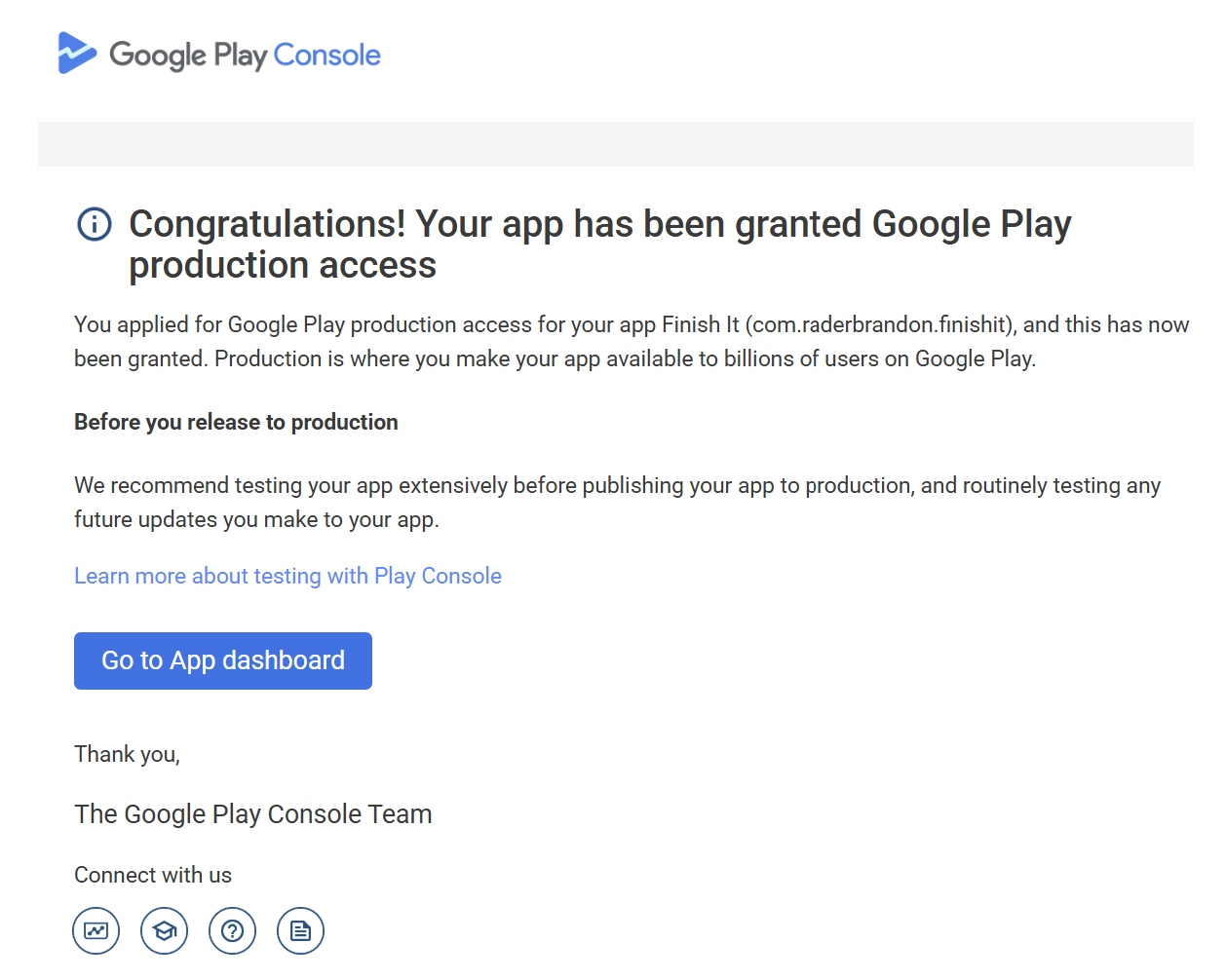
Once the 14 days are successfully completed without any major drop-offs in engagement, the button to apply for production will unlock in your Play Console dashboard. You will need to answer a detailed, multi-part questionnaire about your testing process, the specific feedback you received, and the exact changes you made to the application.
Mastering the Production Application Questionnaire
Many developers successfully finish the 14 days of grueling testing but fail at the very final hurdle: the production questionnaire. Google does not just rubber-stamp your application because you hit the required number of days. A human reviewer will carefully read your answers to determine if you genuinely used the testing phase to improve your product.
You must be incredibly specific in your responses. Vague answers are a guaranteed way to get rejected. If a tester reported that the login button was hard to see on small screens, write that down exactly. Explain that based on this feedback, you increased the button size by twenty percent and changed the background contrast ratio in update version 1.0.2. This level of transparency shows Google that you are a responsible developer who values user safety and experience.
Never leave optional answers blank, and absolutely do not write one-word responses. Treat this questionnaire like an important university exam. Your ability to articulate the value of your Google Play Closed Testing phase directly impacts your approval speed. Detail the methods you used to collect feedback, whether it was through a dedicated Discord server, Google Forms, or one-on-one WhatsApp conversations. The more context you provide, the easier it is for the reviewer to approve your app.
Pre-Launch Checklist for Play Store Closed Testing
To make sure you are absolutely ready for your testers and won't waste their time, we have created a comprehensive checklist. Do not invite a single tester until you can confidently check off every item on this list.
App Readiness and Stability
Console Configuration and Legal
Tester Management Strategy
Building a Sustainable Developer Strategy for Long-Term Success
Passing the closed testing phase is a major milestone for any developer, but it is truthfully only the beginning of your long-term journey. The crucial skills you learn during this rigorous process - gathering actionable feedback, analyzing subtle user behavior, and communicating clearly with a diverse audience - are exactly the same skills you need to grow and monetize your app after the official launch.
By focusing on a high-quality, deeply engaged testing experience with real users in Bangladesh, you are building a solid foundation of trust. These early testers often become your most loyal, long-term users and your biggest organic advocates. They are the ones who will leave glowing, five-star positive reviews on launch day, eagerly share the app with their friends and family, and help you climb the highly competitive Play Store search rankings.
Do not view the testing requirements as a harsh punishment or an unnecessary obstacle from Google. Instead, view them as a free, mandatory beta-testing period that forces you to step out of your developer bubble and make a genuinely better product. Embrace the process, engage authentically with your testers, and use their invaluable insights to create an application that truly resonates with your target market and stands the test of time.
Frequently Asked Questions
We know this entire publishing process can be incredibly overwhelming for new developers. Below are the absolute most common questions creators have about securing Play Store testers and navigating the strict evaluation phase successfully.
Why did Google suddenly make 14 days of closed testing mandatory for new accounts?
Google introduced this strict rule to combat the massive flood of low-quality, buggy, and sometimes malicious apps entering the Play Store ecosystem. In the past, developers could instantly publish applications that crashed on launch or contained intrusive spam. By forcing a dedicated 14-day testing period with real, human users, Google ensures that developers take the time to fix critical issues and polish their apps before they reach the general public. It is fundamentally a strict quality control measure designed to protect everyday Android users.
Can I just use my close friends and family members as my primary testers?
Yes, you absolutely can use friends and family, and Google even suggests this as an easy starting point. However, friends and family are often heavily biased. They might not want to hurt your feelings by telling you that your app is confusing, slow, or poorly designed. Furthermore, getting a large group of friends to actually remember to open an app every single day for two straight weeks is surprisingly difficult. Most developers quickly find that relying solely on personal networks leads to incomplete testing and eventual rejection due to low, inconsistent engagement.
What actually happens if a tester forgets and misses a day during the 14-day period?
Google's algorithm looks for continuous, daily engagement across your overall testing group. If one or two testers miss a single day, it is usually not a total disaster, provided the rest of the group remains highly active and engaged. However, if multiple testers stop opening the app for several consecutive days, Google's automated systems will definitely flag the testing phase as inactive and reject your production application. This is exactly why having highly committed, reliable testers is so absolutely crucial. You need people who treat the testing process seriously.
How do I truly know if my Android app is ready to begin closed testing?
Your app should be practically and functionally complete before you begin. It should absolutely not be a rough prototype, a broken alpha build, or a half-finished concept. All core features must work exactly as intended, there should be no obvious placeholder text anywhere, and it must not crash during normal, everyday use. The primary purpose of closed testing is to find hidden, obscure bugs and refine the user experience, not to test basic, fundamental functionality that should have been fixed during your internal development and debugging phase.
Am I allowed to update my app while the 14-day closed testing is actively running?
Yes, you can, and Google actually strongly encourages it! If your testers find a major, game-breaking bug on day three, you should immediately fix it and push a new update directly to the closed testing track. Pushing updates shows the Google review team that you are actively maintaining the app and actively responding to real user feedback. Just carefully ensure that the updates do not drastically change the core purpose of the app, as this can deeply confuse your existing testers and disrupt their workflow.
What exactly does the term 'opt-in' mean for my prospective testers?
Simply typing an email address into the Play Console is not nearly enough to make someone a tester. You must generate a specific opt-in link directly from the console dashboard and send it to your chosen testers. The tester must click this unique link on their Android device, sign in with the exact same Google account you added to the list, and explicitly click a button that says 'Become a tester'. Only after completing this mandatory step will they be able to search for and download the closed testing version of your app directly from the Play Store.
Will Google actually reject my app if I do not get enough written feedback?
Yes, they almost certainly will. When you finally apply for production access, the mandatory questionnaire specifically asks what exact feedback you received and how you tangibly acted on it. If you simply write "I got no feedback, everything was perfect," Google will likely reject your application immediately because it strongly implies the testers did not actually use the app deeply or care enough to report issues. Real, functioning apps always have areas for improvement. You must provide concrete, specific examples of user feedback and your subsequent developmental actions.
Why is it so beneficial to have testers specifically from the Bangladesh market?
If your app's target audience includes Bangladesh, having genuine local testers is absolutely invaluable. They will naturally test the app on local mobile networks, which rapidly helps you understand performance under real-world data conditions that you cannot simulate. They also provide crucial insights on cultural relevance, appropriate language localization, and regional user experience preferences. Ultimately, it proves to Google that your app is carefully tailored and highly optimized for the specific market you intend to serve, increasing your overall chances of approval.
Is there a significant difference between internal testing and closed testing?
Yes, there is a massive, fundamental difference. Internal testing is a quick, casual way to distribute your app to up to 100 people (usually just your immediate development team) without any strict rules, engagement metrics, or review processes. Closed testing, on the other hand, is the formal, mandatory phase required by Google for all new personal developer accounts. It is heavily monitored for daily engagement and strict compliance, and it requires you to confidently pass a comprehensive human review before you can even think about moving to the production track.
What should I realistically do if my final application for production is rejected by Google?
First and foremost, do not panic. Google will usually send an automated but detailed email explaining exactly why your application was rejected. Most often, the reason is simply 'insufficient tester engagement' or a 'lack of detailed feedback provided in the application questionnaire'. Unfortunately, you will need to start another full round of closed testing from scratch. This time around, strongly ensure your testers are significantly more active, collect much better written feedback, and spend considerably more time writing detailed, thoughtful, and comprehensive answers on the final production application questionnaire.
The Testing Pipeline
A straightforward 4-step process to get your Android app approved.
Sign In
Connect your Google account and choose your preferred closed testing package for your Android app.
Opt-In URL
Share your Play Store opt-in URL. We immediately deploy 12 real testers to launch and review your Android app daily.
Testing Begins
Our crew initiates daily launch sessions on physical devices, verifying usability and logging crashes for your Android app.
Compliance Complete
We continuously perform closed app testing for 14 days to help you meet Google Play production requirements. We also provide a compliance report.
Why Developers Trust Us
Deploy your Android app onto real retail-grade handsets using our secure laboratory environment.
The 14-Day Production Guarantee
We complete the required 14-day closed testing process with real human testers and physical Android devices, while providing clear testing evidence and documentation throughout the process.
If Google specifically rejects production access due to insufficient testing engagement, you are covered by our free re-run or 100% refund guarantee, subject to our Refund Policy.
Verified Production Access
Quality QA Testing Reports
Clear, actionable reports with screenshots and evidence for every important issue found during testing.
Real Device Testing & Diagnostics
Real human testers use physical Android devices to test your app, verify real user flows, and provide clear testing evidence and professional QA reports.
Guaranteed App Approval
Transition your Android app to public production access with confidence. We deliver verified session logs and compliant Console activity.
One Cycle. Complete Approval.
Choose the ideal closed testing cycle for your Android release.
Loading Packages
Please wait while we fetch the best options for your region...
Frequently Asked Questions
Everything you need to know about passing your closed testing requirements.