Play Store testers for 14-day Android closed testing in Bolivia
Find Play Store testers in Bolivia for 14-day Google Play closed testing. Fulfill Play Console requirements with 12 real testers and launch quickly.
Mastering Google Play Closed Testing for Android Developers in Bolivia
Building an Android app in Bolivia is an exciting journey. From tech startups in Santa Cruz de la Sierra and software development teams in Cochabamba to digital creators in La Paz, Bolivian engineering talent is growing fast. However, publishing your application to the Google Play Store requires passing a strict policy checkpoint known as Google Play Closed Testing.
Google requires all personal developer accounts created after November 2023 to run a closed test with at least 12 opt-in testers who maintain active access for 14 consecutive days. Skipping or rushing this crucial phase results in an immediate rejection when you apply for production access. To launch your app successfully, you must understand how to manage closed testing effectively.
Why Google Mandates 12 Testers for 14 Days
The policy requiring 12 Testers for 14 Days is designed to stop buggy, unoptimized, and malicious apps from entering the Play Store ecosystem. Google wants verifiable proof that real human beings installed your APK or Android App Bundle (AAB), opened it across multiple sessions, and navigated its user interface on actual hardware.
For Bolivian developers, this testing phase provides an invaluable opportunity to evaluate how an app behaves across local network conditions. Cellular carriers like Entel Bolivia, Tigo Bolivia, and Viva feature fluctuating latency, varying signal strengths between urban valleys and rural plains, and intermittent 4G LTE connections. Testing with real users ensures your caching mechanisms, offline modes, and API error handlers work reliably before public launch.
The Technical Reality of Play Console Metrics and Telemetry
Many developers assume Google Play Closed Testing is merely a waiting game where you add twelve email addresses and let the clock tick down. In reality, Google Play Console evaluates real-time telemetry from every opted-in device to decide if your test is authentic.
Google tracks several vital technical metrics throughout the 14-day window:
- Android Vitals and Crash Thresholds: Google automatically flags apps that exceed the core vitals threshold. Your application must maintain a user-perceived crash rate below 1.09% and a user-perceived Application Not Responding (ANR) rate below 0.47%. If your app hangs or crashes when switching between Wi-Fi and mobile networks on Entel or Tigo, your production application will be denied.
- Hardware Architecture and Screen Density: Bolivian consumers use a diverse spectrum of budget-friendly and mid-range Android devices, including popular models from Samsung (Galaxy A-series), Xiaomi (Redmi and Poco), Tecno, Infinix, and Motorola. Google verifies whether your test cohort runs on diverse screen sizes (from compact 720p displays to FHD+ AMOLED screens), processor architectures (ARM64, ARMv7), and OS versions spanning Android 10 through Android 15.
- Daily Active User (DAU) Consistency: If all twelve testers open the app for thirty seconds on Day 1 and never open it again until Day 14, automated review algorithms mark the test as inactive. Genuine human users launch apps organically across various times of day, creating natural usage patterns that satisfy Google verification systems.
- Opt-In Integrity and Feedback Loops: Testers must accept the closed testing invite through the official Play Store or web link using their registered Google accounts. Google monitors whether testers submit private feedback through the Play Store interface, providing proof of active engagement.
The Fatal Flaws of Automated Bot Farms vs Real Human Testers
When developers struggle to recruit participants, they often consider cheap online shortcuts such as bot farms or automated click scripts. Using automated scripts or fake accounts to bypass Google Play Closed Testing is extremely risky and can permanently damage your developer credentials.
Google employs advanced machine learning to detect synthetic traffic, datacenter IP addresses, and repetitive tap coordinates. Here is how real human testers compare against automated bot services:
Authentic Human Testers in Bolivia
Real human testers download your Android app directly from the Google Play Store onto their everyday physical smartphones. These devices carry authentic Google account histories, residential IP addresses, and natural usage routines across carriers like Entel, Tigo, and Viva.
Human testers interact with your app organically. They scroll through feeds, fill out forms, rotate their screens, and encounter real UI bottlenecks. If a checkout button overlaps on a budget screen or a local payment gateway fails to load, human testers flag the issue immediately. This authentic telemetry creates genuine Android Vitals logs that help you breeze through the final production review without issues.
Automated Bots and Scripted Farms
Automated testing farms use headless emulators, rooted virtual machines, or scripted cloud servers to simulate app installs. These tools execute rigid, repetitive tap sequences that trigger automated fraud filters inside the Google Play Console review pipeline.
Bots cannot provide qualitative user feedback, test local carrier latency, or uncover edge-case layout glitches on physical hardware. When Google security algorithms detect synchronized logins from shared datacenter IP pools or unverified dummy accounts, your production request is rejected instantly. In many cases, Google will permanently terminate the developer account with zero chance of appeal.
Comparing Your Android Closed Testing Strategies
To achieve full compliance with Google Play Closed Testing requirements, you have three primary paths. You can organize a DIY testing group with friends and colleagues, risk automated bot farms, or partner with a professional managed testing service.
| Feature | Professional Managed Service | DIY (Friends & Family) | Cheap Bot Farms |
|---|---|---|---|
| Google Policy Compliance | 100% Guaranteed Approval Ready | Variable (High risk of dropouts) | Zero (Triggers account bans) |
| Hardware Authenticity | Real physical Android smartphones | Real physical smartphones | Emulators and virtual instances |
| 14-Day Continuous Retention | Monitored daily with backup testers | Difficult to enforce consistently | Scripted artificial pings |
| Network & Carrier Realism | Authentic residential and carrier IPs | Authentic personal networks | Datacenter and proxy IP pools |
| Actionable Developer Feedback | Structured bug reports and logs | Casual or subjective feedback | None (No human involvement) |
| Production Questionnaire Support | Detailed answers and data logs | Minimal documentation | None |
| Developer Time Investment | Zero management overhead | 15 to 25 hours chasing testers | Wasted time after account ban |
Struggling with the 14-Day Testing Requirement?
Skip the hassle of recruiting unreliable testers. Our professional fleet of real Android devices guarantees Google Play compliance in exactly 14 days. Zero bots. Zero emulators. 100% production approval guarantee.
Step-by-Step Roadmap to Production Approval
Navigating the Play Console closed testing workflow requires strict adherence to Google guidelines. Follow this structured roadmap to steer your Android application from early build upload to full public release.
Build Preparation and Store Listing
Export your release-ready Android App Bundle (AAB) with production signing keys. Ensure your target SDK matches Google latest API level requirement (API level 34 or higher). Complete the mandatory store listing details, including high-resolution app icons (512x512 PNG), feature graphics (1024x500 JPEG/PNG), accurate content ratings, and a legally compliant privacy policy URL hosted on a live domain.
Create and Configure Closed Testing Track
Navigate to Google Play Console, select your application, and open the Closed testing section under the Release management menu. Create a new closed track release and upload your signed AAB. Create an email list containing the exact Google account addresses of your verified testing cohort. Configure country availability to include Bolivia and any other regional target markets.
Distribute Opt-In Links and Verify Installs
Send the web opt-in URL (Google Play join link) or the direct Android Play Store testing link to all invited testers. Each tester must open the link, click 'Become a Tester', and download the application directly through the Google Play client on their physical device. Verify in your Play Console dashboard that at least 12 individual testers show an 'Installed' status.
Maintain 14 Consecutive Days of Active Testing
Keep your closed test active for a minimum of 14 continuous days without interruption. Encourage testers to open the application regularly, navigate through major features, trigger network requests, and test local storage. Monitor your Android Vitals dashboard daily to identify and resolve any unhandled exceptions, memory leaks, or ANR crashes.
Deploy Fixes and Gather User Feedback
If testers identify bugs or layout issues on specific device resolutions, prepare updated builds and upload them to the same closed testing track. Pushing updates does not reset your 14-day timer as long as testers update the app and remain enrolled. Collect structured feedback regarding navigation, loading speeds, and overall usability to document for Google review team.
Submit Production Access Application
Once the 14-day period concludes with 12 active testers, the 'Apply for Production' button unlocks in the Play Console. Complete the required questionnaire thoroughly, detailing your testing methodology, feedback gathered, and technical improvements made. Once approved by Google review team, promote your closed build to the Production track and launch publicly.
Comprehensive Pre-Launch Closed Testing Checklist
Before inviting testers and starting your 14-day countdown, review this pre-launch checklist to ensure all technical, operational, and regulatory assets are properly configured.
Play Console Configuration
Device and Network Compatibility
Policy, Privacy, and Content Compliance
Answering the Production Access Questionnaire with Confidence
The final hurdle in Google Play Closed Testing is the production access questionnaire. After your 14 days finish, Google presents a series of detailed questions. Reviewers examine your answers to verify whether you conducted a genuine quality assurance process or merely tried to bypass platform requirements.
When completing the questionnaire, keep the following best practices in mind:
1. Describing Your Tester Recruitment Strategy
Explain clearly how you sourced your testing cohort. State that you selected diverse Android users across different hardware specifications and geographical locations to evaluate real-world performance. Emphasize that testers used their personal devices under normal everyday operating conditions rather than automated cloud servers.
2. Detailing Feedback and User Insights
Provide specific, qualitative examples of feedback received during testing. Mention feedback regarding UI layout clarity, font legibility on smaller screens, navigation flow improvements, or onboarding simplification. Concrete details prove to Google reviewers that human beings evaluated your user experience.
3. Explaining Technical Bug Fixes and Updates
Document the technical issues identified and resolved during the 14-day test. Detail any crash logs, ANRs, or API latency bugs identified through the Play Console Vitals dashboard or direct user reports. Explain how subsequent AAB releases resolved these issues to enhance overall stability.
4. Demonstrating Public Launch Readiness
Conclude your application by explaining why your app is ready for global distribution. Highlight low crash rates, optimized memory consumption, and positive tester reception as evidence that your software meets the highest standards of the Google Play ecosystem.
Frequently Asked Questions
Do all 12 closed testers need to be physically located in Bolivia?
No. Google Play Console policies do not require testers to be physically located inside Bolivia, even if your app targets the Bolivian market. Testers can be located in any country where your closed testing track is made available. However, each tester must have an active, verified Google account, opt in through the official testing link, and keep the application installed on a physical Android device for the full 14 days. Having local testers can provide valuable localized feedback on carrier networks like Entel and Tigo, but international human testers fully satisfy Google compliance criteria.
What happens if one of my 12 testers uninstalls the app before Day 14?
If a tester uninstalls your application or leaves the testing program, your active tester count will fall below the required threshold of 12. Google tracking systems monitor daily active enrollment. If your active count drops below 12, Google Play Console may pause your testing progress, meaning the 14-day timer will not complete successfully. To prevent this, professional testing services enroll 15 to 20 testers, providing a safety buffer so your test remains continuous even if an individual user experiences device issues.
Can I release updates and fix bugs while the 14-day test is running?
Yes. You are fully permitted and encouraged to release new builds to your closed testing track during the 14-day testing window. Deploying bug fixes, performance optimizations, and UI adjustments demonstrates active development. Pushing an update will not reset your 14-day progress counter, provided your testers install the updated version and continue using the app normally.
Why is an Internal Testing track insufficient for production access?
Internal testing tracks are intended for rapid internal iteration among up to 100 teammates. Google Play Console policies explicitly state that internal testing does not satisfy the 12 Testers for 14 Days requirement for personal developer accounts. You must create a dedicated Closed Testing track, configure a tester list, distribute opt-in links, and run the test for 14 consecutive days before you become eligible to apply for production access.
How does Google distinguish real human testers from automated bot scripts?
Google evaluates complex telemetry data, including hardware device identifiers, touch input dynamics, session lengths, network variation, and account history. Real human users launch applications at irregular hours, scroll at natural velocities, switch between mobile carriers and Wi-Fi networks, and have established Google accounts with existing store activity. In contrast, automated bots run on predictable datacenter IP subnets, lack authentic account histories, and generate synthetic, repetitive interaction patterns that trigger automated fraud flags.
How long does Google take to review the Production Access application?
Once you complete your 14-day closed testing period and submit the production access questionnaire, the Google Play review team typically takes between 2 to 7 business days to evaluate your submission. If your test demonstrated continuous daily active engagement, healthy Android Vitals, and thorough questionnaire responses, approval is usually granted on the first attempt, allowing you to publish immediately to the public Production track.
Final Thoughts: Launching High-Performing Android Apps in Bolivia
Publishing an Android application from Bolivia requires more than just clean code and appealing design. Meeting Google Play Closed Testing compliance is a necessary foundation for long-term commercial success on the Google Play Store.
By maintaining 12 Testers for 14 Days on real hardware, monitoring Android Vitals, and gathering authentic human feedback across diverse mobile networks, you protect your developer account and ensure your users enjoy a seamless, crash-free experience. Treat closed testing as a powerful quality assurance milestone, and position your app for maximum visibility, high store ratings, and sustainable growth in Bolivia and international markets.
Our QA Process
Your journey to Google Play production access, simplified and automated.
Choose Package
Authenticate your account to initialize the 14-day QA fleet for your Android release.
Submit Link
Upload your testing link. We assign 12 verified users with real Android devices to download and test your Android release.
Active Testing
A dedicated testing supervisor is assigned to monitor progress while testers engage with your Android app and provide feedback throughout the testing period.
Get Approved
Our lab maintains active installations for two weeks straight, ensuring a clean track record and providing a QA compliance log for your release.
The Premium QA Advantage
Satisfy your Play Store Console testing obligations with our managed physical device fleet tailored for Android builds.
The 14-Day Production Guarantee
We complete the required 14-day closed testing process with real human testers and physical Android devices, while providing clear testing evidence and documentation throughout the process.
If Google specifically rejects production access due to insufficient testing engagement, you are covered by our free re-run or 100% refund guarantee, subject to our Refund Policy.
Verified Production Access
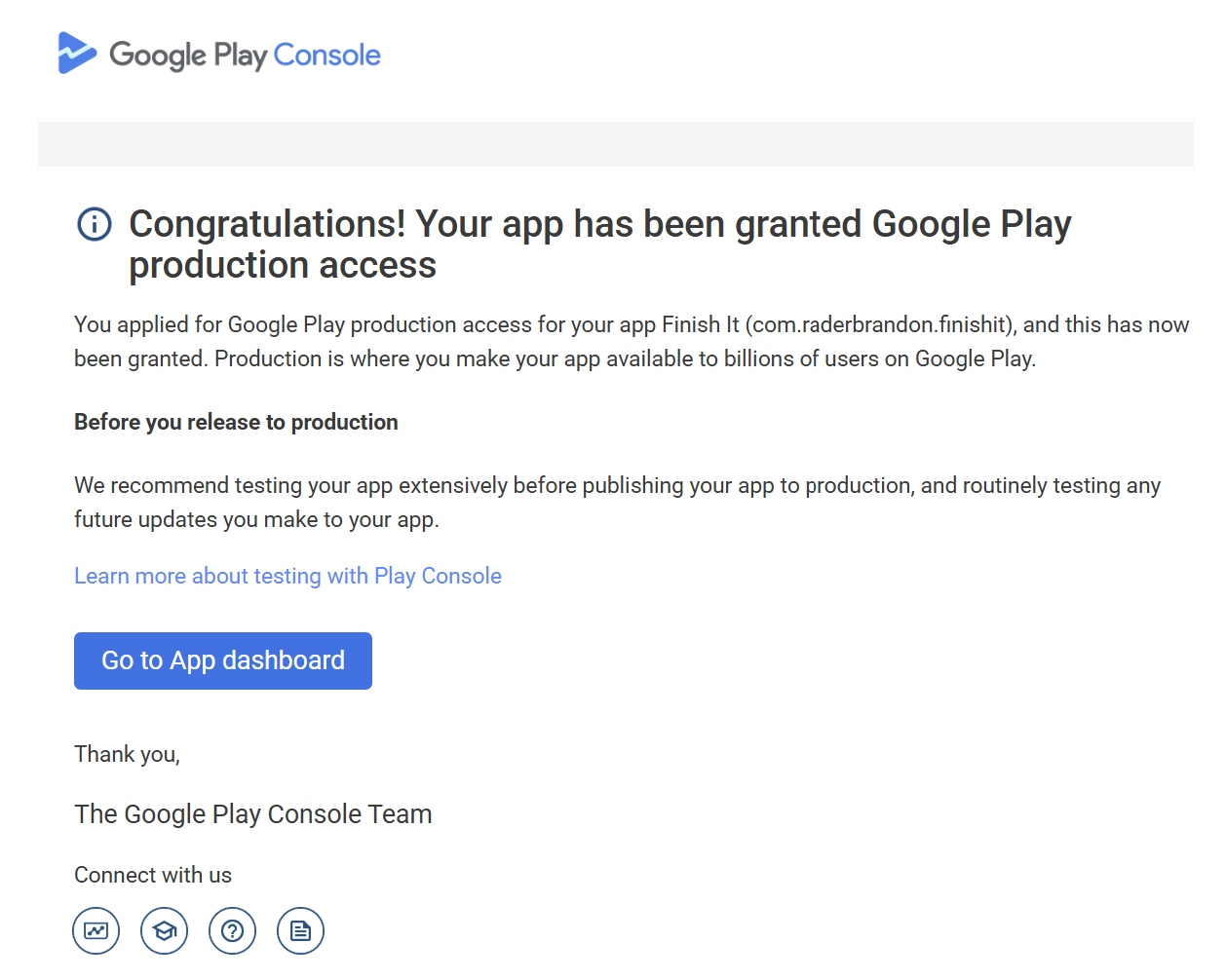
Quality QA Testing Reports
Clear, actionable reports with screenshots and evidence for every important issue found during testing.
Real Device Testing & Diagnostics
Real human testers use physical Android devices to test your app, verify real user flows, and provide clear testing evidence and professional QA reports.
Production Access Secured
Our structured 14-day closed testing process is designed to meet Google Play's production requirements for your Android release.
Simple Closed Testing Pricing
Select the plan that fits your Android app complexity.
Loading Packages
Please wait while we fetch the best options for your region...
Frequently Asked Questions
Everything you need to know about passing your closed testing requirements.