Play Store testers for 14-day Android closed testing in Cambodia
Find Play Store testers in Cambodia for 14-day Google Play closed testing. Fulfill Play Console requirements with 12 real testers and launch quickly.
The Cambodian Android Ecosystem and Developer Challenges
Launching an app in Cambodia requires navigating a uniquely dynamic mobile environment. Android dominates the market, but it runs across a wide spectrum of devices ranging from entry-level Transsion hardware (Infinix, Tecno) and budget Xiaomi or Realme handsets to flagship Samsung Galaxy phones. Furthermore, mobile connectivity relies heavily on major local cellular providers like Smart Axiata, Cellcard, and Metfone. Testing your app under genuine network conditions ensures your background sync, push notifications, and API handshakes survive network switching between high-speed urban 4G and intermittent provincial towers.
Beyond hardware and connectivity, local user experience depends on proper support for Khmer script rendering and payment workflows. If your app includes e-commerce or subscriptions, it must smoothly interact with QR-based digital payments such as the National Bank of Cambodia's Bakong system, ABA PayWay, or Wing. Bot emulators running in foreign data centers cannot replicate real SIM connections, local carrier IP ranges, or genuine user interactions with local payment gateways. Conducting real Google Play Closed Testing in Cambodia verifies that your app performs reliably for local users while satisfying Google's rigorous engagement standards.
Real Cambodian Testers vs. The Synthetic Bot Trap
Desperate developers often turn to cheap automation farms that promise instant closed testing completion using emulators and VPNs. Unfortunately, Google Play Console employs sophisticated behavioral and device integrity heuristics that detect synthetic activity instantly, risking permanent developer account termination.
Authentic Cambodian Testers
- Genuine Regional Hardware: Tested across physical devices running on Smart Axiata, Cellcard, and Metfone mobile networks.
- Localized Validation: Real humans check Khmer font layouts, dual KHR/USD price formatting, and local payment deep links.
- Organic Telemetry: Natural daily user sessions generate valid metrics that satisfy Google's engagement requirements.
- Zero Policy Penalties: Total compliance with Google Play Developer Policies keeps your developer account safe.
Automated Script & Bot Farms
- Virtual Emulators: Datacenter IP ranges and identical hardware fingerprints are quickly flagged by Play Protect.
- Zero Real-World Feedback: Scripts cannot tell you if Khmer typography breaks or if a payment modal freezes.
- Artificial Activity: Identical open-and-close timestamps trigger manual review flags in the Play Console.
- High Risk of Account Bans: Violations can lead to track rejection or permanent developer account termination.
Decoding Google's 14-Day Closed Testing Requirement
Google's policy requires personal developer accounts to maintain active closed testing with at least 20 testers for 14 continuous days. If you already have 8 internal team members or early adopters, securing the remaining 12 testers for 14 days ensures full compliance without unnecessary delays.
During this 14-day window, Google Play Console silently tracks your application's Core Vitals and engagement signals. Algorithms monitor User-Perceived Crash Rates, Application Not Responding (ANR) occurrences, daily active device counts, and whether testers actually interact with distinct screens. If testers uninstall on day two or show zero recurring sessions, the system resets your 14-day counter. Genuine, sustained interaction from real testers proves your build is stable, compliant, and ready for production release.
Struggling with the 14-Day Testing Requirement?
Skip the hassle of recruiting unreliable testers. Our professional fleet of real Android devices guarantees Google Play compliance in exactly 14 days. Zero bots. Zero emulators. 100% production approval guarantee.
Deep Dive: Play Console Telemetry, Android Vitals, and Heuristics
Passing Google Play Closed Testing is no longer just a checkbox where you invite 20 email addresses and let the clock run out. Modern Google Play algorithms actively evaluate your build through Android Vitals and Play Protect telemetry gathered straight from testing devices. Google uses these telemetry signals to distinguish between authentic human software testing and synthetic bot activity before allowing any developer to apply for production access.
1. User-Perceived Crash Rate and Bad Behavior Thresholds
Google Play Console groups app stability into core technical metrics. The most critical metric during your 14-day testing period is the User-Perceived Crash Rate. This measures the percentage of daily active users who experience at least one crash while actively interacting with the foreground UI:
- Google's Bad Behavior Threshold for Crashes: 1.09% across all devices, and 8.0% per individual device model. If your testing pool experiences unhandled runtime exceptions on budget devices like the Tecno Spark or Infinix Hot series, your crash rate will spike above the allowable threshold.
- Root Cause Detection: Crashes often occur during initialization, background thread context switching, or when unbundling JSON payloads with unexpected null values. Real human testers trigger these corner cases by rotating screens, putting the app in the background while receiving phone calls, and typing unexpected characters into form fields.
- Proactive Crash Remediation: Maintain a real-time crash dashboard using Firebase Crashlytics or Sentry. Every time a tester triggers a fatal stack trace, isolate the exact device model, Android API level, and thread state to push a hotfix build directly to your closed testing track.
2. Application Not Responding (ANR) Thresholds and Main Thread Blocking
An Application Not Responding (ANR) error occurs whenever your app freezes the main UI thread for longer than 5 seconds (or 10 seconds for broadcast receivers). In Android, the main UI thread handles touch input, frame rendering, and lifecycle transitions.
- Google's Bad Behavior Threshold for ANRs: 0.47% overall user-perceived ANR rate, and 8.0% per device model. Exceeding this threshold during closed testing signals to Google that your app is sluggish and unprepared for commercial release.
- Common Culprits in Cambodian Environments: In regions with variable mobile data connectivity across Smart, Cellcard, or Metfone, executing synchronous database queries (e.g., Room DB / SQLite) or making synchronous HTTP network calls on the main thread will inevitably cause ANR dialogs.
- Strict Thread Hygiene: Ensure all heavy computational tasks, bitmap decodings, encryption handshakes, and local storage read/write operations run inside asynchronous coroutines (Kotlin) or dedicated background worker threads (RxJava / Java Executors).
3. Stuck Partial Wake Locks and Battery Drain Telemetry
Android Vitals closely tracks battery consumption metrics. If your app requests a wake lock to keep the device CPU active during background sync operations, failing to release that wake lock creates a Stuck Partial Wake Lock:
- Threshold Trigger: Having wake locks held for more than an hour continuously without user awareness triggers an immediate negative flag in Play Console.
- Excessive Background Wi-Fi Scans and Network Wakeups: Firing periodic network polling every few seconds drains the device battery and triggers automated throttling in Android 12, 13, 14, and 15 through Android Doze mode.
- Best Practice Implementation: Modern Android apps must rely on
WorkManagerfor deferrable background jobs instead of legacy background services or unbounded wake locks.WorkManagerintelligently respects system battery constraints, Doze mode, and device charging states.
4. Behavioral Heuristics and Session Depth Telemetry
Google's internal review system analyzes tester engagement patterns during the 14-day window:
- Session Duration and Interval Variance: Human testers open an app at varying times of day, spend between 2 to 15 minutes exploring menus, and produce non-linear touch event coordinates. Synthetic bots open the app at the exact same minute each day, tap the same exact pixel coordinates, and close the process after exactly 30 seconds. Google's machine learning classifiers flag this robotic behavior effortlessly.
- Distinct Screen Transitions: Play Console tracks whether your testers explore sub-views, user account settings, search catalogs, and checkout screens, or if they merely stare at the login screen. Genuine testers interact naturally with deep links, permission request dialogs, and form inputs.
- Device Fingerprint Diversity: Having all 20 testers share identical screen resolutions, GPU renderers, and IP subnet ranges indicates an emulator farm. Real Cambodian testing distributes your telemetry across genuine hardware profiles, carrier IP addresses, and authentic build fingerprints.
Mastering the Google Play Production Access Questionnaire
At the end of your 14 continuous testing days, Google Play Console unlocks the Apply for Production button. You will be presented with a mandatory questionnaire asking detailed questions about your testing process, user feedback, and technical improvements. Failing to provide comprehensive, authentic answers is one of the most common reasons developers get rejected at the final hurdle.
Here is how you should structure your answers to pass Google's human and automated review:
Question 1: How did you recruit your testers?
- What Google Wants to Know: Google wants to verify that your testers represent genuine prospective users rather than automated bots or paid review spammers.
- Winning Answer Strategy: Explain that you combined your core internal developer team with a managed cohort of targeted Android testers located in your target launch market (Cambodia). Detail how testers were invited through Google Play's official Closed Testing email list system, installed the build via the Play Store opt-in URL, and tested across a wide array of physical smartphones running Android 10 through Android 15 on local cellular networks like Smart Axiata, Cellcard, and Metfone.
Question 2: How did testers engage with your app, and what feedback did they provide?
- What Google Wants to Know: Did you actually receive qualitative feedback, or was the testing track passive?
- Winning Answer Strategy: Provide specific, concrete examples of user feedback collected during the 14 days. Mention feedback regarding UI layout adjustments on tall aspect ratio screens, Khmer font readability on budget devices, form validation improvements for Cambodian phone numbers (+855), and edge-case network timeout handling during intermittent 3G/4G connectivity switching. Showing clear feedback proves active human involvement.
Question 3: What changes or improvements did you make based on tester feedback?
- What Google Wants to Know: Did you iterate and push software updates to resolve discovered issues?
- Winning Answer Strategy: Detail the version updates you rolled out to your closed testing track during the 14 days. For example, explain: "In version 1.0.2 (Build 4), we patched a memory leak in the image caching pipeline that caused high memory consumption on entry-level 2GB RAM devices. In version 1.0.3 (Build 5), we updated our network retry policy with exponential backoff to handle slow mobile connections without throwing unhandled timeout exceptions."
Question 4: Why do you believe your app is ready for production release?
- What Google Wants to Know: Are you confident in your app's stability, security, and policy compliance?
- Winning Answer Strategy: Highlight your clean Android Vitals dashboard, emphasizing that your User-Perceived Crash Rate remained at 0.0% (or well below the 1.09% threshold) and your ANR rate was 0.0% across all tester sessions over the final continuous week of testing. Reiterate that all user flows, payment redirects (Bakong / KHQR / ABA), and core features were thoroughly validated on physical consumer hardware.
Comparing Your Closed Testing Delivery Options
Choosing how to fulfill your 14-day closed testing requirement directly impacts your release timeline, budget, and account safety. Here is how managed testing compares against informal DIY testing and risky automated farms:
| Feature | Managed Local Testing Service | DIY Testing (Friends & Family) | Automated Bot & Emulator Farms |
|---|---|---|---|
| Google Policy Safety | 100% Fully Compliant | Compliant (High drop-off risk) | Severe Account Ban Risk |
| Cambodian Network Testing | Yes (Smart, Cellcard, Metfone) | Variable depending on network | None (Emulated datacenter proxies) |
| Android Vitals Health | Continuous monitoring & low crash rates | Unmonitored, accidental crashes | Synthetic, easily flagged telemetry |
| Actionable Bug & UX Feedback | Detailed written bug reports & UX logs | Unstructured, casual feedback | None (Robotic scripted taps) |
| Team Management Overhead | Zero (Fully coordinated for you) | High (Requires daily follow-ups) | Low initially, catastrophic on ban |
| 14-Day Completion Certainty | Guaranteed continuous daily activity | Low (Testers often stop after day 3) | Fails Google's telemetry checks |
| Production Questionnaire Support | Complete data & feedback logs provided | Developers must guess details | Zero valid testing evidence |
Pre-Launch Checklist for Cambodian Android Deployments
Before distributing your closed testing track to Cambodian participants, review this comprehensive preparation checklist to avoid preventable crashes, localization bugs, and review delays.
Khmer Localization & Typography
Local Payment & Deep Link Integration
Technical Stability & Network Resilience
Your Roadmap to Google Play Production Approval
Achieving production approval in the Google Play Console follows a structured, milestone-driven pathway. Here is how our managed testing process guides your build from closed testing to public release:
Track Configuration & Opt-In Setup
Configure your Closed Testing track in Google Play Console, create an email list for authorized testers, and generate your secure web and Android opt-in links.
Targeted Tester Allocation
We deploy verified human testers across Cambodia who join your testing track, accept the Google Play invite, and install the build onto their physical Android devices.
14 Days of Active Device Testing
Testers launch and use your app across the required 14 continuous days, exploring core features, generating organic telemetry, and testing UI flows under real local network conditions.
Bug Logging & Telemetry Monitoring
Our team continuously monitors Play Console vitals, collecting qualitative feedback, localization observations, and crash details so your developers can push incremental hotfixes if needed.
Production Access Application
Once the 14-day continuous testing threshold is satisfied, the Play Console unlocks your production application form. Submit your application with confidence backed by authentic testing data.
Frequently Asked Questions
Why do I need specific Android testers in Cambodia instead of global testing pools?
Testing locally in Cambodia ensures that your application is evaluated on the exact network environments, cellular carriers (Smart Axiata, Cellcard, Metfone), and device hardware configurations prevalent across the country. Local testers can also validate crucial contextual elements like Khmer script rendering, dual-currency KHR/USD calculations, and seamless app-switching with local payment systems such as KHQR and Bakong. Real regional telemetry provides strong positive quality signals to Google Play during the review process.
Can I use this service if I already have 8 testers and only need 12 testers for 14 days?
Yes, absolutely. Many indie developers and startup teams can recruit 7 to 9 friends or colleagues but struggle to reach the full 20-tester minimum required by Google Play. We seamlessly fill the gap by supplying the remaining 12 verified human testers on physical Android devices. They will remain opted in and active throughout the entire 14-day duration to ensure you satisfy Google's closed testing threshold without interruption.
How do you ensure testers remain active every day so my 14-day counter does not reset?
We coordinate daily engagement with our verified tester network using structured reminder workflows. Testers open your app, navigate multiple views, and test core interactive elements across diverse daily sessions. This sustained human activity generates the organic session telemetry, screen transition metrics, and background check-ins that the Google Play Console requires to validate continuous testing.
Are the testing devices real Android phones or emulators running over a proxy?
Every tester in our network uses an authentic, physical Android smartphone running genuine Android OS builds connected to local mobile carriers and home Wi-Fi networks. We never use emulators, virtual machines, automated scripts, or VPN tunnels. Google Play's automated integrity checks easily detect synthetic emulator fingerprints, so using real devices is essential to keep your developer account compliant and safe from suspensions.
What happens if our team releases an updated APK or AAB build during the 14 days?
You can publish updates to your closed testing track at any time. When you release a new version in the Play Console, our testers receive the update through the Google Play Store on their devices and continue testing the latest build. Releasing updates during the testing period actually demonstrates healthy developer responsiveness to Google, showing that you are actively fixing bugs and refining user experience before going live.
What details do I need to prepare in Play Console before adding your testers?
You only need to prepare your Closed Testing track with an active release build, set your track to allow email list opt-ins, and share your opt-in URL (web or Android link) with us. Once you provide the invite link and add our designated tester email addresses to your authorized list, our testers immediately join your track, download your app from Google Play, and begin the 14-day testing process.
Our QA Process
A straightforward 4-step process to get your Android app approved.
Choose Package
Connect your Google account and choose your preferred closed testing package for your Android app.
Submit Link
Share your Play Store opt-in URL. We immediately deploy 12 real testers to launch and review your Android app daily.
Active Testing
Our crew initiates daily launch sessions on physical devices, verifying usability and logging crashes for your Android app.
Get Approved
We continuously perform closed app testing for 14 days to help you meet Google Play production requirements. We also provide a compliance report.
The Premium QA Advantage
Deploy your Android app onto real retail-grade handsets using our secure laboratory environment.
The 14-Day Production Guarantee
We complete the required 14-day closed testing process with real human testers and physical Android devices, while providing clear testing evidence and documentation throughout the process.
If Google specifically rejects production access due to insufficient testing engagement, you are covered by our free re-run or 100% refund guarantee, subject to our Refund Policy.
Verified Production Access
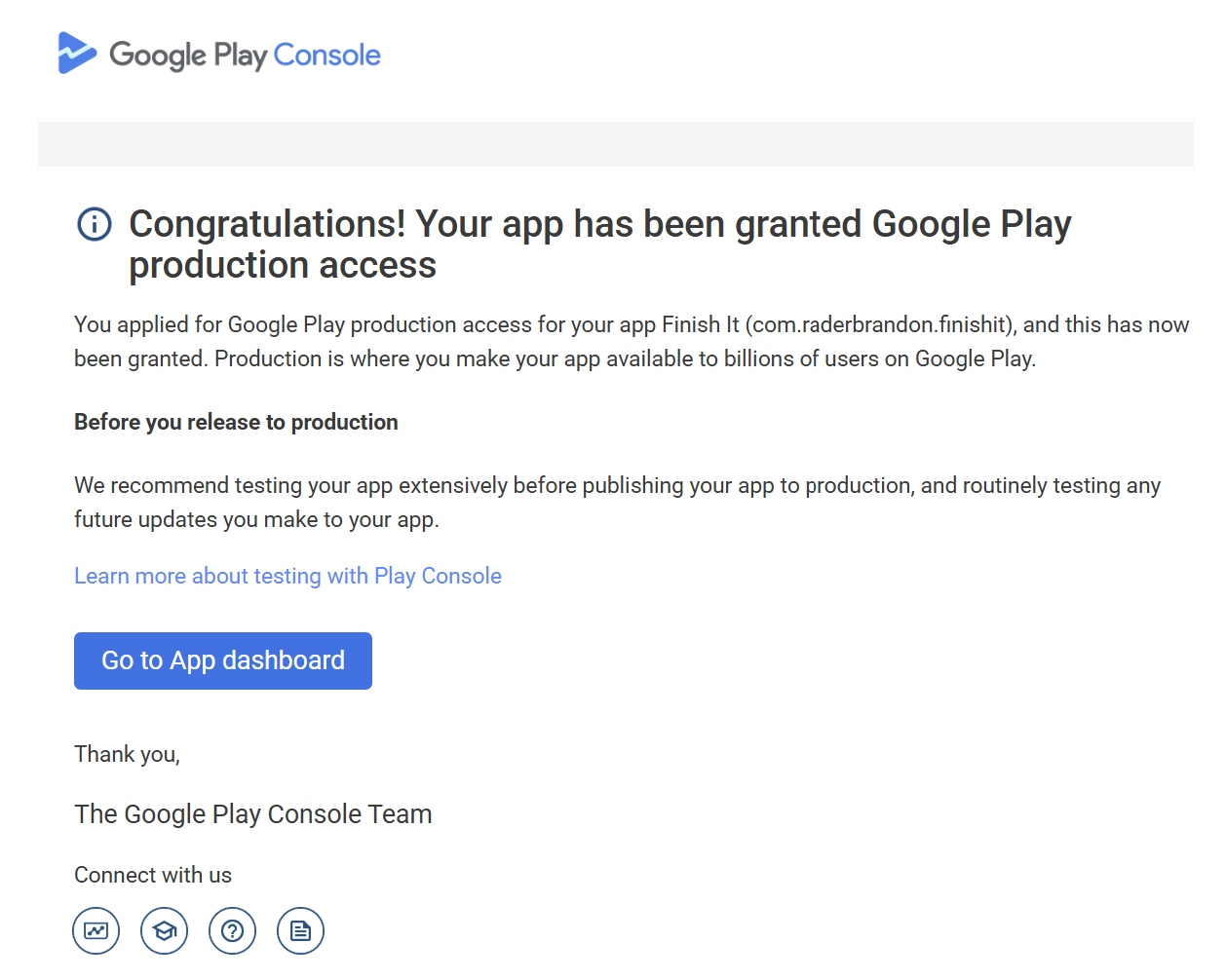
Quality QA Testing Reports
Clear, actionable reports with screenshots and evidence for every important issue found during testing.
Real Device Testing & Diagnostics
Real human testers use physical Android devices to test your app, verify real user flows, and provide clear testing evidence and professional QA reports.
Production Access Secured
Transition your Android app to public production access with confidence. We deliver verified session logs and compliant Console activity.
One Cycle. Complete Approval.
Choose the ideal closed testing cycle for your Android release.
Loading Packages
Please wait while we fetch the best options for your region...
Frequently Asked Questions
Everything you need to know about passing your closed testing requirements.