Play Store testers for 14-day Android closed testing in Cyprus
Secure Play Store testers in Cyprus for 14-day Google Play closed testing. Our 12 real testers meet Play Console requirements and help you go live fast.
The Cypriot Mobile Ecosystem and Compliance Dynamics
Cyprus represents a compact yet highly sophisticated market where mobile users rely heavily on multilingual apps supporting Greek, English, and Turkish, alongside complex European financial, booking, and logistics workflows. The Android ecosystem across Cyprus features a mix of Samsung, Xiaomi, Google Pixel, and OnePlus devices operating on local networks such as Cyta (Cytamobile-Vodafone), Epic, and PrimeTel. Testing on this real hardware diversity is essential because emulators fail to uncover device-specific background battery optimizations, push notification delivery drops, and network transition glitches.
In addition to hardware fragmentation, building and publishing from Cyprus means full compliance with the European Union General Data Protection Regulation (GDPR) and the ePrivacy Directive. Google Play's automated review system scrutinizes whether your closed testing build requests unnecessary permissions, handles user consent transparently, and adheres to data collection declarations made in your Data Safety section. When you run your Play Store Closed Testing with authentic testers, you uncover hidden crashes, permission leaks, and regional formatting quirks before your application ever reaches the public store.
Authentic Device Testing vs. Automated Bot Farms
Developers seeking a quick fix often encounter cheap online services offering instant testing packages powered by automated scripts, emulators, or click farms. While these options may seem convenient, they represent a severe hazard to your developer account. Google's algorithms analyze hardware fingerprints, device sensor data, Google Play account longevity, IP routing, and organic user interaction curves. Automated bots lack natural session variability and fail to generate legitimate user feedback.
Authentic Managed Testers
- Genuine Physical Hardware: Real Android devices with authentic Google Play accounts, diverse OS versions (Android 11 to 15), and natural carrier networks.
- Organic Telemetry: Natural tap intervals, varying session lengths, app restarts, and background task execution that satisfy Play Console analytics.
- Actionable Bug Discovery: Real human feedback on UI rendering, localization inconsistencies, payment integration hiccups, and authentication flow bugs.
- Zero Policy Violation Risk: Full compliance with Google Play Developer Policies and closed testing rules, completely protecting your console account.
Automated Bot & Farm Services
- Emulator Fingerprints: Identical build signatures, virtualized hardware profiles, and spoofed device IDs that trigger Google's anti-abuse algorithms.
- Mechanical Usage Curves: Predictable session times, scripted click trajectories, and zero organic touch variance that alert automated audit bots.
- Zero Usability Insights: Bots cannot identify confusing UX flows, broken Greek character encoding, or real-world network latency issues.
- Account Termination Risk: Using bot networks violates Google Play spam and artificial engagement policies, risking permanent account suspension.
Decoding Google's 14-Day Closed Testing Metrics
Google's closed testing framework is specifically engineered to test your software under real-world conditions over an extended timeline. During the mandatory two-week testing period, the Play Console backend continuously collects telemetry that directly informs the reviewer's decision when you apply for production access.
The automated system monitors several vital technical and behavioral signals:
- Core Android Vitals: Google tracks your Application Not Responding (ANR) rate and user-perceived crash rate. If your ANR rate exceeds the bad behavior threshold (typically 0.47%) or your crash rate climbs above 1.09%, your application will automatically be flagged for deeper scrutiny or outright rejection when you apply for production.
- Opt-in Continuity: The algorithm monitors how many testers joined via your web or Android opt-in link and whether they maintained their opt-in status throughout the entire 14-day window. If testers opt out or uninstall the build prematurely, the continuous 14-day counter resets.
- Natural Session Distribution: The Play Console tracks session frequency, app launches, background syncs, and memory consumption across varying physical devices. Real users launch apps at different times of the day, switch between Wi-Fi and mobile data, and generate natural event logs that emulators cannot replicate.
- In-App Feedback and Reviews: Having real testers submit private bug reports and feedback through Google Play provides undeniable proof to reviewers that your closed test was a legitimate, collaborative quality assurance exercise.
Struggling with the 14-Day Testing Requirement?
Skip the hassle of recruiting unreliable testers. Our professional fleet of real Android devices guarantees Google Play compliance in exactly 14 days. Zero bots. Zero emulators. 100% production approval guarantee.
Comparing Your Closed Testing Pathways
When preparing to fulfill the closed testing mandate for your app, you have three primary routes. Choosing the right path depends on your available time, technical resources, and risk tolerance.
| Feature | Managed Professional Testing | DIY Network (Friends & Family) | Low-Cost Bot Farms |
|---|---|---|---|
| Google Play Compliance | 100% Guaranteed and Safe | High (if they stay active) | Extremely low (high risk of ban) |
| Participant Reliability | Guaranteed daily retention for 14 full days | High drop-off rate after 2 - 4 days | Synthetic, scripted, easily flagged |
| Device Diversity | Broad matrix of real Android hardware | Limited to devices owned by acquaintances | Virtualized server instances / emulators |
| Feedback Quality | Comprehensive, structured bug reports | Usually heavily biased or very superficial | Completely non-existent |
| Time Investment | Minimal (fully managed, hands-off) | Extremely high (constant messaging) | Minimal setup, catastrophic risks |
| Production Approval Rate | Consistently high first-attempt approvals | Mixed results due to inactive tester logs | Frequent rejections and account warnings |
Pre-Launch Closed Testing Preparation Checklist
Before inviting testers into your closed testing track, verify that your release build and Play Console setup meet essential production standards. Complete the following preparation checklist to ensure a seamless 14-day test cycle.
Google Play Console Configuration
Technical Build & Performance Verification
European Privacy and Regional Localization
Your 14-Day Roadmap to Google Play Production Approval
Navigating closed testing is a structured, four-phase journey. By following this systematic roadmap, you ensure that every requirement is satisfied with full documentation, paving the way for immediate approval when applying for production access.
Step 1: Track Setup and Tester Invitation
Upload your release App Bundle to the closed testing track in Google Play Console. Configure your tester list with verified Google accounts and share the unique Web and Android join links with your testing cohort. Ensure that all testers actively opt in and download the initial build directly from the Play Store.
Step 2: Continuous Daily Interaction and Telemetry
Over the mandatory 14-day testing period, real testers actively engage with your app on their personal Android devices. They explore critical user flows, test push notification triggers, experiment with background data syncs, and generate natural, diversified telemetry that populates the Google Play Console vitals dashboard.
Step 3: Monitoring Vitals and Patching Issues
Monitor your Firebase Crashlytics logs and Play Console crash dashboards during days 4 through 10. If an edge-case bug or UI glitch is discovered, push an updated release bundle directly to the closed testing track. Testers update to the new version seamlessly, demonstrating to Google that you actively maintain and refine your app based on real-world feedback.
Step 4: Applying for Production Access with Confidence
Once the 14-day threshold is reached with 20 or more active testers, the 'Apply for production' button becomes active in the Play Console. Complete the required production questionnaire with detailed, honest answers explaining your testing methodology, feedback loops, and bug fixes to secure rapid production release approval.
Frequently Asked Questions About Closed Testing in Cyprus
Why does Google require 20 testers for 14 days on personal developer accounts?
In late 2023, Google updated its developer policy for personal accounts to elevate app quality across the Play Store. By mandating that developers engage at least 20 opted-in testers continuously over 14 days, Google ensures that mobile apps are thoroughly vetted on real physical devices before reaching public users. This process drastically reduces day-one crashes, malicious permission abuse, broken user interfaces, and abandoned software, protecting the integrity of the Android ecosystem.
Can I combine friends and family with a managed testing service to reach the 20-tester minimum?
Yes, you can easily combine your own internal testers with our professional testing network. For example, if you already have 8 friends or team members opted in, you can add 12 managed testers to safely reach the mandatory 20-tester threshold. Our testers join your closed testing email list, accept your opt-in link, and maintain active daily usage on their personal devices throughout the entire 14-day period.
What happens if a tester uninstalls the app or opts out during the 14-day window?
If your active opted-in tester count drops below 20 at any point during the 14-day testing cycle, the Play Console timer may stall or completely reset. To avoid this setback, it is strongly recommended to maintain a buffer of 22 to 25 opted-in testers. Professional managed testing services eliminate this risk by guaranteeing that all assigned testers keep the app installed and actively interact with it for the full duration.
Can I push new updates or bug fixes while the 14-day closed test is running?
Yes, pushing updates to your closed testing track during the 14-day window is fully supported and actively encouraged by Google. Releasing version updates to resolve bugs or optimize UI performance shows Google's reviewers that you are actively responding to tester feedback. When an update is deployed, your testers will receive the new build via standard Play Store auto-updates without resetting your 14-day timer.
How should I answer the Play Console production questionnaire after the 14 days conclude?
When applying for production access, the Play Console asks specific questions regarding how you recruited your testers, what feedback you received, and how you iterated on your software. You should provide clear, authentic answers explaining your target audience, summarizing the feedback gathered (such as UI usability remarks or edge-case crashes), and highlighting specific bug fixes or performance optimizations implemented during the test cycle.
Does testing with users located in Cyprus help with European GDPR and data compliance?
Testing within the European Union, including Cyprus, ensures your application handles real-world EU regulatory environments seamlessly. Authentic testers operating under GDPR conditions will test your Cookie and Consent Management dialogs, verify that data deletion and privacy requests function smoothly, and ensure your third-party analytics do not fire prematurely before consent is recorded, preventing severe compliance fines and Play Store rejections.
The Testing Pipeline
Your journey to Google Play production access, simplified and automated.
Sign In
Authenticate your account to initialize the 14-day QA fleet for your Android release.
Opt-In URL
Upload your testing link. We assign 12 verified users with real Android devices to download and test your Android release.
Testing Begins
A dedicated testing supervisor is assigned to monitor progress while testers engage with your Android app and provide feedback throughout the testing period.
Compliance Complete
Our lab maintains active installations for two weeks straight, ensuring a clean track record and providing a QA compliance log for your release.
Why Developers Trust Us
Satisfy your Play Store Console testing obligations with our managed physical device fleet tailored for Android builds.
The 14-Day Production Guarantee
We complete the required 14-day closed testing process with real human testers and physical Android devices, while providing clear testing evidence and documentation throughout the process.
If Google specifically rejects production access due to insufficient testing engagement, you are covered by our free re-run or 100% refund guarantee, subject to our Refund Policy.
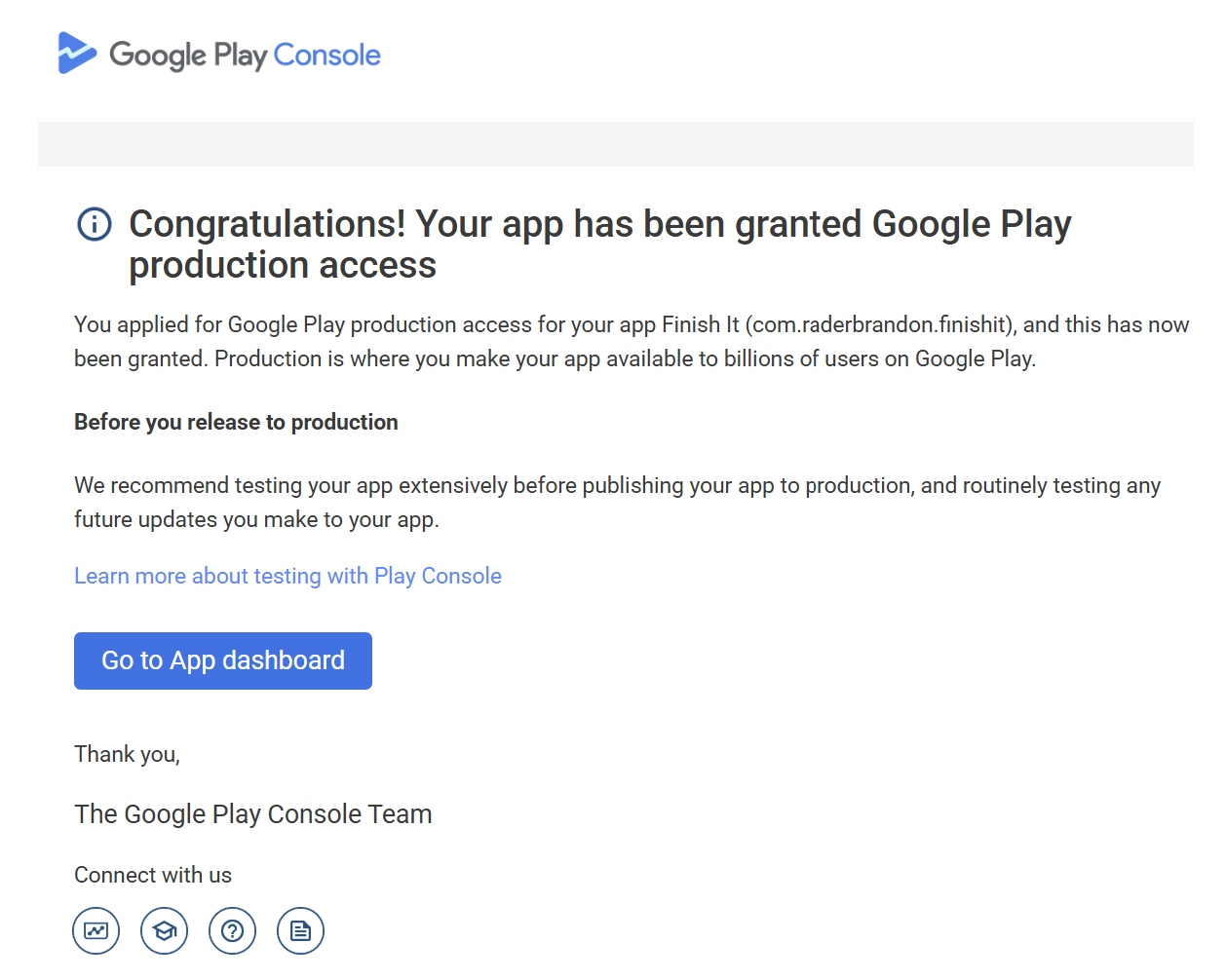
Verified Production Access
Quality QA Testing Reports
Clear, actionable reports with screenshots and evidence for every important issue found during testing.
Real Device Testing & Diagnostics
Real human testers use physical Android devices to test your app, verify real user flows, and provide clear testing evidence and professional QA reports.
Guaranteed App Approval
Our structured 14-day closed testing process is designed to meet Google Play's production requirements for your Android release.
Simple Closed Testing Pricing
Select the plan that fits your Android app complexity.
Loading Packages
Please wait while we fetch the best options for your region...
Frequently Asked Questions
Everything you need to know about passing your closed testing requirements.