Play Store testers for 14-day Android closed testing in Czechia
Get Play Store testers in Czechia for 14-day Google Play closed testing. Our 12 real testers help you meet Play Console requirements and launch fast.
Launching an Android app in Central Europe feels a bit like navigating the winding, cobblestone streets of Prague - rich with potential, but full of unexpected turns if you don't know the route. Before your app can find its way onto the screens of users across Czechia, it has to pass a crucial checkpoint set by Google. This mandatory phase, known as Google Play Closed Testing, requires you to gather a specific group of people who will interact with your creation over a set period. It is not just a formality; it is a vital stress test to ensure your software holds up under the unpredictable taps, swipes, and daily habits of real users in the Czech market. Finding 20 reliable individuals to commit to this process can be surprisingly difficult for independent developers and fresh startups. If you are struggling to assemble this group, you are not alone. Securing genuine Play Store testers for your 14-day Android closed testing in Czechia is the bridge between a good idea and a live, compliant application.
Why Your App Needs Real Czech Testers
The Google Play Console policies are strict. They demand that new personal developer accounts put their apps through a rigorous 14-day evaluation before hitting production. This means you need a dedicated team of testers who will actually install, open, and use your app consistently. Fake engagement or automated bots will trigger red flags, potentially leading to your app being rejected or your account being suspended.
When you target the Czech market, having locals test your app offers an extra layer of validation. They can spot localization errors, UI glitches on devices popular in the region, and cultural nuances that an automated system would miss completely. Real human feedback during your Play Store Closed Testing phase is invaluable. It transforms a raw build into a polished, user-ready product.
The Challenge of Finding 20 Dedicated People
You might think asking friends and family is the easiest way to fulfill the 12 Testers for 14 Days requirement (or 20 testers for 14 days, as is often the case for standard closed tracks). However, keeping them engaged for a full two weeks is a massive challenge. People get busy, they forget to open the app, or they simply lack the technical vocabulary to give you actionable feedback.
Relying on social media groups often yields similar frustrations. You might get a surge of initial installs, but the daily active usage drops off a cliff by day three. Google monitors this engagement closely. If your testers are not actively interacting with the app, the closed testing period will not count towards your compliance goals. This is why securing a professional, reliable testing service is often the most cost-effective and stress-free route.
Understanding the Nuances of Google Play Closed Testing
To fully grasp the magnitude of the Google Play Closed Testing requirements, developers must look beyond the simple numbers. It is not merely about having twenty people hit a download button. Google's overarching goal is to elevate the overall quality, stability, and safety of the Android ecosystem. For years, the Play Store struggled with a massive influx of low-quality, poorly optimized applications that frustrated end users and damaged the platform's reputation. The closed testing mandate is their frontline defense against this problem.
When your app enters the testing phase, the Google Play Console begins monitoring a variety of hidden metrics. They are tracking how often the app is launched, the average session duration, and whether the app experiences any silent crashes in the background. They are also looking at device diversity. If all twenty of your testers are using the exact same model of a brand new flagship phone on the same Wi-Fi network, the testing data looks highly suspicious and incredibly narrow. Real-world testing requires a diverse array of hardware, operating system versions, and network conditions.
Furthermore, the geographical location of your testers plays a subtle but important role. While you can theoretically test an app meant for Czechia using testers from across the globe, having a concentrated group of users within your target market provides the most authentic data. Czech mobile networks have specific latencies, and local users might interact with specific regional APIs or payment gateways that external testers cannot access. Authentic Play Store testers for your 14-day Android closed testing in Czechia will generate the exact type of localized telemetry that proves your app is ready for the Central European market.
Navigating these nuances requires a strategic approach. It demands a testing cohort that understands their responsibility. They must know that their daily interactions are being logged and that their consistent participation is the key that will eventually unlock your production access.
The Dangers of Cutting Corners with Bot Farms
In the rush to get an app to market, some developers are tempted to look for shortcuts. A quick internet search will reveal dozens of shady services offering immediate compliance using automated scripts and massive device farms. These services promise to fulfill your testing requirements overnight for a fraction of the cost of real human testers. Engaging with these bot farms is the most dangerous mistake a developer can make during their launch process.
Google employs some of the most sophisticated machine learning algorithms on the planet, and these algorithms are specifically trained to detect artificial engagement. Bot farms operate in highly predictable patterns. They often use emulators rather than real hardware, they route their traffic through known data center IP addresses, and their in-app behavior lacks the chaotic, random nature of genuine human interaction. A bot might tap the same button at the exact same millisecond interval every day, whereas a human user will explore menus, scroll erratically, and occasionally leave the app running in the background.
When the Play Console detects these automated patterns, the consequences are severe and often irreversible. At best, your testing data will be invalidated, forcing you to start the agonizing two-week process all over again. At worst, Google will flag your entire developer account for policy violations. This can lead to a permanent ban, effectively ending your career as an Android developer on the Play Store before it even truly begins.
The risk simply does not outweigh the perceived reward. Protecting your intellectual property and your developer reputation means committing to the process the way it was designed to be done. You need genuine Play Store Closed Testing, utilizing real devices operated by real people who are capable of providing organic, unscripted engagement over the entire mandatory duration.
How Professional Testing Transforms Your Launch
Opting for a professional testing service eliminates the anxiety and uncertainty associated with the compliance phase. Instead of begging friends for favors or rolling the dice on unverified online forums, you partner with an organization that specializes in connecting developers with dedicated, vetted testers. This approach transforms a stressful hurdle into a valuable opportunity for product improvement.
When you invest in a professional service for your 14-day Android closed testing in Czechia, you are buying peace of mind. These services manage the logistical nightmare of coordinating twenty individuals. They handle the onboarding process, ensure that all testers properly opt-in via your specific Google Play link, and monitor their daily activity to guarantee that the engagement metrics remain consistently high. If a tester drops out due to unforeseen circumstances, a professional service will seamlessly replace them to ensure your 14-day continuous streak is not broken.
Beyond mere compliance, these professional testers provide actionable, high-quality feedback. They are accustomed to evaluating mobile software and can clearly articulate the issues they encounter. Instead of receiving a vague message saying "it doesn't work", you will receive detailed reports outlining the specific device model, the Android version, the exact sequence of actions that led to a crash, and screenshots of any visual glitches. This detailed feedback loop allows you to squash critical bugs and refine the user experience before your app is exposed to the harsh scrutiny of the public market. It is an investment in the long-term viability and rating of your application.
| Feature | Professional Testing Service | DIY (Friends & Family) | Automated Bot Farms |
|---|---|---|---|
| Google Compliance | 100% Guaranteed Success | Highly Risky (Low Engagement) | Massive Risk of Account Ban |
| Feedback Quality | Detailed, Actionable, Technical | Vague, Infrequent, or Non-existent | Absolutely Zero Feedback |
| Time Investment | Minimal (Fully Managed Process) | Very High (Constantly Chasing People) | Low but Ultimately Destructive |
| Market Relevance | High (Targeted Locales Available) | Varies Wildly | Completely Irrelevant |
| Overall Cost | Fixed, Predictable Investment | "Free" but costly in wasted time | Cheap upfront, expensive later |
Genuine Human Testing
Real users in Czechia interact with your app daily on real, unmodified Android devices. They provide constructive feedback on UI/UX, report bugs accurately, and ensure your app meets the stringent engagement metrics required by the Google Play Console. This organic, unpredictable activity builds a strong foundation for your app's future success and guarantees compliance.
Automated Bot Testing
Bots create artificial install spikes but utterly fail to generate the nuanced, sustained engagement Google's sophisticated algorithms look for. Using these illicit services almost always results in severe policy violations, immediate app rejection, or total developer account termination. The short-term shortcut leads directly to a permanent dead end.
Struggling with the 14-Day Testing Requirement?
Skip the hassle of recruiting unreliable testers. Our professional fleet of real Android devices guarantees Google Play compliance in exactly 14 days. Zero bots. Zero emulators. 100% production approval guarantee.
Pre-Launch Prep: Getting Ready for Testing
App Console Configuration
Ensure your Google Play Developer account is fully verified with up-to-date contact information, verified email addresses, and valid payment profiles.
Fill out all mandatory store listing fields thoroughly. This includes a compelling app title, a concise short description, a detailed full description, and high-quality, representative screenshots.
Complete the required content rating survey accurately to receive the appropriate age and maturity rating for your application in the Czech market and globally.
Technical Readiness
Upload an App Bundle (.aab) that has been thoroughly tested locally on multiple devices to ensure there are no immediate, catastrophic crashes upon the initial launch.
Host a comprehensive privacy policy on a valid, publicly accessible URL and clearly link it within your Play Console settings. This is a strict legal requirement for all apps.
Create the specific opt-in link for your designated closed track so your authorized testers can officially join the program and legally download the beta version of the app.
Your Path to Production in Czechia
Step 1: Initial Setup and Tester Opt-in
You finalize your app's configuration in the Play Console, set up your closed testing track, and generate the unique opt-in URL. You then securely share this link with our testing coordination team. Our vetted group of real users in Czechia will use this specific link to officially associate their Google accounts with your testing program.
Step 2: Secure and Tracked Installation
Once opted in, the testers download your application directly from the official Google Play Store infrastructure onto their personal Android smartphones and tablets. This guarantees the installations are logged organically by Google's backend systems, completely avoiding any red flags typically associated with manual sideloading or unofficial third-party app repositories.
Step 3: Sustained 14-Day Engagement Phase
Over the course of the next two continuous weeks, the dedicated testers will open and actively interact with your app daily. They will navigate through various internal screens, push core functionalities to their limits, and ensure the continuous, unbroken engagement that Google's compliance algorithms demand for a successful closed testing phase.
Step 4: Comprehensive Feedback Collection
Throughout the entire testing duration, our users will carefully document their in-app experiences. They will promptly report any software bugs, unexpected crashes, confusing navigation flows, or general usability issues they encounter. This highly actionable feedback allows you to expertly refine and polish your app before exposing it to the broader, more critical public audience.
Step 5: Apply for Final Production Access
Once the grueling 14 days are successfully completed and all stringent engagement metrics are satisfied, the Google Play Console will automatically unlock your ability to officially apply for production access. Armed with a flawless testing record and a polished application, your final submission is significantly more likely to be approved swiftly by the review team.
Frequently Asked Questions About Closed Testing
Why did Google introduce this strict 14-day testing requirement for new developers?
Google introduced this mandatory requirement as a sweeping initiative to significantly elevate the overall quality, safety, and reliability of applications available on the public Play Store. In previous years, the digital storefront was heavily saturated with low-effort, broken, or sometimes malicious apps that actively ruined the consumer experience. By enforcing a strict, lengthy testing phase, Google ensures that developers are genuinely committed to their products. The 14-day period is intentionally designed to simulate a real-world launch on a much smaller, controlled scale. It mathematically proves that your app can run stably over an extended duration, that regular users can navigate its interface without experiencing constant crashes, and that you, as the developer, are actively monitoring vital feedback. It is a necessary quality control measure that ultimately protects the end user and improves the platform's reputation.
What exactly happens if a tester forgets to open the app and misses a day of testing?
The Google Play Console meticulously tracks daily active engagement across your entire testing cohort. While a single, isolated missed day by just one tester might not immediately trigger a failure of your entire test, a pattern of consistent inactivity absolutely will cause your test to fail. Google's internal algorithms are specifically calibrated to look for continuous, organic daily interaction. If a significant percentage of your required testers fail to open and use the app for several consecutive days, the automated system will flag your testing phase as incomplete, abandoned, or invalid. If this happens, you will be forced to restart the entire 14-day clock completely from scratch. This precise risk is why relying on uncommitted friends, family members, or unreliable internet forums is incredibly dangerous. Professional testing services mathematically guarantee the daily engagement required to safely satisfy Google's strict criteria.
Do I absolutely need to use testers specifically located in Czechia for my app?
While Google's baseline compliance requirement does not strictly dictate that your testers must physically reside in your primary target country, having local testers provides a massive, undeniable advantage. If your application is designed specifically for the Czech market, utilizing local users allows you to gather crucial feedback on cultural relevance, the exact accuracy of your language localization, and how well the app performs on local cellular network providers. Furthermore, generating a cluster of organic installations from the precise region you intend to target sends incredibly positive signals to the Play Store's complex ranking algorithms. It demonstrates immediate regional relevance right from day one. However, if your application is intended for a broad global audience, utilizing a diverse, international mix of testers is also highly acceptable and beneficial.
How do I know for sure if my application is actually ready to begin the closed testing phase?
Before you formally enter the closed testing phase, your application should be highly feature-complete and generally stable. It should absolutely not be a rough, unfinished prototype. All of your intended core functionalities must work properly, the user interface should be intuitively navigable, and there should be absolutely no obvious, immediate crash loops when the app is initially launched. You should have already conducted rigorous internal testing (often referred to as Alpha testing) by yourself, your co-founders, or your immediate internal team. The formal closed testing phase is specifically meant to catch the obscure edge cases, device-specific hardware bugs, and subtle usability friction points that you and your internal team might have naturally overlooked due to your familiarity with the project. If your app is fundamentally broken from the start, testers will be physically unable to engage with it for the required 14 days, and you will inevitably fail the compliance requirement.
Am I allowed to push updates to my app during the middle of the 14-day testing period?
Yes, you absolutely can push updates, and in many practical scenarios, doing so is highly encouraged by Google. If your dedicated testers uncover a critical, app-breaking bug early in the testing phase, you should immediately compile a fix and push a new update through the Play Console. Pushing active updates演示 to Google's automated systems and manual reviewers that you are actively maintaining the software and directly responding to user feedback. However, you must be extremely careful to ensure that pushing a new update does not accidentally disrupt the daily engagement rhythm of your testers. They need to be able to seamlessly update their local versions and continue utilizing the app without starting from scratch. Frequent, minor bug fix updates are excellent, but massive, sweeping overhauls that drastically change the core functionality might confuse your testers and severely disrupt the established flow of the evaluation period.
What is the actual difference between internal testing, closed testing, and open testing tracks?
Internal testing is the very first, highly restricted stage, usually limited to a maximum of 100 specific users who are typically your lead developers, internal QA team, or close financial stakeholders. It is specifically designed for very early, unstable builds and strictly does not count towards the mandatory 14-day public requirement. Closed testing is the critical, mandatory compliance phase where you need a much larger group (typically 20 independent users) for a sustained, unbroken 14-day period. Access to this track is strictly controlled via pre-approved email lists or highly specific, secure invite links. Open testing is an entirely optional phase that logically comes after a successful closed test. During open testing, literally anyone browsing the public Play Store can freely join your test program and download the pre-release app. It is a fantastic way to gather massive scale feedback before your final, highly publicized production rollout, but it can never be used as a substitute for passing the mandatory closed testing phase.
Exactly what happens after the grueling 14-day period is finally and successfully completed?
Once the demanding 14-day period officially concludes and you have successfully met all of Google's hidden engagement metrics, the Play Console dashboard will automatically unlock a specific option allowing you to apply for full production access. At this stage, you will be required to fill out a final, detailed questionnaire asking specifically about your closed testing process, the exact nature of the feedback you received from your testers, and exactly how you practically implemented that critical feedback into your final application build. Google's internal review team will then manually assess your application, your answers, and your entire testing history log. If they are completely satisfied that your application represents a high-quality product and flawlessly complies with all developer policies, they will officially grant you production access, finally allowing you to publish your app directly to the public Google Play Store for the world to download.
How It Works
How we deploy real devices and guarantee compliance for your release.
Get Started
Sign in with Google to configure the closed testing environment for your Android build.
App Submission
Submit your Google Play Console testing link, and our team will assign qualified testers from our testing network to join your Android closed testing release.
14-Day Cycle
A QA supervisor monitors daily check-ins, ensuring 12 unique Android users engage with your Android build every single day.
Production Access Approval
We guarantee 14 consecutive days of active user check-ins to satisfy Google's compliance policies, delivering an audit-ready PDF feedback report.
Why Choose AppConsoleLab
Experience a next-generation testing infrastructure built for Google Play compliance for your Android release.
The 14-Day Production Guarantee
We complete the required 14-day closed testing process with real human testers and physical Android devices, while providing clear testing evidence and documentation throughout the process.
If Google specifically rejects production access due to insufficient testing engagement, you are covered by our free re-run or 100% refund guarantee, subject to our Refund Policy.
Verified Production Access
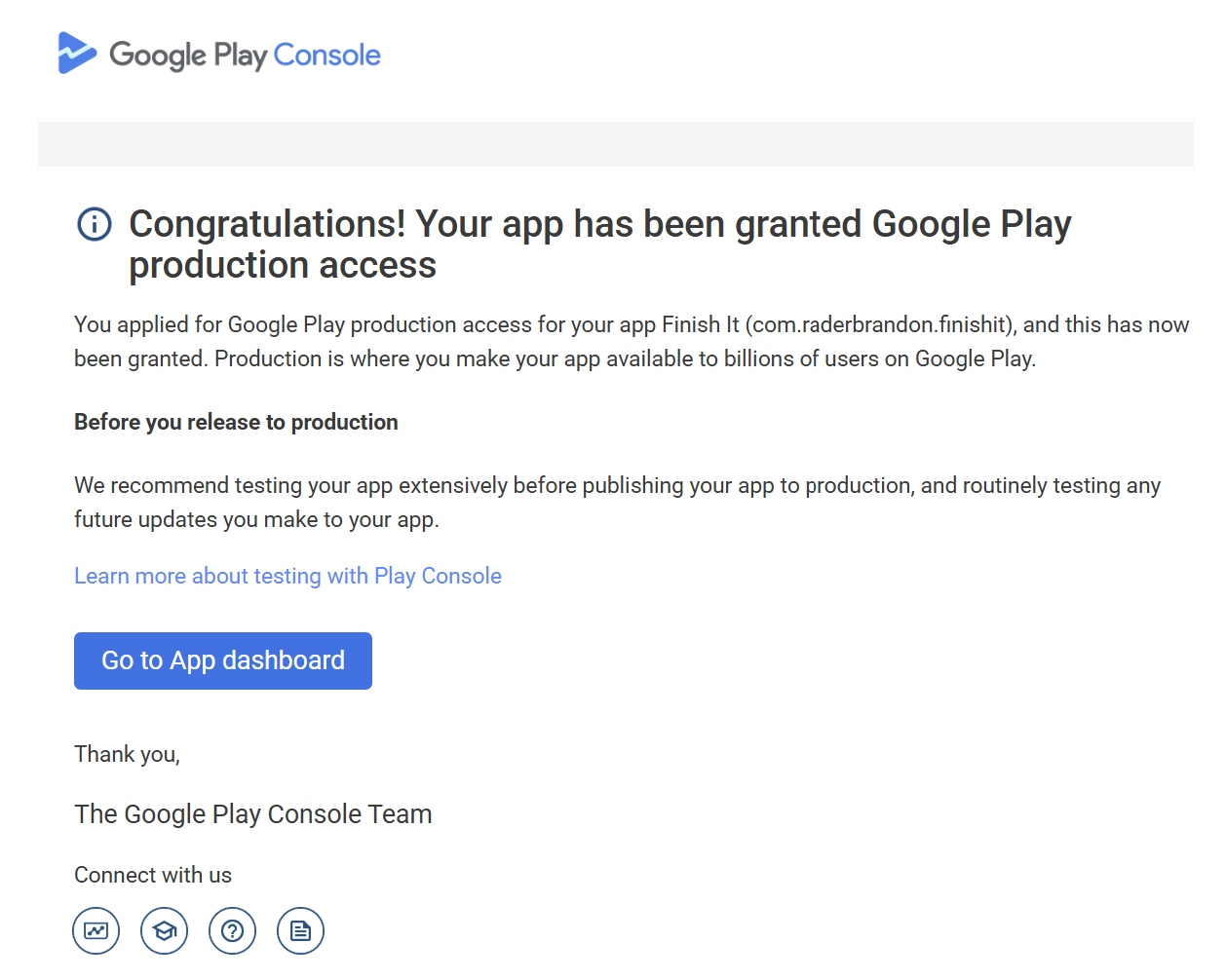
Quality QA Testing Reports
Clear, actionable reports with screenshots and evidence for every important issue found during testing.
Real Device Testing & Diagnostics
Real human testers use physical Android devices to test your app, verify real user flows, and provide clear testing evidence and professional QA reports.
Play Store Ready
Get your Android build approved on the first try. We create an audit-ready compliance profile that proves thorough quality assurance.
Affordable Compliance Cycles
Transparent plans built to satisfy Google Play Console guidelines for your Android build.
Loading Packages
Please wait while we fetch the best options for your region...
Frequently Asked Questions
Everything you need to know about passing your closed testing requirements.