Play Store testers for 14-day Android closed testing in Dominican Republic
Find Play Store testers in Dominican Republic for 14-day Google Play closed testing. Fulfill Play Console requirements with 12 real testers and launch quickly.
Mastering Google Play Closed Testing for Dominican Republic Developers
The Dominican Republic is rapidly emerging as a Caribbean powerhouse for digital innovation, software entrepreneurship, and mobile technology. From vibrant developer communities and tech startups in Santo Domingo to bustling software talent hubs across Santiago de los Caballeros, Dominican mobile engineers are crafting competitive Android applications for local commerce, tourism, logistics, and international markets. However, bringing a new Android app to the global Google Play Store comes with a strict quality requirement established by Google. Every personal developer account created after November 2023 must successfully pass a rigorous closed testing benchmark: maintaining at least 12 testers for 14 days continuously before Google grants permission to publish to open production.
For mobile developers and independent creators across the Dominican Republic, setting up and managing 12 reliable testers across genuine physical hardware can quickly turn into a major stumbling block. Trying to organize peer groups, personal acquaintances, or informal social media circles often leads to inactive testers, sudden uninstalls, and flatlined telemetry logs. When Google Play Console algorithms analyze your testing metrics and find insufficient engagement, production access is denied, forcing your project back to day zero. Passing Google Play closed testing on your first try demands a dependable, continuous testing strategy that produces genuine interaction data on real devices connected to authentic mobile networks.
Understanding the 12 Testers for 14 Days Google Play Mandate
Google established the 12 testers for 14 days closed testing policy to protect Android users from low-quality, buggy, or unstable applications. Under these developer guidelines, newly registered personal Google Play Console accounts cannot publish apps straight to open production tracks. Instead, developers are required to run an invite-only closed test involving a minimum of 12 opt-in participants who install the app build and keep it on their physical devices for 14 continuous calendar days.
Passing this evaluation requires far more than simply collecting 12 email addresses on an access list. Google Play Console tracks continuous interaction telemetry, installation persistence, and user engagement throughout the entire test duration. If participants abandon the test, leave the app unopened after the first day, or participate through scripted device emulators, Google's automated systems detect the lack of genuine usage. This results in the 14-day counter resetting or the final production request being rejected during manual and automated policy reviews.
Unique Closed Testing Challenges in the Dominican Republic
Building Android software in the Dominican Republic involves unique market dynamics that can complicate independent closed testing logistics:
- Carrier Diversity and Local Network Variations: Dominican mobile users rely on cellular networks provided by Claro Dominicana, Altice Dominicana, and Viva. Apps that handle local data, payment processing, or streaming must be tested across these varied telecom networks to uncover latency hiccups, data throttling issues, and connection drops.
- Tester Drop-Off and Inconsistent Engagement: Relying on friends, colleagues, or casual acquaintances in Santo Domingo or Santiago rarely guarantees daily app engagement. Testers often download the build on Day 1 and never open it again, resulting in stagnant Play Console telemetry charts.
- Hardware Fragmentation Across Price Tiers: The Dominican Android market features a wide spectrum of devices, from premium flagship phones to entry-level and mid-range devices from Xiaomi, Samsung Galaxy A-series, Tecno, and Motorola. Testing only on your personal handset leaves device-specific rendering bugs and memory leaks undiscovered.
- Financial and Monetization Nuances (DOP Currency): Apps designed for Dominican consumers often feature local integrations, currency displays in Dominican Pesos (DOP), or local payment gateways. Closed testing must confirm that UI layouts, checkout flows, and network calls behave seamlessly before public release.
- The Threat of Fake Bot Services: Desperate developers sometimes turn to cheap bot farms or fake download schemes found online. These services use rooted emulators and script farms that trigger Google Play Protect security flags, leading to account strikes or permanent developer account termination.
Real Physical Device Testers vs. Automated Bot Farms
Selecting the right testing approach determines whether your application receives smooth production approval on the first attempt or gets caught in endless testing resets and account compliance warnings.
Real Human Testers (Safe and Compliant)
- Real physical Android smartphones spanning Android 10 through Android 15.
- Authentic user engagement generating natural UI touches, scrolling, and genuine background sessions.
- Continuous 14-day retention with zero unexpected mid-test uninstalls or drops.
- High-quality telemetry signals that satisfy Google Play Console automated review systems.
- Safe, verified Google accounts with established trust profiles and zero bot markers.
- Useful bug reports, device logs, and constructive feedback to improve your app build.
Bot Networks and Click Farms (Extreme Risk)
- Rooted emulators, headless virtual devices, and shared IP proxies flagged by Google security.
- Synthetic, robotic touch sequences with uniform session lengths and repetitive telemetry.
- High drop-off rates and sudden uninstalls that break the mandatory 14-day continuous requirement.
- Zero valid crash logs or human user experience insights for developers.
- Immediate detection by Google Play Protect anti-fraud algorithms.
- Serious risk of production rejection, developer policy strikes, and total account termination.
Comparing Android Closed Testing Methodologies
The comparison table below outlines the core differences between a professional managed testing service, manual peer testing, and risky automated bot farms.
| Feature / Metric | Managed Human Testing Service | DIY Peer and Friend Network | Automated Bot Farms |
|---|---|---|---|
| Verified Human Testers | 12+ real human testers guaranteed | Unpredictable friend availability | 0 (Automated scripts) |
| Device Hardware Variety | Diverse physical Samsung, Xiaomi, Motorola, Pixel phones | Limited to a few personal phones | Cloud emulators and virtual instances |
| 14-Day Continuous Retention | 100% guaranteed active retention | Frequent early uninstalls and forgotten tests | Erratic connections and sudden drop-offs |
| Google Telemetry Quality | Organic daily opens, touches, and background sync | Infrequent, flatlined, or sporadic usage | Flagged as inorganic bot behavior |
| Production Approval Rate | Extremely high first-time pass rate | Low to moderate due to missing engagement | 0% (High risk of account ban) |
| Developer Time Investment | Under 15 minutes of initial setup | 30 to 50 hours chasing tester updates | High time spent fixing account penalties |
| Policy Compliance | 100% compliant with Google Play policies | Compliant but hard to sustain | Severe violation of developer terms |
Struggling with the 14-Day Testing Requirement?
Skip the hassle of recruiting unreliable testers. Our professional fleet of real Android devices guarantees Google Play compliance in exactly 14 days. Zero bots. Zero emulators. 100% production approval guarantee.
Critical Play Console Metrics Every Developer Must Track
To ensure your application passes Google Play closed testing evaluation, you need to actively monitor key technical health metrics in your Google Play Console dashboard throughout the 14-day test cycle:
- Daily Active Devices (DAD): Keep track of daily active installations across all 12+ tester devices. Google's review systems check whether the app was opened and used consistently across the 14 calendar days rather than sitting idle after the initial download.
- Opt-In Retention Continuity: Verify that your testers maintain their active opt-in status via the web or mobile testing link for the full duration. If testers opt out prematurely and your total active pool falls below 12, Google will reset your testing timeline.
- Crash Rate and Android Vitals: Monitor your app's core stability metrics. Google enforces strict thresholds for production quality: keep your crash rate below the bad behavior threshold of 1.09% and your Application Not Responding (ANR) rate well below 0.47%.
- Cold Start Time and App Performance: Ensure cold startup times remain under 5 seconds across entry-level hardware. Sluggish startup times or excessive memory consumption can trigger negative automated ratings during Play Console review.
- Network Request Resiliency: Validate that your app gracefully handles slow data connections, airplane mode toggles, and transitions between Wi-Fi and mobile networks like Claro or Altice without crashing or freezing.
Pre-Launch Closed Testing Checklist for Dominican Developers
Before requesting production access from Google Play Console, go through this structured preparation checklist to confirm your release build meets all technical and operational benchmarks.
Google Play Console Setup
App Stability and Telemetry Verification
Step-by-Step Roadmap to Production Access Approval
Follow this proven roadmap to guide your Android application smoothly from closed testing setup to live publication on the Google Play Store.
Track Configuration and Build Upload
Create your closed testing track inside Google Play Console. Upload your signed production-ready Android App Bundle (AAB), configure target countries, and generate your closed testing opt-in links.
Tester Recruitment and Opt-In Onboarding
Invite 12 or more verified human testers using real Android devices. Ensure all testers join the program through the Google Play opt-in link and successfully install the application directly from the Play Store.
14-Day Continuous Telemetry and Active Usage
Maintain active daily engagement throughout the mandatory 14-day window. Testers open the app, navigate features, trigger backend APIs, and generate natural user interaction data.
Telemetry Monitoring and Stability Hotfixes
Track Android Vitals, crash logs, and ANR statistics in Google Play Console. If bugs or performance issues are discovered, upload updated builds to the closed track without interrupting your 14-day testing clock.
Production Access Application and Store Launch
Once the 14-day testing period concludes, submit your official application for production access in Google Play Console. Provide clear, detailed answers about your testing workflow, tester feedback, and bug fixes to receive full approval.
Frequently Asked Questions
Why does Google Play require 12 testers for 14 days for personal developer accounts?
Google introduced the closed testing policy in late 2023 to raise overall app quality and security standards across the Play Store. By requiring personal developer accounts to test their applications with at least 12 real users for 14 consecutive days before launching publicly, Google ensures that software undergoes meaningful testing on physical hardware. This process helps identify severe bugs, memory leaks, high crash rates, and privacy issues before apps reach the general public.
Can developers in the Dominican Republic use testers located in other countries?
Yes. Google Play does not require your closed testers to be physically located in the Dominican Republic. As long as your closed testing track settings include the countries where your testers reside, testers from anywhere in the world can participate. In fact, testing across multiple geographical regions and telecom networks often strengthens your application's stability profile by verifying compatibility across international network configurations, language locales, and diverse phone models.
What happens if a tester uninstalls the app or leaves the test early?
If an opted-in tester uninstalls your application or leaves the testing track and your total active tester count drops below 12, Google's automated monitoring system will flag the disruption. This often pauses or resets the 14-day countdown timer, requiring you to recruit replacement testers and start over. To avoid this risk, professional testing services typically assign 15 to 20 testers to your track so your active count remains safely above the minimum threshold throughout the entire 14 days.
Can I release updates or fix bugs during the 14-day closed testing period?
Yes. You can upload new builds and version updates to your closed testing track at any point during the 14-day test. Releasing updates does not reset your 14-day timer. In fact, pushing bug fixes and performance enhancements based on tester feedback demonstrates active developer maintenance, which creates a positive impression when Google reviewers evaluate your production access questionnaire.
How does Google distinguish real human testers from automated bot services?
Google Play Console and Google Play Protect use advanced behavioral telemetry and machine learning models to detect artificial testing activity. Real human users exhibit natural variations in session length, touch coordinates, scroll speeds, typing rhythms, and network conditions. Bot farms running on emulators or automated scripts produce rigid, repetitive patterns from shared IP ranges and unverified Google accounts, which triggers automated anti-fraud filters and leads to account rejections or bans.
What answers should I provide when applying for production access after 14 days?
When your 14-day closed test finishes, Google Play Console asks several questions regarding your testing process. You will need to describe how you recruited your testers, summarize the specific feedback and bug reports you received, outline the improvements or code changes you implemented during the test, and explain why your app is ready for open production. Giving detailed, honest answers supported by actual testing history ensures a fast and successful production review.
The Testing Pipeline
A straightforward 4-step process to get your Android app approved.
Sign In
Connect your Google account and choose your preferred closed testing package for your Android app.
Opt-In URL
Share your Play Store opt-in URL. We immediately deploy 12 real testers to launch and review your Android app daily.
Testing Begins
Our crew initiates daily launch sessions on physical devices, verifying usability and logging crashes for your Android app.
Compliance Complete
We continuously perform closed app testing for 14 days to help you meet Google Play production requirements. We also provide a compliance report.
Why Developers Trust Us
Deploy your Android app onto real retail-grade handsets using our secure laboratory environment.
The 14-Day Production Guarantee
We complete the required 14-day closed testing process with real human testers and physical Android devices, while providing clear testing evidence and documentation throughout the process.
If Google specifically rejects production access due to insufficient testing engagement, you are covered by our free re-run or 100% refund guarantee, subject to our Refund Policy.
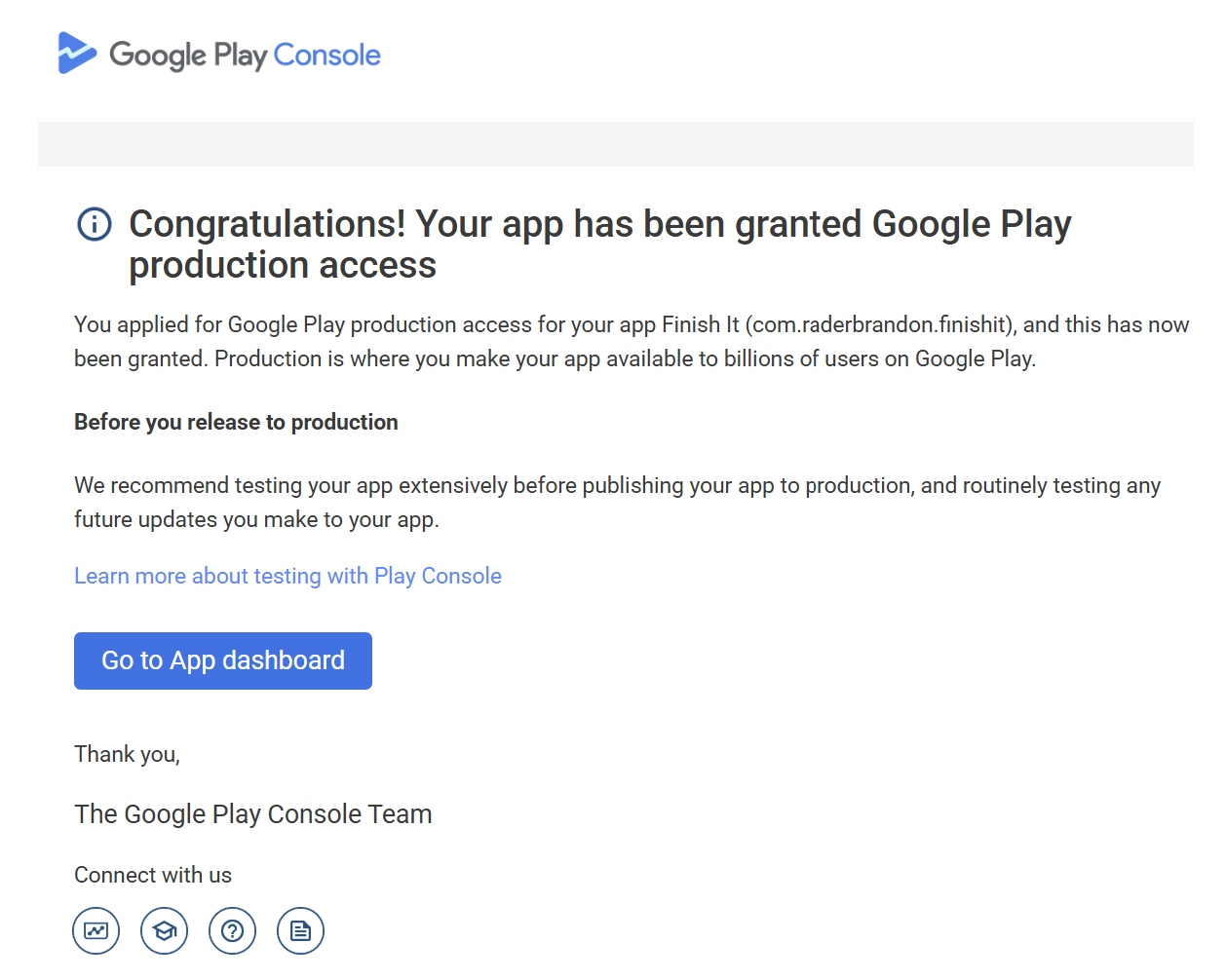
Verified Production Access
Quality QA Testing Reports
Clear, actionable reports with screenshots and evidence for every important issue found during testing.
Real Device Testing & Diagnostics
Real human testers use physical Android devices to test your app, verify real user flows, and provide clear testing evidence and professional QA reports.
Guaranteed App Approval
Transition your Android app to public production access with confidence. We deliver verified session logs and compliant Console activity.
One Cycle. Complete Approval.
Choose the ideal closed testing cycle for your Android release.
Loading Packages
Please wait while we fetch the best options for your region...
Frequently Asked Questions
Everything you need to know about passing your closed testing requirements.