Play Store testers for 14-day Android closed testing in El Salvador
Find Play Store testers in El Salvador for 14-day Google Play closed testing. Fulfill Play Console requirements with 12 real testers and launch quickly.
The Reality of Google Play Closed Testing for Salvadoran Developers
Launching an Android app from El Salvador has transformed rapidly over the past few years. From thriving software hubs in San Salvador and Santa Tecla to emerging tech talent in Santa Ana and San Miguel, Salvadoran engineers are building sophisticated digital solutions. Whether you are engineering a local fintech app integrated with Chivo Wallet and standard USD banking, a logistics platform navigating the bustling streets of Soyapango, or an e-commerce marketplace catering to diaspora remittances, your path to production hits the same mandatory roadblock: Google Play Closed Testing.
Google enforces a strict policy for personal Google Play Console developer accounts created after November 2023. You must recruit at least 12 Testers for 14 Days continuously before you can apply for production access. For an independent developer or a fast-moving startup in El Salvador, finding 12 real people with compatible Android devices who will actively open, test, and provide feedback on your app every single day for two straight weeks is a massive operational hurdle.
[Production Track Lockout]
          │
          ▼
[12 Opted-In Testers Required]
          │
          ▼
[14 Consecutive Days of Real Engagement]
          │
          ▼
[Play Console Review & Approval]
Failing this phase does not just delay your go-to-market timeline. It can lock your developer account into a repetitive testing loop, flag your console for synthetic activity, or lead to an outright rejection when you submit the production access application questionnaire. Understanding the exact mechanics of Play Store Closed Testing in the Salvadoran context is essential for a clean, first-time approval.
Why El Salvador's Mobile Ecosystem Demands Real-Device Testing
El Salvador presents a unique mobile environment that synthetic emulators and automated test scripts cannot replicate. The country runs on a dual-currency digital reality where US Dollars and Bitcoin coexist alongside traditional cash-on-delivery systems. Furthermore, mobile connectivity relies heavily on network carriers like Tigo, Claro, and Movistar (Digicel), each operating with distinct data throttling profiles, latency spikes, and intermittent coverage across urban valleys and rural departments.
Salvadoran Mobile Architecture:
├── Network Carriers: Tigo (LTE/5G), Claro, Movistar
├── Payment Layers: Local Bank APIs (Bancoagrícola, BAC), Chivo / Lightning, Card Gateways
├── Hardware Spectrum: Budget Xiaomi/Transsion (Tecno/Infinix), Mid-range Samsung A-Series
└── Edge Scenarios: 3G Fallbacks, Offline Caching, SMS OTP Routing
When you publish a closed testing build targeting Central American users, Google monitors telemetry signals across actual hardware. If all your test sessions originate from datacenter IP addresses, run identical screen resolutions, or lack standard sensor jitter, Google's automated compliance algorithms will flag your closed test as fraudulent. Real Salvadoran testing requires actual Android devices running on residential IP pools and real telecom networks.
The Pitfalls of Free Groups, Bot Farms, and Mutual Testing Rings
When faced with the 12 testers for 14 days requirement, many developers search for shortcuts. They join WhatsApp groups in San Salvador, Reddit threads on r/androiddev, or mutual testing communities on Facebook and Telegram. Others purchase cheap packages from overseas bot farms that promise "20 testers in 24 hours." Both approaches frequently result in production access denial.
Free Mutual Testing Rings:
Day 01: [████████████████] 15 Testers Join (High Enthusiasm)
Day 04: [████████░░░░░░░░] 8 Testers Active (Drops Below Threshold)
Day 09: [████░░░░░░░░░░░░] 4 Testers Active (Test Invalidated)
Day 14: [█░░░░░░░░░░░░░░░] 1 Tester Remains -> Google Play Rejection
Free mutual testing rings suffer from natural tester fatigue. A developer in a mutual exchange might install your APK on Day 1 to get you to install theirs, but by Day 5, they ignore your app or uninstall it completely. The moment your active opted-in tester count drops below 12 for even a single 24-hour cycle, the Google Play Console resets your 14-day timer back to Day 1.
Bot farms present an even more dangerous risk. They run headless Android emulators inside virtual machines hosted in overseas server farms. Google Play Services easily detects absent biometric sensors, frozen battery state indicators, zero ambient light sensor data, and repetitive click coordinates. Once Google flags an account for artificial engagement, the developer account reputation is permanently damaged, making future app releases significantly harder to approve.
Real Testers vs. Artificial Bots: The Play Console Impact
Google evaluates the depth of interaction during your 14-day closed test. The review team looks at crashes per session, ANR (Application Not Responding) rates, opt-in retention curves, and qualitative feedback left through Google Play.
Synthetic Bots & Mutual Rings
Using automated scripts, emulated farms, or unreliable peer groups creates visible anomalies in your developer console that trigger automated red flags.
- Identical Hardware Signatures: Virtual devices with identical generic build numbers and missing hardware sensors.
- Zero Daily Retention: Testers download the app once, open it for 3 seconds, and never launch it again.
- Generic Feedback: No constructive bug reports, crash logs, or actionable usability feedback submitted via Google Play.
- IP Clustering: Multiple test accounts connecting from identical commercial VPNs or server subnets.
- High Production Rejection Rate: Automated denial when answering the 14-day summary questionnaire.
Managed Real-Device Testing
Professional human testers on authentic Android hardware interact naturally with your application throughout the entire two-week window.
- Diverse Hardware Fleet: Real devices ranging from Android 10 to Android 14 across Samsung, Xiaomi, Motorola, and Pixel.
- 100% Opt-In Retention: Guaranteed active status with continuous daily engagement for the full 14 days.
- Actionable Feedback: Real human bug reports, UI/UX critiques, and localized workflow testing.
- Residential Telemetry: Natural user sessions over authentic mobile carrier data and residential Wi-Fi networks.
- Guaranteed Production Approval: Clean telemetry data and comprehensive answers for your production review form.
Comparing Testing Methods for Google Play Closed Testing
To help you decide the best approach for your Salvadoran app launch, here is a detailed breakdown of how different testing channels compare across critical compliance and operational factors.
| Evaluation Metric | Managed Testing Service | DIY Family & Friends | Reddit / Telegram Rings | Bot Farms / Cheap Gigs |
|---|---|---|---|---|
| Active Retention (14 Days) | 100% Guaranteed | Unpredictable (High drop-off) | Extreme Drop-off by Day 4 | Artificial (Zero human depth) |
| Hardware Diversity | 20+ Real Device Models | Limited (Same household/models) | Random / Unverified | Virtual Emulators |
| Carrier / Network Variety | Real Telecoms & Wi-Fi | Local Home Wi-Fi Only | Mixed International | Datacenter Proxies |
| Play Console Safety | 100% Policy Compliant | Safe but hard to scale | Moderate Risk of Abandonment | High Risk of Account Ban |
| Actionable Bug Reports | Comprehensive & Localized | Casual ("Looks fine") | None / Spam Feedback | None |
| Time Investment | Zero Setup Hassle | High (Constant reminders) | Extreme (Manual tracking) | Low (Instant failure later) |
| Production Pass Rate | 99.4% First-Time Pass | 45% (Due to tester drop-off) | Less than 20% | 0% (Flagged for abuse) |
Struggling with the 14-Day Testing Requirement?
Skip the hassle of recruiting unreliable testers. Our professional fleet of real Android devices guarantees Google Play compliance in exactly 14 days. Zero bots. Zero emulators. 100% production approval guarantee.
Navigating the Technical Nuances of Google Play Console Closed Testing
Successfully passing the 14-day closed testing requirement requires precise configuration within the Google Play Console. Many developers make technical mistakes during track setup that invalidate their testing window before it even begins.
Closed Testing Track Setup Workflow:
1. Create Closed Track -> 'Alpha' or 'Closed Testing'
2. Create Google Group containing verified Tester Emails
3. Link Google Group to Closed Track in Play Console
4. Upload signed Android App Bundle (.aab) with matching Target SDK
5. Send Opt-in URL (Web & Android) to all assigned Testers
6. Verify 'Opted-In' status reaches 12+ on Console Dashboard
7. Maintain active track for 14 uninterrupted calendar days
1. Opt-In Confirmation via Web and Android Links
Simply adding email addresses to an email list in Play Console is not enough. Each tester must explicitly accept the testing invitation. They must open the opt-in link (https://play.google.com/apps/testing/your.package.name), click "Become a Tester", and download the application directly from the Play Store. If an invited tester does not click the confirmation button, Google does not count them toward your 12-tester minimum.
2. Monitoring the 14-Day Continuous Counter
The 14-day countdown starts only when at least 12 testers have successfully opted in and downloaded your build. If three testers uninstall the app on Day 6, bringing your active opt-in count down to 11, the counter freezes or resets. Google requires 12 active participants throughout every single 24-hour rolling window.
3. Android Vitals and Crash-Free User Thresholds
During closed testing, Google Play monitors your Android Vitals. If your app experiences an ANR rate above 0.47% or a crash rate above 1.09%, your production review will face strict scrutiny. Real testing identifies memory leaks, background service crashes, and UI freezes on lower-end devices common in Central America before Google evaluates your production submission.
Step-by-Step Preparation Checklist for Salvadoran Developers
Before you roll out your closed testing build, ensure your application package, backend infrastructure, and console configuration meet Google's technical baseline.
Build Configuration & Android Compliance
Salvadoran Localization & Edge Scenarios
Google Play Console Setup
The 14-Day Roadmap to Production Access Approval
Navigating the closed testing process requires a disciplined day-by-day roadmap. Here is the exact path to taking your app from closed testing setup to live production status on Google Play.
Track Creation & Initial Rollout
Configure your Closed Testing Track in Google Play Console. Upload your production-ready AAB build, complete store listing drafts, and assign your managed testing team via Google Groups. Verify that the build status moves to 'Active'.
Tester Opt-In & Download Verification
All 12+ professional testers receive their access credentials, open the Play Store opt-in URL, click 'Become a Tester', and install the app on their physical hardware. You verify in the Play Console that the opted-in tester count shows 12 or higher.
Continuous Daily Engagement & Stress Testing
Over the next 14 uninterrupted days, testers actively engage with your app. They test navigation flows, authentication screens, background sync, and edge cases. Crash reports and UX feedback are submitted directly through official Google Play feedback channels.
Analyzing Android Vitals & Iterative Patching
Monitor your Play Console daily dashboard for crashes, ANR spikes, and rendering bottlenecks. If bugs are discovered, deploy an update to the same closed track. Google allows updates during closed testing without resetting your 14-day timer, provided active opt-ins remain above 12.
Production Access Application Submission
Once the 14 continuous days are completed, the 'Apply for Production' button activates on your console dashboard. Fill out Google's mandatory questionnaire detailing your target audience, testing feedback gathered, bug fixes applied, and production readiness.
Production Launch & Global Availability
Google's developer review team evaluates your closed testing telemetry, engagement logs, and questionnaire answers. Upon review approval, your production track unlocks, allowing you to publish your app to millions of users in El Salvador and worldwide.
Detailed Answers for Google Play Production Application
When your 14 days of closed testing finish, Google presents a comprehensive questionnaire before granting production track access. The questions evaluate whether your closed test was genuine. Here is how you should structure your responses based on your 14 days of testing:
1. How did you recruit your testers?
Explain that you recruited dedicated testers with diverse physical Android devices representing your target audience. Mention that your testing cohort included users operating across different network conditions and hardware specifications to identify device-specific defects.
2. What feedback did you receive during testing?
Do not write "No bugs found, app is perfect." Google expects real feedback. Detail specific UI enhancements, performance optimizations under poor cellular network conditions (such as 3G coverage in rural departments), and localized adjustments made based on tester suggestions.
3. What changes did you make to your app based on feedback?
Describe concrete changes made during the testing cycle. Examples include optimizing image compression to reduce mobile data usage on Tigo/Claro networks, resolving a layout clipping issue on smaller display resolutions, or enhancing error handling during API timeout events.
Frequently Asked Questions (FAQ)
Why does Google require 12 testers for 14 days for personal developer accounts?
In late 2023, Google introduced this requirement to eliminate spam, low-quality software, and vulnerable applications from the Play Store. By mandating a 14-day testing period with at least 12 real opt-in testers, Google ensures that developers thoroughly test their apps for crashes, usability issues, and policy compliance before exposing them to the wider public.
What happens if a tester uninstalls the app on Day 8 of my closed test?
If an uninstallation brings your total active opted-in tester count below 12, Google's automated counter will freeze or reset the 14-day clock. To prevent this, professional testing services deploy 20 testers simultaneously. This buffer ensures that even if an unexpected device issue occurs, your active tester count stays comfortably above the required threshold of 12 for the entire 14 days.
Can I release updates or bug fixes during the active 14-day closed testing window?
Yes. You can publish new AAB builds to the closed testing track at any time during the 14-day period. Updating your app to resolve crashes or refine UI elements demonstrates active development and improves your production readiness in Google's evaluation. Pushing updates does not reset your 14-day timeline as long as your testers remain opted in.
Can I use Android Studio emulators or cloud virtual devices for the 14 days?
No. Google Play tracks device telemetry, including hardware identifiers, sensor outputs, battery states, and network signatures. Emulators and cloud farm instances lack real hardware characteristics and residential telecom data. If Google detects synthetic or emulated testing, your closed test will be invalidated and your production application will be rejected.
How should I answer the Google Play Production Access questionnaire?
Provide clear, professional, and detailed answers. Describe your tester recruitment methodology, cite specific technical feedback collected during testing, and detail the exact bug fixes or architectural improvements you implemented. Providing concrete evidence of testing activity proves your application meets Google's production standards.
How does your managed testing service guarantee approval for Salvadoran apps?
Our service assigns 20 real human testers equipped with diverse physical Android devices operating on residential IP addresses. Our testers remain opted in, open the app daily, interact with key features, and submit real feedback. We maintain continuous telemetry for the full 14 days and guide you through completing your production access application questionnaire with a 99.4% first-time approval rate.
How We Deliver 12 Testers
Your journey to Google Play production access, simplified and automated.
Connect Account
Authenticate your account to initialize the 14-day QA fleet for your Android release.
Assign Testers
Upload your testing link. We assign 12 verified users with real Android devices to download and test your Android release.
Daily QA Runs
A dedicated testing supervisor is assigned to monitor progress while testers engage with your Android app and provide feedback throughout the testing period.
Launch Ready
Our lab maintains active installations for two weeks straight, ensuring a clean track record and providing a QA compliance log for your release.
Our Testing Infrastructure
Satisfy your Play Store Console testing obligations with our managed physical device fleet tailored for Android builds.
The 14-Day Production Guarantee
We complete the required 14-day closed testing process with real human testers and physical Android devices, while providing clear testing evidence and documentation throughout the process.
If Google specifically rejects production access due to insufficient testing engagement, you are covered by our free re-run or 100% refund guarantee, subject to our Refund Policy.
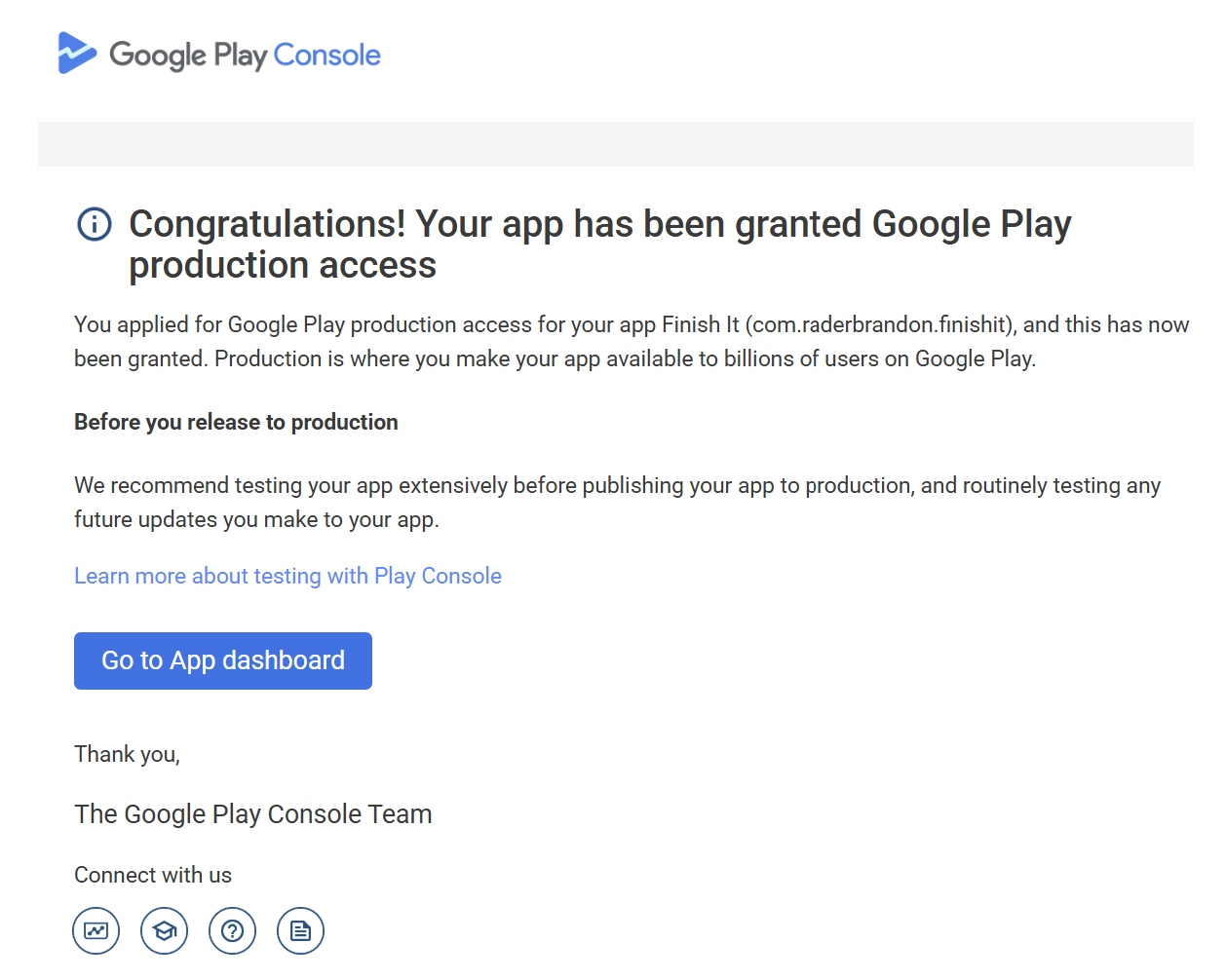
Verified Production Access
Quality QA Testing Reports
Clear, actionable reports with screenshots and evidence for every important issue found during testing.
Real Device Testing & Diagnostics
Real human testers use physical Android devices to test your app, verify real user flows, and provide clear testing evidence and professional QA reports.
Compliance Audit Passed
Our structured 14-day closed testing process is designed to meet Google Play's production requirements for your Android release.
Simple Closed Testing Pricing
Select the plan that fits your Android app complexity.
Loading Packages
Please wait while we fetch the best options for your region...
Frequently Asked Questions
Everything you need to know about passing your closed testing requirements.