Play Store testers for 14-day Android closed testing in Estonia
Get Play Store testers in Estonia for 14-day Google Play closed testing. Our 12 genuine testers fulfill all Play Console requirements for a fast Play Store launch.
The Google Play 14-Day Closed Testing Rule Explained
In late 2023, Google introduced a policy to raise overall software quality on the Play Store. Personal developer accounts created after November 2023 cannot launch directly to public production. Instead, you must recruit at least 12 distinct opt-in testers who install your app via an invitation link, maintain the installation on their personal devices, and interact with the build continuously over 14 consecutive days.
This requirement is not a mere checkbox where testers simply install the APK and let it sit idle in background storage. Google Play Console monitors opt-in stability, active device states, session frequencies, app updates, and crash reports. If tester engagement drops below Google's algorithmic threshold, your application for production access will be declined, forcing you to repeat the entire two-week cycle from scratch.
Why Estonian Developers Face Unique Closed Testing Hurdles
Developing software in Estonia usually means building for an international audience from day one. Because the domestic market is compact, local teams build high-velocity fintech, SaaS, mobility, and AI apps meant for the EU, the US, and Asian markets. However, this global ambition creates specific operational bottlenecks during Play Store Closed Testing.
First, assembling a localized circle of 12 distinct individuals with diverse Android hardware (Samsung Galaxy, Google Pixel, Xiaomi, OnePlus) across varying OS levels (Android 11 through Android 15) is difficult for boutique agencies or solo creators. Second, relying on casual tester groups often leads to sudden uninstalls or forgotten accounts. When an unmanaged tester deletes the app on day 11 to free up storage, your active count drops below the mandatory baseline, invalidating the test.
Finally, attempting to bypass this rule using bot farms, click scripts, or emulator networks triggers Google's anti-fraud detectors. These deceptive practices often lead to immediate account termination and permanent developer blacklisting across the entire Google ecosystem.
Real Device Testing vs. Emulators and Bot Networks
When facing tight launch deadlines, developers are often tempted by automated emulator services or cheap bot networks promising instant closed testing completion. Understanding the deep telemetry collected by Google Play services shows why synthetic shortcuts are dangerous.
Genuine Human Testing
- Authentic Telemetry: Generates natural touch events, variable session durations, screen rotations, and genuine network handoffs across live cellular and Wi-Fi networks.
- Real Hardware Signals: Runs on verified physical devices with genuine IMEI numbers, unique Google Play Service tokens, battery drainage profiles, and ambient sensors.
- Zero Account Risk: Complies 100% with Google Play Developer Program Policies, protecting your developer reputation and ensuring smooth production approval.
- Actionable User Feedback: Delivers real crash logs, UI layout quirks on varied screen sizes, and constructive bug feedback before public release.
Bots and Emulated Rings
- Synthetic Fingerprints: Cloud emulators share identical CPU signatures, mock location attributes, generic display ratios, and robotic interaction scripts.
- Sudden Telemetry Drops: Scripts open apps for exact 30-second intervals without natural scrolling, triggering Google Play anti-fraud alarms.
- Instant Rejections: Google Play Console flags synthetic clusters, leading to automatic rejection of production access applications.
- Risk of Developer Bans: Account associations with blacklisted bot farms can result in permanent Play Console termination under Associated Account policies.
Google's automated review system looks at hundreds of subtle signals. Real users switch between apps, experience intermittent cellular drops, adjust volume, and occasionally encounter ANR (Application Not Responding) dialogs. Emulators running on server farms produce uniform, unnatural logs that modern fraud algorithms detect effortlessly.
The Core Technical Signals Google Play Console Evaluates
Gaining production access is not just about keeping the test open for 336 hours; it is about proving to Google's review algorithm that your application is stable, useful, and properly tested. During your Closed Testing run, Google evaluates several distinct operational categories:
1. Opt-in and Retention Consistency
Every tester must accept the closed testing invite through the official Google Play web or Android opt-in URL. Google monitors whether these accounts remain enrolled throughout the entire 14-day window. If testers leave the testing program mid-cycle, your qualified tester count drops immediately.
2. Daily Active Engagement and Session Depth
Google measures whether users actually open the application and explore its core user interface. Brief app opens that last two seconds with zero screen transitions are heavily discounted. Authentic testing requires testers to navigate menus, trigger background services, interact with databases, and test user input fields.
3. Build Iteration and Bug Resolution
A flawless test where zero bugs are found and no updates are pushed can look suspicious to automated reviewers, especially for complex applications. Publishing at least one or two incremental build updates (e.g., v1.0.1 -> v1.0.2) during the 14-day phase demonstrates active developer engagement and responsive debugging.
4. Direct Feedback Channels
Google provides a dedicated private feedback channel inside the Play Store for closed testers. When real testers submit bug reports, feature suggestions, or performance notes through this official interface, it creates verifiable proof of an active testing lifecycle.
Struggling with the 14-Day Testing Requirement?
Skip the hassle of recruiting unreliable testers. Our professional fleet of real Android devices guarantees Google Play compliance in exactly 14 days. Zero bots. Zero emulators. 100% production approval guarantee.
Comparing Closed Testing Strategies for Estonian Teams
To choose the right path for your app launch, evaluate the primary testing strategies available to Estonian engineering teams:
| Feature & Metric | Dedicated Managed Testing | Friends, Family & Peer DIY | Automated Bot Networks | Free Swap Communities |
|---|---|---|---|---|
| Guaranteed 12+ Testers | Yes (100% coverage guaranteed) | Rarely (high drop-off rate) | Yes (fake virtual devices) | Inconsistent (hit or miss) |
| Full 14-Day Retention | Guaranteed with replacement | Unpredictable (people forget) | Artificial uptime | Poor (users drop out early) |
| Real Hardware Variety | Diverse OEM & OS mix | Limited to personal network | Generic cloud instances | Limited and unverified |
| Google Policy Safety | Fully compliant (Zero risk) | Fully compliant | High ban risk (Violates TOS) | Moderate risk (suspicious rings) |
| Private Feedback Delivery | Structured, detailed reports | Casual chat messages | None (or fake template text) | Low quality / irrelevant text |
| Developer Time Required | Less than 15 minutes setup | 15 - 25 hours chasing testers | Minimal setup, high rework | 20+ hours testing other apps |
| Production Approval Rate | 99% first-attempt success | Variable (frequent restarts) | < 5% (frequent rejections) | Low to moderate |
Managing closed testing manually often becomes an exhausting full-time job. Instead of focusing on product features, backend scalability, and marketing plans, founders spend weeks messaging acquaintances on Telegram or Slack, pleading with them to open the app for five minutes. A dedicated testing service eliminates this friction entirely.
Essential Closed Testing Checklist for Developers
Before launching your closed testing track in Google Play Console, follow this technical checklist to ensure your app package, privacy configurations, and testing tracks meet all Google requirements.
Pre-Release Technical Preparation
Play Console Configuration & Compliance
Active 14-Day Phase Execution
Step-by-Step Roadmap to Production Access
Achieving full production access on the Google Play Store follows a structured lifecycle. Here is the exact roadmap from your initial build to a successful worldwide public release.
Track Creation & Tester Recruitment
Set up your Closed Testing track inside Google Play Console. Choose your testing methodology (Google Groups or Email Lists) and recruit 12 or more verified testers with real Android devices across supported regions.
Opt-In & Build Distribution
Publish your release to the closed testing track and distribute the opt-in URL. Ensure every tester opts in via Google Play, installs the build, and performs an initial exploratory session on their physical device.
14-Day Active Engagement Phase
Maintain daily active engagement across the testing cohort for 14 continuous days. Testers interact with features, trigger core user flows, and submit private feedback while you monitor crash logs and Android Vitals.
Answering Google's Production Questions
Once the 14-day requirement is fulfilled, apply for Production Access in Play Console. You will be prompted to answer detailed questions regarding your testing strategy, tester feedback received, and technical improvements made.
Production Approval & Global Rollout
Google's review team assesses your testing telemetry, crash metrics, and written responses. Upon approval, your production track unlocks, allowing you to publish your app to millions of users worldwide.
How to Answer Google's Production Access Questionnaire
When the 14-day testing period finishes, the "Apply for Production" button activates in your Play Console dashboard. Google will present you with a mandatory questionnaire that directly influences whether your application is granted production clearance.
Here is how you should approach each section of the questionnaire:
1. How did you recruit your testers?
Be transparent and specific. Explain that you engaged a dedicated testing community of real Android users with diverse device models and OS versions. Highlight that testers were chosen based on target demographic fit, geographic distribution, and their ability to provide technical feedback on your app's specific feature set.
2. What feedback did you receive from testers during closed testing?
Summarize real usability feedback, visual edge cases, or performance issues identified during the test. For example, mention how testers on older Android versions reported UI clipping on specific screen aspect ratios, or how localization strings needed adjustments. Concrete, authentic examples prove to Google that your testing phase was meaningful.
3. What changes did you make to your app based on tester feedback?
Detail the exact build versions you deployed to resolve reported issues. Describe how you optimized network requests, patched a specific crash on cold startup, or simplified your onboarding flow. Demonstrating an iterative development cycle during the closed testing period is the strongest signal of production readiness.
Frequently Asked Questions
Why does Google require 12 testers for 14 days for personal developer accounts?
Google introduced this requirement to ensure that apps published on the Play Store meet high standards for stability, security, and user experience. Requiring independent developers to test their builds on at least 12 real devices over two weeks helps catch critical bugs, memory leaks, and policy violations before apps reach the public.
Can I use Internal Testing to satisfy the 14-day closed testing requirement?
No. Internal testing tracks are meant for rapid internal QA and sharing builds among your core development team. Google Play Console specifically requires an active Closed Testing track (Alpha/Closed Beta) with opt-in links to count toward the 14-day requirement for production access.
What happens if a tester uninstalls the app on day 10 of testing?
If an unmanaged tester uninstalls your app and your active tester count drops below the mandatory 12-user threshold, Google's system may pause or reset your 14-day progression. Working with a managed testing service guarantees continuous coverage, as reserve testers are immediately deployed if any device becomes inactive.
Can Estonian developers test with users located in other countries?
Yes. Google Play Closed Testing allows you to invite testers globally, as long as your closed testing track is configured to include the countries where those testers are located. Testing across diverse international regions is often beneficial for apps targeting European and global markets.
Are automated emulators or bot clicks acceptable for closed testing?
No. Using bots, click farms, or cloud emulator clusters directly violates Google Play Developer Program Policies. Google uses sophisticated device fingerprinting, behavioral analysis, and network telemetry to detect synthetic traffic. Accounts caught using bots face immediate rejection and risk permanent developer account termination.
How quickly can I apply for production access after completing the 14 days?
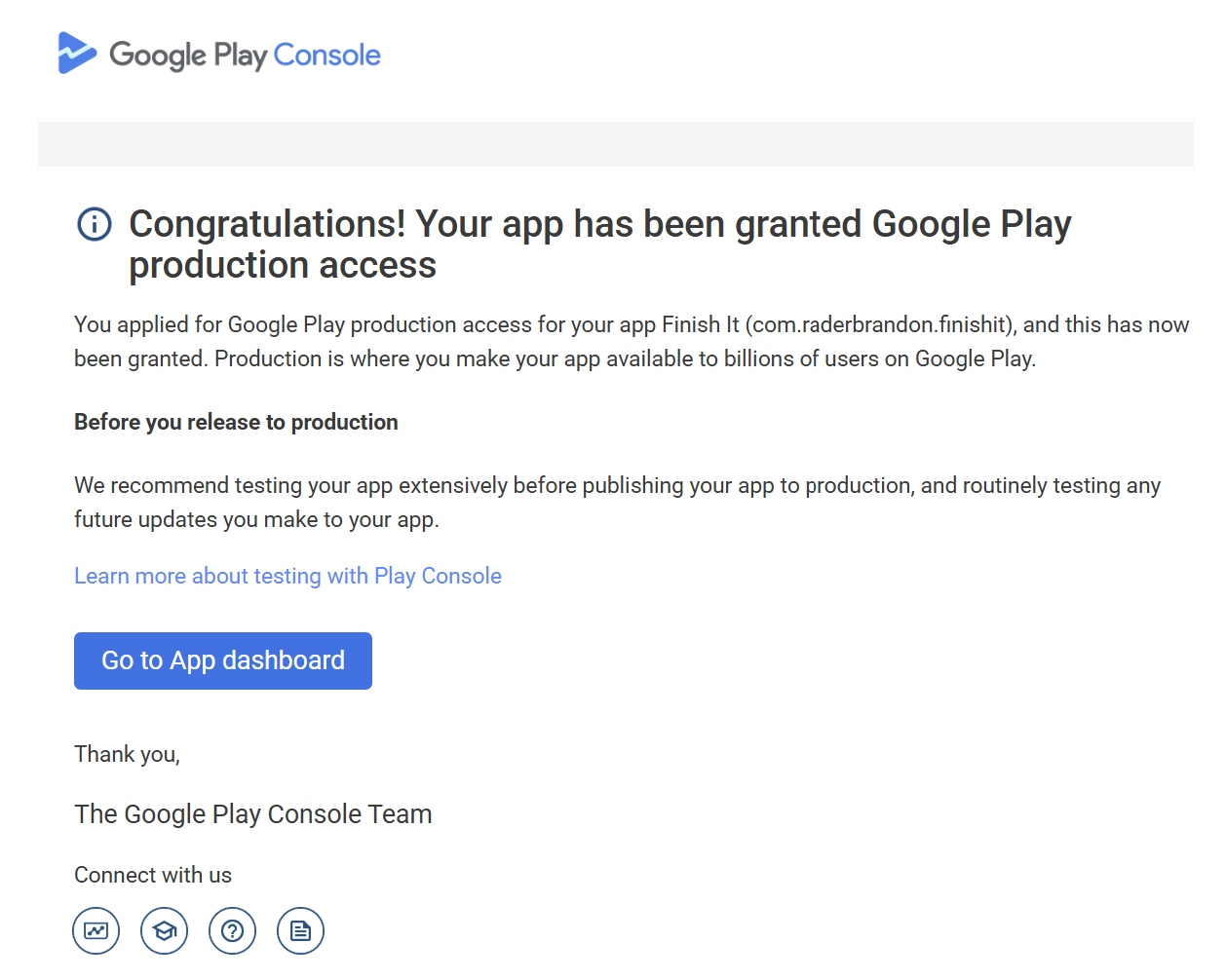
As soon as the 14 consecutive days of active testing are logged in Google Play Console, the "Apply for Production" button will become clickable on your dashboard. Once you submit your responses to Google's testing questions, the review team typically processes applications within 2 to 7 business days.
The Testing Pipeline
How we deploy real devices and guarantee compliance for your release.
Sign In
Sign in with Google to configure the closed testing environment for your Android build.
Opt-In URL
Submit your Google Play Console testing link, and our team will assign qualified testers from our testing network to join your Android closed testing release.
Testing Begins
A QA supervisor monitors daily check-ins, ensuring 12 unique Android users engage with your Android build every single day.
Compliance Complete
We guarantee 14 consecutive days of active user check-ins to satisfy Google's compliance policies, delivering an audit-ready PDF feedback report.
Why Developers Trust Us
Experience a next-generation testing infrastructure built for Google Play compliance for your Android release.
The 14-Day Production Guarantee
We complete the required 14-day closed testing process with real human testers and physical Android devices, while providing clear testing evidence and documentation throughout the process.
If Google specifically rejects production access due to insufficient testing engagement, you are covered by our free re-run or 100% refund guarantee, subject to our Refund Policy.
Verified Production Access
Quality QA Testing Reports
Clear, actionable reports with screenshots and evidence for every important issue found during testing.
Real Device Testing & Diagnostics
Real human testers use physical Android devices to test your app, verify real user flows, and provide clear testing evidence and professional QA reports.
Guaranteed App Approval
Get your Android build approved on the first try. We create an audit-ready compliance profile that proves thorough quality assurance.
Affordable Compliance Cycles
Transparent plans built to satisfy Google Play Console guidelines for your Android build.
Loading Packages
Please wait while we fetch the best options for your region...
Frequently Asked Questions
Everything you need to know about passing your closed testing requirements.