Play Store testers for 14-day Android closed testing in Georgia
Find Play Store testers in Georgia for 14-day Google Play closed testing. Fulfill Play Console requirements with 12 real testers and launch quickly.
The Georgian Android Ecosystem: Tbilisi, Batumi, and Kutaisi
Georgia has rapidly transformed into one of the Caucasus region's most dynamic technology hubs, fueled by progressive digital policies, international tech talent relocation, and a vibrant local developer community centered around GITA (Georgia's Innovation and Technology Agency) and vibrant coworking spaces in Saburtalo and Vake. Mobile internet adoption is overwhelmingly Android-driven, with users expecting high-performance digital experiences across banking, micro-mobility, e-commerce, and public digital services.
However, the local mobile environment presents distinct technical realities that simulated environments cannot replicate. Real Georgian users interact with apps across major national cellular providers such as MagtiCom, Silknet, and Cellfie, switching frequently between high-speed urban fiber Wi-Fi, 4G LTE, and transitional 5G networks in urban centers. Furthermore, device fragmentation is pronounced. The market is populated with a wide mix of high-end flagships and diverse mid-tier devices from Samsung, Xiaomi, Redmi, Poco, Realme, and Honor, alongside legacy Android versions. Running your Play Store Closed Testing track with authentic local testers provides indispensable validation that your app performs smoothly across these real-world conditions.
Real Users vs. The Bot Farm Trap
When faced with Google's testing mandate, some developers look for shortcuts on freelance boards, turning to automated click farms or cheap bot services. This is a fatal mistake. Google's review pipeline relies on sophisticated machine learning models that monitor hardware fingerprints, battery draw curves, sensor data, and biometric touch variation. When an account submits automated or VPN-masked accounts, Google flags the telemetry as fraudulent, leading to rejected production applications or permanent developer account suspensions.
Authentic Georgian Testers
- Genuine Physical Hardware: Tests run on real Samsung, Xiaomi, Pixel, and Motorola devices operating on genuine Georgian IP addresses (MagtiCom, Silknet, Cellfie).
- Natural Telemetry Patterns: Organic session lengths, realistic touch events, variable foreground/background intervals, and realistic system resource usage.
- Cultural & Linguistic Nuance: Crucial verification of Georgian script (Mkhedruli) rendering, local currency (GEL - ₾) formatting, and regional phone prefixes (+995).
- Zero Policy Violation Risk: Fully compliant with Google Play Developer Distribution Agreement guidelines, protecting your account health and reputation.
Automated Emulators & Bot Farms
- Synthetic Device Signatures: Emulated hardware profiles and virtualized network stacks easily detected by Google Play Protect and SafetyNet APIs.
- Robotic Interaction Telemetry: Fixed touch coordinates, identical session durations, and simultaneous logins that trigger anti-fraud detection algorithms.
- No Qualitative Feedback: Zero meaningful insights regarding UI responsiveness, translation edge cases, local crash logs, or usability friction.
- High Risk of Rejection: Direct path to rejected production access requests, closed track resets, and permanent developer account termination.
Decoding Google's 14-Day Closed Testing Metrics
Google's policy requires continuous testing over a 14-day window not to test your patience, but to evaluate software stability under realistic operational conditions. Google Play Console silently aggregates key vitals throughout this period to establish whether an application is technically mature enough for global distribution.
The automated evaluation looks closely at Android Vitals thresholds. If your Application Not Responding (ANR) rate exceeds the core metric threshold of 0.47% or your crash rate surpasses 1.09%, your application is immediately flagged as unstable. During closed testing, Google monitors how quickly your team pushes updates, whether crashes decrease between successive Android App Bundles (AABs), and how actively opt-in testers download and run the latest releases. Having verified testers who keep the app installed and interact with it daily produces the healthy telemetry footprint that automated review algorithms require before granting production access.
Struggling with the 14-Day Testing Requirement?
Skip the hassle of recruiting unreliable testers. Our professional fleet of real Android devices guarantees Google Play compliance in exactly 14 days. Zero bots. Zero emulators. 100% production approval guarantee.
Comparing Your Testing Options for Google Play Compliance
Meeting the requirements for Closed Testing requires choosing a testing strategy that balances compliance, operational effort, and engineering quality. The table below outlines how our dedicated managed testing service compares to informal DIY recruitment and unsafe automated scripts.
| Evaluation Metric | Managed Testing Service (Real Users) | DIY (Friends & Colleagues) | Automated Bots & VPN Services |
|---|---|---|---|
| Play Console Policy Compliance | 100% Guaranteed real human engagement | Compliant, but vulnerable to tester inactivity | High Risk of immediate account penalty |
| Tester Retention (14 Full Days) | 100% Guaranteed daily active participation | Frequent drop-off after day 2 or 3 | Programmed pings easily flagged by AI |
| Hardware & Network Diversity | Real devices across Magti, Silknet, Cellfie | Limited to personal circles and devices | Virtual emulators sharing identical device fingerprints |
| Actionable Bug & Feedback Logs | Structured feedback, logs, and device data | Casual, non-technical verbal remarks | Zero qualitative or usability feedback |
| Administrative Developer Overhead | Zero - completely managed workflow | Heavy time spent chasing friends daily | Minimal initial effort, high risk of rejection |
| Production Access Approval Rate | Industry-leading first-time pass rate | Mixed - often delayed by inactive testers | Extremely low - triggers review audit flags |
Technical Architecture: Preparing Your App for Georgia
Before launching your closed testing track, ensure your build is properly hardened for the local market and compliant with Play Store requirements. Pay special attention to Georgian font rendering, network resilience, and regional integrations.
// Example: Safe localized currency formatter for Georgian Lari (GEL)
fun formatGeorgianCurrency(amount: Double): String {
    val georgianLocale = Locale("ka", "GE")
    val currencyFormat = NumberFormat.getCurrencyInstance(georgianLocale)
    return try {
        currencyFormat.format(amount)
    } catch (e: Exception) {
        // Graceful fallback ensuring standard GEL symbol representation
        String.format(Locale.US, "₾ %.2f", amount)
    }
}
When localizing your user interface into Georgian (Mkhedruli script), font rendering can introduce subtle layout bugs. Standard Georgian text often requires additional vertical line height compared to Latin typography. If your TextViews or Jetpack Compose Text composables use rigid height constraints, descending characters may get clipped on smaller screens or custom OEM fonts. Real device testing across local handsets is the most effective way to catch these visual regressions before release.
Georgian Localization & Cultural Adaptations
Android Vitals & Crash Resilience
Play Console Configuration & Track Setup
Step-by-Step Roadmap: From Closed Track to Production Access
Achieving seamless production rollout in the Google Play Console requires a disciplined, structured approach. Here is how our managed testing process guides your app through every stage of compliance.
Step 1: Track Configuration & Target Audit
We verify your closed testing track configuration in the Google Play Console, ensuring your opt-in links, country availability settings, and App Bundles (AAB) are properly configured. We audit basic compliance prerequisites to ensure the build installs cleanly without initial crash loops.
Step 2: Onboarding Real Georgian Testers
We deploy our vetted network of authentic Android users located across Georgia, including Tbilisi, Batumi, and Kutaisi. Each tester joins your designated Google Group, accepts your Play Store web or Android opt-in invitation, and installs your app directly through the official Google Play store client.
Step 3: 14 Days of Consistent Daily Engagement
Over the course of 14 continuous days, our testers actively open and interact with your application on their personal devices. They navigate core user flows, trigger background events, test regional input validations, and produce the continuous, organic telemetry signals that Google Play algorithms look for.
Step 4: Real-World Feedback & Bug Reporting
During the testing cycle, testers log actionable bug reports, user experience friction points, and device-specific anomalies. You receive structured feedback allowing your engineering team to release iterative app updates directly to the closed track, demonstrating proactive developer maintenance.
Step 5: Applying for Production Access
Once the 14-day continuous engagement window concludes with clean Android Vitals, the Play Console unlocks your production application questionnaire. Armed with comprehensive testing data, qualitative user feedback, and documented update history, you submit your production request with maximum confidence.
Deep Dive: Mastering the Play Console Production Application
Completing the 14-day testing period is an essential milestone, but your final step is answering Google's production access evaluation questions. Google's review team uses these questions to assess whether you conducted genuine quality assurance or merely treated testing as a superficial checkbox.
When filling out the production questionnaire in Play Console, avoid brief, generic answers. Instead, provide detailed technical insight into your testing lifecycle:
- How did you recruit your testers? Explain that you engaged a dedicated cohort of real Android users in your primary target market of Georgia, utilizing targeted community distribution to test across specific device classes, screen densities, and local mobile carriers.
- What feedback did you receive from testers? Detail specific bugs, UI adjustments, and performance improvements discovered during the 14 days. Mention practical examples such as fixing Mkhedruli font truncation, optimizing API timeout thresholds for cellular network transitions, or refining checkout navigation flows.
- What changes did you make based on that feedback? Reference the specific version codes and update release notes published during your closed testing track. Showing that you pushed iterative builds to resolve reported bugs proves to Google that you took tester feedback seriously.
Providing thorough, authentic responses backed by clean Android Vitals telemetry gives the Google Play editorial and compliance teams the exact evidence they need to grant production access swiftly.
Frequently Asked Questions
Why does Google require 14 continuous days of closed testing for Android apps?
Google established the 14-day closed testing policy for personal developer accounts created after November 2023 to improve the overall quality, security, and stability of apps published on Google Play. Rather than evaluating an app solely through automated static scanners, Google wants proof that real users can install, run, and interact with the application over an extended period without encountering critical crashes, severe battery drain, or unresponsive screens (ANRs). A two-week window allows developers to identify regressions across different device models and prove they can reliably maintain their software through regular updates.
Can I use testers outside of Georgia if my app is localized for the Georgian market?
While Google does not strictly require your testers to reside in the exact country where your business is incorporated, using testers in your primary target market offers immense advantages. Local Georgian testers provide crucial validation that regional features - such as Georgian language script rendering, local phone number formatting (+995), integration with local banking payment gateways (like TBC and BOG), and carrier performance on MagtiCom or Silknet - function properly under real-world conditions. Furthermore, localized testing generates authentic geographic telemetry that aligns naturally with your app's intended distribution regions.
What happens if a tester uninstalls the app before the 14 days are complete?
If testers uninstall your app or remain inactive during the testing window, your active tester count in the Google Play Console may drop below the required threshold. When this occurs, Google Play algorithms may pause or reset the 14-day countdown timer until you recruit additional active testers to restore the required cohort. This is why relying on informal groups of friends or coworkers often leads to frustration. Our managed testing service guarantees that all assigned testers keep your application installed and remain actively engaged throughout the entire 14-day period.
How many updates should I push to the closed testing track during the 14 days?
While Google does not mandate a specific number of updates, publishing at least 1 or 2 iterative builds during your closed testing track is highly beneficial. When you publish a new version code that addresses minor bug fixes, UI adjustments, or localization tweaks reported by your testers, it demonstrates to Google's review team that you are actively responding to feedback and maintaining your codebase. Documenting these updates in your release notes provides concrete evidence during your final production access review.
How do real testers access and install my app during closed testing?
Testers access your application directly through official Google Play infrastructure. After you set up your Closed Testing Track in the Google Play Console and choose Google Groups or email lists for distribution, testers receive an official Google Play opt-in link (web or Android URL). Upon clicking the link and opting into the test, they are directed to the Google Play Store client to download and install the app onto their physical Android devices just like any standard store release.
Can you help if I already have some testers but need additional users to reach the requirement?
Yes, absolutely. Many indie developers and development agencies successfully recruit 5 to 8 colleagues or friends but struggle to find the remaining reliable participants needed to maintain consistent daily engagement. Our managed service can seamlessly provide the additional verified testers required to complete your cohort, ensuring your app maintains steady engagement signals and passes Google's 14-day threshold without delay.
Our QA Process
A straightforward 4-step process to get your Android app approved.
Choose Package
Connect your Google account and choose your preferred closed testing package for your Android app.
Submit Link
Share your Play Store opt-in URL. We immediately deploy 12 real testers to launch and review your Android app daily.
Active Testing
Our crew initiates daily launch sessions on physical devices, verifying usability and logging crashes for your Android app.
Get Approved
We continuously perform closed app testing for 14 days to help you meet Google Play production requirements. We also provide a compliance report.
The Premium QA Advantage
Deploy your Android app onto real retail-grade handsets using our secure laboratory environment.
The 14-Day Production Guarantee
We complete the required 14-day closed testing process with real human testers and physical Android devices, while providing clear testing evidence and documentation throughout the process.
If Google specifically rejects production access due to insufficient testing engagement, you are covered by our free re-run or 100% refund guarantee, subject to our Refund Policy.
Verified Production Access
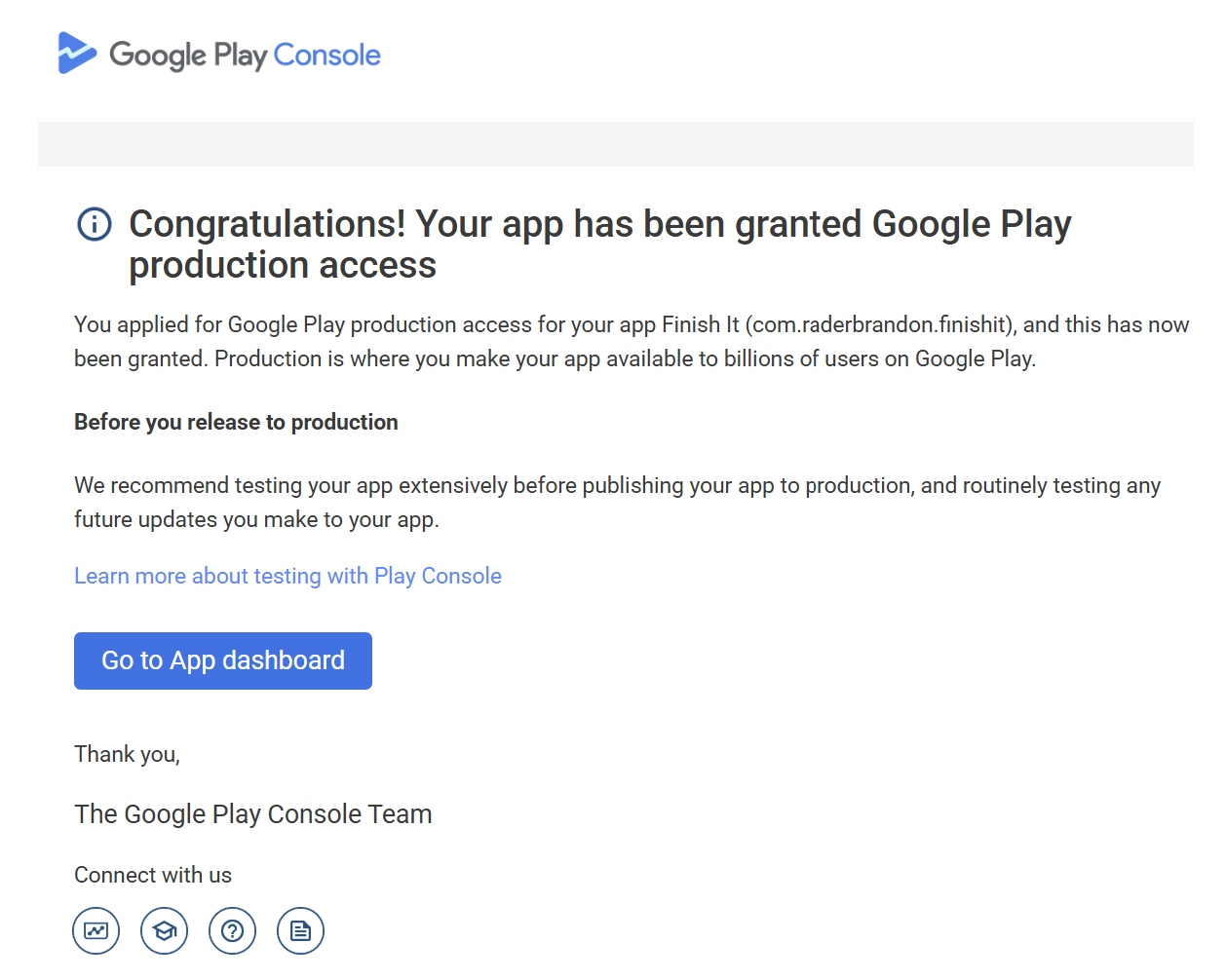
Quality QA Testing Reports
Clear, actionable reports with screenshots and evidence for every important issue found during testing.
Real Device Testing & Diagnostics
Real human testers use physical Android devices to test your app, verify real user flows, and provide clear testing evidence and professional QA reports.
Production Access Secured
Transition your Android app to public production access with confidence. We deliver verified session logs and compliant Console activity.
One Cycle. Complete Approval.
Choose the ideal closed testing cycle for your Android release.
Loading Packages
Please wait while we fetch the best options for your region...
Frequently Asked Questions
Everything you need to know about passing your closed testing requirements.