Play Store testers for 14-day Android closed testing in Ghana
Get authentic Play Store testers in Ghana. Pass Google Play closed testing efficiently with our expert 12 testers for 14 days Play Console service.
Imagine trying to sell thick snow boots in the middle of a sweltering desert. That is exactly what it feels like when you launch a mobile application without properly testing it in the specific regional market you want to target. Right now, Ghana is experiencing an absolutely massive digital revolution. From the bustling, energetic streets of Accra to the rapidly growing technological hubs in Kumasi, mobile technology is the essential heartbeat of everyday life here. People rely almost entirely on their Android smartphones for everything, whether it is paying for daily groceries with mobile money platforms, catching a ride across town, or streaming local entertainment. If you are an ambitious developer looking to break into the lucrative West African market, you cannot just guess what works from thousands of miles away. You need real people on the ground to interact with your software. But there is a significant catch to this process. Google has dramatically tightened the reins on how apps are published to the public. To get your Android application onto the store, you must pass a very strict compliance phase. You need genuine people to opt-in, download, and actively use your product before the big release. This is where finding reliable people for Google Play Closed Testing becomes your biggest hurdle, especially if you are not based locally in the country.
Why Ghana is a Strategic Market for App Testing
Ghana boasts a uniquely vibrant, youthful, and primarily mobile-first population. The entire digital landscape is heavily dominated by Android devices, making it the absolute perfect testing ground for your new application. Local users have very specific expectations regarding user interface design, data consumption efficiency, and offline capabilities. Testing here means you are optimizing for actual real-world conditions, like fluctuating network speeds and the integration of popular local payment gateways. If your app can thrive in this dynamic environment, it is highly likely to succeed across broader African markets. It is not just about ticking a box for compliance; it is about gathering authentic feedback that shapes your product for a highly active user base.
The Reality of Google Play Testing Requirements
Google requires all new developers to conduct thorough testing to ensure maximum quality and safety on their platform. The policy strictly dictates that you must maintain a specific number of active testers over a continuous two-week period. This means consistent daily engagement, not just a simple one-time download. Even if you are searching for a setup like 12 Testers for 14 Days to validate your idea, you must ensure they are completely legitimate accounts. Failing to meet these strict engagement metrics, or using automated bots, will result in immediate rejection of your application. Your testers must genuinely interact with your app, find hidden bugs, and provide feedback that proves your application is ready for the public. Play Store Closed Testing is a mandatory hurdle, specifically designed to protect users from broken or malicious software.
Comparing Your Testing Options
Before committing to a specific strategy, it is crucial to clearly understand the landscape of available options. Here is a detailed breakdown of how different approaches stack up against Google's rigorous standards.
| Feature | Professional Service | DIY (Friends & Family) | Automated Bots |
|---|---|---|---|
| Real Devices | Yes, diverse Android models | Yes, but limited variety | No, heavily simulated |
| Daily Engagement | Guaranteed consistent usage | Often drops off quickly | Zero human interaction |
| Local Market Focus | Yes, targeted in Ghana | Depends on your network | Unreliable IP masking |
| Feedback Quality | Detailed and actionable | Casual and unstructured | None provided |
| Account Safety | Fully compliant and safe | Safe, but highly unreliable | Extremely high ban risk |
Struggling with the 14-Day Testing Requirement?
Skip the hassle of recruiting unreliable testers. Our professional fleet of real Android devices guarantees Google Play compliance in exactly 14 days. Zero bots. Zero emulators. 100% production approval guarantee.
Real Testers vs. Automated Bots: The High-Stakes Gamble
When you are rushing to launch your product, it might be incredibly tempting to use cheap, automated services to quickly pass the closed testing phase. However, Google's detection algorithms are incredibly sophisticated today. Let us look at exactly why authentic human testing is the only safe and logical path forward for your business.
Authentic Ghanaian Testers
True Device Diversity Real people use a incredibly wide variety of Android brands, screen sizes, and operating system versions commonly found in the local market. This exposes device-specific bugs you would never find on a computer emulator.
Natural Usage Patterns Genuine users open your app at completely different times of the day, navigate screens randomly, and interact with features just like a normal consumer would. This human behavior tells Google your app is being legitimately tested.
Valuable Local Feedback A real tester can easily tell you if your app uses way too much mobile data, if the local slang used in your UI feels wrong, or if a specific feature crashes when the internet connection suddenly drops.
Guaranteed Compliance Using real accounts ensures you meet all strict guidelines without triggering alarms. Your app will smoothly pass the review process, allowing you to launch with total confidence and complete peace of mind.
Fake Bot Services
Static and Predictable Bots usually operate from the exact same IP addresses, using simulated devices that all look totally identical to Google's security systems. This instantly raises massive red flags during the automated review process.
Zero Meaningful Interaction Fake accounts just install the app and sit completely dormant. They do not click buttons, they do not generate crash logs, and they certainly do not provide the daily engagement that the Play Console mandates.
High Risk of Account Bans If Google detects that you are actively manipulating the testing requirements with bots, they will not just reject your app. They can permanently suspend your entire developer account, destroying months of hard work.
Worthless Data You learn absolutely nothing about how your application performs in the real world. When you finally launch, you will be hit with a massive wave of negative reviews from actual users who encounter bugs the bots missed.
Your 14-Day Testing Journey: Step-by-Step
Navigating the complex compliance process does not have to be overwhelming or stressful. Here is a clear, step-by-step roadmap of exactly what your two weeks of testing will look like when targeting the Ghanaian market.
Day 1: Account Setup and App Distribution
The very first day is all about logistics and coordination. You will add the email addresses of your Ghanaian testers to your Google Play Console testing track. We carefully ensure that every single tester successfully receives the invitation link, opts into the testing program, and downloads the application directly from the official store. This initial download is critically important because it registers the start of your mandatory testing period with Google's backend systems.
Days 2-5: Initial Onboarding and Core Feature Exploration
During the first few crucial days, testers will create accounts, set up their user profiles, and begin to explore the main features of your application. This is exactly when the most obvious and glaring bugs are usually discovered. Testers will navigate through your primary menus, test your core user flows, and ensure the application does not crash on initial startup. They will interact with the app in short, natural sessions, perfectly mimicking how a new user explores a fresh product.
Days 6-10: Deep Dive and Edge Case Testing
As we move steadily into the second week, testers begin to really push the boundaries of your app. They will extensively test features that require more effort, such as uploading heavy files, completing long forms, or using complex offline modes. For the local market specifically, they might test how the app handles network switching abruptly from Wi-Fi to a 3G network. Consistent, daily engagement is heavily maintained across all devices to fully satisfy the continuous testing requirements.
Days 11-13: Final Polish and Feedback Collection
The official testing period is winding down, but user engagement remains exceptionally high. Testers will deliberately revisit features they had trouble with earlier to see if any recent updates have resolved the issues. We begin actively compiling detailed, written feedback on the overall user experience, performance on older device models, and general satisfaction. This qualitative data is just as vital as the backend analytics Google is constantly tracking.
Day 14: Final Review and Production Rollout
Congratulations! The rigorous two-week period is finally complete. We double check to ensure that all minimum engagement metrics have been completely met. You can now confidently log into your Play Console, review the final testing data, and submit your application for full production access. Because you utilized genuine testers who engaged naturally, your final approval process will be smooth, incredibly fast, and totally hassle-free.
The Ultimate Pre-Launch Checklist for Ghana
Before you invite a single tester to download your app, you must absolutely ensure everything is perfectly configured in your developer account. Missing even a small detail can drastically delay your entire launch timeline. Use this comprehensive checklist to prepare yourself for a flawless testing phase.
Play Console Configuration
App Readiness and Localization
Tester Management Strategy
Frequently Asked Questions About Android Testing
We completely understand that navigating the endless complexities of the Play Store policies can be deeply confusing. Here are extensively detailed answers to the absolute most common questions developers constantly ask about testing their apps specifically for the Ghanaian market.
Why is it so absolutely important to test specifically with users actually located in Ghana?
Testing directly with users situated in your target region is absolutely critical for several major reasons. First and foremost, telecommunication network infrastructure varies wildly across the globe. An application that loads almost instantly on a fiber connection in New York might severely struggle on a congested 3G connection in parts of Accra or Kumasi. Local testers help you immediately identify these frustrating performance bottlenecks. Second, cultural context deeply matters. The exact way people interact with user interfaces, the specific color schemes that appeal to them, and the terminology they instinctively understand are all totally unique to their local environment. Third, if your app integrates heavily with regional services, like local telecom APIs or specialized mobile money platforms, you physically cannot test these accurately from outside the country. By utilizing a local cohort, you guarantee your product is genuinely optimized for the people who will actually be using it daily, significantly increasing your chances of long-term success and positive reviews upon launch.
How exactly does Google technologically track the 14 days of testing?
Google utilizes highly sophisticated, hidden analytics running seamlessly in the background of the Android operating system and the Play Store application itself. They do not just casually look at the date the app was originally downloaded. They actively monitor the daily active usage across the required number of distinct devices and unique Google accounts. They meticulously track deep metrics such as average session length, exact crash rates, ANR (Application Not Responding) errors, and the total frequency of app opens per day. The 14-day continuous clock typically starts ticking only when the required number of testers have officially opted in and actively installed the app on a compatible device. If testers suddenly uninstall the app, or if they simply do not open it for several consecutive days, Google's automated systems will instantly flag the testing phase as incomplete or non-compliant, harshly forcing you to start the process over or extending your required testing duration indefinitely.
What precisely happens if I attempt to use bots or cheap proxy services instead of real people?
Using automated bots, computer emulators, or shady click-farm services is a direct, flagrant violation of Google's strict Developer Policies and is extremely risky. Google actively employs advanced, highly trained machine learning algorithms designed specifically to detect unnatural, robotic behavior. Bots often share identical IP ranges, have exactly the same device fingerprints, and interact with applications in rigid, completely predictable patterns that no actual human would ever replicate. If you are caught attempting to use these fraudulent methods, the consequences are severe and swift. At the absolute minimum, your application will be instantly rejected, and you will be barred from publishing. At worst, your entire developer account will be permanently terminated without appeal. This means you will instantly lose access to any other apps you have published, any monetary revenue you have earned will be frozen, and you will be banned from ever creating a new account in the future. It is simply not worth the monumental risk.
What specific kind of feedback should I expect to receive from my testing group?
When you successfully engage real human testers, you should fully expect a healthy mix of both technical and qualitative feedback. On the technical side, they will diligently help you identify hidden crashes on specific, older device models, weird UI glitches on different screen sizes, and features that simply do not work as originally intended by your development team. Qualitatively, you will receive invaluable insights into the actual user experience. Testers might frankly tell you that a certain call-to-action button is incredibly hard to find, that the text is far too small to read comfortably, or that a specific onboarding process takes way too many steps to complete. They can also provide highly valuable feedback on your app's performance regarding battery drain and background data consumption, which are highly sensitive, critical topics for many mobile users in developing markets. This comprehensive feedback allows you to meticulously refine your application into a polished, truly professional product before it ever reaches the general public.
Am I allowed to update my app's code while the closed test is currently running?
Yes, you absolutely can, and in many practical cases, you are highly encouraged to do so. If your active testers uncover a critical, app-breaking bug during the first few days, it is vastly better to push an immediate update and fix it rather than stubbornly letting them struggle with a broken app for the remainder of the test. When you successfully upload a new version to the testing track, the Play Store will automatically prompt your active testers to update their installation in the background. However, you should definitely avoid making massive, sweeping changes to the core functionality very late in the testing period, as this might unintentionally reset the validation of certain critical user flows. Small, targeted bug fixes, backend performance improvements, and minor UI text tweaks are perfectly fine and clearly show Google that you are actively maintaining and improving your software based on real-world, actionable usage.
Is this rigorous compliance process strictly required for all new developer accounts?
Yes, as of late 2023, Google decisively implemented these strict testing requirements for absolutely all newly created personal developer accounts globally. This was a massive, strategic move by Google to proactively clean up the marketplace and drastically reduce the sheer amount of low-quality, spam, or actively malicious software being freely published. They desperately want to ensure that every new developer is totally committed to providing a highly functional and safe experience for all Android users. While massive, established corporate accounts or very old personal accounts might currently have completely different legacy requirements, absolutely anyone starting fresh today must adhere to this mandatory closed testing phase before they are ever granted access to publish applications to the public production track.
How do I accurately know when I am finally ready to apply for production access?
You will distinctly know you are fully ready when two primary, non-negotiable criteria are totally met. First, the mandatory 14-day continuous period has fully elapsed, and your official developer dashboard definitively reflects that the minimum number of testers have been active consistently throughout that specific time. Second, and arguably far more importantly, your app should be remarkably stable. You should have actively resolved any major crashes or critical, blocking bugs reported by your testing cohort. Your ANR (Application Not Responding) rates should be well within Google's acceptable, green thresholds. Once you feel completely confident that the application provides a totally smooth, highly valuable experience, you will intuitively navigate to the Play Console dashboard. There, you will easily find a dedicated section to formally apply for production. You will comprehensively need to answer detailed questions about the testing process, what you practically learned, and exactly how you addressed user feedback, right before successfully submitting your app for its final, official review.
Does completely passing the testing process guarantee my app will be incredibly successful?
While undertaking rigorous, thorough testing guarantees your app is fundamentally functionally sound and completely compliant with store policies, it unfortunately cannot guarantee total commercial success. Passing the closed testing phase simply means you are legally allowed to put your product on the digital shelf. Ultimate success depends on incredibly many other external factors, heavily including your ongoing marketing strategy, comprehensive App Store Optimization (ASO), the overall market demand for your product, and precisely how well you continually support and update the app long after launch. However, successfully launching a heavily tested, entirely bug-free app gives you a truly massive competitive advantage. It totally prevents those devastating initial one-star reviews that can permanently, irreparably damage a brand new app's fragile reputation, providing you with a very solid, unshakable foundation to steadily build a loyal, happy user base.
What happens if a few testers miss a day of engagement?
Google's requirement focuses on maintaining a continuous period of testing with active engagement. While a single tester missing one single day might not instantly derail the entire process if the rest of your cohort is highly active, it is extremely risky to rely on borderline numbers. If the overall daily active user count dips below the required threshold, Google's automated system may easily invalidate that day, effectively resetting your 14-day timer back to zero. This is exactly why it is highly recommended to recruit significantly more than the minimum required number of testers. By having a buffer of extra participants, you comfortably ensure that even if a few people forget to open the app or experience sudden phone issues, your aggregate engagement metrics remain safely above the mandatory requirement, ensuring a smooth approval process without frustrating delays.
Are there specific rules regarding what the application must actually do during the test?
While Google does not strictly dictate the exact business logic or creative purpose of your application, they heavily mandate that it must provide a genuinely functional, coherent user experience. You cannot simply upload a blank screen, a single static image, or a completely broken interface just to forcefully bypass the timer. The app must contain the core features you intend to release, and testers must be able to navigate through those features meaningfully. The Play Console actively tracks different types of user events, such as screen transitions and button clicks, to gauge real interaction. If the analytics show that testers are merely opening the app and instantly closing it without any internal navigation, reviewers will likely flag the test as illegitimate, delaying your production access until a proper test is conducted.
Can I use Closed Testing to monetize my app before the official launch?
During the Closed Testing phase, your primary focus should be entirely on gathering feedback and ensuring technical stability, not generating revenue. While it is technically possible to test in-app purchases or subscription models in a sandbox environment to ensure the billing flows work correctly, you should not be actively charging testers real money for beta access. Google explicitly provides testing credentials that allow developers and testers to simulate purchases without actual financial transactions occurring. Trying to forcefully monetize a closed testing cohort can lead to significant policy violations and negative user experiences. Keep the test strictly focused on quality assurance, and save your commercial monetization strategies for the official public production rollout.
How It Works
How we deploy real devices and guarantee compliance for your release.
Get Started
Sign in with Google to configure the closed testing environment for your Android build.
App Submission
Submit your Google Play Console testing link, and our team will assign qualified testers from our testing network to join your Android closed testing release.
14-Day Cycle
A QA supervisor monitors daily check-ins, ensuring 12 unique Android users engage with your Android build every single day.
Production Access Approval
We guarantee 14 consecutive days of active user check-ins to satisfy Google's compliance policies, delivering an audit-ready PDF feedback report.
Why Choose AppConsoleLab
Experience a next-generation testing infrastructure built for Google Play compliance for your Android release.
The 14-Day Production Guarantee
We complete the required 14-day closed testing process with real human testers and physical Android devices, while providing clear testing evidence and documentation throughout the process.
If Google specifically rejects production access due to insufficient testing engagement, you are covered by our free re-run or 100% refund guarantee, subject to our Refund Policy.
Verified Production Access
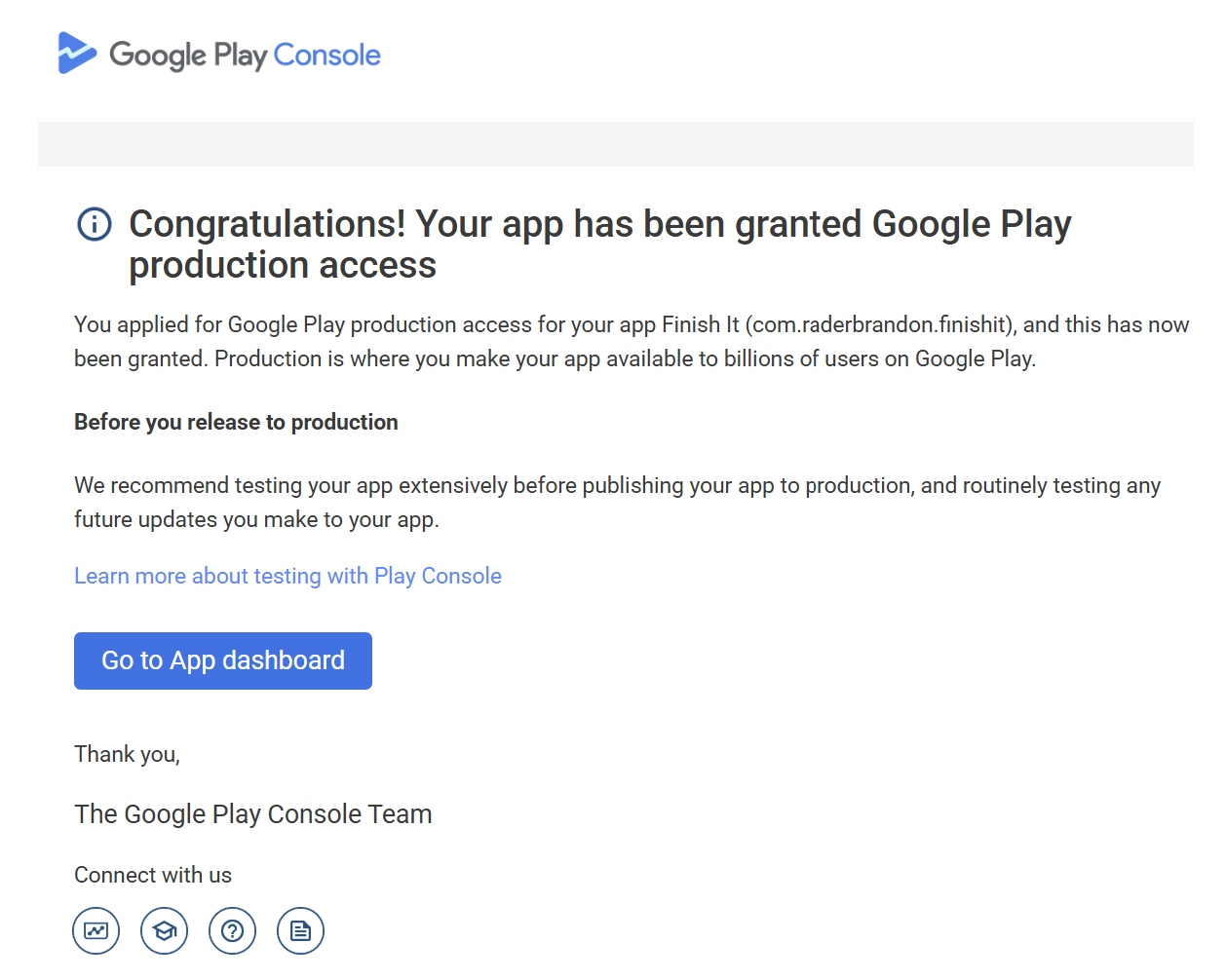
Quality QA Testing Reports
Clear, actionable reports with screenshots and evidence for every important issue found during testing.
Real Device Testing & Diagnostics
Real human testers use physical Android devices to test your app, verify real user flows, and provide clear testing evidence and professional QA reports.
Play Store Ready
Get your Android build approved on the first try. We create an audit-ready compliance profile that proves thorough quality assurance.
Affordable Compliance Cycles
Transparent plans built to satisfy Google Play Console guidelines for your Android build.
Loading Packages
Please wait while we fetch the best options for your region...
Frequently Asked Questions
Everything you need to know about passing your closed testing requirements.