Play Store testers for 14-day Android closed testing in Greece
Get Play Store testers in Greece for 14-day Google Play closed testing. Our 12 real testers meet all Play Console requirements so your app gets approved fast.
Launching a new mobile app into the Greek market is not just about translating your interface into Greek and hoping for the best. The Mediterranean tech ecosystem is growing rapidly, but before local users in Athens or Thessaloniki can even see your app, you have to satisfy a major compliance hurdle set by Google. Navigating the Play Store Closed Testing requirements can feel like hitting a massive bureaucratic wall right when you are ready to launch. You have spent months writing code, debugging, and refining your user experience, only to realize that your app cannot go public until you complete a mandatory testing phase. Securing real, engaged users to evaluate your app is critical, and finding people who fit your target demographic in Greece makes it even harder. You might have heard developers talking about getting those essential 12 Testers for 14 Days to pass the review process. While the standard requirement for new accounts is often 20 testers, the core challenge remains identical across all tracks. You must prove to Google that your application is stable, safe, and genuinely useful. This is not a simple checkbox exercise. It is a strict quality control measure designed to filter out broken apps, spam, and malicious software. If you try to game the system, you risk total account suspension, which is a disaster for any independent developer. Securing authentic feedback from real Greek users is the only legitimate way to ensure your app is ready for the local market and fully compliant with Google Play Closed Testing policies.
Why Localized Greek Feedback Changes Everything
When you build an app specifically for the Greek audience, localized context is absolutely everything. Greek users interact with digital products differently than users in the United States or Northern Europe.
Your app might technically function perfectly, but if the localization feels robotic or culturally disconnected, users will delete it instantly. This is why having actual Greek residents test your app is non-negotiable for serious developers.
The Google Play Closed Testing phase is engineered to catch exactly these kinds of usability and localization issues before a wider public release. It serves as your final safety net.
Relying on generic global testers might help you pass the technical requirements of the Play Store Closed Testing phase, but it will not help you refine your product for the local market.
Local testers will catch cultural nuances, payment gateway quirks specific to Greek banks, and mobile network performance issues across different regions of the country. They provide qualitative feedback that automated tools cannot replicate.
The Danger of Taking Dangerous Shortcuts
Many frustrated developers look for quick fixes when faced with these strict requirements. They buy cheap bot services hoping to breeze through the mandatory testing period without doing the actual work.
This is unequivocally the fastest way to get your Google Play Console account banned forever. Google uses highly sophisticated behavior analysis to detect fake engagement.
If your testers are just opening the app for two seconds and closing it, or if they all share the same suspicious IP address range, Google knows immediately.
Authentic Greek Testers
Real testers install your app on their personal, daily driver devices. They use it naturally while commuting on the Athens Metro, waiting at a local cafe, or relaxing at home. This creates erratic, organic usage patterns that signal genuine human behavior to Google. When they encounter a bug, they take a screenshot and write a coherent, contextual report. They leave realistic feedback about the UI, the Greek translation accuracy, and the overall value proposition of your app. This kind of qualitative data not only guarantees that you pass the Google Play Closed Testing review, but it also gives you actionable insights to dramatically improve your product. Authentic testers stay opted-in for the full duration, ensuring you seamlessly meet the continuous engagement requirements.
Automated Bots & Click Farms
Bot services operate from massive server farms, often masking their real location with cheap VPNs that Google has already permanently blacklisted. These scripts install your app, open it for exactly thirty seconds at the exact same time every day, and generate zero meaningful interaction. They do not scroll naturally, they do not test complex features, and they certainly do not understand Greek localization or culture. Google's advanced machine learning models can spot these rigid, robotic patterns instantly. Using these malicious services is essentially paying money to have your developer account flagged and destroyed. Once your account is associated with policy violations, getting any future app approved becomes exponentially harder.
Comparing Your Closed Testing Options
When you are trying to complete your Play Store Closed Testing, you generally have three main paths forward. You can try to do it yourself, hire a professional service, or risk everything using automated bots. Here is how they stack up in reality.
| Feature | Professional Service | DIY (Friends & Family) | Automated Bots |
|---|---|---|---|
| Pass Rate | Near 100% | Medium (Often fail engagement) | Very Low (High ban risk) |
| Effort Required | Minimal | Extremely High | Low |
| Feedback Quality | Detailed, actionable | Biased, mostly positive | None |
| Market Relevance | Targeted (e.g., Greece) | Limited to your social circle | Random or spoofed locations |
| Compliance | Strict adherence to policies | Hit or miss | Direct policy violation |
| Cost | Upfront investment | Free (but costs time) | Cheap (but costs your account) |
| Time to Complete | Exactly 14 days | Often takes weeks to coordinate | 14 days (until suspension) |
Struggling with the 14-Day Testing Requirement?
Skip the hassle of recruiting unreliable testers. Our professional fleet of real Android devices guarantees Google Play compliance in exactly 14 days. Zero bots. Zero emulators. 100% production approval guarantee.
Pre-Launch Preparation for the Greek Market
Before you invite a single tester to download your application, your app must be fully prepared. The testing phase is not meant for debugging fatal, app-breaking crashes - it is meant for refining the user experience. Use this comprehensive checklist to ensure you are entirely ready for a successful Google Play Closed Testing campaign.
Technical Readiness & Stability
Before initiating your Closed Testing, you must ensure that your app does not crash on startup. Use Android Studio to run rigorous local testing across various API levels and device configurations. A crash on the very first launch will immediately frustrate your testers and result in incredibly poor engagement metrics, which Google monitors very closely during the review process.
While Greek mobile networks are generally fast and reliable, mobile data caps still exist for many users. Ensure your Android App Bundle is fully optimized. Remove unused resources, compress large image files, and utilize dynamic delivery if your app is particularly heavy. A significantly smaller download size encourages higher install rates and much better retention among your selected testers.
Integrate Firebase Crashlytics or a similar professional tool. When your testers in Greece encounter a subtle issue, you need precise technical logs to understand exactly what went wrong. Relying solely on user descriptions is incredibly inefficient. Good error logging allows you to issue quick, effective patches during the 14-day window.
Localization and Cultural Nuance
Do not rely solely on automated translation tools for your user interface. Hire a native speaker to carefully review your copy. Incorrect phrasing, awkward grammar, or culturally inappropriate terminology will immediately alienate your testers and skew their feedback entirely away from the core functionality of your app.
Ensure that all dates use the standard European format and that any financial transactions are displayed accurately in Euros. Small details, like using a comma instead of a decimal point for currency values, can make a massive difference in how professional and trustworthy your application feels to a local Greek user.
Greek words are often significantly longer than their English equivalents. A button that perfectly fits the word for submit in English might completely break your layout when translated to Greek. Thoroughly check all your menus, buttons, and dialog boxes to ensure the text remains contained and visually appealing.
Play Console Configuration
Navigate through the Google Play Console and ensure every single policy declaration is completely accurate. This includes data safety forms, content ratings, and target audience settings. Any discrepancies here can cause your app to be rejected before the testing phase even officially begins, wasting valuable time.
Write clear, concise instructions for your testers. Tell them exactly what specific features to focus on, how to properly report bugs, and what kind of feedback you are ultimately looking for. Good guidance leads to high-quality, actionable insights that will actually help you improve the application.
Provide a completely frictionless way for testers to reach you. Whether it is a dedicated email address, a simple in-app feedback form, or a designated community server, make sure they do not have to jump through complex hoops to tell you what they think. The easier it is, the more valuable feedback you will receive.
Your Journey to Production in Greece
Understanding the chronological steps of the testing phase will help you manage your expectations and coordinate your development efforts effectively. Here is the typical roadmap for navigating the Play Store Closed Testing process successfully.
App Submission and Initial Review
The journey officially begins when you upload your first release to the closed testing track in the Play Console. Google will perform an automated and manual review to ensure your app does not contain malicious code and complies with basic developer policies. This initial review can take anywhere from a few hours to several days. You cannot invite testers until this step is complete, so factor this waiting period into your overall launch timeline.
Onboarding Your Greek Testers
Once approved, you will distribute your opt-in link to your carefully selected group of testers in Greece. They will need to join your testing group, click the opt-in link, and download the app directly from the Play Store. It is absolutely crucial to monitor this phase closely to ensure everyone successfully installs the app and that you have met the minimum required number of active testers to officially start the countdown.
The 14-Day Engagement Period
This is the most critical phase. For two full weeks, your testers must keep the app installed and interact with it regularly. You should actively communicate with them, encouraging them to try different features and asking for their honest opinions. This is exactly when you need to secure your 12 Testers for 14 Days, or whatever specific numeric requirement your account demands. Continuously monitor your Play Console dashboard to verify that active installs are not dropping off unexpectedly.
Iterative Updates and Bug Fixing
As feedback rolls in, you should not just sit back and wait for the time to pass. Use this time to fix reported bugs and push meaningful updates through the closed testing track. Releasing an update does not reset your timer, provided your testers actually update their apps and continue using them. Pushing updates demonstrates to Google that you are actively maintaining the app and responding to real user feedback, which is an incredibly positive signal.
Applying for Production Access
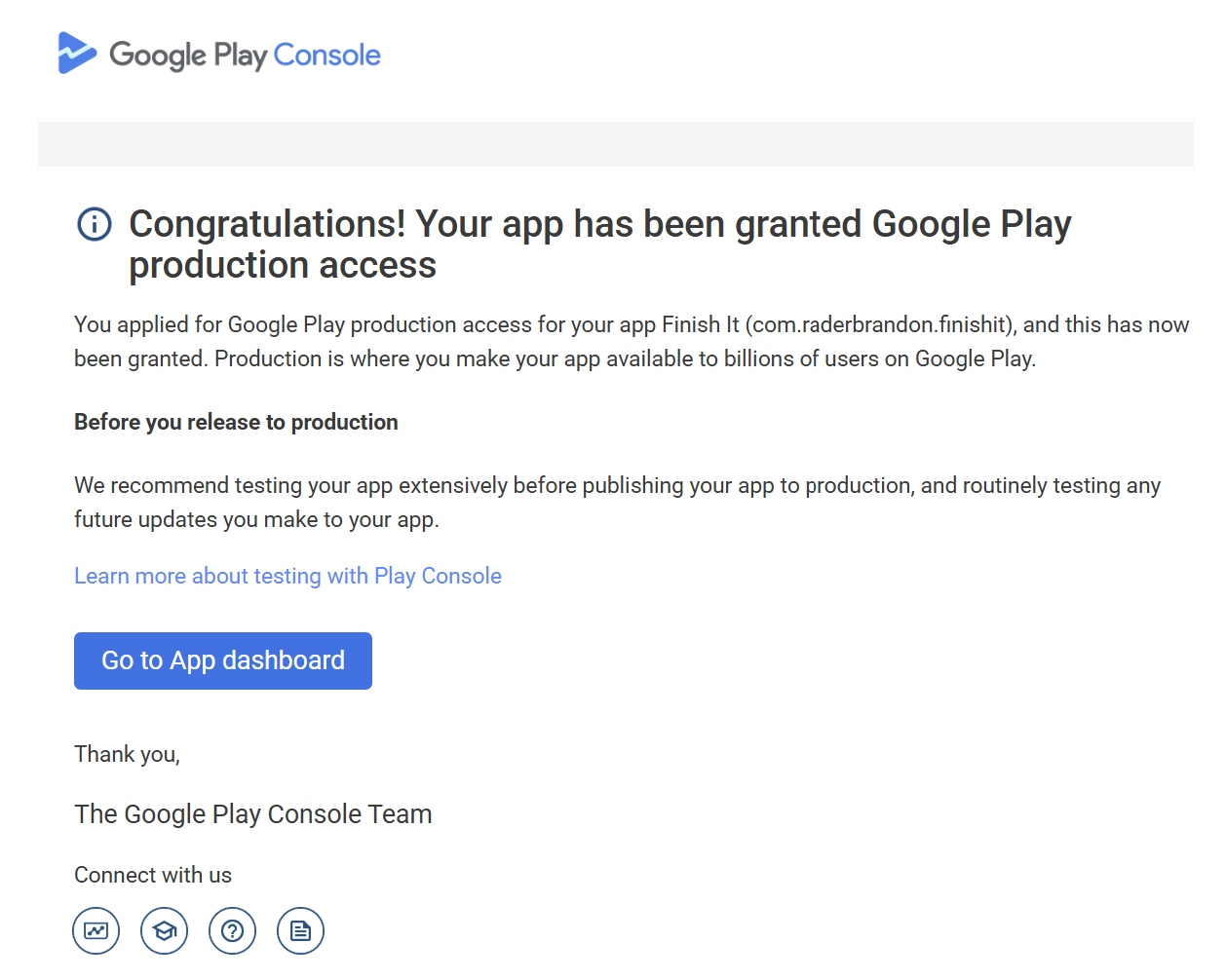
After the required time has passed and you have gathered sufficient feedback, the button to apply for production access will unlock in your Play Console. You will need to fill out a detailed questionnaire explaining exactly how you conducted the test, what specific feedback you received, and what changes you made as a direct result. Take this application seriously, as human reviewers at Google will meticulously read it to determine if you genuinely utilized the testing phase.
Final Approval and Public Launch
If your application is thorough and your testing metrics look completely authentic, Google will finally grant you access to the production track. You can now officially publish your app to the broader Greek market and the rest of the world. Celebrate this major milestone, but always remember that the hard work of maintaining and improving your app based on real-world user data has only just begun.
Frequently Asked Questions About Closed Testing
Developers constantly run into confusion regarding Google's complex policies. Here are detailed, comprehensive answers to the most common questions about the Play Store Closed Testing process, specifically tailored for those targeting the Greek market.
Why is Google so incredibly strict about the 14-day continuous testing rule?
Google implemented these highly stringent rules to combat the massive flood of low-quality, spammy, and quickly abandoned apps cluttering the Play Store ecosystem. In the past, absolutely anyone could publish a broken, non-functional app in a matter of minutes. By enforcing a mandatory 14-day engagement period, Google effectively forces developers to demonstrate actual commitment to their product. It proves that the app is stable enough to remain installed on a device for two full weeks without crashing constantly or causing excessive battery drain. Furthermore, it firmly ensures that developers are actually collecting and thoroughly analyzing user feedback, rather than just treating the entire process as a meaningless administrative hurdle. This ultimately protects end-users from downloading terrible software and maintains the overall integrity and safety of the Android ecosystem.
Can I use automated scripts or click farms to bypass the testing phase?
Absolutely not. Using bots, automated scripts, or cheap click farms is a direct, severe violation of Google Play Developer Policies and is by far the fastest way to get your entire developer account permanently suspended. Google employs highly advanced machine learning algorithms that meticulously analyze user behavior, device telemetry, and complex network patterns. They can easily and quickly differentiate between a real human in Athens organically scrolling through an app and a rigid script running on a server farm somewhere else in the world. If your testers all exhibit the exact same rigid usage patterns, or if they entirely lack normal device activity outside of your app, Google will flag and ban your account without hesitation. The short-term convenience of a shortcut is never worth the long-term destruction of your developer profile.
I heard I need exactly 12 Testers for 14 Days, but my console says 20. What is actually correct?
The standard, official requirement for new personal developer accounts created after November 2023 is 20 testers for 14 continuous days. However, you might frequently hear the phrase 12 Testers for 14 Days circulating in developer forums due to specific enterprise track rules, older account grandfathering policies, or simply widespread misinformation. You must always defer to the exact requirements clearly listed in your specific Google Play Console dashboard. Regardless of the exact number required, the underlying principle remains completely identical: you need a highly dedicated group of real humans who will actively engage with your software and provide meaningful, qualitative feedback that you can actually use to improve the product before a wider public release.
Does pushing an app update during the test reset my 14-day timer back to zero?
No, releasing a new version of your app to the closed testing track absolutely does not reset the 14-day clock, and in fact, it is highly encouraged by Google. When testers report bugs or suggest logical improvements, you should aim to fix those issues and roll out an update as soon as possible. As long as your testers successfully install the update and continue using the app regularly, the timer keeps running seamlessly. Google actually looks very favorably upon developers who push updates during the testing phase, as it clearly demonstrates that you are actively responding to user feedback and diligently improving the app's overall stability. Just ensure the new build does not inadvertently introduce fatal crashes that would cause your frustrated testers to uninstall the app entirely.
What exactly happens if a tester uninstalls the app before the 14 days are officially up?
If a tester uninstalls your app or voluntarily opts out of the testing program, they immediately no longer count towards your required minimum number of active testers. If your total number of active testers drops below the required threshold, your 14-day timer will be paused or completely reset, depending entirely on how long the deficit lasts. This is exactly why it is highly recommended to recruit significantly more testers than the minimum requirement. If you need 20 testers, you should aim for 25 or 30. This provides a very safe buffer in case someone loses their phone, formats their device, or simply loses interest and deletes the app midway through the mandatory process.
How It Works
Your journey to Google Play production access, simplified and automated.
Get Started
Authenticate your account to initialize the 14-day QA fleet for your Android release.
App Submission
Upload your testing link. We assign 12 verified users with real Android devices to download and test your Android release.
14-Day Cycle
A dedicated testing supervisor is assigned to monitor progress while testers engage with your Android app and provide feedback throughout the testing period.
Production Access Approval
Our lab maintains active installations for two weeks straight, ensuring a clean track record and providing a QA compliance log for your release.
Why Choose AppConsoleLab
Satisfy your Play Store Console testing obligations with our managed physical device fleet tailored for Android builds.
The 14-Day Production Guarantee
We complete the required 14-day closed testing process with real human testers and physical Android devices, while providing clear testing evidence and documentation throughout the process.
If Google specifically rejects production access due to insufficient testing engagement, you are covered by our free re-run or 100% refund guarantee, subject to our Refund Policy.
Verified Production Access
Quality QA Testing Reports
Clear, actionable reports with screenshots and evidence for every important issue found during testing.
Real Device Testing & Diagnostics
Real human testers use physical Android devices to test your app, verify real user flows, and provide clear testing evidence and professional QA reports.
Play Store Ready
Our structured 14-day closed testing process is designed to meet Google Play's production requirements for your Android release.
Simple Closed Testing Pricing
Select the plan that fits your Android app complexity.
Loading Packages
Please wait while we fetch the best options for your region...
Frequently Asked Questions
Everything you need to know about passing your closed testing requirements.