Play Store testers for 14-day Android closed testing in Guatemala
Find Play Store testers in Guatemala for 14-day Google Play closed testing. Fulfill Play Console requirements with 12 real testers and launch quickly.
Navigating Google Play Closed Testing in Guatemala
Building mobile apps across the tech corridor in Guatemala City or tech hubs in Quetzaltenango brings massive opportunity. Android dominates the Guatemalan digital landscape, powering local fintech platforms, delivery services, agricultural tools, and retail marketplaces. However, taking your Android package from a local build to production status on the Google Play Store requires passing Google Play closed testing. Under Google's updated developer policy, every personal developer account must run a mandatory closed track with at least 12 testers for 14 days continuously before requesting production access.
Passing this evaluation is not just about keeping a test track open for two weeks. Google's review algorithm scrutinizes real user behavior, telemetric logs, crash rates, and engagement data. In Guatemala, where users switch between 4G networks like Tigo Guatemala and Claro or connect via intermittent Wi-Fi, realistic test conditions matter. If Google suspects automated scripts, bot farms, or inactive testers, your production application will be denied, forcing you to restart the entire 14-day cycle from scratch.
The Google Play 14-Day Closed Testing Mandate Explained
Google enforces closed testing requirements to eliminate poor-quality releases, unexpected crashes, and spam apps on the Play Store. When you create a closed testing track in Google Play Console, you must recruit eligible participants who opt in via web or Android links, download your app build, and keep it installed on their devices for a minimum of 14 consecutive calendar days.
+-----------------------------------------------------------------------------------+
|                        GOOGLE PLAY CLOSED TESTING PIPELINE                        |
|                                                                                   |
|  [Closed Track Build]  -->  [12+ Testers Opt-In]  -->  [14 Days Real Device Use]   |
|                                                                 |                 |
|  [Production Denied]   <--  [Google Telemetry Review]  <--  [Engagement Logs]     |
|         |                                                       |                 |
|  (Restart 14-Day Track)                                 [Production Approved]     |
+-----------------------------------------------------------------------------------+
For Guatemalan developers targeting local consumers or international audiences, meeting these criteria requires genuine human interactions. Testers must open the app across various days, explore key user workflows, test local payment forms or GTQ currency formatting, and submit qualitative feedback through the Play Store feedback channel.
Guatemala Android Ecosystem Realities and Technical Bottlenecks
Developing for Guatemala requires testing across unique network and hardware variables. Mobile users in Guatemala City, Mixco, Villa Nueva, and regional departments often use diverse mid-range and budget Android hardware. If your testing group only uses high-end flagship devices on high-speed fiber internet, you miss critical real-world bugs that cause crashes and high ANR (Application Not Responding) rates.
+-----------------------------------------------------------------------------------+
|                      GUATEMALAN TESTING ENVIRONMENT VARIABLES                     |
|                                                                                   |
|  * Mobile Carriers:       Tigo Guatemala (LTE/5G), Claro Guatemala (LTE/5G)       |
|  * Currency & Locale:     Quetzal (GTQ), es-GT Spanish locale formatting          |
|  * Hardware Spread:       Xiaomi Redmi, Samsung Galaxy A-series, Motorola, Tecno  |
|  * Network Volatility:    Variable latency, regional handovers, 3G/4G fallback    |
|  * Payment Gateways:      Local banking APIs, card processing, digital wallets    |
+-----------------------------------------------------------------------------------+
Carrier Network Transitions and Latency Handling
Mobile internet coverage in Guatemala fluctuates between urban 4G/LTE networks and slower 3G or unstable connections in rural areas. Applications relying on real-time API syncs, WebSocket connections, or background telemetry must handle network timeouts gracefully. Real testers operating on Tigo and Claro mobile connections will surface latency bottlenecks, image caching issues, and socket disconnections before your app reaches public users.
Hardware Diversity and Memory Management
Budget devices common across Central America often feature 2GB to 4GB of RAM and entry-level MediaTek or Unisoc processors. These devices aggressively kill background services to free up system memory. Closed testing on real hardware reveals background sync failures, memory leaks, and render freezes that emulator tests never catch.
Locale, Regional Formatting, and Currency
Validating the es-GT locale is vital for Guatemalan commerce apps. From number formatting with comma decimals to proper display of the Quetzal (GTQ / Q) symbol, real testers verify that typography, input keyboards, and date pickers behave properly on local devices.
The Real Danger of Bot Farms, Emulators, and Reciprocal Swap Rings
Many independent developers attempt shortcuts when facing the 12 testers for 14 days requirement. Some hire cheap gig services using bot scripts and device emulators. Others participate in peer-to-peer tester swap forums where developers promise to install each other's apps without ever opening them. Both approaches trigger high-risk red flags inside Google Play Console.
Bot Services & Swap Rings (High Risk)
- Identical Device IDs: Emulators and cloud farms run duplicate hardware fingerprints and repetitive IP subnets that Google easily identifies.
- Zero Interaction Depth: Scripts install the APK and close it instantly, producing flat zero-duration telemetry in Play Console metrics.
- Simultaneous Drop-Offs: Testers all delete the build or go dormant at once, signaling fraudulent engagement.
- Production Rejection: Google flags the account, denies production release, and can place developer accounts under permanent scrutiny.
Managed Real Human Testing (Safe & Compliant)
- Unique Hardware & IPs: Real users on genuine physical devices across diverse cellular networks like Tigo and Claro.
- Organic In-App Activity: Testers launch the app repeatedly across 14 days, navigating screens and triggering realistic events.
- Actionable Bug Reports: Testers file detailed crash insights, UI defect logs, and real feedback via the Google Play feedback loop.
- Seamless Approval: Complete telemetry history proves organic user retention, securing fast production clearance.
Google's review algorithms evaluate active engagement data: session durations, screen transitions, crash stack traces, and Play Store feedback entries. If your 12 testers show zero activity between day 1 and day 14, your production access questionnaire will likely trigger an immediate automated refusal.
Comparing Testing Approaches for Guatemalan Android Developers
Choosing the right testing approach determines whether your app launches smoothly on schedule or gets stuck in endless review delays. The comparison table below highlights why managed testing outperforms DIY outreach and bot services:
| Evaluation Metric | Managed Closed Testing Service | DIY Community & Peer Swaps | Low-Cost Bot Farms & Emulators |
|---|---|---|---|
| Tester Quality | 100% Real verified human testers | Unvetted volunteers & developers | Automated scripts & virtual emulators |
| Device Diversity | Multiple Android OS versions & OEMs | Random, often limited hardware | Virtual images with identical fingerprints |
| Daily Engagement | Consistent organic daily interactions | Inconsistent, high early drop-off rate | Scripted mock opens or zero interaction |
| Network Realism | Live carrier networks (Tigo, Claro, Wi-Fi) | Mixed, mostly static home Wi-Fi | Data center proxy IPs & VPN subnets |
| Feedback Quality | Structured bug reports & console feedback | Rare, vague, or non-existent notes | Zero meaningful human feedback |
| Compliance Safety | 100% Google Play Policy compliant | Moderate risk of tester abandonment | Extreme risk of account warning/ban |
| Time to Launch | Exactly 14 days guaranteed | Unpredictable (often 30+ days) | Fails production review |
Struggling with the 14-Day Testing Requirement?
Skip the hassle of recruiting unreliable testers. Our professional fleet of real Android devices guarantees Google Play compliance in exactly 14 days. Zero bots. Zero emulators. 100% production approval guarantee.
Step-by-Step Roadmap to Complete 14-Day Closed Testing
Executing a successful closed test requires structured planning from initial bundle upload to final production submission. Follow this sequential roadmap to ensure your app satisfies every technical and policy requirement.
Prepare Release Bundle & Privacy Assets
Generate an optimized Android App Bundle (AAB) signed with your production release keys. Ensure your target SDK meets the latest Google Play requirement (API 34+). Configure all mandatory Play Console store listing assets, including an active privacy policy URL, app access credentials for test accounts, data safety declarations, and content ratings.
Configure Closed Testing Track
Create a new Closed Testing track in Google Play Console. Choose your track settings and create an authorized email list using Google Groups or individual email addresses. Upload your signed AAB build, complete rollout to 100%, and wait for Google's standard automated pre-launch report and preliminary track review.
Onboard 12+ Verified Real Testers
Distribute the opt-in web link (play.google.com/apps/testing/your.package.id) to your verified testing group. Ensure at least 12 testers formally accept the invitation, download the build via Google Play, and complete their initial onboarding session on their personal physical devices.
Monitor Daily Engagement & Stability
Track daily session activity, ANR rates, and crash volumes inside Play Console vitals. Testers must open the app across different days of the 14-day window, exercise core application features, test local payment or offline caching flows, and submit private feedback through Google Play.
Collect Feedback & Patch Incremental Builds
Review inbound bug reports regarding UI layout shifts, network timeouts on Tigo/Claro connections, or device-specific memory constraints. If necessary, push updated builds directly to the closed testing track. Incremental version updates demonstrate active maintenance to Google's evaluation team.
Submit Production Access Application
Once 14 full days have elapsed with continuous tester participation, unlock the production request button. Complete the Play Console questionnaire with specific, detailed answers describing your recruitment method, testing methodology, feedback collected, and bug fixes deployed during the testing track.
Comprehensive Developer Checklist for Play Console Compliance
Before submitting your production application, verify that your release meets all technical, infrastructural, and procedural requirements outlined below.
Technical Architecture & Build Readiness
Target API level is set to the latest required Android SDK version with 64-bit architecture support included in the AAB.
ProGuard / R8 minification rules are tested to prevent runtime obfuscation crashes on reflection-based libraries.
App payload size is optimized, and on-demand feature modules load correctly across slower 3G/4G cellular networks.
Crashlytics or real-time exception logging is active to track unhandled null pointers and background thread freezes.
Network, Locale & Hardware Resilience
Network timeout handlers and offline cache states are validated for variable connectivity across Tigo and Claro networks.
Regional currency formatting (GTQ / Quetzal) and es-GT localization strings render without overlapping text fields.
App renders smoothly on budget screen resolutions (HD+ 720p) without clipping interactive buttons or form inputs.
Deep links, push notifications, and OAuth login flows work seamlessly across various OEM skins (MIUI, One UI, Motorola).
Closed Testing Track & Policy Compliance
A minimum of 12 real human testers have actively joined the closed track and maintained the app installed for 14 continuous days.
Test demo accounts and login credentials provided in Play Console work without two-factor authentication blocks.
Testers have submitted organic, descriptive feedback through the Play Store testing feedback mechanism.
The 14-day production questionnaire is written thoroughly, highlighting real user insights, feedback, and version updates.
Frequently Asked Questions (FAQs)
Why does Google Play require 12 testers for 14 days for personal accounts?
In late 2023, Google updated its developer policy to improve app quality, reduce security risks, and eliminate abandonware on the Play Store. Personal developer accounts registered after November 2023 must run a closed testing track with at least 12 opt-in testers who maintain access for 14 consecutive calendar days. This requirement ensures that indie developers and startups test their apps on real devices, collect feedback, fix critical bugs, and verify stability before releasing software to hundreds of millions of public Android users worldwide.
Can testers from outside Guatemala test my Guatemala-focused Android app?
Yes. While your app might be designed specifically for the Guatemalan market - featuring Quetzal currency (GTQ), Spanish localization, or integrations with regional services - Google's closed testing track accepts testers from any country you select in your track settings. However, you must ensure that your closed testing track availability settings include the countries where your testers reside. If you restrict track availability solely to Guatemala in the Play Console, testers with Google accounts registered in other regions will not be able to opt in or download your build.
What happens if a tester uninstalls the app on day 8 of the 14-day cycle?
Google measures the number of opt-in testers who remain actively enrolled and have the app installed on their devices throughout the entire 14-day period. If several testers uninstall your app and your active tester count drops below the 12-tester threshold, the 14-day counter can stall or reset. To prevent this risk, it is best practice to recruit 15 to 20 testers rather than the bare minimum of 12. Having a buffer ensures that your test track maintains the required quorum even if one or two testers switch devices or uninstall early.
How does Google detect fake testing services, bots, and emulators?
Google Play Console collects comprehensive device telemetry and behavioral analytics through Google Play Services. The algorithm evaluates device fingerprints, sensor data, battery metrics, IP subnet distribution, and real touch interactions. Cloud-based emulators and automated bot scripts generate static or repetitive hardware signatures, identical IP blocks, and unnatural usage patterns (such as opening and closing an app in under three seconds without navigating screens). When Google detects non-human or emulator activity, it rejects production access applications and may flag the developer account for policy violations.
Can I release updates and fix bugs while the 14-day closed test is running?
Yes, and pushing updates is actually encouraged by Google. Uploading new build versions (AABs) to your active closed testing track to fix bugs, optimize memory usage, or improve UI layouts does not reset your 14-day timer. In fact, demonstrating active development in response to tester feedback shows Google's evaluation team that you took the testing phase seriously. When filling out the production request questionnaire, mentioning specific updates you shipped during closed testing significantly strengthens your approval chances.
What detailed questions does Google ask when applying for production access?
After completing the 14-day closed testing period, Google Play Console unlocks a detailed production application questionnaire. You will be asked: (1) How you recruited your closed track testers; (2) What feedback you received from testers regarding usability, performance, and features; (3) What changes and bug fixes you made to your app based on that feedback; and (4) Why you believe your app is ready for public release on Google Play. Providing detailed, honest, and technical answers backed by real testing logs ensures quick approval from Google's review team.
The Testing Pipeline
A straightforward 4-step process to get your Android app approved.
Sign In
Connect your Google account and choose your preferred closed testing package for your Android app.
Opt-In URL
Share your Play Store opt-in URL. We immediately deploy 12 real testers to launch and review your Android app daily.
Testing Begins
Our crew initiates daily launch sessions on physical devices, verifying usability and logging crashes for your Android app.
Compliance Complete
We continuously perform closed app testing for 14 days to help you meet Google Play production requirements. We also provide a compliance report.
Why Developers Trust Us
Deploy your Android app onto real retail-grade handsets using our secure laboratory environment.
The 14-Day Production Guarantee
We complete the required 14-day closed testing process with real human testers and physical Android devices, while providing clear testing evidence and documentation throughout the process.
If Google specifically rejects production access due to insufficient testing engagement, you are covered by our free re-run or 100% refund guarantee, subject to our Refund Policy.
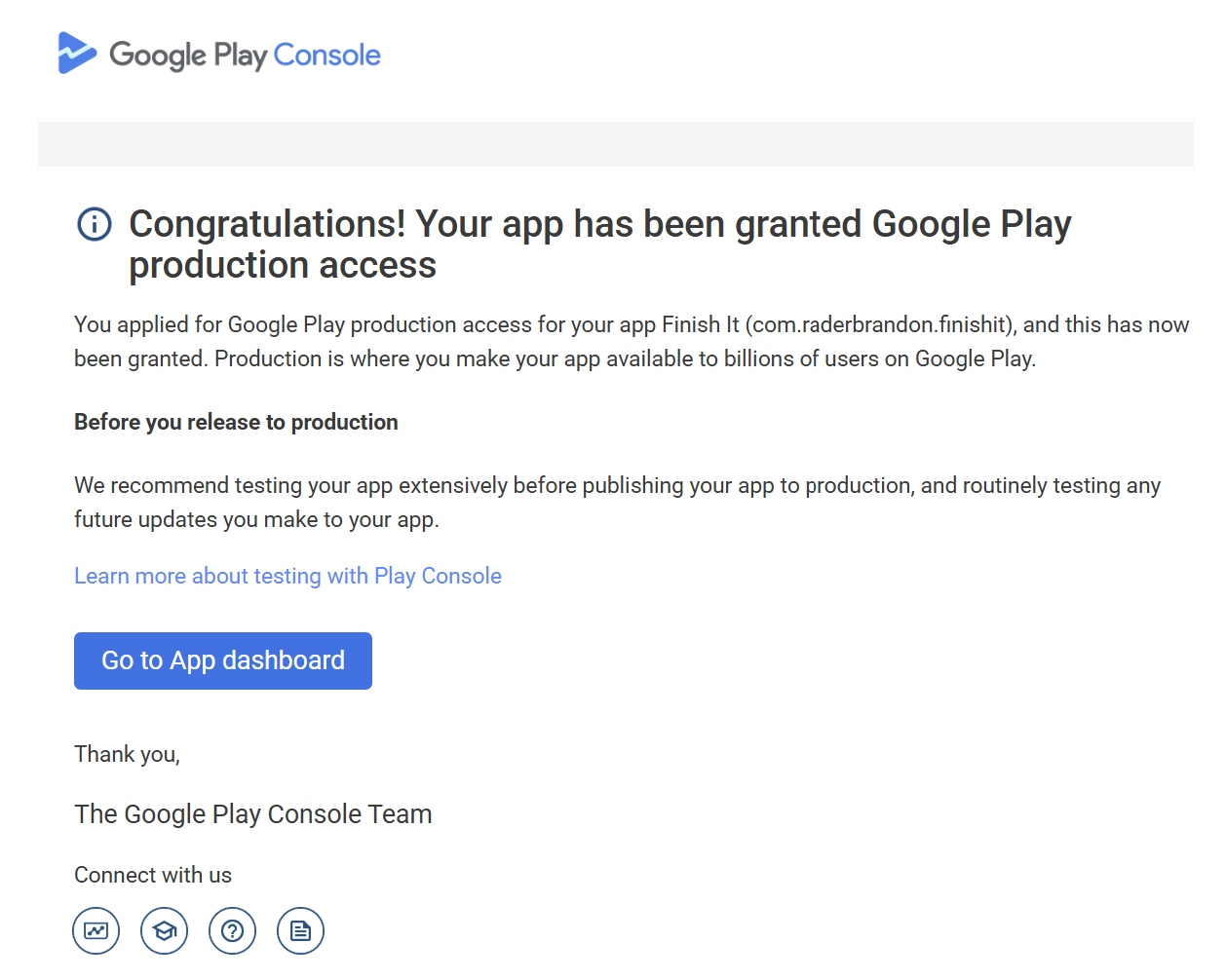
Verified Production Access
Quality QA Testing Reports
Clear, actionable reports with screenshots and evidence for every important issue found during testing.
Real Device Testing & Diagnostics
Real human testers use physical Android devices to test your app, verify real user flows, and provide clear testing evidence and professional QA reports.
Guaranteed App Approval
Transition your Android app to public production access with confidence. We deliver verified session logs and compliant Console activity.
One Cycle. Complete Approval.
Choose the ideal closed testing cycle for your Android release.
Loading Packages
Please wait while we fetch the best options for your region...
Frequently Asked Questions
Everything you need to know about passing your closed testing requirements.