Play Store testers for 14-day Android closed testing in Honduras
Find Play Store testers in Honduras for 14-day Google Play closed testing. Fulfill Play Console requirements with 12 real testers and launch quickly.
The Honduras Android Developer Playbook for Closed Testing
Building mobile apps from Tegucigalpa to the busy industrial center of San Pedro Sula requires grit, technical smarts, and strict adherence to Google Play policies. Honduran developers are building world-class fintech services, remittances tools, agro-logistics dashboards, and regional commerce apps. However, launching on Google Play now demands meeting strict verification bars, specifically the mandatory 14-day closed testing rule.
For personal developer accounts created after November 2023, Google Play requires at least 12 testers opted in continuously for 14 straight days before you can request production access. Passing this audit is not about filling email slots on a spreadsheet. Google evaluates real user engagement, stability signals, and session telemetry across active Android devices.
Why 14-Day Closed Testing Decides Your App Launch
Google introduced this strict verification gate to stop buggy, abandoned, or low-quality apps from flooding the Play Store. When you apply for production access at the end of your 14-day cycle, an automated algorithm and human reviewers examine your Play Console metrics. They look at your crash rates, ANR (Application Not Responding) rates, opt-in consistency, and real user feedback.
If your testers uninstall on day two, or if you use automated bot farms that never generate authentic Android vitals, Google resets your review clock or flat-out rejects your production request. For teams in Honduras budgeting in Honduran Lempiras (HNL), unexpected launch delays cost valuable revenue and destroy market momentum.
The Pitfalls of Bot Farms vs. Real Managed Testers
Many development teams try to shortcut the process by buying cheap 20-tester packages from freelance marketplaces. These services usually run headless Android emulators or bot scripts on servers. Google detects synthetic behavior easily because emulators do not produce normal touch gestures, network switching, battery drain profiles, or genuine hardware telemetry.
When Google catches fake testing rings, they do not just reject the production application. They frequently flag the entire developer account, putting every future project tied to your console at risk.
Fake Bots and Emulator Rings
Using fake accounts or automated emulators exposes your Play Console to severe penalties:
- Zero real user interactions, touch events, or session diversity.
- Instant uninstalls or static device uptime flagged by Play Console algorithms.
- No authentic crash reports, log traces, or localized feedback.
- High risk of production rejection and developer account termination.
Real Managed Human Testers
Professional managed testing provides compliant, organic Android telemetry:
- Real human testers on genuine physical Android devices across diverse OS versions.
- Continuous 14-day opt-in retention with organic daily sessions and app usage.
- Real-time bug logs, ANR discovery, and detailed usability reviews.
- Guaranteed 100% compliance with Google Play production access requirements.
Navigating Real-World Network and Device Conditions in Honduras
Apps built for Central American users must handle unique regional hardware and network environments. In Honduras, users connect across cellular providers like Tigo Honduras and Claro, transitioning between high-speed 4G LTE in urban districts and spotty 3G coverage in mountainous and rural departments.
If your app makes network calls for digital payments, currency conversions to HNL, or map routing without proper timeout buffers and offline caching, it will trigger ANRs. The Google Play threshold for ANR rates is strict at 0.47%. Exceeding this rate during your closed testing window will kill your chances of production approval.
| Feature / Requirement | Professional Managed Testing | DIY Friends & Family | Automated Bot Services |
|---|---|---|---|
| Active 14-Day Retention | 100% Guaranteed daily engagement | High drop-off after 2 - 3 days | Fake uptime, easily detected |
| Hardware Authenticity | Real physical Android hardware | Mix of personal devices | Cloud emulators and virtual devices |
| Telemetry & Play Vitals | Clean, natural user analytics | Random, unorganized data | Zero legitimate telemetry |
| Actionable Bug Reports | Comprehensive logs & device specs | Vague feedback ("App works fine") | No human feedback or insight |
| Production Pass Rate | Extremely high on first submission | Frequent delays & resets | High rejection & ban risk |
| Cost & Time Efficiency | Fixed, predictable, zero management | High time investment chasing testers | Cheap upfront, disastrous long-term |
Deep Dive: Play Console Telemetry, ANRs, and Crash Limits
Google Play does not keep developers in the dark about what matters. The Android Vitals dashboard tracks your technical health against two core metrics: the User-Perceived Crash Rate and the User-Perceived ANR Rate.
To pass your 14-day evaluation, your app must stay well below the bad behavior thresholds:
- User-Perceived Crash Rate Threshold (1.09%): No more than 1.09% of daily active sessions should experience a fatal crash. During closed testing with 12 to 20 testers, even a single unhandled null pointer exception on app startup can spike your crash rate above 5%, raising red flags.
- User-Perceived ANR Rate Threshold (0.47%): If your main UI thread blocks for more than 5 seconds while loading assets, processing database queries, or syncing with backend APIs over unstable cellular connections, an ANR dialog pops up. Keep this under 0.47%.
- Tester Engagement Signals: Google checks whether testers open the app multiple times across the 14 days, install track updates when you push bug fixes, and submit feedback via the private Play Store tester channel.
Struggling with the 14-Day Testing Requirement?
Skip the hassle of recruiting unreliable testers. Our professional fleet of real Android devices guarantees Google Play compliance in exactly 14 days. Zero bots. Zero emulators. 100% production approval guarantee.
Complete Pre-Launch Closed Testing Checklist
Before you publish your closed testing track and invite your 12 or more testers, make sure your build and console setup meet every technical requirement.
Technical Build & Core Vitals Preparation
Target the latest stable Android API level (API 34 or higher) and configure modern 64-bit App Bundles (.aab).
Keep heavy network and database tasks off the main thread using background workers or coroutines to prevent ANRs.
Implement robust error handling and offline fallbacks for intermittent 3G or 4G data connections.
Integrate Firebase Crashlytics or Play Console bug tracking to capture real-time stack traces during testing.
Google Play Console & Track Configuration
Create a closed testing track, set the country availability to include Honduras and target markets, and upload your signed release.
Set up an email list or Google Group containing your verified real testers and copy the web / Android opt-in links.
Prepare comprehensive privacy policies and accurate data safety declarations matching your app permissions.
Verify that testers keep the app installed and open it periodically for the full 14-day duration.
Your 14-Day Roadmap to Production Approval
Reaching production on Google Play requires a disciplined, step-by-step approach. Follow this proven roadmap to guide your app from initial test build to live store listing.
Step 1: Release Closed Track Build
Upload your production-ready Android App Bundle (.aab) to the Closed Testing track in Google Play Console. Ensure all store listing details, content ratings, and data safety forms are completed.
Step 2: Recruit & Opt-In Real Testers
Invite at least 12 to 20 verified testers to your closed track via Google Groups or email lists. Ensure every tester opens the opt-in link, accepts the invitation, and installs the build directly from the Play Store.
Step 3: Monitor Daily Telemetry & Vitals
Track daily opt-in metrics in Play Console. Observe Crashlytics and Android Vitals to ensure crash rates stay well below 1.09% and ANRs stay below 0.47% across various device models.
Step 4: Push Iterative Updates & Gather Feedback
Address discovered bugs quickly by pushing updated builds to the closed track. Encourage testers to submit written feedback and crash reports through Google Play's private feedback channel.
Step 5: Complete the 14-Day Engagement Cycle
Ensure all testers remain opted in and actively interact with the app for 14 continuous days without dropping off or uninstalling the build.
Step 6: Apply for Production Access
Once the 14-day requirement counter in the Play Console reaches completion, click 'Apply for Production'. Answer Google's questionnaire clearly with data about your testing process, user feedback, and bug fixes.
Frequently Asked Questions
Why does Google Play require 12 testers for 14 days for personal developer accounts?
Google introduced this policy to ensure that newly registered personal accounts thoroughly test their apps on real hardware before distributing them publicly. This requirement helps catch critical bugs, user-interface glitches, and stability issues early, preventing low-quality or fraudulent software from damaging the Android ecosystem and user experience.
What happens if a tester uninstalls the app or leaves the test group on day 10?
If your active tester count drops below 12 at any point during the 14-day period, Google Play Console will pause or reset the 14-day verification timer. To prevent this setback, it is strongly recommended to recruit 15 to 20 testers so you always have a comfortable buffer above the required minimum.
Can I use Android emulators on PC to satisfy the 14-day closed testing requirement?
No. Google Play tracks hardware diagnostics, Google Play Services signatures, battery performance patterns, and user touch events. Emulators and automated bot scripts produce artificial telemetry that Play Console algorithms detect easily, resulting in production application denials and potential account flags.
How should Honduran developers prepare their apps for local network variations?
Developers targeting users on networks like Tigo Honduras and Claro should implement network retry policies, caching strategies, and timeout handlers. Make sure your app does not block the main UI thread during network handoffs between Wi-Fi and mobile data to avoid triggering ANRs in Android Vitals.
What questions does Google ask when applying for production access after 14 days?
Google asks detailed questions about your testing strategy: how you recruited your testers, what real feedback you received, which bugs or crashes were discovered, how you resolved those issues, and why you believe your app is ready for public release on the Play Store.
How does using a professional testing service ensure Google Play compliance?
A dedicated testing service provides genuine Android users running your build on physical devices. They maintain continuous opt-in retention for the full 14 days, interact organically with your app features, generate legitimate telemetry, and provide detailed feedback that simplifies your production access questionnaire.
Our QA Process
How we deploy real devices and guarantee compliance for your release.
Choose Package
Sign in with Google to configure the closed testing environment for your Android build.
Submit Link
Submit your Google Play Console testing link, and our team will assign qualified testers from our testing network to join your Android closed testing release.
Active Testing
A QA supervisor monitors daily check-ins, ensuring 12 unique Android users engage with your Android build every single day.
Get Approved
We guarantee 14 consecutive days of active user check-ins to satisfy Google's compliance policies, delivering an audit-ready PDF feedback report.
The Premium QA Advantage
Experience a next-generation testing infrastructure built for Google Play compliance for your Android release.
The 14-Day Production Guarantee
We complete the required 14-day closed testing process with real human testers and physical Android devices, while providing clear testing evidence and documentation throughout the process.
If Google specifically rejects production access due to insufficient testing engagement, you are covered by our free re-run or 100% refund guarantee, subject to our Refund Policy.
Verified Production Access
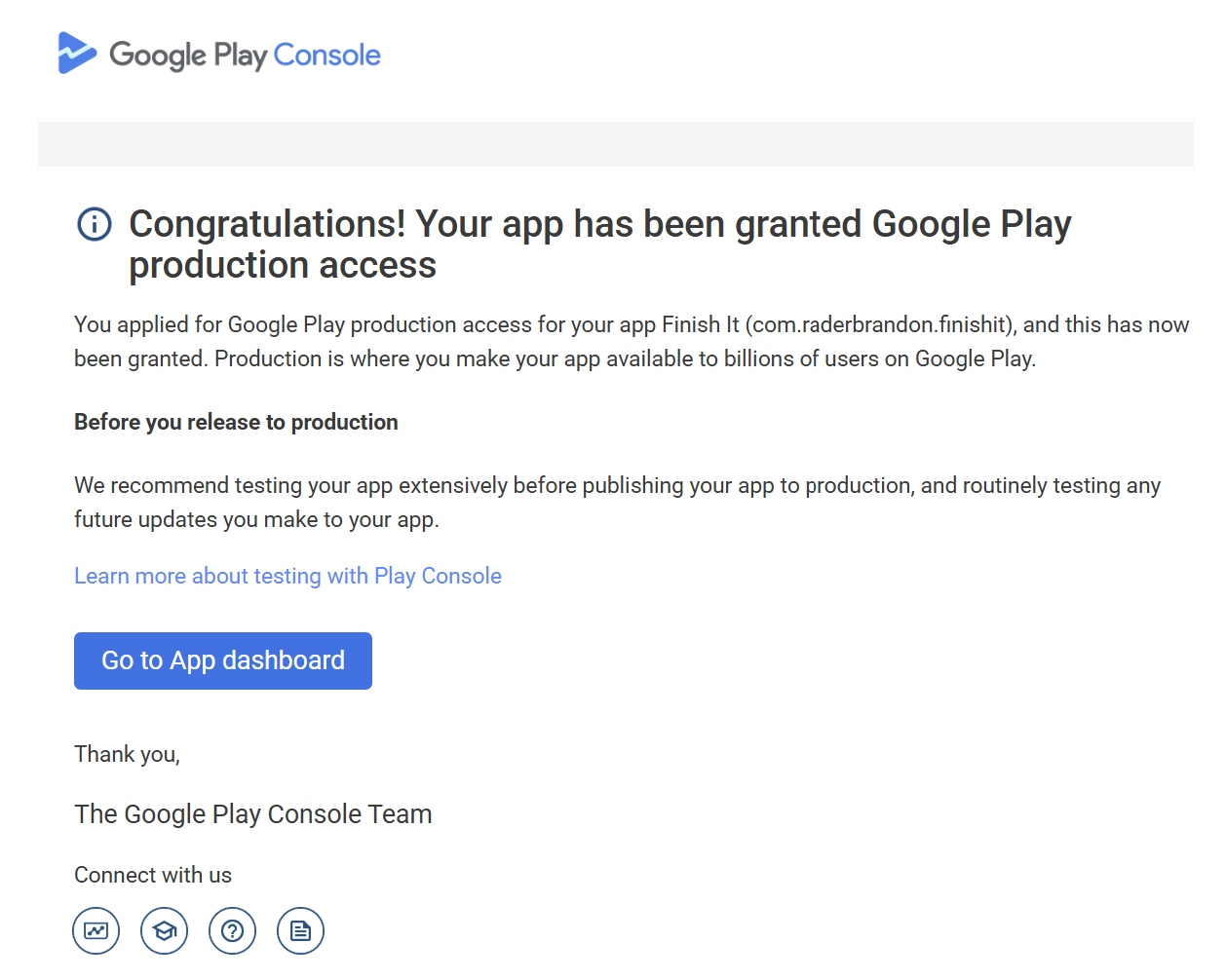
Quality QA Testing Reports
Clear, actionable reports with screenshots and evidence for every important issue found during testing.
Real Device Testing & Diagnostics
Real human testers use physical Android devices to test your app, verify real user flows, and provide clear testing evidence and professional QA reports.
Production Access Secured
Get your Android build approved on the first try. We create an audit-ready compliance profile that proves thorough quality assurance.
Affordable Compliance Cycles
Transparent plans built to satisfy Google Play Console guidelines for your Android build.
Loading Packages
Please wait while we fetch the best options for your region...
Frequently Asked Questions
Everything you need to know about passing your closed testing requirements.