Play Store testers for 14-day Android closed testing in Hungary
Find Play Store testers in Hungary for 14-day Android closed testing. Pass Google Play Console with 12 real human testers and get your app published fast.
Launching an Android application from the heart of Europe means navigating a unique blend of creative innovation and strict global compliance. Whether you are coding from a bustling café in Budapest or a quiet studio in Debrecen, the final hurdle before your app reaches the masses is the notoriously strict Google Play Closed Testing requirement. The mandate is clear: you must secure at least 20 active testers who will engage with your application for 14 consecutive days. This isn't just a simple box to check; it is a rigorous evaluation of your app's stability, user experience, and overall readiness for the dynamic Android ecosystem. For many Hungarian developers, the challenge isn't building a phenomenal app, it is finding a dedicated group of real people willing to meticulously test it day in and day out. As the European market grows increasingly competitive, understanding the nuances of Play Store Closed Testing is the critical differentiator between an app that languishes in development purgatory and one that seamlessly transitions to production.
The Reality of the 14-Day Challenge
The transition from a brilliant idea to a live application on the Google Play Store is fraught with logistical hurdles. For developers based in Hungary, the localized challenge often revolves around community building and resource allocation.
While the tech ecosystem in Hungary is thriving, convincing 20 individuals to consistently open, interact with, and provide meaningful feedback on an unreleased app for two uninterrupted weeks is a monumental task.
The Google Play Closed Testing policy was designed to protect end-users from buggy, incomplete, or malicious software. By enforcing the 14-day testing period, Google ensures that developers cannot simply rush their products to market without due diligence.
However, this safety measure often acts as a massive bottleneck for independent creators and small startups who lack the network of a large enterprise.
Quality and Compliance Standards
Google's enforcement of the closed testing mandate is driven by a strong commitment to user trust. The Play Console's algorithms are increasingly sophisticated.
They are designed to monitor not just the raw number of testers, but the quality and consistency of their engagement. If the system detects unnatural patterns, your app is likely to be flagged.
This is why automated bots or cheap, low-quality testing farms are not merely ineffective; they are actively dangerous to your developer account.
For a developer in Hungary, adhering to these rules means focusing exclusively on genuine engagement. Real Play Store testers will explore different features and trigger diverse error logs.
This authentic interaction is exactly what the Play Console requires to validate your 14-day testing phase. At the end of the 14 days, you must answer specific questions about the feedback you received. Without real testers, answering these convincingly becomes impossible.
Real Testers vs. Automated Bots
The temptation to shortcut the Google Play Closed Testing requirement is strong, especially when you are eager to launch. The grueling wait to publish can cause many to seek out quick fixes and gray-market solutions. However, the risks associated with fake testing services far outweigh the temporary convenience they promise. When you rely on artificial inflation of your testing metrics, you are playing a dangerous game with Google's sophisticated fraud detection algorithms. Let's compare the impact of utilizing real, human testers versus falling for the trap of automated bots.
Genuine Human Testing
Real testers provide authentic engagement that the Play Console's algorithms recognize and reward. They interact with your app organically, navigating through different screens, testing edge cases, and generating realistic session durations. This genuine behavior fulfills the core intent of the 14-day requirement. Furthermore, real users can provide qualitative feedback, highlighting UX issues, confusing navigation, or localized translation errors that automated systems simply cannot perceive. This ensures your app is truly ready for the Hungarian market and beyond. When real users test your app, they bring their unique perspectives, diverse Android hardware, and varying network conditions into the equation, providing a stress-test that emulators can never match.
Automated Bots and Farms
Bots rely on repetitive, scripted actions that create massive red flags within the Google Play ecosystem. They log in from identical IP ranges, perform the exact same sequence of taps, and exhibit zero variation in their daily usage patterns. Google's sophisticated fraud detection systems can easily identify these anomalies. Using bots not only guarantees that your closed testing phase will be rejected, but it also puts your entire Google Developer account at risk of suspension or permanent termination, effectively destroying your digital business. The short-term illusion of progress quickly evaporates when you receive an automatic rejection email from the Play Console, leaving you worse off than when you started.
The Evolution of App Publishing in Hungary
Hungary has steadily emerged as a powerhouse of digital innovation in Central and Eastern Europe. With a strong tradition of technical education and a growing community of agile startups, Hungarian developers are producing applications that compete on a global scale. From fintech solutions tailored to the European market to innovative mobile games and lifestyle utilities, the diversity of apps originating from this region is impressive. The local development scene is vibrant, heavily supported by local tech hubs, university incubators, and a culture that values engineering excellence.
However, this rapid growth also means that the stakes are higher than ever before. When you submit your app for Google Play Closed Testing, you are not just representing your own brand; you are participating in a highly competitive digital marketplace where user expectations are incredibly high. Ensuring that your app functions flawlessly across the diverse range of Android devices prevalent in Hungary and the broader European Union requires a robust, well-planned testing strategy. The 14-day period is your sandbox, a strictly controlled environment where you can stress-test your backend infrastructure, optimize battery consumption, and fine-tune your user interface based on actual human interaction. Skipping or manipulating this step ultimately harms your app's long-term viability in a market that demands perfection.
Struggling with the 14-Day Testing Requirement?
Skip the hassle of recruiting unreliable testers. Our professional fleet of real Android devices guarantees Google Play compliance in exactly 14 days. Zero bots. Zero emulators. 100% production approval guarantee.
Technical Intricacies of the 14-Day Window
To successfully navigate the Play Store Closed Testing phase, it is entirely essential to understand the technical nuances of how Google tracks tester engagement. The 14-day clock does not simply start the moment you casually add a list of email addresses to your testing track in the Play Console. Instead, the rigorous countdown begins only when the required minimum of 20 testers have actively opted into the testing program and installed the application on a compatible Android device.
Continuous, Uninterrupted Engagement
Google explicitly mandates that all 20 testers must remain opted-in and keep the application installed for 14 consecutive days. If a single tester uninstalls the app, clears their account, or leaves the testing program on day 12, that specific user's progress is invalidated. This strict continuity requirement is exactly why relying on friends, family, or casual acquaintances can be incredibly risky; they may forget to keep the app installed, switch phones, or simply fail to open it regularly. The requirement for daily interaction, while occasionally seeming somewhat opaque in Google's official documentation, is widely understood by experienced industry professionals to mean that testers should launch the app and interact with it meaningfully throughout the entire two-week period.
Harnessing Device Diversity
The global Android ecosystem is famous for its extreme hardware fragmentation. An application that runs perfectly on a brand-new, top-tier flagship device might crash instantly or exhibit severe lag on an older, budget-friendly smartphone that is still widely used in many regions. By actively engaging real, geographically diverse testers for your Google Play Closed Testing, you inherently benefit from unparalleled device diversity. Your testers will naturally install your app on a vast array of screen sizes, operating system versions, and unique hardware configurations. This exposure reveals device-specific bugs, memory leaks, and performance bottlenecks that you might never have discovered while testing solely in an Android Studio emulator or on your own personal test device.
Monitoring Crash Analytics and ANRs
Throughout the entirety of the 14-day closed testing period, the Google Play Console closely and continuously monitors your application's technical performance metrics. Unusually high crash rates or frequent 'App Not Responding' (ANR) errors will severely damage your chances of being approved for public production. Utilizing real human testers helps you identify the exact root causes of these critical issues. When a real user experiences a crash while navigating your app, the resulting stack trace uploaded to your Play Console provides invaluable diagnostic information. This data allows your development team to swiftly deploy targeted updates to the closed track and stabilize the app before it ever reaches the unforgiving general public.
Preparing for a Successful Closed Test
Before you even think about beginning the 14-day countdown, meticulous preparation is absolutely crucial. A poorly prepared, highly unstable app will not only deeply frustrate your 20 testers but will also waste incredibly valuable time if you are forced to abandon and restart the testing phase from scratch. The following comprehensive checklist outlines the essential steps every Hungarian developer should meticulously follow before initiating their Play Store Closed Testing journey.
Pre-Testing Technical Audit
Ensure that all primary features of your app are fully implemented, connected to the backend, and functional. The closed testing phase is meant for finding hidden bugs and refining the UX, not for completing half-finished features or placeholder screens.
Integrate essential tools like Firebase Crashlytics or Sentry to monitor app stability in real-time. You cannot effectively fix errors that you cannot see in your reporting dashboard.
Unnecessarily large downloads or extremely sluggish performance will inevitably lead to early uninstalls from testers, directly jeopardizing your strict 14-day continuous engagement requirement.
Play Console Configuration
Accurately and honestly declare exactly how your application collects, utilizes, and shares user data to remain fully compliant with Google's increasingly stringent global privacy policies.
Draft compelling, keyword-rich descriptions, precisely localized for the Hungarian market if necessary, and upload high-quality promotional screenshots and app icons.
Create a specific, organized email list or a dedicated Google Group for your 20+ testers and carefully ensure the initial release is properly rolled out to the correct closed testing track.
The Lifecycle of the 14-Day Test
Understanding the day-by-day progression of the closed testing phase helps you manage expectations and ensures you remain highly proactive throughout the entire process. Here is a detailed roadmap outlining the typical user journey through the mandatory Google Play Closed Testing requirement.
Days 1-3: Onboarding and Initial Impressions
This critical first phase involves meticulously ensuring all 20+ of your testers have successfully received the Play Store invitation, opted into the testing program, and installed the application on their devices. This is typically when you will quickly uncover immediate onboarding issues, such as broken registration flows, misconfigured API endpoints, or confusing initial user interface elements that prevent smooth entry into the app.
Days 4-8: Deep Exploration and Bug Discovery
As your testers begin to use the app much more extensively and navigate through secondary screens, deeper functional bugs often begin to emerge. This is the crucial time to monitor your crash reporting dashboards with intense scrutiny. You should be fully prepared to roll out minor, highly targeted updates to the closed track to fix critical issues, but you must avoid massive structural overhauls that might disrupt the ongoing testing experience or alter the core functionality too drastically.
Days 9-13: Sustained Engagement and Feedback
Maintaining your testers' interest often becomes challenging in the second week. Real human testers will continue to interact organically if the app provides value. This period is an excellent opportunity to solicit specific, directed feedback on particular features or to ask them detailed questions about their overall user experience, navigation flow, and perceived app speed.
Day 14 and Beyond: The Final Review
Once the gruelling 14 consecutive days are completely finished, the Play Console dashboard will finally update to allow you to officially apply for production access. During this application, you must carefully and extensively articulate the specific feedback you received from your testers and the exact technical and design improvements you made as a result. A thoughtful, highly detailed application significantly increases your chances of rapid approval by Google's review team.
Strategic Advantages of Thorough Testing
While the 14-day rule can frequently feel like an annoying bureaucratic burden, it is actually a tremendous strategic opportunity for developers. Launching an untested, buggy application is a guaranteed recipe for immediate one-star reviews. These early negative reviews can permanently damage your app's discoverability and ranking in the Play Store's search algorithm, effectively killing your app's momentum before it even begins.
By fully embracing the Google Play Closed Testing requirement, you are actively investing in your application's long-term commercial success. Real testers provide an essential safety net. They allow you to safely refine your monetization strategies, test the absolute clarity of your user interfaces, and ensure that your app genuinely and intuitively solves the specific problem it was designed to address. For developers heavily targeting the Hungarian market or the broader European sector, this phase is incredibly invaluable for verifying localized text content, ensuring that local cultural nuances are deeply respected, and confirming that regional payment gateways or localized third-party API integrations function completely seamlessly.
Furthermore, a smooth, exceptionally bug-free launch generates highly positive early reviews and massive organic momentum. The Google Play Store's complex ranking algorithms heavily favor applications that exhibit high user retention rates and consistently low crash rates. The rigorous, mandatory 14-day testing period directly and powerfully contributes to these positive backend metrics, giving your app a critical, distinct advantage in the highly competitive post-launch environment.
| Feature | Unprofessional Services | Real Human Testing | Automated Bots |
|---|---|---|---|
| Account Safety | High Risk of Warning | 100% Safe & Compliant | Extreme Risk of Ban |
| Engagement Type | Sporadic & Unreliable | Organic & Daily | Scripted & Repetitive |
| Actionable Feedback | Rarely provided | Detailed, Useful & Contextual | None exists |
| Play Console Approval | Unlikely to pass manual review | Guaranteed (if app meets quality standards) | Instant Automated Rejection |
| Device Variation | Limited to a few older models | Extensive (Reflects Real-world fragmentation) | Emulated/Identical Hardware |
Maximizing the Value of Your Testers
Simply having 20 people install your app on their phones is only the absolute bare minimum baseline requirement. To truly extract maximum benefit from the closed testing phase and ensure a flawless production launch, you must actively and strategically manage the entire testing process.
Communicate constantly and clearly with your testing cohort. While you cannot and should not explicitly instruct them to mechanically use the app for a specific number of minutes each day, you can enthusiastically encourage them to explore specific newly built features. For example, you might send a friendly update message saying, 'Today, our development team would love for you to try out the new advanced search filtering system and let us know if the sorting options feel intuitive for your daily use.' This type of gentle, directed guidance keeps your testers highly engaged, makes them feel valued, and ensures that all obscured areas of your application receive adequate human scrutiny.
Additionally, you must pay incredibly close attention to the silent analytics data. Not every single tester will proactively send you a detailed email outlining their feedback. You must rely heavily on your backend analytics to truly understand user behavior. Where do users spend the majority of their session time? Which specific screens have the highest sudden drop-off rates? Are there particular user actions or navigation paths that consistently lead to an ANR error? Combining this hard quantitative data with the nuanced qualitative feedback you do receive provides a wonderfully comprehensive picture of your app's actual readiness for the public market.
Overcoming Common Rejection Reasons
Even after successfully enduring and completing the 14 days, some developers unfortunately find their application for production access rejected by Google's review team. Deeply understanding the most common reasons for these heartbreaking rejections can help you proactively avoid these massive pitfalls.
The single most frequent reason for rejection is a distinct lack of genuine user engagement. If your 20 testers merely installed the application on day one and absolutely never opened it again for the remaining 13 days, Google's systems will rightfully view the test as entirely invalid. Another extremely common issue is failing to provide adequate, thoughtful detail in the final application questions. When Google explicitly asks how you utilized your tester feedback, a brief, one-sentence answer like 'We fixed some bugs' is woefully insufficient. You must clearly demonstrate that you actively listened to your testing cohort and made tangible, specific improvements to the user experience based on their input.
Finally, you must rigorously ensure your app thoroughly complies with all broader Play Store developer policies. The closed testing review is very often the exact moment when Google's human reviewers take a very close, detailed look at your app's actual content, data handling and privacy practices, and intellectual property compliance. A flawless 14-day test of the app's functionality will absolutely not save an application that ultimately violates Google's core developer policies regarding prohibited content or deceptive behavior.
Do I really need exactly 20 testers for my Android app?
Yes, Google strictly requires a minimum of 20 testers who are completely opted-in to your closed testing track for 14 continuous days. Having 19 testers will absolutely prevent you from moving forward to the production phase. It is always highly recommended to strategically secure more than 20 (e.g., 25 or 30 testers) to account for natural user attrition, just in case someone accidentally uninstalls the app, loses their phone, or changes their device during the critical testing period.
How does Google know if my Play Store testers are real or fake?
The Google Play Console utilizes incredibly advanced machine learning algorithms and vast datasets to meticulously analyze user behavior. They actively track average session lengths, screen interaction patterns, IP addresses, geographical locations, device types, and the daily frequency of app launches. If 20 accounts suddenly exhibit identical, robotic behavior or log in simultaneously from a known VPN server farm, Google will instantly flag the test as fraudulent, leading to swift rejection and potential long-term account suspension.
I am a developer in Hungary; do my testers also have to be located in Hungary?
No, your 20 testers do not strictly need to be geographically located in Hungary unless your specific application is entirely geo-restricted and can only be downloaded or effectively used within the country's borders. However, if your application is heavily localized for the Hungarian market (e.g., specific local delivery services, banking integrations, or entirely Hungarian language content), having local, native testers is incredibly beneficial for providing highly relevant, culturally accurate, and deeply contextual feedback that foreign testers simply cannot offer.
What happens if a tester uninstalls the app on day 10?
If a tester uninstalls your application before the full 14 consecutive days are completely finished, they instantly no longer count towards your required active tester pool. If this specific uninstall drops your total number of active testers below the absolute minimum requirement of 20, you will likely fail the compliance check and have to either restart the testing phase entirely or prolong the testing period until a full roster of 20 testers have completed the full 14 days simultaneously.
I heard I only need 12 testers. Is that true?
Some developers mistakenly search for '12 Testers for 14 Days' based on outdated rumors or confusion with other platform requirements. To be absolutely clear, the official Google Play requirement for new personal accounts is a strict minimum of 20 testers for 14 consecutive days. Aiming for only 12 testers will guarantee that you cannot proceed to the production track.
Can I push updates to my app during the 14-day closed testing period?
Yes, and in fact, it is very often encouraged by Google if you find critical, app-breaking bugs. Pushing functional updates to the closed testing track vividly demonstrates to Google that you are actively maintaining the application, monitoring for errors, and actively responding to tester issues. However, you must avoid pushing massive, structural breaking changes that might completely reset the testing experience, alter the core UI, or cause widespread crashes, as this could deeply frustrate your active testers and lead to those dreaded uninstalls.
How should I answer the final questions when applying for production?
You must be incredibly detailed, highly specific, and deeply reflective. Do not provide generic, copy-pasted answers. Explicitly mention specific features that your testers found confusing, carefully explain the exact technical bugs that were uncovered during the two weeks, and outline the precise coding or design steps you took to resolve these issues. Providing a comprehensive, thoughtful narrative of your testing phase effectively proves to Google that you utilized the 14 days exactly as intended to vastly improve your app's overall quality.
Is the 14-day rule applicable to all types of apps and developer accounts?
This specific 20-tester, 14-day requirement applies primarily to personal developer accounts that were created after November 13, 2023. If you have a much older legacy account or a fully established corporate enterprise account with a proven history of published applications, you might be entirely exempt from this specific hurdle. However, for all new independent developers and fresh startups, this remains a strictly mandatory step for publishing any new application on the global Play Store.
Will paying for a tester service guarantee my app gets approved for production?
No service on earth can absolutely guarantee final approval, as Google's internal review team makes the ultimate final decision based on your app's overall quality, functionality, and strict policy compliance. However, utilizing a highly reputable service that genuinely provides real, verified human testers who organically and actively engage with your app will successfully satisfy the complex 14-day requirement safely. Conversely, using cheap, automated bot services virtually guarantees an instant rejection and puts your entire developer future at massive risk.
What counts as 'meaningful engagement' during the 14 days?
Meaningful engagement involves actions that a real user would take when evaluating an app. This includes opening the app daily or every other day, navigating through multiple screens, clicking buttons, testing input fields, and generating realistic session lengths (e.g., several minutes rather than simply opening and closing the app in three seconds). Google's algorithms look for natural, human-like variability in these interaction patterns to verify the authenticity of your Play Store closed testing phase.
Can I use emulators instead of real physical devices for my testers?
While you can technically use emulators for your own internal development testing, relying on testers who use emulators for the official 14-day closed testing phase is highly discouraged and extremely risky. Google can easily detect when an app is running on a virtual device. If the majority of your 20 required testers are logging in from emulated environments, it strongly signals artificial testing or bot activity, which will almost certainly trigger a rejection of your production application. Real physical Android devices are absolutely essential for passing this rigorous requirement.
The journey of launching a successful Android application from Hungary is a highly exciting and deeply rewarding endeavor. By thoroughly understanding and meticulously fulfilling the strict Google Play Closed Testing requirements, you ensure that your application enters the global market fully optimized, technically stable, and completely ready to delight users. Embrace this 14-day period not as an annoying bureaucratic roadblock, but as a truly vital final polish for your digital creation. The effort you invest in securing high-quality Play Store testers today will pay massive dividends in user retention and positive reviews tomorrow.
How We Deliver 12 Testers
Your journey to Google Play production access, simplified and automated.
Connect Account
Authenticate your account to initialize the 14-day QA fleet for your Android release.
Assign Testers
Upload your testing link. We assign 12 verified users with real Android devices to download and test your Android release.
Daily QA Runs
A dedicated testing supervisor is assigned to monitor progress while testers engage with your Android app and provide feedback throughout the testing period.
Launch Ready
Our lab maintains active installations for two weeks straight, ensuring a clean track record and providing a QA compliance log for your release.
Our Testing Infrastructure
Satisfy your Play Store Console testing obligations with our managed physical device fleet tailored for Android builds.
The 14-Day Production Guarantee
We complete the required 14-day closed testing process with real human testers and physical Android devices, while providing clear testing evidence and documentation throughout the process.
If Google specifically rejects production access due to insufficient testing engagement, you are covered by our free re-run or 100% refund guarantee, subject to our Refund Policy.
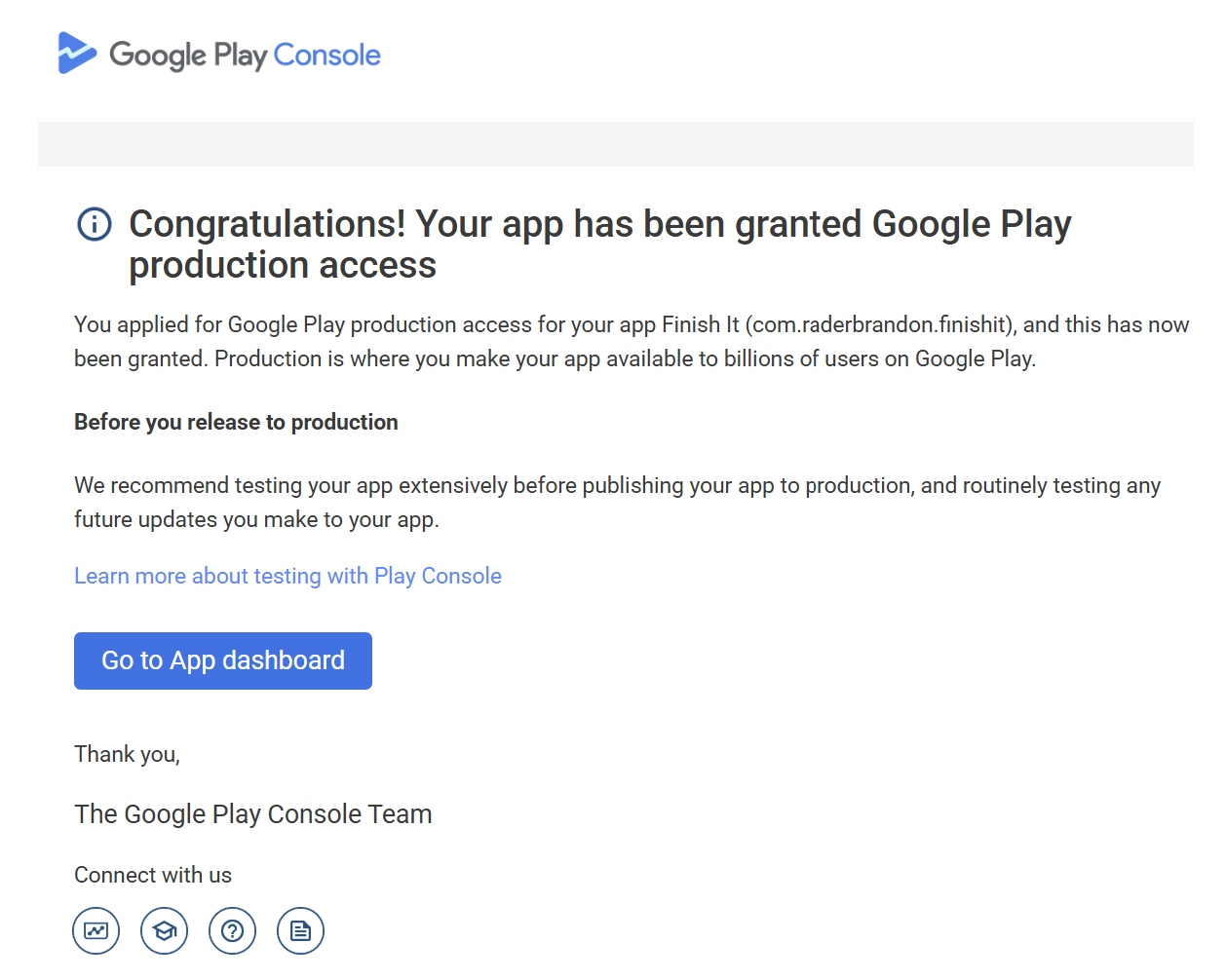
Verified Production Access
Quality QA Testing Reports
Clear, actionable reports with screenshots and evidence for every important issue found during testing.
Real Device Testing & Diagnostics
Real human testers use physical Android devices to test your app, verify real user flows, and provide clear testing evidence and professional QA reports.
Compliance Audit Passed
Our structured 14-day closed testing process is designed to meet Google Play's production requirements for your Android release.
Simple Closed Testing Pricing
Select the plan that fits your Android app complexity.
Loading Packages
Please wait while we fetch the best options for your region...
Frequently Asked Questions
Everything you need to know about passing your closed testing requirements.