Play Store testers for 14-day Android closed testing in Jordan
Find Play Store testers in Jordan for 14-day Google Play closed testing. Fulfill Play Console requirements with 12 real testers and launch quickly.
The Google Play Closed Testing Requirement in Jordan
Google mandates that all personal developer accounts created after November 2023 must recruit at least 12 opt-in testers who stay continuously opted-in for 14 consecutive days before production access can be unlocked. This policy ensures your Android package meets stability, accessibility, and security benchmarks across real physical hardware.
For tech teams in Amman and across the Kingdom, setting up internal testing tracks often leads to tester fatigue. Coworkers forget to open the app, friends uninstall after two days, and Google Play Console logs flatline engagement. Passing Google Play Closed Testing requires active daily interactions, structured feedback logs, and diverse Android OS coverage.
Real Managed Testers
Genuine Engagement Real humans across Jordan and international markets interact with core UI workflows, test payment gateways, and trigger crash logs.
100% Policy Compliant Testers stay continuously opted in for the full 14 days without dropouts, keeping your Play Console telemetry clean.
Actionable Feedback Receive detailed bug reports, screen size rendering quirks, and localized UX feedback before public release.
Bot Farms & Reciprocal Rings
Automated Script Traps Emulators and bot scripts ping Google Play endpoints with identical device fingerprints, triggering automated developer account flags.
High Dropout Rates Free swap groups and reciprocal rings often abandon testing halfway through, resetting your 14-day timer back to day 1.
Rejected Production Access Google review teams manually check tester feedback quality; zero feedback or bot gibberish leads straight to production rejection.
Why Jordanian Android Developers Face Closed Testing Hurdles
Building an app in Jordan means catering to both high-end flagship devices in West Amman and budget hardware in regional university hubs. If your closed testing group only includes three coworkers using the exact same Samsung Galaxy model, Google automated review algorithms notice the lack of hardware diversity.
Furthermore, Jordanian apps targeting regional markets (GCC and Levant) need thorough testing on Arabic RTL (right-to-left) layouts, localized payment integrations (like CliQ and local gateway sandboxes), and variable cellular network conditions (4G and emerging 5G networks). If your testers do not interact with these localized components, Play Console analytics show shallow engagement metrics that harm your production application.
| Feature / Metric | Managed Testing Service | DIY Coworker / Friend Testing | Bot Services & Swaps |
|---|---|---|---|
| Active Testers | 20 Guaranteed Real Humans | 12 to 15 Unreliable Volunteers | Fake Accounts / Emulators |
| Duration Retention | 14 Consecutive Days Non-Stop | High drop-off by Day 5 or 6 | Instant drop / Banned accounts |
| Hardware Diversity | Multiple Android OEMs & OS Versions | 2 or 3 Homogeneous Devices | Identical virtual machine IDs |
| Console Feedback | Meaningful UX and bug notes | Blank or generic comments | Zero feedback or bot spam |
| Production Approval | 99% First-Time Pass Rate | Frequent rejections and resets | Account suspension risk |
| Android Vitals Health | Continuous ANR and crash tracking | Unmonitored crashes | Fake synthetic logs |
| Production Questionnaire | Detailed audit trails & proof | Weak or generic responses | Instant algorithmic flags |
Struggling with the 14-Day Testing Requirement?
Skip the hassle of recruiting unreliable testers. Our professional fleet of real Android devices guarantees Google Play compliance in exactly 14 days. Zero bots. Zero emulators. 100% production approval guarantee.
Navigating the Technical Nuances of Google Play Console Telemetry
To secure production approval on the first attempt, you must treat Closed Testing as a data-gathering milestone rather than a bureaucratic box to check. The Play Console tracks several telemetry data points during the 14-day window:
- Daily Active Engagements (DAU): Automated systems monitor whether opt-in testers actually open the app, authenticate sessions, and navigate multiple activity screens. If twelve testers opt into your track on Day 1 but never launch the package again, the system notes zero active telemetry. When you submit your production request, the review team will see that no real evaluation took place.
- Opt-in Retention Ratio: Testers who opt in on the web or Play Store must remain in the closed track without unenrolling. If an unenrollment drops your active count to 11 on Day 13, the automated 14-day countdown stops immediately.
- Crash Free Session Rates and Android Vitals: Maintaining a 99%+ crash-free session rate across diverse API levels (Android 10 through Android 15) proves your build is stable. Google Play Console tracks User-Perceived Crash Rates and User-Perceived Application Not Responding (ANR) rates against bad behavior thresholds (0.47% for crashes and 0.47% for ANRs). If your build exceeds these thresholds during testing without subsequent patch releases, your production request faces severe scrutiny.
- App Startup Latency and Cold Starts: Google tracks how quickly your first activity paints frames on screen. Testers using real hardware generate realistic Time to Initial Display (TTID) metrics. Bot emulators running in headless server clouds produce abnormal launch timestamps that look suspicious in telemetry graphs.
- Screen Density and Resource Qualifier Loading: When real devices run your
.aab(Android App Bundle), Google Play Feature Delivery and Dynamic Split APKs deliver specific density-dependent assets (e.g.xxhdpi,xxxhdpi) and native architecture binaries (arm64-v8a,armeabi-v7a). A testing pool with diverse hardware verifies that dynamic asset splitting functions without missing resource crashes. - Tester Feedback Submissions: Direct feedback sent through the Google Play private feedback channel proves to the review team that humans evaluated your application. The review team looks at whether users provided specific observations on UI elements, localization, authentication quirks, or battery consumption.
Jordanian development agencies working under tight client SLAs cannot afford a 14-day cycle reset. Using a managed testing platform provides the device diversity, geographic spread, and consistent daily app launches required by Google evaluation algorithms.
Mastering the Production Access Questionnaire
At the end of your 14-day testing period, Google Play Console unlocks the "Apply for Production" button. Clicking this button presents a mandatory, detailed questionnaire that determines whether your app is granted production rights or sent back to closed testing for another two weeks. This questionnaire is reviewed by Google human trust and safety engineers alongside automated telemetry checks.
Here is how you must prepare your technical responses based on your 14 days of closed testing data:
1. Describing Your Tester Recruitment Strategy
Google asks: How did you recruit testers for your closed test?
- What to avoid: Never say "I bought testers online" or "I posted my link in a free testing exchange group on Reddit or Facebook." Also avoid saying "I asked my friends."
- How to answer properly: Explain that you ran a targeted closed testing group consisting of qualified Android users, domain specialists, and beta testers across your target demographic. Highlight that your testing pool represented varied physical hardware (Samsung, Xiaomi, Google Pixel, OnePlus) running Android OS versions from API level 29 to 35.
2. Demonstrating Engagement and Feedback Iteration
Google asks: What feedback did you receive from testers during closed testing?
- What to avoid: Writing "Everything worked fine and testers loved the app" is the fastest way to get rejected. Google knows that no pre-release software is completely bug-free.
- How to answer properly: Provide specific examples of constructive feedback. Mention UI adjustments for Arabic RTL text formatting, adjustments to touch targets on smaller screens, fixes for minor layout clipping on devices with camera cutouts or dynamic notches, and optimizations for network timeouts during slow mobile data connections.
3. Detailing Technical Changes and Version Iterations
Google asks: What changes did you make to your app based on feedback from testers?
- What to answer: Reference specific version codes that you pushed during the 14-day testing period. For example: "In Version Code 2 (v1.0.1), we optimized bitmap memory allocation in our home feed RecyclerView to eliminate frame drops. In Version Code 3 (v1.0.2), we revised our local currency formatters for Jordanian Dinar (JOD) and updated our retry logic for network requests on intermittent 4G connections."
4. Defining Your App Target Audience and Value Proposition
Google asks: Why is your app ready for a wider public audience on Google Play?
- How to answer: Summarize your final Android Vitals metrics, noting a 99.8% crash-free session rate across all 14 test days. Emphasize that all primary user journeys - registration, onboarding, core business workflows, offline caching, and account management - have been thoroughly validated on real consumer hardware.
Pre-Testing Technical Audit
applicationId and signing keys match your production keystore.assetlinks.json), and OAuth callback redirects function on fresh installs without cached tokens.14-Day Monitoring & Compliance
Step-by-Step Roadmap to Production Access
Getting your app from closed track to open production requires a disciplined, step-by-step approach. Follow this structured roadmap to satisfy all Google Play requirements:
Create Closed Testing Track
Create a new Closed Testing track inside Google Play Console. Upload your signed release Android App Bundle (.aab), complete release notes, ensure accurate privacy policy links, and save rollout changes.
Deploy 20 Dedicated Testers
Share the private web or store opt-in link with 20 verified human testers. Having 20 testers guarantees you stay well above Google minimum threshold of 12 testers even if an individual user experiences device issues.
Maintain 14 Days of Continuous Activity
Ensure testers install your build, open the app daily, interact with primary user flows, trigger key UI states, and submit private feedback via the Google Play interface throughout the 14-day window.
Deploy Mid-Test Patch Releases
Release at least one update during the test cycle (e.g. v1.0.1) addressing tester suggestions. This proves active developer maintenance and responsiveness to real-world user feedback in Google Play Console logs.
Complete Production Application Questionnaire
Once the 14-day countdown completes, answer Google standard production access questionnaire, citing real feedback received, specific bug fixes, and verified Android Vitals metrics.
Launch to Production
Receive production track approval and publish your application publicly to users in Jordan, the Middle East, and global markets with confidence.
Best Practices for Jordanian Tech Companies and Freelancers
To maximize the commercial success of your app after passing Google Play Closed Testing, keep these market-specific architectural and testing principles in mind:
1. Arabic Right-to-Left (RTL) Layout Integrity
Jordanian developers frequently build dual-language apps (Arabic and English). Android provides native RTL support through android:supportsRtl="true" in the AndroidManifest.xml and using start/end constraints in ConstraintLayout rather than left/right constraints. During closed testing, make sure your testers toggle system language settings between Arabic and English. Look out for:
- Mirrored navigation arrows and swipe gestures.
- Custom vector graphics with directional indicators that should or should not flip.
- Currency symbols formatting correctly next to numerals (e.g. "50.00 JOD" vs "50.00 د.أ").
- Bidirectional text formatting inside chat or dynamic comment fields using Unicode formatting characters.
2. Network Resilience Across Diverse Jordanian Infrastructures
While Amman enjoys widespread 4G and growing 5G connectivity, regional areas and transit corridors between Amman, Zarqa, Aqaba, and Irbid can experience sudden cell tower handovers and high packet latency. Ensure your closed testing phase tests how your app handles:
- Graceful offline transitions using Room database local caching.
- Exponential backoff retry policies for OkHttp / Retrofit network calls.
- Clear user feedback when payment processing or SMS verification fails due to connectivity timeouts.
3. Payment Gateway and Sandbox Verification
For e-commerce, on-demand services, and fintech applications integrating local payment rails (such as CliQ, PayTabs, HyperPay, or direct card processing), closed testing is your primary opportunity to test sandbox transactions. Verify that webview authentication handshakes, 3D Secure verification redirects, and deep link callbacks work cleanly on varied Chrome custom tabs and default browser setups.
Frequently Asked Questions
Why does Google Play require 12 testers for 14 days for developers in Jordan?
In November 2023, Google updated its Play Console developer policies worldwide, mandating that all new personal developer accounts recruit at least 12 testers who remain opted into a closed testing track for 14 consecutive days before production publishing is allowed. Google introduced this policy to combat spam, low-quality software, and sudden Day-1 crashes. For Jordanian developers, this means every personal account must demonstrate real-world device compatibility, app stability, and active user engagement across authentic hardware before launching publicly to users in Jordan, the MENA region, or worldwide.
Can I use friends, family, or coworkers in Amman to fulfill the 12 testers rule?
While you can invite friends, family, or coworkers in Amman, this approach frequently fails due to natural tester fatigue. Google Play Console telemetry does not just count whether 12 email accounts joined a Google Group; it tracks whether those 12 testers actually download the .aab package, keep it installed, open it repeatedly across the 14 days, and provide feedback. In typical DIY setups, coworkers forget to open the app after Day 3, or friends uninstall it when they need phone storage. If your active count drops below 12 even for a single day, Google automated counter pauses or resets back to Day 1.
What happens if a tester uninstalls the app on day 10 of closed testing?
If an enrolled tester uninstalls your application or opts out of your closed testing track on Day 10, and your total number of active opted-in testers drops below 12, Google Play Console will pause or reset your 14-day evaluation period. To prevent this painful delay, our managed closed testing service assigns 20 dedicated human testers. This 20-tester buffer ensures that even if one or two individuals encounter unexpected device battery or network issues, your active opted-in count stays comfortably above Google mandatory 12-tester baseline throughout the entire 14 days.
Are automated bots, emulators, or reciprocal swap groups safe for Play Store closed testing?
No. Relying on bot farms, cloud emulators, or reciprocal testing groups (where developers trade test installs on forums or Telegram) carries severe risks. Google automated security systems inspect hardware identifiers, battery status data, sensor signals, IP subnets, and user behavioral patterns. Cloud emulators sharing identical virtual hardware signatures are quickly flagged as artificial engagement. When Google detects fake testing, it will reject your production application and can flag your Google Play Developer account for deceptive behavior, leading to permanent account termination.
How does your managed closed testing service work for Jordanian developers?
Our service simplifies the entire 14-day closed testing process. Once you provide your closed testing opt-in link or email list, we deploy 20 verified human testers with diverse physical Android devices (different brands, screen sizes, and OS versions ranging from Android 10 to Android 15). Our testers opt in through the official Google Play interface, install your build, open the application daily, interact with your features, and submit authentic private feedback via Google Play. We monitor daily telemetry to ensure 100% compliance, and we provide you with structured feedback logs to help you answer the production access questionnaire.
Can I release updates to my app during the 14-day closed testing period?
Yes. Publishing update releases (version code bumps) to your closed testing track during the 14-day window is fully supported and actively recommended by Google. When you push updates that address bug reports or refine UI features, Google review systems take this as proof of active development and healthy tester interaction. Our 20 assigned testers will update to your latest release via the Play Store, test the new changes, and continue their daily engagement without interrupting your ongoing 14-day testing clock.
Our QA Process
How we deploy real devices and guarantee compliance for your release.
Choose Package
Sign in with Google to configure the closed testing environment for your Android build.
Submit Link
Submit your Google Play Console testing link, and our team will assign qualified testers from our testing network to join your Android closed testing release.
Active Testing
A QA supervisor monitors daily check-ins, ensuring 12 unique Android users engage with your Android build every single day.
Get Approved
We guarantee 14 consecutive days of active user check-ins to satisfy Google's compliance policies, delivering an audit-ready PDF feedback report.
The Premium QA Advantage
Experience a next-generation testing infrastructure built for Google Play compliance for your Android release.
The 14-Day Production Guarantee
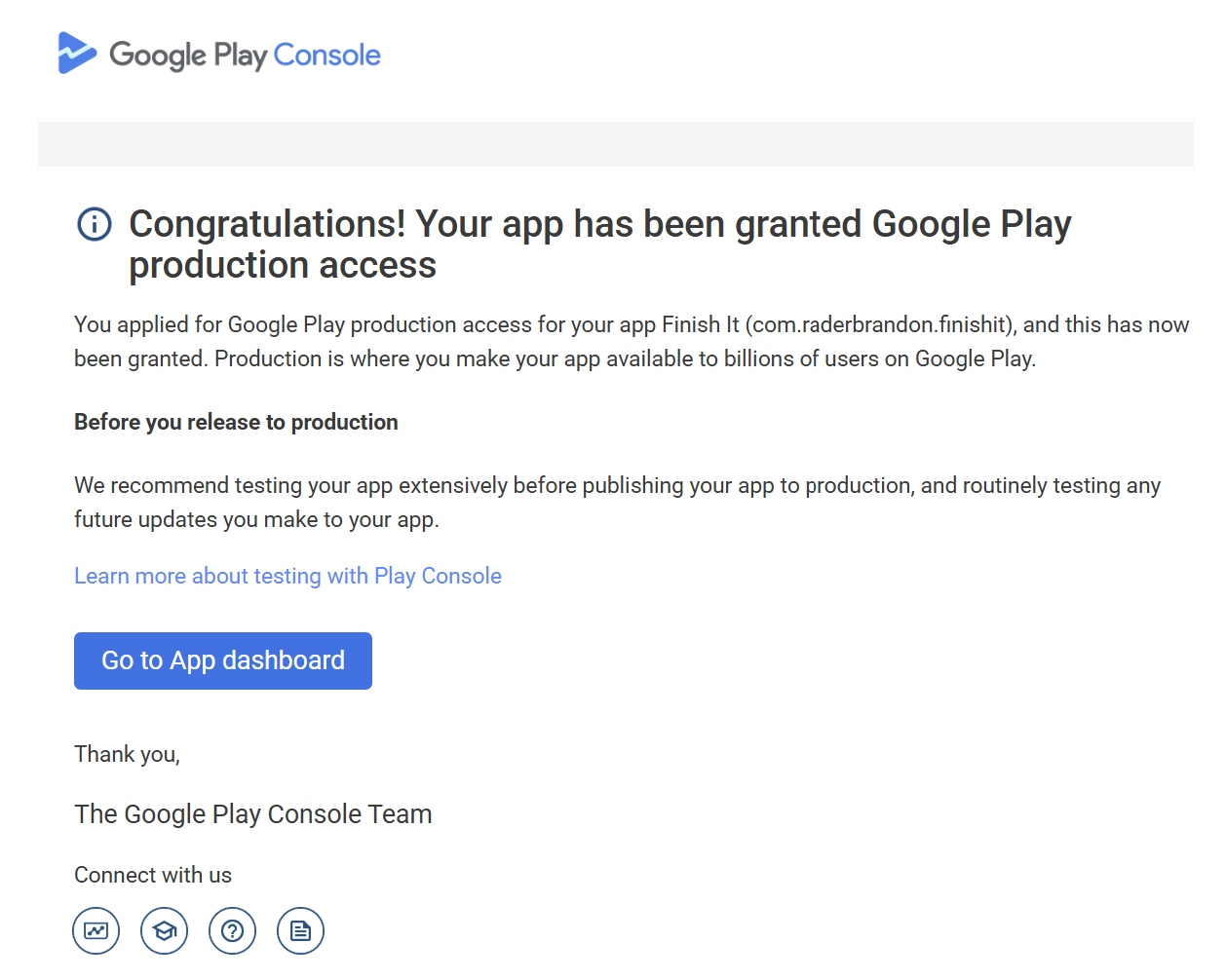
We complete the required 14-day closed testing process with real human testers and physical Android devices, while providing clear testing evidence and documentation throughout the process.
If Google specifically rejects production access due to insufficient testing engagement, you are covered by our free re-run or 100% refund guarantee, subject to our Refund Policy.
Verified Production Access
Quality QA Testing Reports
Clear, actionable reports with screenshots and evidence for every important issue found during testing.
Real Device Testing & Diagnostics
Real human testers use physical Android devices to test your app, verify real user flows, and provide clear testing evidence and professional QA reports.
Production Access Secured
Get your Android build approved on the first try. We create an audit-ready compliance profile that proves thorough quality assurance.
Affordable Compliance Cycles
Transparent plans built to satisfy Google Play Console guidelines for your Android build.
Loading Packages
Please wait while we fetch the best options for your region...
Frequently Asked Questions
Everything you need to know about passing your closed testing requirements.