Play Store testers for 14-day Android closed testing in Korea
Find real Play Store testers in Korea for Google Play closed testing. Fulfill Play Console requirements securely with 12 testers for 14 days.
Launching an Android app in South Korea is like opening a high-end cafe in the middle of Seoul. The foot traffic is massive, the customers are incredibly tech-savvy, and the competition is fierce. If your app crashes on a popular local device or your Korean localization feels even slightly unnatural, users will uninstall it before you can even release an update. That is exactly why passing your Closed Testing phase with real, local users is absolutely critical. You simply cannot afford to fake your way into one of the most lucrative and demanding mobile markets in the entire world.
Why South Korea Demands Better Testing
South Korea boasts one of the highest smartphone penetration rates globally, with Android heavily dominating the digital landscape. However, this high standard means Google Play is exceptionally strict about what gets published for this specific audience. When you are looking for Play Store testers for 14-day Android closed testing in Korea, you are not just ticking a basic compliance box on the console. You are actively gathering vital feedback from users who expect flawless performance, lightning-fast loading times, and perfect cultural alignment from day one.
The Real vs. Fake Testing Dilemma
Many developers panic when they see the stringent testing requirements on the Google Play Console. The temptation to buy cheap, automated bot services is huge. However, Google's algorithms have become incredibly sophisticated at detecting unnatural behavior. If your testers install the app, never open it, and leave generic reviews, your app will likely be rejected. Worse, your developer account could face severe penalties.
For the Korean market, this is even more critical. Bots cannot tell you if your text expansion breaks the UI, or if your payment gateway integrates smoothly with local Korean payment methods. You need genuine human interaction.
Real Korean Testers
Real human testers provide actionable, localized feedback. They will actually open your app every day, navigate through your core features, and report bugs that specifically affect Korean users. They help you optimize your user interface for Hangul characters and ensure your app feels native to the local culture. This genuine activity perfectly aligns with Play Store Closed Testing guidelines, ensuring a smooth approval process.
Automated Bots
Bot farms use automated scripts and VPNs to fake their location. They will install your app, let it sit idle, and maybe generate a generic, nonsensical review. Google's advanced tracking metrics easily flag this lack of meaningful engagement. Using bots to bypass Google Play Closed Testing almost guarantees a rejection, wasting your time and putting your entire developer account at massive risk of permanent suspension.
Core Requirements for Play Store Closed Testing
Before you can even think about hitting the publish button, you must satisfy Google's specific criteria. While some private testing phases might involve finding 12 Testers for 14 Days to check early features, the official Google Play Closed Testing policy strictly requires a minimum of 20 opted-in testers for at least 14 consecutive days.
During this mandatory two-week period, your testers must actively engage with your application. They cannot simply download it and forget about it. Google monitors session lengths, crash reports, and overall engagement metrics. For an app targeting South Korea, you want these metrics to reflect real usage patterns in that specific timezone. If all your "Korean" testers are miraculously active only during European night hours, Google will notice the discrepancy.
Furthermore, you must gather substantial feedback and use it to improve your app. When you apply for production access, Google will ask you to detail the feedback you received and explain the changes you made based on that feedback. Having real Korean testers means you will have genuine, culturally relevant feedback to present, making your application for production access much stronger and far more likely to be approved on the first try.
Your Roadmap to Korean Market Readiness
Navigating the path from a finished build to a fully published app in South Korea requires a strategic, step-by-step approach. Follow this roadmap to ensure you hit every milestone without delays.
Optimize for the Local Market
Before inviting a single tester, ensure your app is genuinely ready for South Korea. This means professional localization, not just machine translation. Ensure your UI can handle Hangul characters without breaking layouts. Integrate popular local sign-in options if possible, and ensure your servers offer low latency for users based in East Asia. First impressions matter immensely in this market.
Set Up Your Closed Track
Navigate to your Google Play Console and create a new closed testing track. Carefully select South Korea as your target region. Fill out all necessary store listing details, including localized screenshots and a compelling Korean description. Make sure your privacy policy is up to date and fully compliant with both Google's rules and local data protection regulations.
Recruit Genuine Testers
This is where many developers stumble. You need to find real people with active Android devices who are willing to commit to the 14-day process. Whether you are using a professional service, reaching out to local online communities, or leveraging social media, make sure your testers understand the commitment required. Quality over quantity is the rule here, though you still must meet the minimum numbers.
Monitor the 14-Day Testing Phase
Once your testers have opted in and downloaded the app, the clock starts. During these 14 days, actively monitor your Google Play Console dashboard. Look out for crash reports, ANRs (Application Not Responding), and any feedback submitted through the private feedback channel. Engage with your testers, ask specific questions about their experience, and begin working on any necessary bug fixes immediately.
Analyze Feedback and Update
After the testing period concludes, compile all the feedback. Did users find the navigation intuitive? Were there any localization errors? Did the app perform smoothly on typical devices used in Korea? Implement the necessary changes and upload a new, improved build to the console. This demonstrates to Google that you take the testing process seriously.
Apply for Production Access
With your 14 days complete and your app refined based on real feedback, you can finally answer Google's assessment questions. Be thorough and honest about what you learned and how you improved the app. Submit your application and wait for the review. With a solid testing phase behind you, you are in an excellent position for approval.
Struggling with the 14-Day Testing Requirement?
Skip the hassle of recruiting unreliable testers. Our professional fleet of real Android devices guarantees Google Play compliance in exactly 14 days. Zero bots. Zero emulators. 100% production approval guarantee.
Pre-Launch Prep Checklist for South Korea
To guarantee your app passes the rigorous Google Play Closed Testing phase and succeeds in the Korean market, you need to prepare meticulously. Use this comprehensive checklist to ensure nothing slips through the cracks before you begin testing.
Localization and Cultural Fit
Technical Readiness
Play Console Configuration
Comparing Your Options for Finding Testers
When you need Play Store testers for 14-day Android closed testing in Korea, you generally have three main avenues. Understanding the pros and cons of each is vital for a successful launch.
| Feature | Professional Service | DIY Sourcing | Bot Farms |
|---|---|---|---|
| User Authenticity | 100% Real Humans | Real Humans | Automated Scripts |
| Market Relevance | Targeted Korean Users | Varies wildly | Irrelevant locations |
| Engagement Level | High, consistent activity | Unpredictable | Zero meaningful interaction |
| Google Compliance | Fully Compliant | Usually Compliant | High Risk of Ban |
| Time Investment | Very Low | Extremely High | Low |
| Actionable Feedback | Detailed and localized | Minimal to none | None |
| Cost | Moderate investment | "Free" but costs time | Cheap but dangerous |
Choosing a professional service that specializes in real human testers is often the most cost-effective route when you factor in the value of your time and the massive risk associated with non-compliance.
Frequently Asked Questions
Understanding the nuances of Google Play Closed Testing, especially for a specific region like South Korea, can be challenging. Here are detailed answers to the most common questions developers have when preparing for their 14-day trial.
Why does Google Play require exactly 20 testers for 14 days?
Google introduced this strict requirement to drastically improve the overall quality of apps on the Play Store. In the past, developers could instantly publish buggy, unpolished apps, leading to a poor user experience. By enforcing a 14-day testing period with at least 20 continuous testers, Google ensures that apps are actually usable before they reach the general public. While some developers look for ways to just get 12 Testers for 14 Days to test early alpha builds, the official policy for new personal developer accounts strictly mandates 20 testers. This duration allows enough time to catch memory leaks, battery drain issues, and complex bugs that only appear after sustained usage over multiple days.
Can I use testers from other countries for my Korean app launch?
Technically, the Play Console allows you to invite testers from any region you have selected in your testing track. However, if your primary goal is to succeed in South Korea, using testers from the US or Europe is a massive strategic mistake. Testers outside your target market cannot provide accurate feedback on your Korean localization, nor can they tell you if your app feels culturally relevant. Furthermore, Google analyzes device data, network latency, and usage times. If an app designed strictly for Korea is only being tested by users on European cellular networks during European daylight hours, it may raise red flags during your final review for production access. Always aim for market-specific testers whenever possible.
What happens if a tester uninstalls the app during the 14 days?
Consistency is the key to passing Closed Testing. If a tester opts in, downloads the app, and then uninstalls it on day five, they no longer count towards your minimum requirement of 20 active testers. If your total number of active, opted-in testers drops below 20 at any point during the 14 days, your testing period may be invalidated, and you might have to start the clock all over again. This is why it is highly recommended to recruit a buffer of testers - perhaps 25 or 30 - to ensure that even if a few people drop out, you still comfortably exceed Google's strict minimum threshold.
How does Google know if I am using fake bots instead of real testers?
Google operates the most advanced mobile operating system and the largest app store in the world. Their ability to detect fraudulent activity is unparalleled. They do not just look at download numbers; they analyze a massive array of telemetry data. This includes session durations, the specific screens navigated, touch patterns on the screen, network IP ranges, device hardware IDs, and the presence of known VPN or emulator signatures. Bots typically exhibit highly repetitive, unnatural patterns that stand out immediately against the chaotic, varied behavior of real human users. Attempting to trick Google with cheap bot services is the fastest way to get your app rejected and your developer account permanently terminated.
What kind of feedback should I expect from real Korean testers?
Real human testers, especially those in a tech-forward market like South Korea, can provide incredibly valuable insights. You should expect feedback on your localization - they will quickly point out if a translation sounds awkward or informal when it should be polite. They will report on UI issues, such as text clipping on specific Samsung device screens. They might also provide feedback on the overall user journey, noting if the onboarding process is confusing or if certain features load too slowly on local networks. This qualitative data is exactly what Google wants to see when you apply for production access; they want proof that you listened to users and improved the app.
Do I need to update my app during the 14-day testing period?
While it is not strictly mandatory to push an update during the 14 days, it is highly recommended if your testers uncover significant bugs. Pushing an update shows Google that you are actively monitoring the test and responding to issues, which is exactly the behavior they want to encourage. However, be cautious - pushing a completely broken update that causes the app to crash on startup could ruin your testers' experience and cause them to uninstall. Always test your updates thoroughly in an internal track before rolling them out to your closed testing group.
How long does it take for Google to review my application for production access?
Once you have successfully completed your 14 days with the required number of active testers, you will fill out a detailed questionnaire about your testing process and apply for production access. The review process typically takes anywhere from 2 to 7 business days, though it can occasionally take longer during busy periods. The thoroughness of your application matters greatly. If you provide vague, one-sentence answers about the feedback you received, Google may reject your application and ask you to test again. Providing detailed, comprehensive answers that clearly demonstrate how the Closed Testing phase improved your app will significantly speed up your approval process.
The journey to launching a successful app in South Korea begins long before your marketing campaign. It starts with a rigorous, honest, and comprehensive testing phase. By securing real Play Store testers for 14-day Android closed testing in Korea, you are not just satisfying a technical requirement - you are building a foundation of quality that will resonate with one of the world's most discerning user bases. Take the time to do it right, gather genuine feedback, and prepare your app for true global success.
How We Deliver 12 Testers
Your journey to Google Play production access, simplified and automated.
Connect Account
Authenticate your account to initialize the 14-day QA fleet for your Android release.
Assign Testers
Upload your testing link. We assign 12 verified users with real Android devices to download and test your Android release.
Daily QA Runs
A dedicated testing supervisor is assigned to monitor progress while testers engage with your Android app and provide feedback throughout the testing period.
Launch Ready
Our lab maintains active installations for two weeks straight, ensuring a clean track record and providing a QA compliance log for your release.
Our Testing Infrastructure
Satisfy your Play Store Console testing obligations with our managed physical device fleet tailored for Android builds.
The 14-Day Production Guarantee
We complete the required 14-day closed testing process with real human testers and physical Android devices, while providing clear testing evidence and documentation throughout the process.
If Google specifically rejects production access due to insufficient testing engagement, you are covered by our free re-run or 100% refund guarantee, subject to our Refund Policy.
Verified Production Access
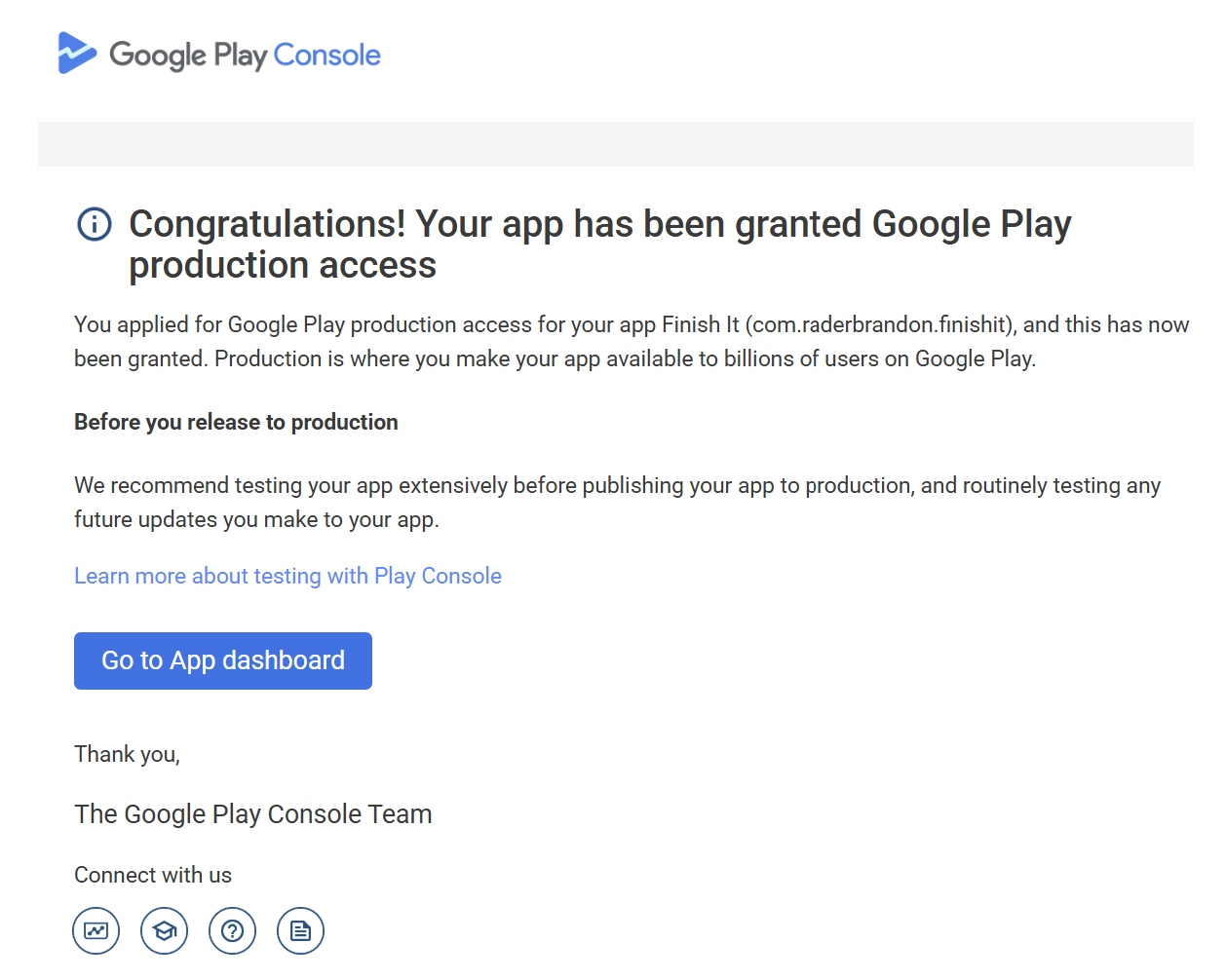
Quality QA Testing Reports
Clear, actionable reports with screenshots and evidence for every important issue found during testing.
Real Device Testing & Diagnostics
Real human testers use physical Android devices to test your app, verify real user flows, and provide clear testing evidence and professional QA reports.
Compliance Audit Passed
Our structured 14-day closed testing process is designed to meet Google Play's production requirements for your Android release.
Simple Closed Testing Pricing
Select the plan that fits your Android app complexity.
Loading Packages
Please wait while we fetch the best options for your region...
Frequently Asked Questions
Everything you need to know about passing your closed testing requirements.