Play Store testers for 14-day Android closed testing in Latvia
Find Play Store testers in Latvia for 14-day Android closed testing. Pass Google Play Console with 12 real human testers and get your app published fast.
The Reality of Google Play Closed Testing in the Baltic Market
Latvia presents a unique mobile environment where cutting-edge 5G connectivity, widespread adoption of digital identity platforms like Smart-ID, and strict European Union data privacy standards intersect. Meeting the baseline criteria for Google Play Closed Testing requires far more than just registering a list of email addresses on your developer dashboard. Google's automated systems evaluate whether your opted-in participants actually download, retain, and interact with the build over a two-week period.
When developers run a Play Store Closed Testing track targeting Latvia, they must ensure the app performs flawlessly across varied local conditions. Whether a user is connecting via high-speed fiber Wi-Fi in central Riga, switching to mobile data across the Vidzeme countryside, or running your build on popular mid-range Samsung, Xiaomi, or Motorola devices, real-world session data matters. Passing the rigorous 12 Testers for 14 Days benchmark requires sustained engagement that generates healthy crash-free metrics, genuine touch events, and clean telemetry that Google's review algorithm can trust.
Why Bot Farms and Fake Testers Ruin Developer Accounts
The temptation to cut corners using cheap script-driven services or emulator farms is a trap that has permanently crippled countless developer accounts. Google's Play Protect and account integrity algorithms actively analyze telemetry patterns to detect artificial behavior. When twenty accounts join an opt-in link from matching subnet IP ranges, boot identical virtualized hardware profiles, and perform robotic click sequences at predictable intervals, the Play Console flags the entire testing track as fraudulent.
Authentic Latvian Testing
- Genuine Hardware Profiles: Builds run on real consumer smartphones with varied chipsets, screen resolutions, and battery health profiles across Baltic mobile networks.
- Natural Telemetry Signals: Human testers open the app at irregular times, rotate screens, navigate complex UI trees, and background the app organically.
- Zero Policy Violation Risk: 100% compliant with Google Play Console developer policies, ensuring your production track application passes review without warning flags.
- Actionable Bug Discovery: Uncover real edge cases like broken Latvian character encoding (garumzīmes and mīkstinājuma zīmes) and local payment flow glitches before public release.
Automated Bot & Script Farms
- Synthetic Emulation Flags: Virtualized devices emit identical Android build fingerprints and mock hardware signatures that Google's systems detect immediately.
- Static & Predictable Logs: Automated scripts execute the exact same UI pathways for identical durations, triggering algorithmic rejection for low-quality engagement.
- High Risk of Permanent Bans: Violating closed testing rules can lead to rejected production applications, extended 30-day testing penalties, or total developer account termination.
- Zero Qualitative Value: Bots cannot report confusing onboarding steps, broken regional date formats, or sluggish interface animations.
Decoding Google's 14-Day Continuous Testing Rules
Understanding what Google actually evaluates during the mandatory two-week testing phase is essential for any developer striving for a smooth production rollout. Google introduced these rules specifically to eliminate low-quality, broken, and deceptive apps from clogging the Play Store. The algorithm does not simply check whether an app was installed on day one; it continuously tracks backend vitals across the entire duration.
+-----------------------------------------------------------------------------------+
|                        GOOGLE PLAY CONSOLE TELEMETRY ENGINE                       |
+-----------------------------------------------------------------------------------+
|                                                                                   |
|  [Opted-in Testers] ---> [Daily App Opens] ---> [Session Length & Touch Events]   |
|                                                              |                    |
|                                                              v                    |
|  [Crash-Free Rates] <--- [ANR Ratio Checks] <--- [Background State Transitions]   |
|           |                                                                       |
|           +-------------> [14-Day Compliance Score] ---> [Production Approval]    |
+-----------------------------------------------------------------------------------+
Key performance indicators monitored by Google during your Closed Testing period include:
- Application Not Responding (ANR) Thresholds: If your app freezes the main UI thread for more than 5 seconds while loading assets or calling remote APIs, Google records an ANR. Keep this well below the 0.47% bad behavior threshold.
- Crash-Free User Metrics: Google expects your crash rate to stay strictly below 1.09%. Real testers navigating your app will uncover uncaught exceptions, null pointer bugs, and memory leaks before public users encounter them.
- Active Retention & Daily Engagement: Opted-in testers who uninstall the app on day two or never reopen it harm your testing telemetry. Google looks for consistent, scattered check-ins throughout the 14-day window.
- Hardware Diversity: Testing across multiple Android OS versions (from Android 11 through Android 15) and diverse hardware configurations proves that your build is versatile and stable.
Struggling with the 14-Day Testing Requirement?
Skip the hassle of recruiting unreliable testers. Our professional fleet of real Android devices guarantees Google Play compliance in exactly 14 days. Zero bots. Zero emulators. 100% production approval guarantee.
Comparing Testing Approaches for Baltic Developers
When planning your closed testing track, you have three primary methods available. Choosing the right path determines whether your launch stays on schedule or gets derailed by review rejections.
| Evaluation Metric | Professional Managed Testing | Friends, Family & Peer Swaps | Cheap Automated Bot Services |
|---|---|---|---|
| Play Console Compliance | Guaranteed compliance with genuine human engagement | Moderate compliance, but vulnerable to high tester drop-off | Severe risk of automated detection and account strike |
| Tester Retention (14 Days) | 100% committed daily engagement across all 14 days | High drop-off rate after day 3 as personal contacts lose interest | Scripted pings that get flagged by anti-fraud systems |
| Device & Carrier Realism | Real consumer devices on authentic regional connections | Limited to whatever hardware your immediate circle owns | Virtualized emulator instances sharing data center IPs |
| Setup & Coordination Effort | Completely hands-off once the opt-in link is shared | Painstaking manual tracking, daily reminders, and awkward follow-ups | Quick setup but disastrous long-term risk for your account |
| Qualitative Feedback | Detailed bug reports, crash logs, and usability insights | Shallow feedback like "looks good" without actionable bug details | Zero human feedback or qualitative user observations |
Technical Pre-Launch Checklist for Latvia and the EU
Before sending your build to opted-in participants in your Google Play Closed Testing track, make sure your app meets essential European and Latvian technical standards. Use this structured checklist to ensure your build is ready for rigorous evaluation.
Baltic Localization & Formatting Standards
EU Privacy & Regulatory Compliance
Android Core Performance & Stability
Your 4-Step Roadmap from Closed Testing to Production Approval
Transitioning your application from closed testing to a live, public listing on Google Play requires a clear, disciplined workflow. Here is the step-by-step roadmap to successfully navigate the entire process without delays.
Step 1: Release Track Setup & Opt-In Configuration
Create a new Closed Testing track in your Google Play Console dashboard. Upload your signed Android App Bundle (.aab), set up your tester email distribution list, and copy your private web and Android opt-in testing links. Make sure your store listing details, screenshots, and privacy policy are fully filled out so testers see a complete, professional onboarding experience.
Step 2: Real Tester Deployment & Verification
Deploy your testing track to our network of verified Android testers. Each participant joins your closed track using their personal Google account, accepts the invitation via the Play Store link, downloads the app directly onto their physical Android device, and verifies the initial installation.
Step 3: 14 Days of Active Human Engagement
Over the mandatory 14 consecutive days, our testers open your app daily, interact with key features, navigate various screens, and test different device orientations. This consistent, organic activity generates authentic telemetry, keeps ANR and crash ratios healthy, and builds the engagement history Google's approval team expects.
Step 4: Review Application & Production Launch
Once the 14-day continuous testing threshold is satisfied, access the Play Console dashboard to complete the production access questionnaire. Provide clear, honest details about the feedback you gathered during testing, submit your application for review, and transition your track to production with total confidence.
Frequently Asked Questions
Why does Google Play require 12 to 20 testers for 14 continuous days?
In late 2023, Google introduced stricter requirements for personal developer accounts created after November 13, 2023. To prevent broken, malicious, or low-quality apps from entering the Play Store, developers must run a closed testing track with at least 20 opted-in testers (or complete targeted testing cohorts such as 12 dedicated testers alongside existing team members) who remain opted in continuously for at least 14 days. This allows Google's systems to collect real-world performance metrics, stability logs, and engagement telemetry before granting permission to publish to the production track.
Can I use emulators or automated scripts to satisfy the testing requirement?
No. Using emulators, bot scripts, or virtualized testing farms is one of the quickest ways to get your Google Play developer account permanently suspended. Google's SafetyNet, Play Integrity API, and backend telemetry analyzers can easily detect mock device profiles, repetitive click patterns, and shared IP ranges. Authentic closed testing requires real humans using genuine consumer hardware running official Android OS builds.
What happens if a tester uninstalls the app during the 14-day testing period?
If an opted-in tester uninstalls the app or leaves the testing group, your count of active testers drops. If the total number of active testers falls below Google's required threshold, your 14-day countdown timer may pause or reset entirely in the Play Console. Using a managed testing service guarantees that all assigned testers keep the app installed and actively engage with it across the entire 14-day period without unexpected drop-offs.
How do Latvian diacritics and localization affect Google Play approval?
While Google does not directly reject apps solely for minor translation typos, severe encoding bugs that cause UI text to overflow, crash string parsers, or render unreadable question marks will lead to elevated crash rates and poor user telemetry. In addition, when human reviewers evaluate your production application, a polished, correctly localized interface that handles Latvian characters (such as ā, č, ē, ģ, ī, ķ, ļ, ņ, š, ū, ž) demonstrates that the app is complete, stable, and ready for public release.
What questions does Google ask when applying for Production access after testing?
After completing the 14-day closed testing period, you must answer a series of questions in the Google Play Console before production access is unlocked. Google asks about your target audience, how you recruited your testers, what kind of feedback you received during testing, what bugs or performance issues you identified and resolved, and why you believe your application is now ready for a public release. Providing specific, transparent answers based on real testing feedback ensures fast approval.
Can I release updates or fix bugs during the active 14-day closed testing track?
Yes. In fact, pushing updates to your closed testing track during the 14-day window is strongly viewed by Google as a positive indicator of active development and responsive maintenance. When your testers encounter bugs and you release an updated AAB build, Google's review algorithm notes that the testing track is fulfilling its intended purpose: identifying flaws and improving app quality prior to public launch.
The Testing Pipeline
How we deploy real devices and guarantee compliance for your release.
Sign In
Sign in with Google to configure the closed testing environment for your Android build.
Opt-In URL
Submit your Google Play Console testing link, and our team will assign qualified testers from our testing network to join your Android closed testing release.
Testing Begins
A QA supervisor monitors daily check-ins, ensuring 12 unique Android users engage with your Android build every single day.
Compliance Complete
We guarantee 14 consecutive days of active user check-ins to satisfy Google's compliance policies, delivering an audit-ready PDF feedback report.
Why Developers Trust Us
Experience a next-generation testing infrastructure built for Google Play compliance for your Android release.
The 14-Day Production Guarantee
We complete the required 14-day closed testing process with real human testers and physical Android devices, while providing clear testing evidence and documentation throughout the process.
If Google specifically rejects production access due to insufficient testing engagement, you are covered by our free re-run or 100% refund guarantee, subject to our Refund Policy.
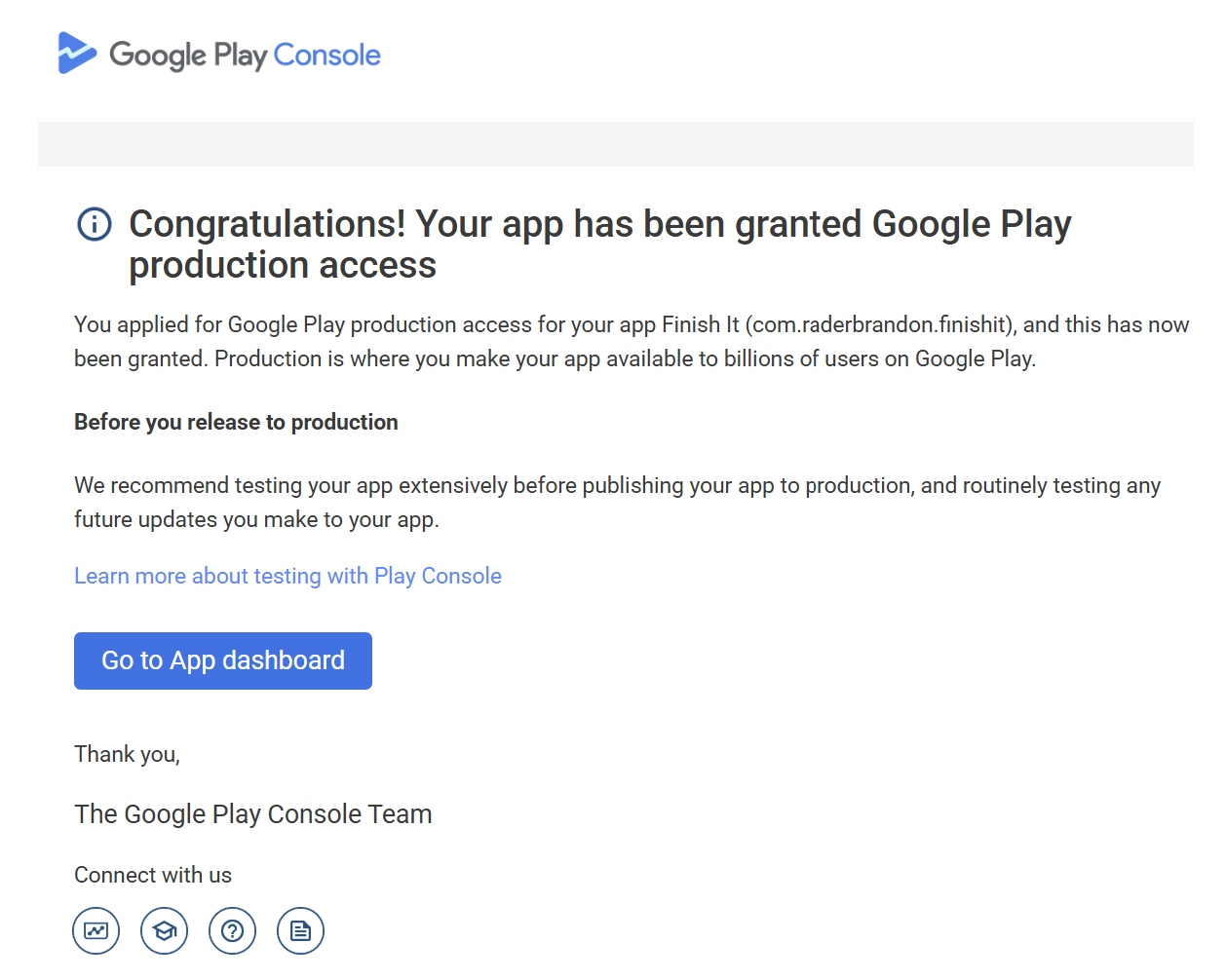
Verified Production Access
Quality QA Testing Reports
Clear, actionable reports with screenshots and evidence for every important issue found during testing.
Real Device Testing & Diagnostics
Real human testers use physical Android devices to test your app, verify real user flows, and provide clear testing evidence and professional QA reports.
Guaranteed App Approval
Get your Android build approved on the first try. We create an audit-ready compliance profile that proves thorough quality assurance.
Affordable Compliance Cycles
Transparent plans built to satisfy Google Play Console guidelines for your Android build.
Loading Packages
Please wait while we fetch the best options for your region...
Frequently Asked Questions
Everything you need to know about passing your closed testing requirements.