Play Store testers for 14-day Android closed testing in Lebanon
Find Play Store testers in Lebanon for 14-day Google Play closed testing. Fulfill Play Console requirements with 12 real testers and launch quickly.
The Reality of Android Closed Testing in Lebanon
Engineering teams in Lebanon often manage unstable internet connections, local payment gateway integrations, and cross-border SaaS workflows. Setting up a closed testing ring under these conditions demands organized execution. When you invite 12 personal contacts, people install the build on day one and forget about it. Google Play Console tracks whether your testers keep the build installed, open new version iterations, and interact with the application.
If your dashboard shows flatlined analytics or testers dropping out on day 9, your 14-day timer breaks. To pass production review on your first attempt, you need genuine, continuous engagement on physical Android devices.
| Strategy Metric | Professional Managed Testing | DIY Friends & Family Network | Automated Bot / Farm Services |
|---|---|---|---|
| Active Opt-in Retention | Guaranteed 100% through 14 full days | High drop-off rate (30% - 60% churn) | Fake tokens dropped upon Google bot purge |
| Hardware Diversity | Real hardware (Samsung, Xiaomi, Pixel) | Limited local device models | Emulators / Cloud VM instances |
| Android OS Coverage | Android 10 up to Android 15+ | Random, often outdated OS levels | Virtualized, identical OS fingerprints |
| Crash Telemetry & Feedback | Actionable logcat reports and native UI bugs | "It works fine" text messages | Zero real human logcat traces |
| Production Access Approval | Over 98% first-round clearance | Frequent rejections for low activity | High risk of permanent console account ban |
Why Google Rejects Production Access Requests
Google's automated review system is designed to catch low-effort compliance attempts. Merely having 12 email addresses on a closed track email list does not satisfy the requirement. The Play Console records background telemetry, crash rates, session lengths, and opt-in consistency.
Authentic Human Testing
- Real Hardware Signatures: Builds run on authentic Android devices with genuine carrier signals, battery states, and diverse screen densities.
- Continuous Engagement: Testers launch new release builds, test deep links, and trigger native UI workflows across all 14 days.
- Natural Feedback Logs: Users submit bug reports and feedback through the private Google Play feedback channel, providing real logcat data.
- Safe Compliance: Complete alignment with Google Play Developer Program Policies, protecting your developer standing.
Bot Farms & Fake Opt-ins
- Virtual Machine Footprints: Emulated Android environments with identical IMEI profiles and spoofed sensor data that Google easily flags.
- Scripted Pings: Automated scripts that install and instantly close the app, creating abnormal analytics curves in Play Console.
- Zero Native Interaction: No crash logs, no layout audits, and no authentic user sessions logged in Firebase or Play vitals.
- Account Penalties: High risk of immediate production rejection, extended 14-day resets, or permanent developer account termination.
When Lebanese development studios deploy fintech tools, delivery platforms, or utility apps, passing this check without delays protects startup funding, client deliverables, and commercial launch timelines.
Struggling with the 14-Day Testing Requirement?
Skip the hassle of recruiting unreliable testers. Our professional fleet of real Android devices guarantees Google Play compliance in exactly 14 days. Zero bots. Zero emulators. 100% production approval guarantee.
Understanding Play Console Telemetry & Android Vitals
To succeed in closed testing, developers must understand what happens behind the scenes inside Google Play Console. Google does not merely check if twelve accounts clicked an invite link. The Play Console engine monitors complex telemetry emitted directly from Google Play Services on each tester device.
1. User Engagement Signals and Foreground Sessions
When an authentic tester opens your application, Android OS registers foreground window focus, user touch events, and runtime state transitions. Google records these sessions in aggregated developer analytics:
- Daily Active Devices (DAD): Measures how many unique opted-in devices launch your application on any given calendar day.
- Session Duration & Interaction Depth: Tracks whether users navigate past the splash screen, interact with Jetpack Compose or XML layout elements, and trigger network requests.
- Return Rate (Day 1, Day 7, Day 14 Retention): A healthy testing cycle displays organic return visits rather than a single 10-second session on Day 1 followed by thirteen days of zero activity.
2. Android Vitals and Performance Thresholds
Google Play evaluates app stability through Android Vitals. If your build triggers poor vitals during closed testing, human reviewers and automated evaluation algorithms will flag your build as unready for production:
- User-Perceived Crash Rate: Must stay well below Google's bad behavior threshold of 1.09%. On closed tracks, aim for 0.00% to 0.20%.
- User-Perceived ANR (Application Not Responding) Rate: Must stay below 0.47%. ANRs caused by heavy background database queries or synchronous network calls on the main UI thread during slow Lebanese internet connections will quickly ruin your vitals score.
- Slow Sessions and Frozen Frames: Measures UI rendering lag where frames take longer than 16ms or 700ms to draw. Smooth scrolling across various refresh rates (60Hz, 90Hz, 120Hz) proves that your UI architecture is production grade.
- Excessive Background Wakeups & Battery Drain: Google Play Services flags background jobs and foreground services that hold persistent wakelocks or trigger battery alarms more than 10 times per hour.
3. Logcat Crash Traces and Private Tester Feedback
Closed testing provides an exclusive feedback loop through the Play Store interface. When testers report an issue, Google Play captures device model details, OS build numbers, available RAM, and stack traces. When you submit your production questionnaire, Google's team compares your written explanations against these logged bug reports and diagnostic histories. Having zero reported issues and zero updates across 14 days looks unnatural and triggers manual scrutiny.
Technical Pre-Launch Checklist for Play Console Compliance
Before starting your 14-day closed testing cycle, ensure your Android package and developer console settings are completely configured. Addressing technical debt before uploading your first .aab prevents unnecessary track resets.
Build Configuration & Android Vitals
Target SDK & Architecture Compatibility: Verify that your build.gradle targets API level 34 or higher (Android 14/15) and compiles 64-bit native libraries (arm64-v8a, armeabi-v7a, x86_64) without obsolete dependencies.
App Bundle Optimization & ProGuard Rules: Generate a signed Android App Bundle (.aab) with R8 code shrinking and resource optimization enabled. Test your ProGuard rules to ensure reflection-based libraries like Retrofit, Gson, or Kotlin Serialization do not throw runtime ClassNotFoundException errors.
Telemetry & Real-Time Crash Monitoring: Integrate Firebase Crashlytics, Sentry, or Datadog alongside Android Vitals. Verify that non-fatal exceptions and network timeout logs are properly captured so you can patch unexpected runtime bugs within the first 48 hours.
Network Resiliency & Offline Caching: Implement Room database caching, OkHttp interceptors with exponential backoff, and graceful network failure UI banners to handle intermittent internet dropouts common across local telecom networks.
Play Console Track Configuration
Closed Testing Track Setup: Create a dedicated Closed Testing track in Play Console, set your distribution country settings to include your tester pool, and link your Google Group.
Privacy Policy & Sensitive Permission Justification: Host a comprehensive Privacy Policy on a public HTTPS URL. Declare and justify sensitive runtime permissions (such as POST_NOTIFICATIONS, ACCESS_FINE_LOCATION, CAMERA, and foreground services) in the App Content console section.
Test Credentials & Demo Access Provisioning: If your app requires SMS OTP verification, OAuth login, or Lebanese phone number registration, supply active bypass credentials and universal demo logins in the Play Console App Access section so Google reviewers and testers can inspect all gated features.
Data Safety Form & SDK Declarations: Complete the Data Safety questionnaire accurately, listing all collected user data points (identifiers, crash logs, financial info) and declaring all third-party analytics and advertising SDK data handling practices.
The 14-Day Roadmap to Production Approval
Navigating Google Play Closed Testing requires a structured timeline. Following this roadmap ensures your application collects the right metrics every single day.
Track Setup & Tester Enrollment
Upload your signed release build to the Closed Testing track. Invite your verified testing team via Google Groups. Testers accept the invitation on the web and opt in through Google Play on their physical devices.
Initial Installation & Vitals Audit
Testers download the build directly from the Play Store. You verify in Play Console that all testers are recorded as active installs, checking initial ANR and crash rate baselines.
Iterative Updates & Continuous Testing
Throughout days 3 to 12, push at least one minor update or bug-fix build. Active testers update their builds, test core interactive features, and log private tester feedback via the Play Store interface.
Telemetry Verification & Production Application
On day 14, confirm that 12 or more testers have remained continuously opted in without interruption. Fill out the comprehensive 20-question production access questionnaire with detailed technical summaries of your testing findings.
Production Launch & Global Distribution
Google's review team validates your tester telemetry, inspects your feedback history, and grants production access. You promote your tested build directly to Production for worldwide download.
How to Answer Google's 20-Question Production Access Questionnaire
Once you complete 14 continuous days with 12 or more active testers, the "Apply for Production" button activates in your Play Console dashboard. Google presents a detailed 20-question review questionnaire designed to evaluate your testing process. Submitting generic, one-sentence answers is the leading cause of rejection at this final stage.
Here is an architectural guide to answering the three core questionnaire categories:
1. Questions About Tester Recruitment and Diversity
- What Google is asking: How did you find your testers, and why are they representative of your target audience?
- How to answer effectively: Detail your recruitment channels. Explain that you assembled a dedicated pool of real Android users testing across diverse hardware brands (Samsung Galaxy, Xiaomi Redmi, Google Pixel, OnePlus) running Android OS versions ranging from Android 10 to Android 15. Highlight that testers represented real end-users who evaluated UI ergonomics, onboarding friction, and localized network reliability.
2. Questions About Tester Engagement and Feedback Channels
- What Google is asking: How did your testers engage with your app, and what methods did they use to submit feedback?
- How to answer effectively: Explain that testers used the native private feedback feature built into Google Play Store alongside in-app diagnostic triggers and Firebase Crashlytics logging. Mention specific feedback topics raised by your testing group, such as dark mode contrast issues on AMOLED displays, slow API responses during low-bandwidth connections, or confusing payment checkout steps.
3. Questions About Iterations, Fixes, and Production Readiness
- What Google is asking: What critical bugs or performance bottlenecks did you identify and resolve during the 14-day window?
- How to answer effectively: Give concrete engineering examples. Reference specific build versions (for example: "In Version 1.0.2, resolved a Kotlin coroutine race condition causing ANRs on Android 11 devices; in Version 1.0.3, optimized image caching with Coil to reduce memory usage by 35% on low-RAM devices"). Conclude with a clear statement affirming that your Android Vitals crash rate is under 0.1%, all core user flows are verified, and the app is structurally prepared for global distribution.
Detailed Frequently Asked Questions
Why does Google require 12 testers for 14 days for Android apps?
In late 2023, Google updated its developer policies for personal Play Console accounts to improve app quality and prevent malicious or broken software from reaching users. Google requires at least 12 testers to be actively opted in to your closed test for at least 14 consecutive days. This rule forces developers to gather genuine user feedback, debug crashes on diverse hardware, and ensure the app meets minimum stability standards before opening it to public download.
Can I use friends and colleagues in Beirut or Tripoli for closed testing?
Yes, you can use personal contacts, but it is often difficult to manage. If any tester uninstalls the app, opts out, or fails to open updates, your active tester count may dip below 12. If that happens, Google's 14-day counter can pause or reset completely. A managed closed testing service guarantees that real human testers stay opted in and active on their devices for the entire duration, removing the risk of unexpected dropouts.
What happens if a tester uninstalls the app on day 10?
If an opted-in tester uninstalls your app and your total number of active opted-in testers falls below the required threshold of 12, Google Play Console will flag the shortfall. In most cases, your 14-day evaluation period will pause until you recruit replacement testers, or the 14-day timer will reset back to day 1. Keeping a buffer of more than 12 active testers prevents single dropouts from ruining your launch schedule.
Are emulators or cloud testing services safe to use for this requirement?
No. Google monitors hardware identifiers, Google Play Services signatures, IP ranges, and device vitals. Emulators and automated bot farms lack authentic sensor data and user engagement patterns. Using automated services can result in immediate rejection of your production access request, and repeated attempts with flagged bot networks can lead to permanent termination of your Google Play Developer account.
Do I need to publish updates to the closed testing track during the 14 days?
While pushing updates is not strictly mandatory if your first build is completely bug-free, publishing at least one update during the 14-day window is strongly recommended. It generates fresh telemetry showing that testers can smoothly download updates and that your release pipeline works as intended. It also provides strong evidence in your production questionnaire that you actively maintained the app during closed testing.
How should I answer Google's 20-question production access questionnaire?
When applying for production access after 14 days, Google asks detailed questions about your testing methodology, how you recruited testers, what feedback you received, and what changes you made. You should provide clear, technical answers detailing real bugs identified, specific device models tested, crash optimizations implemented, and user experience enhancements made during the testing phase. Vague or generic one-sentence answers often trigger manual review rejections.
The Testing Pipeline
How we deploy real devices and guarantee compliance for your release.
Sign In
Sign in with Google to configure the closed testing environment for your Android build.
Opt-In URL
Submit your Google Play Console testing link, and our team will assign qualified testers from our testing network to join your Android closed testing release.
Testing Begins
A QA supervisor monitors daily check-ins, ensuring 12 unique Android users engage with your Android build every single day.
Compliance Complete
We guarantee 14 consecutive days of active user check-ins to satisfy Google's compliance policies, delivering an audit-ready PDF feedback report.
Why Developers Trust Us
Experience a next-generation testing infrastructure built for Google Play compliance for your Android release.
The 14-Day Production Guarantee
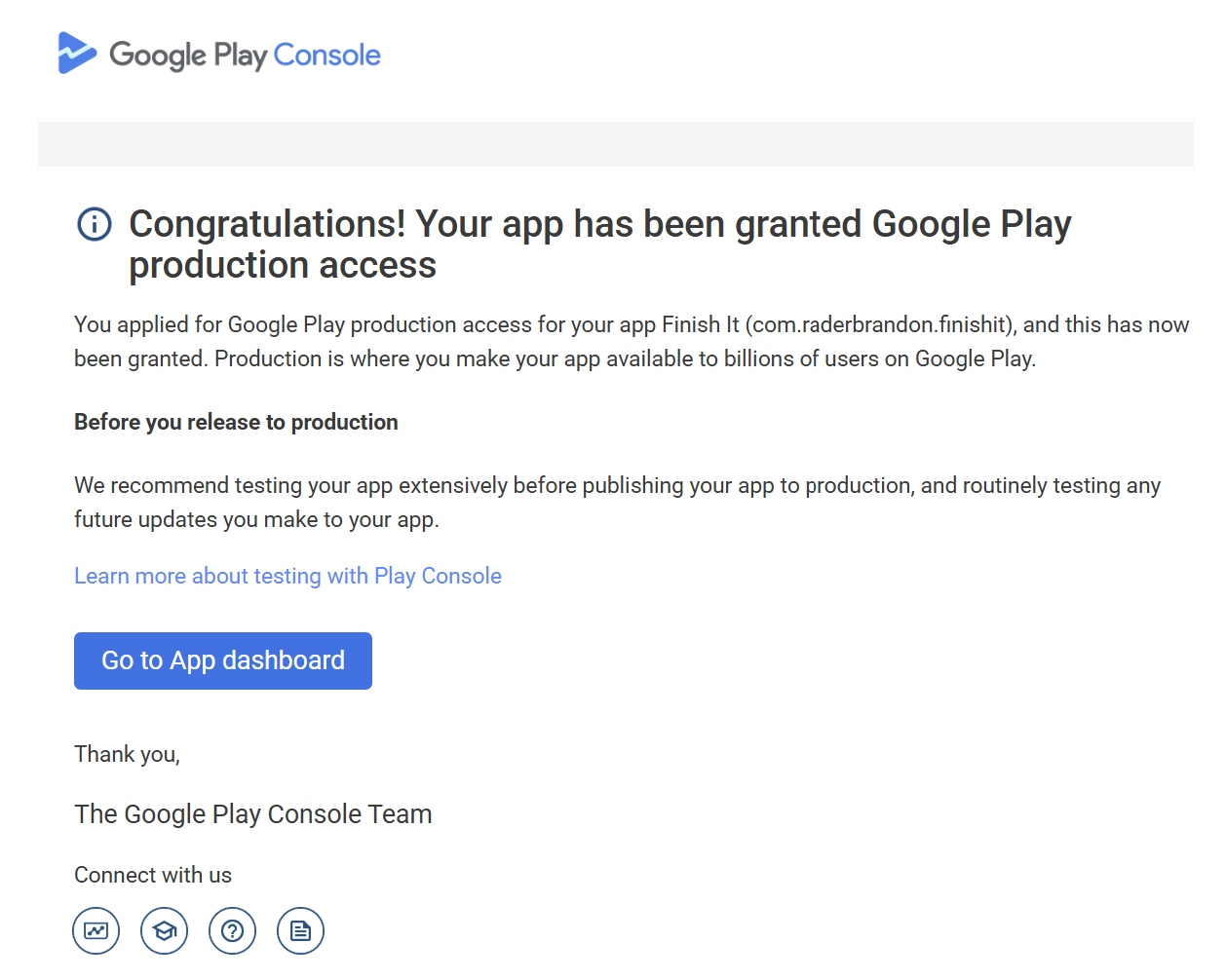
We complete the required 14-day closed testing process with real human testers and physical Android devices, while providing clear testing evidence and documentation throughout the process.
If Google specifically rejects production access due to insufficient testing engagement, you are covered by our free re-run or 100% refund guarantee, subject to our Refund Policy.
Verified Production Access
Quality QA Testing Reports
Clear, actionable reports with screenshots and evidence for every important issue found during testing.
Real Device Testing & Diagnostics
Real human testers use physical Android devices to test your app, verify real user flows, and provide clear testing evidence and professional QA reports.
Guaranteed App Approval
Get your Android build approved on the first try. We create an audit-ready compliance profile that proves thorough quality assurance.
Affordable Compliance Cycles
Transparent plans built to satisfy Google Play Console guidelines for your Android build.
Loading Packages
Please wait while we fetch the best options for your region...
Frequently Asked Questions
Everything you need to know about passing your closed testing requirements.