Play Store testers for 14-day Android closed testing in Lithuania
Get Play Store testers in Lithuania for 14-day Google Play closed testing. Our 12 real testers meet all Play Console requirements so your app gets approved fast.
Why Closed Testing Is Mandatory for Personal Accounts
Google established the 12 testers for 14 days closed testing mandate to ensure apps are thoroughly polished, secure, and crash-free before reaching general consumers. Automated verification systems in the Play Console track whether enrolled testers genuinely install the APK, launch sessions on consecutive days, and interact with core UI workflows.
For teams launching in or from Lithuania, achieving this benchmark using real people validates device performance across regional telecommunications carriers like Telia Lietuva, Tele2, and Bitė. Fulfilling the closed testing requirement with organic user sessions establishes strong developer reputation scores, preventing launch delays and compliance rejections.
The Friction of Coordinating DIY Testers
Organizing friends, colleagues, or casual social media volunteers often turns into an exhausting administrative headache. While peer developers in Vilnius or Kaunas may eagerly opt in on day one, engagement typically drops off sharply within the first week as daily routines get busy.
When daily tester participation drops below the required active threshold, Google Play's automated review system pauses or invalidates the 14-day streak, forcing developers to restart the entire two-week cycle from day one. Managing manual reminders, tracking uninstalls, and hunting for replacement testers wastes vital engineering time that should be spent refining your core product.
What Google Play Console Measures During Closed Testing
Google Play Console tracks far more than a simple list of registered email addresses. Its back-end systems run continuous heuristics to measure the authenticity, health, and reliability of your testing track.
1. Daily Active Engagement and Session Depth
Google's algorithms monitor whether testers actively open the app, navigate through multiple screens, execute gestures, and trigger background tasks over the full 14-day period. Dormant installs where the app is opened once and never touched again do not satisfy the continuous engagement criteria.
2. Android Vitals and Crash Metrics
Every exception, unhandled crash, and Application Not Responding (ANR) incident is logged in your Android Vitals dashboard. Google compares your crash rates against industry thresholds (below 1.09% for user-perceived crash rate and 0.47% for ANR rate). Consistent human testing reveals unexpected crashes on diverse hardware before you request production rollout.
3. Hardware and OS Diversity
Automated checks assess the range of physical devices participating in your test track. A compliant testing group includes multiple screen resolutions, chipset architectures (Qualcomm Snapdragon, MediaTek, Google Tensor, Samsung Exynos), and OS versions ranging from Android 10 through Android 16.
4. Opt-In Retention Stability
Testers must remain enrolled via the official Google Play opt-in web link or Android app link without opting out or uninstalling the package during the testing window. High churn rates trigger policy review flags.
The Fatal Risks of Bots and Fake Testing Services
Facing the challenge of recruiting 12 testers, some developers turn to low-cost bot farms, emulator pools, or synthetic click services. Relying on artificial engagement is the fastest route to a permanent developer account suspension.
Google uses sophisticated machine learning models to detect synthetic traffic. Server farm IP addresses, identical hardware identifiers, repetitive touch coordinates, and unnatural session timestamps are easily flagged. When Google discovers artificial testing manipulation, it does not just reject the production application - it frequently terminates the Google Play Console account and permanently blacklists associated payment profiles, developer identities, and related legal entities under Section 8.3 of the Developer Distribution Agreement.
| Evaluation Metric | Managed Real Tester Cohort | DIY Friends & Peer Network | Bots & Emulator Farms |
|---|---|---|---|
| Compliance Certainty | 100% Guaranteed Production Approval | Uncertain; High Dropout & Restart Rate | Account Suspension & Blacklisting |
| Daily Session Activity | Verified Real Daily Human Interaction | Inconsistent; Falls Off After Day 3 | Scripted Clicks with Zero Human Flow |
| Device Spectrum | 20+ Real Hardware Models (Android 10-16) | Limited to Available Friends' Phones | Virtual Device Emulators & Data Centers |
| Actionable Bug Insights | Written Bug Logs & UX Feedback | Vague Comments or No Feedback | Zero Usability or Diagnostic Value |
| Developer Workload | Completely Hands-Off and Managed | Hours Spent Sending Follow-Up Messages | Minimal Effort, Catastrophic Risk |
| Network & Carrier Realism | Real Residential & Mobile IP Networks | Mixed Home Wi-Fi Connections | Flagged Data Center Proxy IPs |
Authentic Human Testing in Lithuania
Genuine testers download your build directly through official Google Play closed testing opt-in links on physical smartphones. They open the app daily, interact with features across varying screen sizes, and provide real-world crash logs and user feedback that satisfies Google's production review team.
Automated Scripts & Click Farms
Automated scripts run headless emulator instances on cloud servers, simulating repetitive touch events without organic human variance. Google's security systems easily detect synthetic patterns, leading to immediate rejection of production access and lifetime account bans.
Struggling with the 14-Day Testing Requirement?
Skip the hassle of recruiting unreliable testers. Our professional fleet of real Android devices guarantees Google Play compliance in exactly 14 days. Zero bots. Zero emulators. 100% production approval guarantee.
Complete Pre-Launch Closed Testing Checklist
Prepare your application and developer console thoroughly before publishing your closed testing track to avoid unexpected delays.
Play Console Track Configuration
Build Quality & Release Assets
Daily Monitoring & Feedback Collection
Your 14-Day Roadmap to Production Approval
Following a structured testing framework ensures a smooth journey from initial closed release to public launch on the Google Play Store.
Track Setup and Opt-In Distribution
Create your closed testing track, upload your signed release AAB, and invite your verified cohort of 12+ real human testers. Each tester accepts the opt-in invite via Google Play and downloads the build onto their primary Android smartphone.
14-Day Continuous Human Engagement
Testers launch and use your app daily across different days, exploring various flows, navigating screens, and testing UI responsiveness. Their authentic usage generates organic telemetry on Google's servers while keeping crash rates well below vital thresholds.
Telemetry Monitoring and Iterative Updates
Monitor Android Vitals and address any edge-case bugs uncovered during testing. If needed, push minor update builds directly to the closed testing track without interrupting your 14-day counter.
Production Access Application
Once the 14 days conclude with at least 12 active testers, click 'Apply for production' in the Play Console. Answer Google's questionnaire describing your target audience, testing methodology, feedback gathered, and bug fixes applied.
Production Approval and Global Release
Google's review team verifies your engagement metrics, reviews your questionnaire responses, and grants full production publishing rights, allowing you to launch your app to users across Lithuania and worldwide.
Frequently Asked Questions
Why does Google Play require 12 testers for 14 days for personal developer accounts?
In late 2023, Google updated its developer policies to improve app quality, security, and stability on the Play Store. Personal developer accounts registered after November 13, 2023, must test their apps with at least 12 opt-in human testers continuously for 14 days before production access can be requested. This ensures that new applications undergo real-world verification, resolving potential crashes, UI flaws, and policy compliance issues before reaching general users.
What happens if a tester uninstalls the app or stops opening it during the 14 days?
If testers uninstall your app or remain dormant, your active tester count may fall below the required threshold of 12 participants. Google Play's automated review system continuously monitors daily active engagement. If your active numbers drop, your 14-day streak can stall or reset, delaying your production rollout. Working with a managed testing service prevents this risk by providing backup testers who maintain uninterrupted daily activity throughout the entire period.
Can I push new updates or bug fixes to my closed testing track during the 14-day test?
Yes. You can upload new App Bundles (AABs) to your active closed testing track at any point during the 14-day window. In fact, releasing bug fixes and UI improvements based on tester feedback demonstrates active development to Google, which strengthens your production access application. Pushing updates does not restart the 14-day clock as long as testers continue updating and using the app daily.
How does Google distinguish between real human testers and automated testing bots?
Google analyzes deep telemetry patterns including physical device hardware sensors, realistic touch coordinate distributions, natural variable session durations, genuine Google Play account histories, and residential network routing. Bot scripts and emulators run on predictable loops from data center IP ranges with identical hardware footprints. Google easily identifies these synthetic patterns, leading to immediate rejection of production requests and account termination.
How should I answer Google's questions when applying for production access after 14 days?
When your 14-day closed testing period finishes, Google Play Console will prompt you to complete a production application form. You will be asked about your target audience, how you recruited your testers, what feedback you received, and what changes you made based on testing. Provide specific, detailed answers citing real bugs discovered, device types tested, and specific optimizations implemented during the testing cycle.
Are testers in Lithuania suitable for apps intended for a global audience?
Yes. Testing with real Android devices in Lithuania provides robust hardware and OS validation that meets all of Google's global compliance standards. Lithuanian testers use mainstream international Android devices from Samsung, Xiaomi, Google Pixel, Motorola, and OnePlus across standard ARM64 architectures. As long as your closed testing track is configured for global distribution or includes the relevant regions, testing with real European users fully satisfies Google Play's worldwide production requirements.
The Testing Pipeline
A straightforward 4-step process to get your Android app approved.
Sign In
Connect your Google account and choose your preferred closed testing package for your Android app.
Opt-In URL
Share your Play Store opt-in URL. We immediately deploy 12 real testers to launch and review your Android app daily.
Testing Begins
Our crew initiates daily launch sessions on physical devices, verifying usability and logging crashes for your Android app.
Compliance Complete
We continuously perform closed app testing for 14 days to help you meet Google Play production requirements. We also provide a compliance report.
Why Developers Trust Us
Deploy your Android app onto real retail-grade handsets using our secure laboratory environment.
The 14-Day Production Guarantee
We complete the required 14-day closed testing process with real human testers and physical Android devices, while providing clear testing evidence and documentation throughout the process.
If Google specifically rejects production access due to insufficient testing engagement, you are covered by our free re-run or 100% refund guarantee, subject to our Refund Policy.
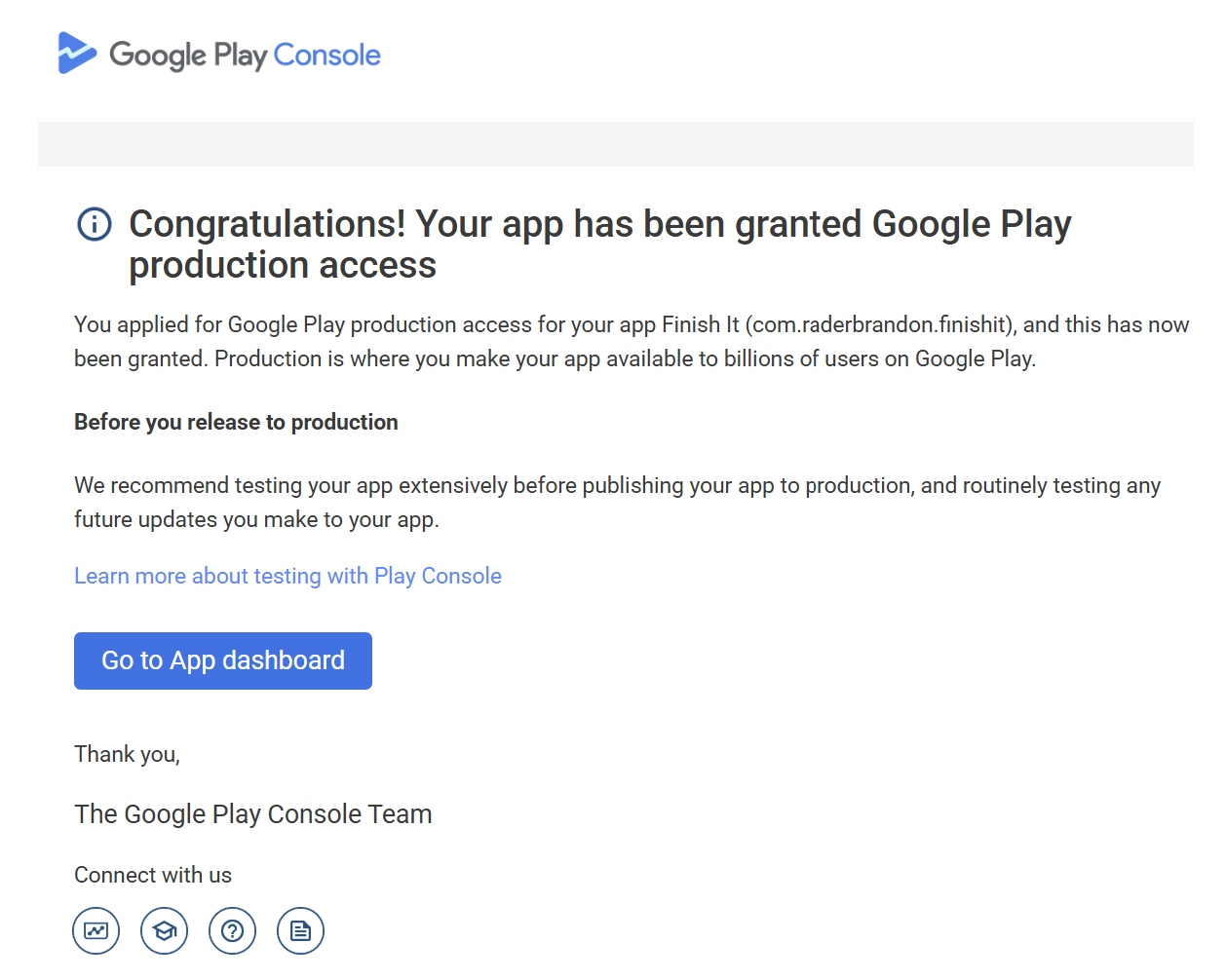
Verified Production Access
Quality QA Testing Reports
Clear, actionable reports with screenshots and evidence for every important issue found during testing.
Real Device Testing & Diagnostics
Real human testers use physical Android devices to test your app, verify real user flows, and provide clear testing evidence and professional QA reports.
Guaranteed App Approval
Transition your Android app to public production access with confidence. We deliver verified session logs and compliant Console activity.
One Cycle. Complete Approval.
Choose the ideal closed testing cycle for your Android release.
Loading Packages
Please wait while we fetch the best options for your region...
Frequently Asked Questions
Everything you need to know about passing your closed testing requirements.