Play Store testers for 14-day Android closed testing in Malta
Find Play Store testers in Malta for 14-day Google Play closed testing. Fulfill Play Console requirements with 12 real testers and launch quickly.
Navigating the 14-Day Google Play Closed Testing Mandate
Google's updated Play Console policy for personal developer accounts requires mandatory closed testing before opening your app to the public. You must recruit a minimum cohort of opted-in testers who maintain active app engagement for 14 uninterrupted calendar days.
The technical evaluation mechanism looks directly at active device retention and spontaneous runtime telemetry. If your enlisted testers install your build on day one, leave it completely untouched on their home screens, or silently uninstall it before the two-week timeframe concludes, your compliance counter halts. To satisfy Play Store Closed Testing parameters, your build must exhibit regular multi-session activity across genuine Android hardware.
The Pitfalls of Friends, Family, and DIY Testing Circles
Many software engineers across Malta initially attempt to clear this milestone by rallying friends, colleagues, and family members across local messaging channels. While enthusiasm is always high during the initial 48 hours, informal volunteer testing groups suffer extreme operational decay within the first week.
Managing personal contacts quickly turns into an exhausting chore of daily reminders and follow-ups. When volunteer testers drop off, neglect mandatory app updates, or inadvertently uninstall the APK, your active tester count plummets beneath the minimum threshold. Google automated evaluation flags this steep drop in user engagement, forcing you to start the entire 14-day testing period from day zero and delaying your commercial launch.
Understanding Google Telemetry and Play Console Metrics
Google does not evaluate your testing cycle using simple binary opt-in checks. Behind the scenes, the Play Console gathers sophisticated telemetry to gauge software reliability and authentic human engagement.
When real testers open your application across Maltese telecommunications carriers such as Epic Malta, GO Mobile, and Melita, the operating system dispatches vital diagnostic health signals directly to Google Play servers.
- Application Not Responding (ANR) Thresholds: Google monitors ANR rates to ensure your main UI thread never locks up during background I/O or network requests. In production-ready apps, the user-perceived ANR rate must remain strictly below the 0.47% bad behavior threshold.
- Crash Rate Telemetry: Unhandled runtime exceptions and fatal crashes are recorded down to the exact device hardware configuration, chipset architecture, and Android API level.
- Session Depth and Navigation Breadth: Play Console analytics observe whether users explore multiple Activities, Fragments, and Composable screens, or if the app is abruptly closed after mere seconds.
- Hardware and Display Diversity: Automated review systems reward builds tested across heterogeneous screen resolutions, varying RAM capacities (from 3GB budget devices up to 16GB flagship devices), and diverse Android versions ranging from Android 10 through Android 15 and 16.
Authentic Human Testing in Malta
- Genuine Physical Hardware: Real people running authentic physical devices across major local networks like Epic, GO, and Melita generate natural system telemetry.
- Organic Usage Patterns: Testers launch multiple app sessions at varied times throughout the day, interact with core features, and trigger genuine UI transitions.
- Detailed Qualitative Diagnostics: Receive real human feedback on UI ergonomics, localization nuances, and performance quirks across diverse form factors.
- Absolute Compliance Safety: 100% compliant with Google Play Console policies, protecting your developer standing and ensuring a smooth transition to production.
Synthetic Bots and Farm Scripts
- Identical Virtual Signatures: Virtual machines and emulators share identical CPU profiles, virtual sensors, and GPU configurations that Google's Play Protect easily flags.
- Robotic Timing Intervals: Automated scripts fire inputs with exact millisecond periodicity and zero touch pressure variation, triggering anti-fraud systems.
- Zero Usability Value: Automated scripts cannot provide meaningful UX feedback or evaluate regional localization and real-world payment flows.
- High Risk of Account Termination: Using synthetic tester farms violates Google Play Developer Distribution Agreements, leading to permanent developer account bans.
The Hidden Dangers of Bot Farms and VPN Spoofing
Faced with tight product deadlines, some engineering teams consider automated bot services or low-cost click farms that promise instant closed testing completion. This shortcut is one of the most dangerous gambles you can make with your Google Play developer credentials.
Google employs state-of-the-art fraud detection models that easily differentiate between a living human using a smartphone and an emulated headless script hosted in a cloud data center. Emulated devices lack realistic battery discharge curves, gyroscope noise, Bluetooth sensor arrays, and natural touch coordinate dispersion. When Google flags suspicious activity in your closed testing track, your production application is denied immediately, and your developer account risks permanent suspension alongside any linked payment methods.
Struggling with the 14-Day Testing Requirement?
Skip the hassle of recruiting unreliable testers. Our professional fleet of real Android devices guarantees Google Play compliance in exactly 14 days. Zero bots. Zero emulators. 100% production approval guarantee.
Choosing the Right Testing Pathway for Your Android App
To understand how professional managed testing stacks up against makeshift friend circles and risky synthetic alternatives, consider this direct comparison:
| Metric and Feature | Professional Managed Cohort | Informal Friends & Family Group | Automated Bot and Click Farms |
|---|---|---|---|
| Play Console Policy Compliance | 100% Guaranteed and Verified Safe | Highly Vulnerable to Activity Drop-offs | Severe Policy Violation (Account Ban Risk) |
| Active Daily Retention | Guaranteed Continuous 14-Day Testing | Inconsistent, Drops Significantly After Day 3 | Scripted, Artificial, Flagged by Algorithms |
| Physical Hardware Diversity | 20+ Unique Android Smartphone Models | Limited to 3 to 5 Personal Devices | Emulated Cloud Instances and Cloned VMs |
| Carrier & Network Variety | Epic, GO, Melita, and European 4G/5G/Wi-Fi | Restricted to Single Local Household Network | Data Center Proxies and Masked VPN Subnets |
| Actionable Bug & UX Reporting | Detailed Crash Logs and UI Feedback | Vague or Emotional Reactions | Completely Non-Existent Telemetry Value |
| Developer Time Commitment | Zero Overhead (Fully Managed) | Endless Manual Follow-ups and Nagging | Minimal Effort with Catastrophic Risk |
| Production Access Approval Rate | Industry-Leading Success on First Review | Frequent Rejections Due to Low Activity | Instant Denial and Account Scrutiny |
Pre-Launch Closed Testing Preparation Checklist
Before inviting testers into your closed testing track, make sure your Android application is technically prepared and meets all Play Console requirements.
Technical Architecture & Build Configuration
build.gradle.kts configuration.Play Console Setup & Opt-In Infrastructure
Localization & Regional Ergonomics
Your Step-by-Step Roadmap to Production Access
Navigating the 14-day closed testing journey is a structured engineering milestone. Here is the proven roadmap to transition your build from a closed testing track to full global production on Google Play.
Step 1: Release Candidate Audit and Console Setup
Upload your finalized Android App Bundle (AAB) to the Closed Testing track within your Google Play Console. Configure your release notes, verify all store listing assets, and provide active test account login credentials so testers can evaluate every authenticated feature without barriers.
Step 2: Onboarding Verified Real-Device Testers
Distribute the official Google Play opt-in link to a dedicated cohort of verified human testers. Each tester accepts the testing invitation through their personal Google accounts and downloads the application directly from the Play Store onto their physical smartphone.
Step 3: Sustained 14-Day Active Testing Protocol
Over the course of 14 continuous days, testers launch your app across multiple sessions, exercise core user workflows, test push notifications, and navigate key interface screens. This sustained usage generates organic device telemetry, crash-free user sessions, and authentic Play Store retention metrics.
Step 4: Iterative Diagnostics and QA Consolidation
Review live telemetry and qualitative feedback gathered throughout the testing phase. If unexpected ANRs or device-specific UI layout glitches arise, publish updated build patches directly to your closed testing track without resetting your active 14-day compliance counter.
Step 5: Production Access Submission and Global Release
Once the 14-day continuous testing threshold is achieved, the 'Apply for Production' button unlocks inside your Google Play Console. Submit your application along with well-documented responses summarizing your testing methodology, feedback collected, and technical refinements to secure immediate production approval.
Frequently Asked Questions
Why does Google Play Console strictly require 12 testers for 14 days for personal developer accounts?
Google introduced this mandatory closed testing policy to eliminate low-quality, buggy, and non-compliant applications from the Play Store. By requiring at least 12 testers to continuously test an app for 14 days, Google ensures that developers thoroughly validate their software on real physical devices across varying network environments. This testing window allows Google automated telemetry to verify that the app maintains a low crash rate, avoids severe ANR freezes, and demonstrates real user engagement before being granted open distribution to global audiences.
Can I use testers located in Malta if my Android app is intended for worldwide distribution?
Yes, absolutely. Google allows your closed testing cohort to come from any country where your closed testing track is enabled. Having real human testers based in Malta provides excellent testing quality because Malta offers modern mobile networks, high smartphone penetration, and multilingual users comfortable with both English and European digital products. Google algorithms focus on device diversity, human interaction fidelity, and continuous retention rather than limiting you to a single geographic territory.
What happens if a tester uninstalls my app during the 14-day closed testing period?
If an opted-in tester uninstalls your application or ceases opening it, your active opted-in tester count can drop below the mandatory 12-tester threshold. When this occurs, Google Play Console may pause your 14-day progress counter until the required number of active installations is restored. In worst-case scenarios, a significant drop in active testers can force you to restart the entire 14-day testing period from the beginning. This is why working with a professional testing service that provides built-in backup testers is the safest way to ensure uninterrupted compliance.
Can I release updates and bug fixes to the Play Store during the active 14-day testing cycle?
Yes! Pushing updated builds to your closed testing track during the 14-day period is not only permitted, it is strongly encouraged by Google. Releasing new APK or AAB versions to fix bugs reported by your testers demonstrates to Google review team that you are actively maintaining the software and using the testing period for genuine quality assurance. Deploying build updates to an existing closed track does not reset your 14-day testing timer, provided your active opted-in testers continue updating and using the app.
How does Google Play detect and penalize fake bot testers and emulator farms?
Google Play relies on SafetyNet, Play Integrity API, and advanced backend behavioral analytics to evaluate testing authenticity. Emulated virtual devices share distinct hardware signatures, lack physical gyroscope and accelerometer noise, maintain unvarying battery percentages, and route traffic through data center IP addresses. Furthermore, automated bots exhibit robotic click patterns with identical millisecond intervals. If Google detects synthetic engagement, your application for production access will be summarily denied, and your developer account risks permanent termination.
What questions does Google ask when applying for Production Access after completing the 14 days?
When you click 'Apply for Production' in the Google Play Console, you must complete a formal questionnaire. Google asks you to describe your target audience, explain how you recruited your closed testing cohort, summarize the specific feedback you received from your testers, outline the bug fixes and enhancements made during the 14 days, and justify why your application is ready for production. Providing detailed, technical, and transparent answers based on authentic testing data ensures fast approval from Google human review team.
How It Works
How we deploy real devices and guarantee compliance for your release.
Get Started
Sign in with Google to configure the closed testing environment for your Android build.
App Submission
Submit your Google Play Console testing link, and our team will assign qualified testers from our testing network to join your Android closed testing release.
14-Day Cycle
A QA supervisor monitors daily check-ins, ensuring 12 unique Android users engage with your Android build every single day.
Production Access Approval
We guarantee 14 consecutive days of active user check-ins to satisfy Google's compliance policies, delivering an audit-ready PDF feedback report.
Why Choose AppConsoleLab
Experience a next-generation testing infrastructure built for Google Play compliance for your Android release.
The 14-Day Production Guarantee
We complete the required 14-day closed testing process with real human testers and physical Android devices, while providing clear testing evidence and documentation throughout the process.
If Google specifically rejects production access due to insufficient testing engagement, you are covered by our free re-run or 100% refund guarantee, subject to our Refund Policy.
Verified Production Access
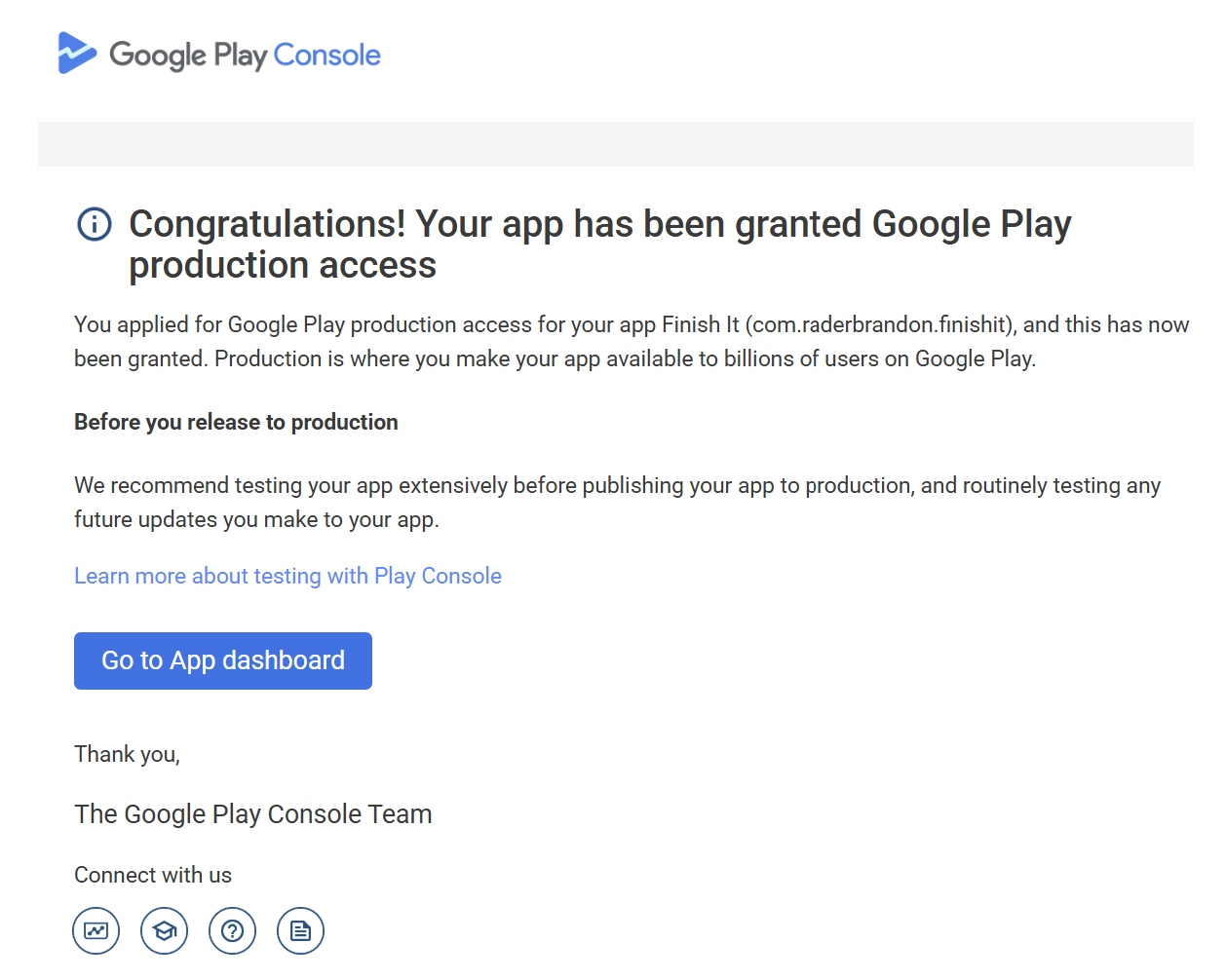
Quality QA Testing Reports
Clear, actionable reports with screenshots and evidence for every important issue found during testing.
Real Device Testing & Diagnostics
Real human testers use physical Android devices to test your app, verify real user flows, and provide clear testing evidence and professional QA reports.
Play Store Ready
Get your Android build approved on the first try. We create an audit-ready compliance profile that proves thorough quality assurance.
Affordable Compliance Cycles
Transparent plans built to satisfy Google Play Console guidelines for your Android build.
Loading Packages
Please wait while we fetch the best options for your region...
Frequently Asked Questions
Everything you need to know about passing your closed testing requirements.