Play Store testers for 14-day Android closed testing in Mongolia
Find Play Store testers in Mongolia for 14-day Google Play closed testing. Fulfill Play Console requirements with 12 real testers and launch quickly.
Navigating the Mongolian Android Development Landscape
Mongolia's mobile ecosystem is centered around mobile-first utility. Smartphone usage is exceptionally high, with Android commanding the vast majority of consumer hardware across major urban centers and regional aimags. Yet, developers often encounter unique platform challenges when preparing for global or localized release.
A major challenge revolves around linguistic rendering and UI responsiveness. Modern Mongolian apps frequently balance Cyrillic Mongolian text with occasional traditional Mongolian script or English technical terms. Variable character lengths in Cyrillic strings can easily cause text truncation, broken line wraps, or overlapping UI components on compact budget smartphones. Furthermore, localized fintech tools, delivery services, and educational apps must integrate reliably with local banking APIs, QPay gateways, and mobile wallet infrastructure while remaining resilient against fluctuating cellular connectivity outside urban centers.
When you recruit real Mongolian testers for your Google Play Closed Testing track, you gain immediate visibility into these edge cases. You discover how your layouts behave across diverse physical devices from Samsung, Xiaomi, and Realme, how background sync processes handle network transitions across Unitel and Mobicom, and whether your onboarding workflow feels natural to Mongolian users.
The Pitfalls of Automated Bots vs. Authentic Human Testers
Facing the pressure of launching quickly, many developers search for shortcuts to fulfill the 14-day rule. The web is full of low-cost services offering automated scripts, cloud emulators, or VPN-routed bot rings to pass the 12-tester threshold overnight. Choosing this route is one of the quickest ways to jeopardize your developer account.
Google Play's detection algorithms evaluate hundreds of hardware and telemetry signals during closed testing. Bot farms use rooted virtual devices with static hardware fingerprints, predictable session timings, and zero natural sensor activity. When Google identifies artificial engagement, they do not just reject your production access request - they may permanently terminate your Google Play Console account for deceptive behavior.
Authentic Mongolian Testers
- Real Hardware & Networks: Tests run on authentic physical devices operating on genuine local networks (Unitel, Mobicom, Skytel), generating legitimate network and battery telemetry.
- Natural Human Interactions: Real users navigate flows, test Cyrillic text fields, trigger organic edge cases, and report genuine bugs.
- Accurate Telemetry Profiles: Natural session lengths, screen rotations, background pauses, and crash logs satisfy Play Console automated compliance scanners.
- Account Safety Guaranteed: Total compliance with Google Play Developer Policies protects your personal developer reputation and keeps your app track clean.
Automated Bots & Emulator Farms
- Identical Hardware Fingerprints: Virtual instances share identical build properties and emulator flags that Google SafetyNet and Play Protect instantly flag.
- Zero Usability Insights: Bots cannot tell you if your MNT currency symbols break layout containers or if your QPay deep-links fail.
- Suspicious Telemetry Patterns: Static 30-second sessions and simultaneous login timestamps trigger automated review flags inside Google Play Console.
- High Risk of Account Suspension: Using fake engagement violates Google's core integrity policies, leading to denied production access or account bans.
Understanding Play Console Telemetry and the 14-Day Rule
Google does not enforce the 14-day closed testing requirement merely to make developers wait. The 14-day duration acts as an active data-gathering window where Google's automated systems evaluate app stability, user engagement, and core technical metrics before granting production access.
During this two-week window, the Play Console monitors several crucial health signals:
- Active Opt-In Retention: Having 12 testers opt in on Day 1 is not enough if they all uninstall by Day 3. Google monitors whether testers keep the app installed on their devices throughout the entire 14-day testing window.
- Android Vitals & Crash Rates: The Play Console tracks your crash rate and Application Not Responding (ANR) rate. If your app exceeds the bad behavior threshold (such as an overall crash rate higher than 1.09% or a user-perceived ANR rate above 0.47%), your production application will likely be rejected.
- Organic Interaction Data: Google evaluates natural interaction patterns, including how often users open the build, resume from background states, and interact across multiple app updates.
By engaging genuine Play Store Closed Testing participants who actually keep the app installed and interact with it across the test period, you build a healthy Android Vitals record that makes production approval smooth and predictable.
Struggling with the 14-Day Testing Requirement?
Skip the hassle of recruiting unreliable testers. Our professional fleet of real Android devices guarantees Google Play compliance in exactly 14 days. Zero bots. Zero emulators. 100% production approval guarantee.
Comparing Testing Options for Your Android App
When structuring your strategy to recruit 12 testers for 14 days, it helps to compare the primary paths available to independent developers and engineering teams.
| Evaluation Metric | Professional Managed Testing | DIY Testing (Friends & Family) | Low-Cost Bot Farms |
|---|---|---|---|
| Google Policy Compliance | 100% verified, fully compliant with Play Console rules | Compliant if testers remain active and opted-in | Non-compliant; triggers policy strikes and bans |
| Hardware Diversity | Real consumer Android smartphones across varied OS versions | Limited to the devices owned by your immediate social circle | Simulated virtual environments with duplicate device IDs |
| Tester Retention (14 Days) | Guaranteed daily retention throughout the full test cycle | High dropout rate; friends frequently forget or uninstall | Scripted retention that lacks natural human telemetry |
| Qualitative Feedback | Actionable bug reports, UI reviews, and localized insights | Casual, biased feedback without structured bug details | Completely non-existent; no human feedback provided |
| Network & Locale Realism | Authentic regional carriers (Unitel, Mobicom, Skytel) | Authentic local connections if your contacts are in-country | Data center IP addresses masked with consumer VPNs |
| Production Approval Rate | High success rate due to organic vitals and continuous data | Moderate; often delayed by inactive testers dropping out | Zero; commonly results in rejection or account ban |
Pre-Testing Checklist: Preparing Your Build for Closed Testing
Before you upload your App Bundle (.aab) to the Google Play Console and invite your closed testing group, complete these technical and operational preparation steps to prevent unnecessary delays.
Play Console Configuration & Compliance
Target Latest Android API Level: Ensure your application targets the latest required Android API level (API 34 or higher) to satisfy current Google Play publishing mandates.
Target Countries Configured: Double-check that Mongolia (and all other intended global launch regions) is selected under the Countries/Regions tab within your Closed Testing track.
Privacy Policy & Permissions: Verify that your public Privacy Policy URL is live, accessible, and accurately details all runtime permissions (such as location, camera, or storage access).
App Content Declarations Complete: Fill out all mandatory questionnaire sections in the Play Console, including Data Safety, Target Audience, Financial Features, and Ads declarations.
Local App Optimization & Stability
Cyrillic & Font Rendering Check: Audit all UI layouts on small and large screen form factors to ensure Cyrillic Mongolian typography does not truncate or wrap awkwardly.
Payment & Currency Verification: Test all pricing displays to confirm that Mongolian Tögrög amounts (MNT / ₮) format cleanly without visual glitches.
Network Resilience & Offline Handling: Implement graceful offline fallbacks and error handling for users moving between high-speed 4G/5G in Ulaanbaatar and lower-bandwidth 3G coverage in provincial areas.
ProGuard / R8 Obfuscation Verification: Test release builds locally to ensure code shrinking and obfuscation rules have not stripped necessary data models or third-party SDK dependencies.
The 5-Step Roadmap to Successful Production Access
Navigating the 14-day closed testing requirement does not have to be stressful. By following a structured step-by-step roadmap, you can systematically move from an initial release build to full Google Play Store production approval.
Step 1: Set Up Closed Testing Track in Play Console
Create a new Closed Testing track within your Google Play Console dashboard. Configure your release settings, define your release name and release notes, and upload your signed release Android App Bundle (.aab).
Step 2: Recruit and Organize 12+ Real Testers
Assemble your group of real Android testers. Create an email list containing their Google Play account email addresses and attach the list to your closed testing track. Ensure you have at least 12 to 20 opted-in testers to maintain a safe margin.
Step 3: Distribute Opt-In Links & Confirm Installations
Share the web or Android opt-in link provided by Google Play Console with your testing group. Verify that all testers accept the invite via the Google Play Store, download the build, and complete an initial onboarding session on their devices.
Step 4: Maintain Active 14-Day Engagement & Telemetry
Keep your testers engaged across the 14 continuous days. Testers should periodically open the app, explore features, test updates, and generate organic Android Vitals data while leaving the app installed.
Step 5: Apply for Production Access with Complete Answers
Once the 14-day milestone completes with all 12+ testers continuously opted-in, submit your production access application. Provide thorough, detailed answers explaining your recruitment process, testing feedback gathered, and bug fixes implemented during the closed test.
Frequently Asked Questions
Why does Google Play require 12 testers for 14 days for personal developer accounts?
In late 2023, Google introduced a strict policy for all new personal developer accounts to improve overall app quality and protect consumers from malicious or broken software. Google requires developers to run a closed test with at least 12 opted-in testers continuously over 14 full days before unlocking production publishing rights. This mandatory window gives Google's automated systems enough time to gather realistic telemetry data, monitor crash rates (Android Vitals), and verify that the developer is actively maintaining and testing their application on real devices.
Can I use automated testing tools or emulators to satisfy the 14-day requirement?
No. Using automated bots, device farms, or cloud emulators to simulate tester engagement is a direct violation of Google Play Developer Program Policies. Google's algorithms analyze deep device telemetry, including hardware sensor data, battery metrics, Google Play Services authentication tokens, and user interaction patterns. When artificial patterns are detected, Google will reject your production access request and may permanently terminate your Play Console developer account.
What happens if a tester uninstalls the app during the 14-day closed testing period?
If a tester uninstalls your application or opts out of the closed test, your active tester count in the Play Console drops. If your total active opted-in tester count falls below the required threshold of 12 testers, your 14-day countdown may pause or reset completely. To prevent this, it is best practice to recruit between 15 and 20 reliable testers so that unexpected uninstalls do not interrupt your testing progress.
How should I test Mongolian language fonts and Cyrillic UI elements in Android?
Mongolian applications often utilize Cyrillic script alongside technical English terms, which can lead to layout issues due to varying string lengths. During closed testing, have real testers examine screens on multiple physical device sizes. Focus on button labels, modal dialogue windows, checkout forms, and push notifications to confirm that text wraps cleanly without overlapping, clipping, or breaking layout containers across different display densities and system font scaling settings.
Can I push bug fixes and app updates while the 14-day test is running?
Yes, you can and should push app updates during the closed testing period. When you fix bugs or improve features, upload a new build (.aab) to the same Closed Testing track. Pushing updates demonstrates to Google's review team that you are actively responding to user feedback and improving app stability. As long as your testers remain enrolled in the closed testing track, updating your build will not reset your 14-day counter.
What questions does Google ask when applying for Production access after the 14 days?
After completing the 14-day closed testing period, Google Play Console prompts you to fill out a production access questionnaire. You will be asked how you recruited your testers, what specific feedback you received from them, what changes or bug fixes you made during the test, and why you believe your app is ready for a public audience. Providing thoughtful, authentic, and detailed responses about your testing process is crucial for securing final production approval.
Our QA Process
Your journey to Google Play production access, simplified and automated.
Choose Package
Authenticate your account to initialize the 14-day QA fleet for your Android release.
Submit Link
Upload your testing link. We assign 12 verified users with real Android devices to download and test your Android release.
Active Testing
A dedicated testing supervisor is assigned to monitor progress while testers engage with your Android app and provide feedback throughout the testing period.
Get Approved
Our lab maintains active installations for two weeks straight, ensuring a clean track record and providing a QA compliance log for your release.
The Premium QA Advantage
Satisfy your Play Store Console testing obligations with our managed physical device fleet tailored for Android builds.
The 14-Day Production Guarantee
We complete the required 14-day closed testing process with real human testers and physical Android devices, while providing clear testing evidence and documentation throughout the process.
If Google specifically rejects production access due to insufficient testing engagement, you are covered by our free re-run or 100% refund guarantee, subject to our Refund Policy.
Verified Production Access
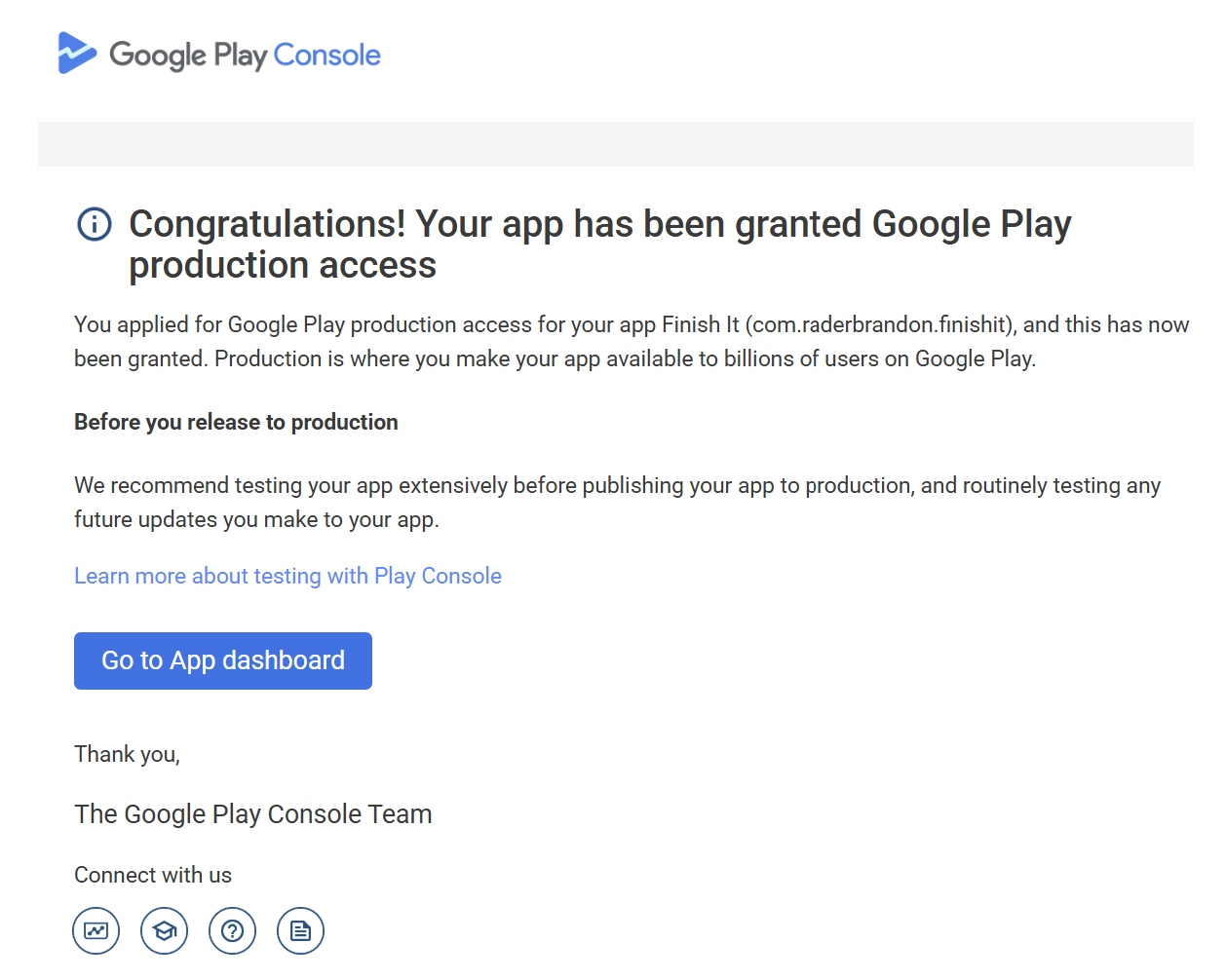
Quality QA Testing Reports
Clear, actionable reports with screenshots and evidence for every important issue found during testing.
Real Device Testing & Diagnostics
Real human testers use physical Android devices to test your app, verify real user flows, and provide clear testing evidence and professional QA reports.
Production Access Secured
Our structured 14-day closed testing process is designed to meet Google Play's production requirements for your Android release.
Simple Closed Testing Pricing
Select the plan that fits your Android app complexity.
Loading Packages
Please wait while we fetch the best options for your region...
Frequently Asked Questions
Everything you need to know about passing your closed testing requirements.