Play Store testers for 14-day Android closed testing in Norway
Pass Google Play closed testing with Play Store testers in Norway. Secure 12 testers for 14 days to meet Play Console rules for Android app testing.
Picture this: you have spent months, perhaps even years, refining your Android application. You have translated your brilliant idea into thousands of lines of perfectly optimized code, and you are finally ready to introduce it to one of the most digitally advanced and lucrative markets in the world - Norway. But before you can pop the non-alcoholic champagne, sit back, and watch the download metrics skyrocket, a formidable gatekeeper stands firmly in your way. Google's strict developer policy now requires a comprehensive Play Store Closed Testing phase before any new personal developer account can publish an app to the public masses.
You might be thinking that finding a few friends to tap around your app for a few days is enough to satisfy the algorithm. However, the reality of the requirement is far more rigorous than most developers anticipate. You need a dedicated, reliable group of users to actively engage with your creation over a sustained period. While some independent developers scour the internet looking for ways to just scrape by, securing genuine Play Store testers for 14-day Android closed testing in Norway is not just a frustrating compliance box to tick - it is a golden opportunity to perfect your product.
Norwegians are inherently tech-savvy, they value high-quality digital experiences, and they are notoriously unforgiving of buggy, poorly localized software. The Scandinavian standard for user interface and user experience is exceptionally high. If your application can survive a rigorous Closed Testing phase with real users from Oslo to Tromsø, proving its stability and value, it has the potential to thrive anywhere on the globe. In this comprehensive guide, we are going to dive deep into exactly why you need authentic testers, how the Google Play Closed Testing requirements actually work behind the scenes, and why taking cheap shortcuts could spell absolute disaster for your hard-earned developer account.
The Reality of Google Play Closed Testing
When Google first introduced the mandatory testing phase for new personal developer accounts created after November 2023, it sent shockwaves through the indie developer and startup community. The rule sounds relatively straightforward on paper, but the execution is where many stumble. You need real humans to opt-in to your testing track and keep your application installed for a consecutive two-week period. Many developers still search forums and blogs for the phrase '12 Testers for 14 Days' hoping for a lighter, older requirement, but the current standard demands a robust, unwavering group of at least 20 active testers.
The primary goal behind this policy shift is to ensure that only functional, valuable, and safe applications make it to the production track of the Google Play Store. For years, the store was flooded with low-effort clone apps, spam, and outright malware. This testing phase acts as a vital quality assurance filter, protecting end-users and elevating the overall ecosystem.
If you are specifically targeting the Norwegian market, your Play Store Closed Testing phase needs to reflect the exceptional quality expected by that demographic. A testing phase is no longer just about keeping an application dormant on a device to run out a timer. Google's review algorithms are increasingly sophisticated and AI-driven. They actively look for genuine user interaction, monitor crash reports, analyze ANR (Application Not Responding) rates, and study natural usage patterns to determine if an app is truly ready for prime time.
Why Target the Norwegian Market?
Norway boasts one of the highest smartphone penetration rates globally, hovering near total saturation for adults. The digital infrastructure is phenomenal, with blazing-fast 5G networks blanketing even remote fjords, and the users are accustomed to seamless, beautifully designed digital applications. If you are launching an app localized specifically for Norway, or targeting the broader Scandinavian demographic, having testers who inherently understand the cultural context, the local language nuances (whether Bokmål or Nynorsk), and local user expectations is an invaluable asset. Norwegians appreciate clean, minimalist design and hyper-functional utility. Your testing phase is the ultimate proving ground to ensure your app meets these lofty standards.
The Danger of Taking Shortcuts: Real Users vs Bots
It is incredibly tempting to look for the cheapest, fastest way possible to force your way through the testing phase. A quick web search will undoubtedly reveal dozens of shady services and freelance platforms offering to pass your app using automated bots, emulators, or overseas click-farms for pennies on the dollar. Let us be absolutely clear about this - Google's Play Protect system and their backend developer console analytics are specifically engineered to catch exactly this kind of fraudulent behavior.
Using fake testers is a direct violation of Google Play policies and can result in a catastrophic lifetime ban of your Google Developer account. All the hard work, the countless sleepless nights spent debugging code, and your initial financial investment could be permanently wiped out in an instant simply because you tried to bypass the security system. Google links developer accounts via credit cards, recovery emails, phone numbers, and hardware IDs. Once you are banned, creating a new account is virtually impossible.
Authentic Testing Services
- Genuine Devices: Applications are installed on real, physical Android phones and tablets, not server-side emulators.
- Natural Behavior: Testers open the app at random times, click through various screens naturally, and generate real usage telemetry data.
- Valuable Feedback: Real human beings can spot confusing UI elements, clunky navigation, or translation errors that bots miss completely.
- Policy Compliance: One hundred percent compliant with all Google Play Closed Testing guidelines, ensuring a smooth, stress-free path to production.
- Account Safety: Zero risk of developer account termination due to policy violations or fraudulent testing activity.
Fake Bot Services
- Emulated Environments: Relies on massive server-farms and cheap emulators that Google's security algorithms easily identify and flag.
- Predictable Patterns: Bots often open the app at the exact same time every single day, triggering Google's automated spam and fraud filters.
- Zero Meaningful Data: Provides absolutely no actionable feedback on the user experience, visual design, or core functionality.
- High Rejection Rate: Apps are frequently rejected during the final manual review phase due to highly suspicious and robotic testing metrics.
- Account Bans: Exceptionally high probability of losing your developer fee and being banned from the Android ecosystem forever.
What Makes a Successful 14-Day Test?
To truly understand what the Google review team is looking for during your mandatory 14-day evaluation period, we need to look deeply at the underlying metrics that actually matter. It is not just about securing the initial installation. The system monitors a holistic view of your app's health.
- Unwavering Retention: The application must remain installed on the testers' devices for the full, uninterrupted 14 days. If multiple testers uninstall your app on day twelve to free up storage space, your active tester count drops, the compliance clock resets, and your launch is delayed.
- Genuine Engagement: Testers need to actually open and explore the app. An application that sits completely dormant for two straight weeks looks highly suspicious to Google's reviewers and suggests the testers are not genuine.
- Technical Stability: This is the perfect window to meticulously monitor your Android Vitals dashboard. Are there unexpected crashes happening on specific Samsung or Google Pixel device models? Is the app draining the battery excessively or utilizing too much background memory?
- Qualitative Feedback Submission: While it is not strictly mandatory for every single tester to write an essay, having a few dedicated testers submit private, constructive feedback through the Play Store interface strongly reinforces the legitimacy and value of your testing phase.
Struggling with the 14-Day Testing Requirement?
Skip the hassle of recruiting unreliable testers. Our professional fleet of real Android devices guarantees Google Play compliance in exactly 14 days. Zero bots. Zero emulators. 100% production approval guarantee.
Cultural Localization: Winning Over Norwegian Users
When you are preparing for a Norwegian release, localization goes far beyond simply running your English text through a basic translation tool. The Norwegian market demands authenticity. While English proficiency in Norway is among the highest in the non-native speaking world, offering a flawless local experience builds immense trust.
During your Closed Testing phase, you should specifically monitor how users interact with localized elements. Does your app support integration with local payment giants like Vipps? If your app requires identity verification, does it play nicely with BankID, the standard electronic identity in Norway? Furthermore, Norway adheres strictly to European GDPR regulations regarding data privacy. Your privacy policies, cookie consent banners, and data handling practices must be transparent and legally sound. A proper testing phase allows you to verify that these crucial regional integrations function seamlessly before you expose them to the wider public.
The Ultimate Pre-Launch Preparation
Before you even send out your first testing invitation link to a user in Norway, your application needs to be practically flawless. You absolutely do not want to waste your precious 14-day window fixing critical, app-breaking bugs that should have been caught in basic internal testing. Use this comprehensive checklist to ensure your digital product is truly prepared for the spotlight.
Technical Readiness and Optimization
Store Listing and Compliance Essentials
Testing Track Configuration
Comparing Your Testing Options
When you are finally ready to gather your crucial group of testers, you essentially have a few different paths you can take. Let us objectively compare the most common approaches independent developers use to navigate and pass the strict Google Play Closed Testing phase.
| Feature | Professional Testing Service | DIY (Friends, Family, Co-workers) | Shady Bot Networks |
|---|---|---|---|
| Overall Reliability | Extremely High | Low (People get busy and forget) | High (But incredibly dangerous) |
| Manual Effort Required | Minimal to None | Very High | Minimal |
| Quality of Feedback | Structured, detailed, and actionable | Casual, biased, and often vague | Non-existent |
| Developer Account Safety | 100% Secure and Compliant | Safe and Compliant | Extremely Risky (High ban rate) |
| Financial Cost | Moderate Investment | Free (But costs immense personal time) | Cheap |
| Policy Compliance | Guaranteed to pass checks | Uncertain (Depends on engagement) | Fails Google's security checks |
As the comparison clearly illustrates, relying solely on friends and family members is often vastly more stressful than it is actually worth. People have busy, complicated lives. They forget to open the app for days at a time, they accidentally uninstall it to free up space for a downloaded movie, and suddenly your meticulous 14-day timer is ruined, forcing you to start completely from scratch. Professional services that provide real, dedicated, compensated testers take the immense headache and uncertainty out of this critical process.
The Journey to Production: Step-by-Step
Navigating the labyrinthine menus of the Google Play Console for the first time can feel like wandering through a complex maze in the dark. To help you maintain your sanity, here is the exact, step-by-step roadmap you will follow from uploading your very first bundle to celebrating your live application in the Norwegian Play Store.
App Bundle Upload and Configuration
You begin the journey by compiling your optimized Android App Bundle (AAB) and uploading it securely to the Closed Testing track in the Play Console. This initial stage requires methodically filling out all the necessary store listing information, completing regional content ratings, and finalizing your data safety forms.
Initial Google Policy Review
Before your invited testers can even attempt to download the application, Google performs an initial, rigorous automated and manual review to ensure your app code does not violate any core developer policies or request restricted device permissions unnecessarily. This process usually takes a few business days.
Inviting and Onboarding Testers
Once officially approved for the testing track, you manually add your testers' registered Google email addresses to the approved testing list. You will then share the special opt-in web link with them. For a smooth Norwegian launch, ensuring these specific users are ready to engage immediately is crucial.
The 14-Day Evaluation Crucible
The critical clock officially starts ticking the moment the required minimum number of testers have accepted the opt-in invite and actively installed the app on their devices. Over the next two consecutive weeks, they will interact with your software, and Google will silently monitor all the resulting telemetry and stability data.
Applying for Production Access
After successfully surviving the 14 days without your tester count dropping below the threshold, a special button will finally unlock in your Play Console dashboard allowing you to apply for coveted production access. You will be required to answer a few detailed questions about how the testing phase went and what specific user feedback you implemented.
The Final Launch
Upon passing the final, thorough review from the Google team, your application smoothly transitions to the public production track. It is now officially live, fully searchable in the Google Play Store, and ready to be downloaded by millions of potential highly-engaged users in Norway and beyond!
Maximizing the Value of Your Testers
If you are going to go through the significant effort and potential expense of securing a dedicated group of testers, you should actively extract as much developmental value from the process as humanly possible. Google Play Closed Testing is not merely an annoying bureaucratic obstacle; it is a highly concentrated, incredibly valuable focus group for your product.
Encourage your testers to actively try and break your application. Ask them to navigate through the complex menus as fast as possible, to intentionally lose their Wi-Fi connection while loading a crucial payment page, and to input unexpected special characters into standard text fields. The obscure bugs and logical flaws they uncover during this two-week safety period are critical issues that your actual paying customers will now never have to experience. This highly proactive approach saves you from devastating, momentum-killing one-star reviews on your official launch day.
Understanding the Algorithm's Perspective
While Google obviously does not explicitly publish the exact parameters and mathematical weights of their internal testing review algorithm, years of collective developer experience and observation have painted a very clear picture. The automated system is ultimately looking for a healthy baseline of standard application behavior.
If your application crashes immediately on fifty percent of the devices it is installed on, Google will highly likely reject your application for production access, even if those loyal testers stubbornly kept the broken app installed for the full 14 days. Google's primary imperative is to maintain the overall quality and reputation of the Play Store ecosystem. This is exactly why having real, communicative testers who can quickly report these crashes - allowing you to push vital emergency updates during the testing phase - is absolutely critical. And yes, you can confidently update your app code while it is actively in the Closed Testing phase. Doing so does not reset your 14-day countdown clock, provided the testers actually download and install your updated version.
Frequently Asked Questions
Do I absolutely need all my testers to physically reside in Norway if I am launching my app there?
While Google's official policy does not strictly mandate that your initial testing group must reside perfectly within your target launch country, having testers from Norway is exceptionally highly recommended if your application is heavily localized, culturally specific, or tailored for that exact market. It ensures the feedback you receive regarding language, local integrations, and user experience is completely culturally and contextually relevant to your future customer base.
What exactly happens if a tester decides to uninstall my app on day 12 of the test?
This is the most common pitfall. If your total number of active, installed testers drops below the strict minimum requirement set by Google at any point during the 14 days, the compliance requirement is unfortunately no longer met. You will need to immediately recruit a replacement tester, and depending on the severity of the drop, the 14-day consecutive testing period may be entirely reset by the system. This severe penalty is exactly why reliable, professional testing services are so incredibly valuable.
Am I allowed to push code updates or bug fixes to my app during the 14-day testing period?
Yes, absolutely! In fact, Google highly encourages this practice. If your testing group uncovers a significant bug and you swiftly push an update to resolve it, it clearly demonstrates to Google's reviewers that you are in active development and genuinely engaging with the testing process to improve the product. Pushing a new version to the testing track does not reset your 14-day timer.
I keep seeing references to the '12 Testers for 14 Days' rule. Is this still the active requirement?
The developer requirements have evolved significantly over time to combat platform spam, and the current, actively enforced standard for all new personal developer accounts requires a robust group of at least 20 active testers for 14 continuous days. You may still see older developer forums, outdated blog posts, or legacy services mentioning 12 testers, but you must strictly adhere to the current Play Console guidelines of 20 testers to successfully publish your application today.
How long does Google typically take to review the application after the 14 days are finally over?
Once you successfully complete the testing phase and officially apply for production access within the console, Google's final review typically takes anywhere between 2 to 7 business days. However, this timeframe can vary wildly depending on the overall complexity of your application, the permissions it requests, and the current backlog volume of the review queue.
Final Thoughts on Conquering the Play Store
Entering the highly sophisticated Norwegian digital app market is a genuinely exciting milestone for any software developer or ambitious startup. The local purchasing power is exceptionally high, the users are deeply engaged with their devices, and a successful, well-crafted application can generate significant, sustained revenue. However, the mandatory barrier to entry - the strict Google Play Closed Testing requirement - must be respected and navigated correctly.
By treating this 14-day evaluation period not as an arbitrary punishment, but as a vital, highly beneficial quality assurance phase, you set your software application up for long-term, sustainable success. Avoid the dangerous temptation of cheap bot networks and fake accounts that risk your entire enterprise. Invest the time and resources in real, high-quality, authentic testing. Gather the telemetry data, aggressively fix the hidden bugs, relentlessly refine the user experience based on real feedback, and when you finally earn the right to hit that publish button, you can do so with the absolute confidence that your app is truly ready to conquer Norway and the world.
How We Deliver 12 Testers
A straightforward 4-step process to get your Android app approved.
Connect Account
Connect your Google account and choose your preferred closed testing package for your Android app.
Assign Testers
Share your Play Store opt-in URL. We immediately deploy 12 real testers to launch and review your Android app daily.
Daily QA Runs
Our crew initiates daily launch sessions on physical devices, verifying usability and logging crashes for your Android app.
Launch Ready
We continuously perform closed app testing for 14 days to help you meet Google Play production requirements. We also provide a compliance report.
Our Testing Infrastructure
Deploy your Android app onto real retail-grade handsets using our secure laboratory environment.
The 14-Day Production Guarantee
We complete the required 14-day closed testing process with real human testers and physical Android devices, while providing clear testing evidence and documentation throughout the process.
If Google specifically rejects production access due to insufficient testing engagement, you are covered by our free re-run or 100% refund guarantee, subject to our Refund Policy.
Verified Production Access
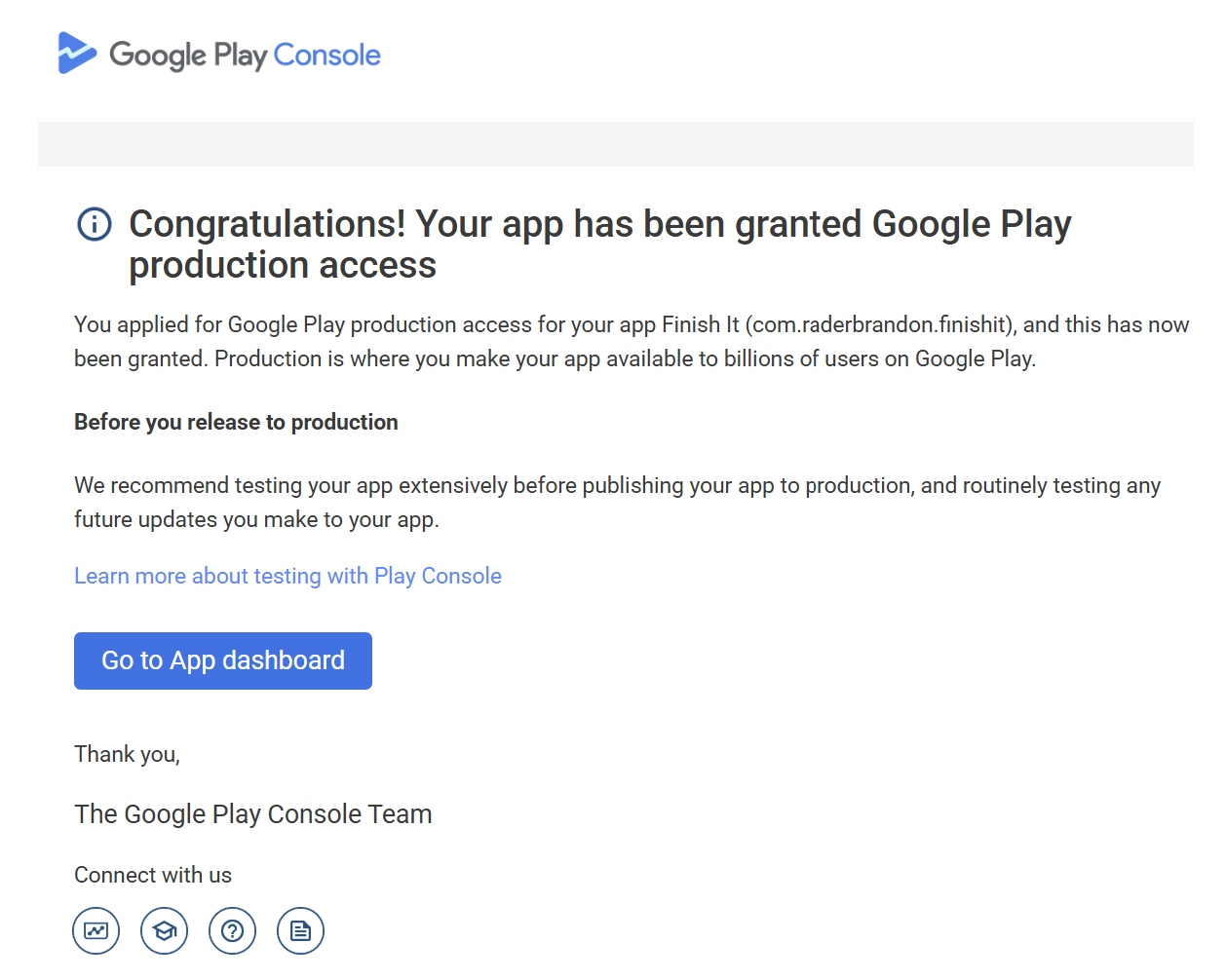
Quality QA Testing Reports
Clear, actionable reports with screenshots and evidence for every important issue found during testing.
Real Device Testing & Diagnostics
Real human testers use physical Android devices to test your app, verify real user flows, and provide clear testing evidence and professional QA reports.
Compliance Audit Passed
Transition your Android app to public production access with confidence. We deliver verified session logs and compliant Console activity.
One Cycle. Complete Approval.
Choose the ideal closed testing cycle for your Android release.
Loading Packages
Please wait while we fetch the best options for your region...
Frequently Asked Questions
Everything you need to know about passing your closed testing requirements.