Play Store testers for 14-day Android closed testing in Oman
Find Play Store testers in Oman for 14-day Google Play closed testing. Fulfill Play Console requirements with 12 real testers and launch quickly.
Why 12 Active Testers Are Mandatory for Google Play
Google introduced the 12-tester policy to eliminate low-quality, buggy, and non-functional apps from flooding the store. Under this framework, automated validation systems monitor the closed testing track to confirm that genuine users engage with your build continuously. It is not enough to send email invites or have testers download the APK once and forget it. Google expects sustained, real-world user activity across the entire 14-day window.
For mobile teams developing in or targeting the Sultanate, securing verified Play Store Closed Testing participants provides critical baseline telemetry. Testing your application on authentic regional hardware over local telecommunication networks like Omantel, Ooredoo Oman, and Vodafone Oman reveals crucial real-world bugs, regional latency issues, payment gateway quirks, and Arabic right-to-left (RTL) layout rendering defects before your public launch.
The Logistical Friction of Managing DIY Testers
Recruiting a DIY tester cohort of friends, family members, or casual online volunteers almost always leads to unexpected friction. While volunteers often agree to help with great enthusiasm, their participation drops dramatically after forty-eight hours. People forget to open the app, mute testing notifications, or accidentally uninstall the build to free up internal phone storage.
When your active tester count drops below the mandatory threshold of 12 for even a single day, Google Play Console pauses the countdown timer or rejects your production access application entirely. Trying to constantly nudge twelve to twenty busy contacts across two full weeks turns into a stressful chore that drains time away from core engineering, marketing, and feature development.
What Google Evaluates During the 14-Day Closed Track
When your Android App Bundle (.aab) is deployed to the closed testing track, Google Play Console initiates continuous automated telemetry gathering. The review algorithms evaluate several key health metrics that determine whether your app qualifies for production access:
- Daily Active Engagement (DAU): Automated crawlers verify that enrolled users open the application across varied times of the day, navigate through separate screens, and trigger UI events rather than generating static single-second sessions.
- Android Vitals & Crash Rates: The Play Console tracks your User-Perceived Crash Rate and Application Not Responding (ANR) rate. Keeping these numbers well below Google's bad behavior threshold (0.47% for crashes and 0.28% for ANRs) is mandatory for approval.
- Hardware & Operating System Diversity: Review systems inspect the variety of devices executing the test. A healthy testing cohort includes diverse chipset architectures (ARM64, ARMv7), varied screen aspect ratios, and multiple Android versions ranging from Android 10 up through Android 15 and 16.
- Tester Opt-In Authenticity: Google verifies that testers accepted their invites through authorized Google Play opt-in URLs and downloaded the app directly through the Google Play Store client using verified Google accounts with valid transaction and activity histories.
The Severe Risks of Using Synthetic Testing Services
Faced with the challenge of gathering reliable testers, some creators turn to cheap bot packages or automated script farms advertising instant approvals. Relying on synthetic testing methods is the fastest way to get your Google Play developer credentials permanently blacklisted.
+-------------------------------------------------------------------------+
|                  SYNTHETIC BOT FARM DETECTION PIPELINE                  |
+-------------------------------------------------------------------------+
| [Data Center IP Pool] ---> [Static Emulators] ---> [Automated Clicks]   |
|                                                                         |
|  Google Detection Systems:                                              |
|  * Identical Canvas Fingerprints & Accelerometer Null Data              |
|  * Linear Touch Vectors & Superhuman Tap Cadence                        |
|  * Clustered Cloud ASN IP Addresses (AWS, DigitalOcean, Hetzner)        |
|                                                                         |
|  RESULT: Track Invalidation -> Account Suspension -> Identity Ban       |
+-------------------------------------------------------------------------+
Google’s sophisticated behavioral neural networks easily distinguish human interaction from script loops. Emulators running on cloud servers lack genuine sensor telemetry such as battery temperature fluctuations, ambient light sensor inputs, and variable touch pressure. When Google identifies artificial engagement on your closed testing track, the consequences are severe: immediate rejection of production access, permanent closure of your developer account, and association-level blacklisting of your legal name, payment methods, and national identity details.
How a Managed Testing Partner Streamlines Compliance
Partnering with a professional testing provider turns Google Play Closed Testing into an effortless, predictable success. Rather than gambling your release timeline on unverified volunteers or dangerous bot networks, a managed service supplies genuine human testers using physical Android smartphones.
A managed cohort guarantees that your daily active tester numbers remain safely above Google's requirements throughout the entire 14-day cycle. You gain detailed bug feedback, actionable UX insights, and the exact telemetry footprint Google Play algorithms look for when granting production release rights.
| Evaluation Metric | Professional Managed Service | DIY Friends & Social Groups | Automated Click Farms / Bots |
|---|---|---|---|
| Compliance Guarantee | 100% Guaranteed 14-Day Completion | High Risk of Invalidation & Reset | 100% Risk of Permanent Account Ban |
| Active Daily Usage | Continuous, Verified Daily Testing | Rapid Drop-off After Day 2 or 3 | Fake Programmed Loops |
| Device Spectrum | Real Physical Smartphones (ARM64) | Limited to Casual Personal Phones | Cloud Emulators / Virtual Desktops |
| Network Telemetry | Authentic ISP & Mobile Carrier Data | Random, Often Non-Targeted | Data Center ASN IPs (Flagged) |
| Actionable QA Feedback | Structured Logs, UI & Crash Reports | Minimal or Vague Casual Notes | Zero Real Human Feedback |
| Developer Workload | Zero Management Time Needed | Hours of Chasing Down Contacts | Low Effort, Catastrophic Penalty |
Authentic Human Testing in Oman
Real human testers download your application directly from the Google Play Store on real Android devices. They interact with your features every day across genuine local and regional networks, generating natural touch curves, accelerometer data, and valid session lengths that fulfill Google's rigorous evaluation criteria.
Synthetic Scripts & Cloud Emulators
Automated testing bots run scripted headless browser sessions or emulated Android instances hosted in data centers. Google's security systems detect identical hardware IDs, lack of sensor motion, and synthetic network headers, leading to rejected production requests and permanent developer bans.
Struggling with the 14-Day Testing Requirement?
Skip the hassle of recruiting unreliable testers. Our professional fleet of real Android devices guarantees Google Play compliance in exactly 14 days. Zero bots. Zero emulators. 100% production approval guarantee.
Deep Technical Architecture for Closed Testing Success
To ensure your Android application passes the Play Console review without friction, developers must establish solid continuous integration and telemetry monitoring practices. Below is a structured blueprint covering essential manifest configurations, crash observation techniques, and release management rules.
+-------------------------------------------------------------------------+
|                  14-DAY CLOSED TESTING EXECUTION TIMELINE               |
+-------------------------------------------------------------------------+
| Day 01 - 02: Closed Track Setup, Tester Group Opt-In & Baseline Builds  |
| Day 03 - 06: Core Flow Exploration, Network Stress & Crash Triage       |
| Day 07 - 10: Intermediate Bug-Fix Update (.aab) & Regression Testing    |
| Day 11 - 13: Final Stability Check, Vitals Audit & Feedback Collection  |
| Day 14+:     Production Access Questionnaire Submission & Store Launch  |
+-------------------------------------------------------------------------+
1. Optimize ProGuard and R8 Keep Rules
Obfuscation errors are among the most common causes of silent crashes during closed testing. Ensure that your serialization models, reflection calls, and third-party SDK entry points are protected in your proguard-rules.pro file:
# Preserve serialization models for API responses
-keepclassmembers class * implements java.io.Serializable {
    static final long serialVersionUID;
    private static final java.io.ObjectStreamField[] serialPersistentFields;
    !static !transient <fields>;
    private void writeObject(java.io.ObjectOutputStream);
    private void readObject(java.io.ObjectInputStream);
    java.lang.Object writeReplace();
    java.lang.Object readResolve();
}

# Retain Retrofit and Gson data transfer objects
-keepattributes Signature, InnerClasses, EnclosingMethod
-keepclassmembers,allowobfuscation interface * {
    @retrofit2.http.* <methods>;
}
-keep class com.yourcompany.app.data.models.** { *; }
2. Implement Resilient Network and Offline Handling
Regional network transitions (switching between 5G, 4G LTE, and public Wi-Fi networks in commercial centers) can trigger unhandled socket timeouts. Implement interceptors with clear retry logic in your OkHttpClient configuration:
val okHttpClient = OkHttpClient.Builder()
    .connectTimeout(15, TimeUnit.SECONDS)
    .readTimeout(20, TimeUnit.SECONDS)
    .writeTimeout(20, TimeUnit.SECONDS)
    .retryOnConnectionFailure(true)
    .addInterceptor { chain ->
        val request = chain.request().newBuilder()
            .addHeader("Accept", "application/json")
            .addHeader("X-App-Version", BuildConfig.VERSION_NAME)
            .build()
        chain.proceed(request)
    }
    .build()
3. Handle RTL and Dual-Language Configurations Cleanly
Apps targeting Oman and the wider GCC region must handle both Arabic and English layouts seamlessly. Ensure your AndroidManifest specifies bidirectional support:
<application
    android:allowBackup="true"
    android:icon="@mipmap/ic_launcher"
    android:label="@string/app_name"
    android:roundIcon="@mipmap/ic_launcher_round"
    android:supportsRtl="true"
    android:theme="@style/Theme.App">
    <!-- Main launcher activity -->
</application>
Step-by-Step Pre-Testing Checklist
Use this exhaustive checklist to verify that your Google Play Console configuration and application assets meet all developer policy requirements before inviting closed testers.
Google Play Console Setup
Verify that your D-U-N-S number (for organizations) or government identity documents and official address (for personal accounts) are fully validated and approved by Google.
Provide an optimized app title, short description, comprehensive full description, high-resolution 512x512 app icon, 1024x500 feature graphic, and at least 4 phone screenshots.
Accurately declare all data collection types (location, personal info, financial info, device identifiers) and host a live, publicly accessible privacy policy on an HTTPS domain.
Fill out the IARC content rating questionnaire and declare your target age groups, including special declarations if your app targets children or families.
Release & Closed Track Configuration
Generate a release-ready Android App Bundle targeting the latest required Android API level, signed with your upload key via Google Play App Signing.
Ensure Oman and all other intended target territories are selected and enabled under the Countries/Regions tab within the Closed Testing track settings.
Create an email list in Play Console containing the Google account email addresses of all assigned human testers and save the track configuration.
Copy the unique 'Join on the web' and 'Join on Android' opt-in URLs generated by Play Console to distribute directly to your testing team.
Your 5-Step Roadmap to Google Play Production
Follow this end-to-end milestone journey to transition smoothly from your initial closed test setup to global production release.
Step 1: Track Setup and Tester Invitation
Create your closed testing track inside Google Play Console, upload your initial .aab build, add our dedicated tester list, and share the official opt-in URLs with our coordination team.
Step 2: Official Opt-in & Play Store Installation
Our team of verified human testers accepts the closed testing invitation using their genuine personal Google accounts and installs your app directly from the Google Play Store.
Step 3: 14 Days of Continuous Active Testing
Testers launch and interact with your application every day for 14 continuous days, exploring features, triggering standard UI actions, and producing authentic behavioral telemetry.
Step 4: Quality Assurance Diagnostics & Updates
We monitor your crash analytics, verify Android Vitals compliance, report device-specific UI layout bugs, and test any mid-cycle update builds you deploy without resetting your 14-day clock.
Step 5: Production Access Submission & Store Approval
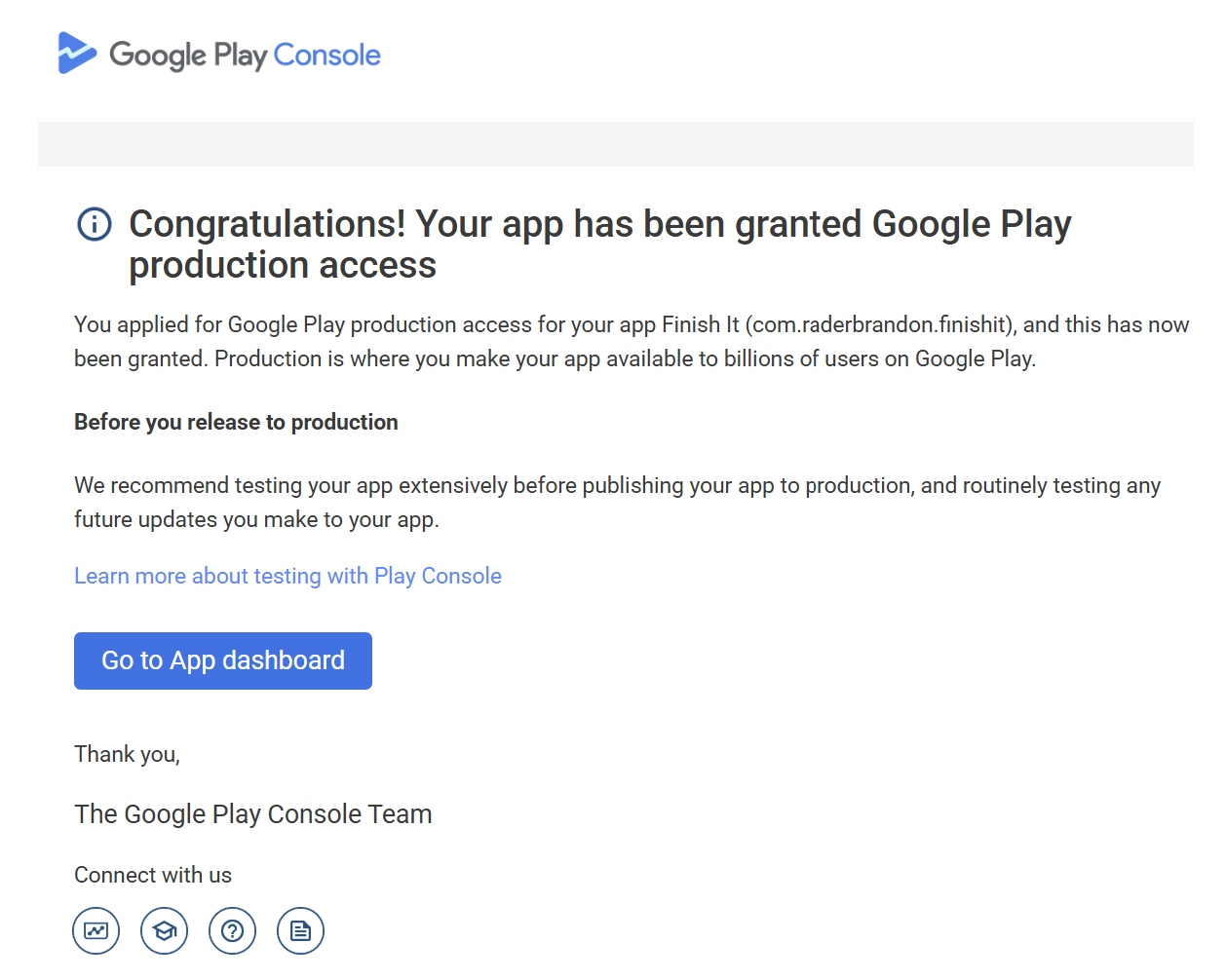
Once the 14-day testing milestone is completed, the 'Apply for Production' button activates in your Play Console. Submit your application using our proven guidance template and release your app worldwide.
Frequently Asked Questions
Why does Google Play strictly require 12 testers for 14 continuous days?
Google Play introduced this mandatory closed testing requirement for all personal developer accounts registered after November 13, 2023. The policy was established to raise the baseline quality of applications on the Play Store, reduce zero-day crash incidents, prevent malware distribution, and verify that indie developers thoroughly test their software across real physical hardware before releasing builds to the public. Meeting this requirement proves to Google's automated assessment systems that your application is stable, functional, and ready for broad distribution.
Can testers be based internationally if my primary target market is Oman?
Yes. Google Play Console allows closed testers from any country where your closed testing track is enabled. However, having a testing group with regional relevance ensures your app is evaluated against authentic local network conditions, regional payment gateways, and Arabic RTL layout configurations. Our managed testing pool incorporates diverse global and regional hardware to provide comprehensive coverage that satisfies all Play Console review algorithms.
What happens if a tester uninstalls the app during the 14-day testing period?
If your active tester count drops below 12 at any point during the 14-day window, Google Play's automated evaluation system may pause your progress or reject your eventual application for production access, forcing you to restart the two-week cycle from Day 1. Our managed service prevents this issue by allocating a buffer of additional backup testers to every project, ensuring your active participant count consistently exceeds 12 every single day.
Can I deploy new app updates and bug fixes during the active 14-day testing cycle?
Yes, you can upload new Android App Bundles (.aab) to your active closed testing track at any time. Updating your app to resolve crashes, fix UI glitches, or improve performance is viewed favorably by Google's review team because it demonstrates active maintenance and developer responsiveness. Updating your build does not reset your 14-day testing countdown as long as your testers remain enrolled and continue testing.
Will private closed tester feedback and reviews harm my public Play Store rating?
No. Any feedback, private reviews, or crash logs submitted by testers during the closed testing phase are strictly confidential and visible only to you inside your Google Play Console dashboard. Closed testing feedback does not appear on your public store listing, has zero impact on your public star rating, and will not be visible to future users when your app launches in production.
How should I answer Google's production access questionnaire after completing the 14 days?
When the 14-day testing period finishes, Google Play Console requires you to complete a production access application. You must answer questions regarding how you recruited your testers, what feedback you collected, what specific changes or bug fixes you made during testing, and why your app is ready for production. We provide all our clients with detailed, customized answer templates based on the actual telemetry and testing data gathered during your 14-day cycle to ensure maximum approval probability.
The Testing Pipeline
How we deploy real devices and guarantee compliance for your release.
Sign In
Sign in with Google to configure the closed testing environment for your Android build.
Opt-In URL
Submit your Google Play Console testing link, and our team will assign qualified testers from our testing network to join your Android closed testing release.
Testing Begins
A QA supervisor monitors daily check-ins, ensuring 12 unique Android users engage with your Android build every single day.
Compliance Complete
We guarantee 14 consecutive days of active user check-ins to satisfy Google's compliance policies, delivering an audit-ready PDF feedback report.
Why Developers Trust Us
Experience a next-generation testing infrastructure built for Google Play compliance for your Android release.
The 14-Day Production Guarantee
We complete the required 14-day closed testing process with real human testers and physical Android devices, while providing clear testing evidence and documentation throughout the process.
If Google specifically rejects production access due to insufficient testing engagement, you are covered by our free re-run or 100% refund guarantee, subject to our Refund Policy.
Verified Production Access
Quality QA Testing Reports
Clear, actionable reports with screenshots and evidence for every important issue found during testing.
Real Device Testing & Diagnostics
Real human testers use physical Android devices to test your app, verify real user flows, and provide clear testing evidence and professional QA reports.
Guaranteed App Approval
Get your Android build approved on the first try. We create an audit-ready compliance profile that proves thorough quality assurance.
Affordable Compliance Cycles
Transparent plans built to satisfy Google Play Console guidelines for your Android build.
Loading Packages
Please wait while we fetch the best options for your region...
Frequently Asked Questions
Everything you need to know about passing your closed testing requirements.