Play Store testers for 14-day Android closed testing in Panama
Find Play Store testers in Panama for 14-day Google Play closed testing. Fulfill Play Console requirements with 12 real testers and launch quickly.
Navigating Google Play Closed Testing from Panama's Tech and Financial Hub
Panama has emerged as a premier technology and financial epicenter in Central America. From fintech startups near Costa del Este and Calle 50 to enterprise software engineers working within the City of Knowledge (Ciudad del Saber), Panamanian developers are building innovative Android solutions that cater to regional commerce and global markets. However, taking a new mobile application from initial code commit to public release on the Google Play Store involves navigating a strict policy framework instituted by Google. Every personal Google Play developer account registered after November 2023 must complete a mandatory closed testing phase with at least 12 testers for 14 days continuously before gaining production release privileges.
For software creators operating in Panama - whether handling dual-currency transactions in USD and Panamanian Balboa (PAB), integrating multi-carrier telecom services across Tigo Panama and +Movil (Cable & Wireless Panama), or building logistics apps tied to the Panama Canal ecosystem - securing continuous engagement from 12 qualified testers is a significant hurdle. Relying on casual friend circles, family members, or unofficial developer groups frequently fails because participants uninstall early or stop opening the app. Passing this evaluation demands consistent daily telemetry, real Android hardware diversity, and verified user activity that satisfies Google Play Console algorithmic checks.
Understanding the 12 Testers for 14 Days Mandate
The 12 testers for 14 days requirement was engineered by Google to prevent unstable, incomplete, or insecure software from reaching commercial end-users on Google Play. Under this policy, personal developer accounts must recruit at least 12 distinct opt-in participants who maintain the closed track build on their personal physical devices throughout a 14-day evaluation window.
Passing this milestone involves far more than simply collecting 12 email addresses on an access list. Google Play Console continuously monitors backend device interaction logs, application installation persistence, and opt-in status. If testers uninstall the APK or AAB build before the 14 days elapse, fail to generate periodic foreground sessions, or enroll through automated emulator scripts, Google resets the 14-day testing timer or denies production track access during the final review.
Common Closed Testing Hurdles for Panamanian Dev Teams
Engineering teams and independent creators throughout Panama face distinct operational challenges when attempting to organize closed testing without professional assistance:
- Tester Inactivity and Natural Drop-off: Volunteer testers frequently install an app on Day 1, explore the initial screen once, and never launch it again. When Google Play Console algorithms detect zero active foreground sessions between Day 4 and Day 14, production access is systematically rejected.
- Device and Screen Homogeneity: Testing exclusively within a local development office restricts validation to two or three common smartphone models running identical Android OS builds, missing critical edge-case memory leaks and layout bugs.
- Local Network and Telecom Variations: Apps optimized solely for high-speed fiber connections in Panama City often suffer sudden ANRs (Application Not Responding) when switched between Tigo Panama and +Movil LTE or 5G data networks.
- Bot Farm and Fake Account Hazards: Contracting low-cost click farms or emulator bots found on public message boards triggers Google's automated anti-abuse filters, resulting in permanent developer account strikes or outright account closure.
- Developer Resource Drain: Manually chasing 12 testers via messaging channels consumes dozens of engineering hours that should otherwise be dedicated to code optimization, UI refinement, and go-to-market strategies.
Real Device Testers vs. Automated Bot Farms
Selecting the right testing framework directly dictates whether your Android application secures immediate production release or gets trapped in recurring testing rejection cycles.
Real Human Testers (Recommended)
- Real physical Android smartphones across Samsung Galaxy, Xiaomi, Motorola, Google Pixel, and Honor hardware.
- Authentic user engagement generating genuine touch events, screen scrolls, UI interactions, and API payloads.
- Unbroken 14-day opt-in retention with organic background sessions and realistic app open cadences.
- Legitimate Android Vitals crash logs and qualitative feedback delivered through official Play Console channels.
- Total compliance with Google Play Developer Program Policies and strict anti-spam guidelines.
Bot Networks and Fake Testers (High Risk)
- Scripted cloud emulators, headless virtual machines, and rooted test farms flagged by Google Play Protect.
- Identical session timestamps, robotic navigational pathways, and unnatural bursts of network traffic.
- Premature uninstalls, dropped opt-ins, and erratic account behavior that reset the 14-day countdown clock.
- Zero meaningful bug diagnostics, UI feedback, or practical crash reporting.
- Severe danger of automated production review refusal and permanent Play Console account suspension.
Comparing Testing Methods for Google Play Closed Testing
The following comparison details the operational differences between managed professional testing services, do-it-yourself internal networks, and automated bot platforms.
| Feature / Metric | Managed Human Testing Service | DIY Internal Network | Automated Bot Farms |
|---|---|---|---|
| Active Human Testers | 12+ verified real human testers | Dependent on friends and colleagues | Zero (automated scripts and emulators) |
| Hardware & OS Diversity | Diverse flagship and mid-range devices (Android 10 - 15) | Limited to personal or office hardware | Virtual cloud instances with spoofed IDs |
| 14-Day Retention Guarantee | Guaranteed continuous 14-day opt-in completion | High risk of tester dropouts on Days 5 - 10 | Unpredictable account bans and early drops |
| Google Telemetry Health | Authentic daily sessions, UI scrolls, and vitals logs | Irregular, sporadic, or flatlined telemetry | Flagged as inorganic bot behavior |
| Play Console Account Safety | 100% compliant with Google developer standards | Safe but operationally difficult to manage | Severe risk of permanent account termination |
| Developer Time Investment | Under 15 minutes of initial setup | 25 to 40 hours of manual coordination | Constant troubleshooting and wasted cycles |
Struggling with the 14-Day Testing Requirement?
Skip the hassle of recruiting unreliable testers. Our professional fleet of real Android devices guarantees Google Play compliance in exactly 14 days. Zero bots. Zero emulators. 100% production approval guarantee.
Technical Play Console Metrics You Must Monitor
To guarantee that your Android closed testing cycle satisfies Google's stringent production review criteria, you must actively track key performance indicators within your Google Play Console dashboard and Android Vitals console:
- Daily Active Devices (DAD): Verify that your closed track records steady, daily foreground launches across all participating tester devices throughout the entire 14-day evaluation window.
- Opt-in Status Stability: Confirm that none of your designated testers abandon the testing program via the web or mobile opt-in link before the 14 days finish.
- ANR (Application Not Responding) Rate: Maintain your overall ANR threshold strictly below Google's bad behavior threshold of 0.47% to prevent your app from being categorized as unstable.
- User-Perceived Crash Rate: Ensure that the user-perceived crash rate stays well below the 1.09% ceiling across all tested Android OS versions and hardware configurations.
- Android Vitals Diagnostics: Regularly inspect slow UI rendering frames (frozen frames exceeding 700ms), excessive background wake locks, and battery drain alarms across distinct screen densities.
- Network Request Latency & Connectivity Handshakes: Monitor how your application handles switching between high-speed Wi-Fi and mobile data networks (such as Tigo Panama and +Movil), ensuring graceful error handling and retry mechanisms.
Pre-Launch Verification Checklist for Panamanian Developers
Before submitting your production access request in Google Play Console, confirm that your application and closed testing track satisfy all technical, operational, and policy prerequisites.
Play Console Configuration & Build Setup
Telemetry, Stability & Documentation Prep
Step-by-Step Roadmap to Production Approval
Follow this structured, battle-tested roadmap to guide your Android app from closed track initialization to successful Google Play production approval.
Closed Track Setup and AAB Upload
Create your closed testing track inside Google Play Console. Upload your signed release Android App Bundle (AAB), configure targeted countries, verify Data Safety declarations, and retrieve your closed test opt-in URL.
Tester Recruitment and Opt-In Verification
Assign 12 or more verified human testers to your closed track. Testers open the opt-in invitation via web or mobile link, join the testing program, and install the build directly from the Google Play Store.
14-Day Active Telemetry and Engagement Window
Testers launch and navigate your application daily on genuine physical devices. This generates authentic touch gestures, valid network telemetry, screen transitions, and real Android Vitals metrics.
Feedback Evaluation and Patch Deployment
Examine incoming tester feedback, error stack traces, and vitals logs. If bugs or UI flaws are discovered, compile and release incremental patches directly to the closed testing track to demonstrate proactive developer maintenance.
Production Application Submission and Launch
Once the 14 continuous days conclude, navigate to the Play Console dashboard, complete the production access evaluation form with thorough testing evidence, and submit your app for final production review.
Frequently Asked Questions
Why does Google Play require 12 testers for 14 days for personal developer accounts?
Google introduced the mandatory 12 testers for 14 days closed testing rule in November 2023 to improve software quality, stability, and security across the Android ecosystem. By requiring new personal developer accounts to demonstrate real-world testing on physical hardware before publishing to production, Google filters out malware, unmaintained templates, and crash-prone applications. This process ensures that developers identify and fix bugs, handle diverse device specifications, and validate Android Vitals metrics prior to exposing their apps to millions of global users on Google Play.
Can developers in Panama use testers located in other countries for closed testing?
Yes. Google Play does not mandate that your testers reside in the same country as your developer account. As long as your closed testing track is configured in Google Play Console to include the countries where your testers live, international participants can opt in, download your app, and test normally. In fact, utilizing testers across diverse geographic regions and cellular carrier networks often strengthens your application's telemetry profile by proving stability across different telecom infrastructures, screen densities, and Android OS versions.
What happens if a tester uninstalls my app on Day 9 of the 14-day test?
If an opted-in tester uninstalls your application or leaves the testing group, and your total count of active opted-in testers falls below the mandatory threshold of 12, Google Play Console's automated tracking system may pause or reset your 14-day countdown timer. To eliminate this risk, professional testing services routinely recruit 15 to 20 verified testers for each track. Maintaining a safety buffer ensures that your active tester count remains safely above 12 even if individual participants experience unexpected hardware issues.
Can I release updates and bug fixes to the closed track during the 14 days without resetting the timer?
Yes. Pushing hotfixes, performance improvements, and UI updates to your active closed testing track during the 14-day evaluation window is fully supported and actively encouraged by Google. Releasing updated AAB builds demonstrates that you are reviewing user feedback, resolving reported issues, and actively maintaining your codebase. Updates do not reset your 14-day timer, provided your active opted-in tester count stays at or above 12 throughout the entire period.
How does Google Play detect and penalize automated bot farms and emulator scripts?
Google Play Protect and Play Console security algorithms analyze hundreds of behavioral, network, and hardware signals. These include hardware sensor outputs (accelerometer and gyroscope data), touch interaction variance, IP address reputation, Google account longevity, and background process execution profiles. Bot farms relying on scripted emulators or automated clickers generate synthetic, repetitive patterns that are easily flagged by Google's anti-fraud systems, leading to automatic rejection of production access and potential permanent developer account termination.
What questions does Google ask when applying for production access after 14 days?
When your 14-day closed test concludes, Google presents a production access questionnaire in the Play Console dashboard. The questions ask: how you recruited your closed track testers, what specific feedback you collected regarding your app's functionality and user interface, what code changes or bug fixes you deployed based on that feedback, and why you believe your application is stable and ready for public distribution. Answering these questions with detailed, authentic technical data backed by real testing logs ensures swift production approval.
Our QA Process
Your journey to Google Play production access, simplified and automated.
Choose Package
Authenticate your account to initialize the 14-day QA fleet for your Android release.
Submit Link
Upload your testing link. We assign 12 verified users with real Android devices to download and test your Android release.
Active Testing
A dedicated testing supervisor is assigned to monitor progress while testers engage with your Android app and provide feedback throughout the testing period.
Get Approved
Our lab maintains active installations for two weeks straight, ensuring a clean track record and providing a QA compliance log for your release.
The Premium QA Advantage
Satisfy your Play Store Console testing obligations with our managed physical device fleet tailored for Android builds.
The 14-Day Production Guarantee
We complete the required 14-day closed testing process with real human testers and physical Android devices, while providing clear testing evidence and documentation throughout the process.
If Google specifically rejects production access due to insufficient testing engagement, you are covered by our free re-run or 100% refund guarantee, subject to our Refund Policy.
Verified Production Access
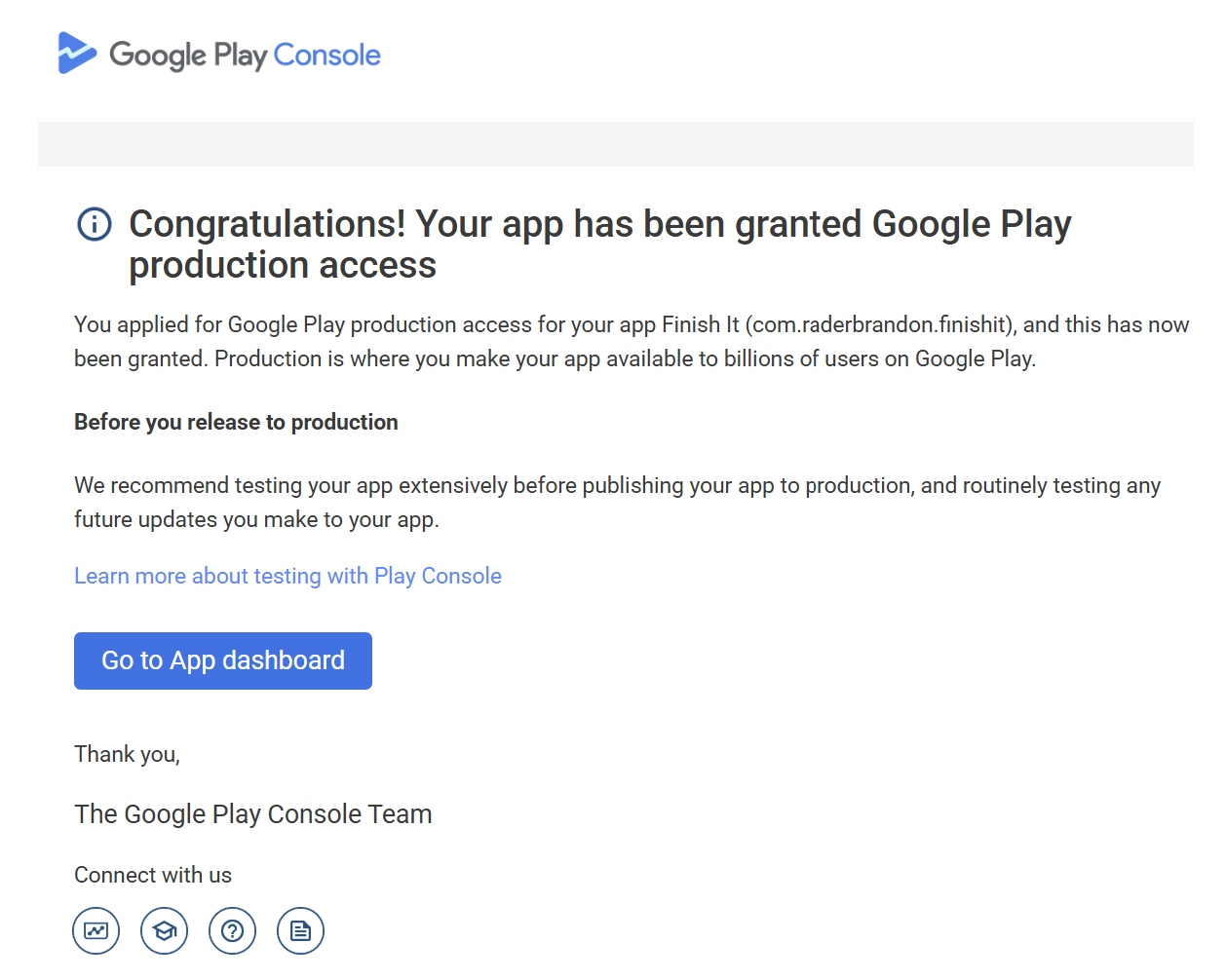
Quality QA Testing Reports
Clear, actionable reports with screenshots and evidence for every important issue found during testing.
Real Device Testing & Diagnostics
Real human testers use physical Android devices to test your app, verify real user flows, and provide clear testing evidence and professional QA reports.
Production Access Secured
Our structured 14-day closed testing process is designed to meet Google Play's production requirements for your Android release.
Simple Closed Testing Pricing
Select the plan that fits your Android app complexity.
Loading Packages
Please wait while we fetch the best options for your region...
Frequently Asked Questions
Everything you need to know about passing your closed testing requirements.