Play Store testers for 14-day Android closed testing in Paraguay
Find Play Store testers in Paraguay for 14-day Google Play closed testing. Fulfill Play Console requirements with 12 real testers and launch quickly.
The Secret to Passing Google's 14-Day Test in Paraguay
Securing production approval from the Play Console review team is no longer a matter of simply uploading a compiled binary and waiting for an automated scanner to finish. Google now evaluates behavioral signals and telemetry to confirm your app delivers real value without fatal runtime defects.
The standard benchmark requires at least 12 testers for 14 days of unbroken participation. Many solo creators attempt to satisfy this by emailing invitation links to casual acquaintances or office colleagues across Central Department.
However, casual testers frequently open an app once, leave it idle, or remove it from storage within 48 hours. When telemetry drops below minimum thresholds or daily sessions flatline, the Play Console automated review algorithm resets the evaluation clock, forcing you back to day one.
In Paraguay, your software must also adapt gracefully to variable connectivity across 4G LTE and growing 5G rollouts, diverse entry-level hardware from brands like Xiaomi, Samsung Galaxy A-series, and Motorola, and local bilingual English, Spanish, and Guaraní interface expectations.
Passing the 14-day milestone demands disciplined, coordinated testing where genuine users interact with your workflows, trigger authentic crash-free sessions, and validate your core feature set every single day.
Real Testers vs Automated Bots - The Ultimate Showdown
Faced with the challenge of gathering dedicated participants, some engineering teams consider automated bot scripts, cloud emulators, or synthetic click farms to simulate user traffic. This shortcut is dangerous and often fatal to developer credentials.
Google's automated risk engines inspect hardware fingerprints, battery status changes, touch latency variances, IP reputation, and Google Play account maturity. When an app receives artificial telemetry from rooted emulators or recycled bot accounts, the Play Console flags the submission for deceptive behavior.
The safest and most reliable path to approval is coordinating genuine human testers who use daily personal devices on physical telecommunication networks.
Real Human Testers in Paraguay
Authentic users install your release onto physical Android smartphones connected to live mobile operators like Tigo, Personal, and Claro Paraguay. Their devices carry genuine Google accounts with rich usage histories, realistic session lengths, and diverse Android OS versions.
Human testers navigate your user flows naturally. They test payment flows in Paraguayan Guaraní (PYG), rotate screens, grant runtime permissions, and provide structured feedback when UI text clips or background services stall on low-memory devices. Their activity produces clean, legitimate Play Console vitals that easily satisfy Google's production review criteria.
Fake Bot Services and Emulators
Bot farms utilize scripted headless emulators running on centralized data center servers. These automated scripts generate robotic, perfectly timed touch events, identical screen resolutions, and repetitive interaction loops with zero human variance.
Emulator farms cannot provide qualitative bug reports or flag localization flaws in regional Spanish or Guaraní strings. Most critically, Google's fraud detection algorithms immediately identify synthetic device signatures, resulting in permanent closed track rejections, test resets, or lifetime developer account terminations under Google Play developer policies.
Comprehensive Testing Methodology Comparison
Selecting the right testing approach directly determines whether your application launches on schedule or gets trapped in repeated 14-day compliance cycles. Review how managed human testing stacks up against informal DIY outreach and hazardous bot networks:
| Feature & Capability | Managed QA Service | Informal DIY Testing | Synthetic Bot Farms |
|---|---|---|---|
| Real Device Hardware | 100% physical phones & tablets | Mixed personal phones | Virtual cloud emulators |
| 14-Day Continuous Retention | Guaranteed daily active use | High drop-off rate (30-60%) | Automated scripted pings |
| Play Console Compliance | Fully compliant with Google policies | Compliant but hard to sustain | Severe policy violation risk |
| Telemetry & Vital Signals | Natural human touch & sensor data | Sporadic & inconsistent logs | Identical synthetic event loops |
| Network Diversity | Real Tigo, Personal, Claro & Wi-Fi | Restricted to personal contacts | Data center proxy IPs |
| Structured Bug Reporting | Detailed reproduction logs & UI bugs | Vague feedback or none | No subjective feedback |
| Production Approval Rate | Extremely high on first attempt | Frequent resets & delays | High account termination rate |
| Paraguay Market Alignment | Regional currency & locale checks | Limited sample size | Zero regional understanding |
Struggling with the 14-Day Testing Requirement?
Skip the hassle of recruiting unreliable testers. Our professional fleet of real Android devices guarantees Google Play compliance in exactly 14 days. Zero bots. Zero emulators. 100% production approval guarantee.
Navigating Android Vitals and Play Console Telemetry
During the 14-day evaluation track, Google's automated systems continuously gather metrics known as Android Vitals. These metrics measure stability, performance, battery drain, and responsiveness. Failing these technical baselines during your closed testing phase signals to Google reviewers that your app is unready for general distribution.
Understanding what the Play Console measures helps you diagnose hidden performance bottlenecks before applying for production access:
1. User-Perceived Crash Rate Thresholds
Google enforces a strict bad behavior threshold for crashes. If your app experiences a user-perceived crash rate exceeding 1.09% across overall sessions, or higher than 8% on specific device models, your application gets flagged. During Closed Testing, a small tester pool means even two unhandled exceptions can spike your crash rate above allowable limits.
Common crash causes include unhandled null pointers during network switches, missing null checks on JSON serialization from local Paraguayan APIs, and uncaught background thread exceptions on older Android versions.
2. Application Not Responding (ANR) Rates
An ANR dialog appears whenever the main UI thread freezes for longer than five seconds. Google sets the maximum allowable ANR threshold at 0.47%.
In intensive applications, freezing typically occurs when developers execute heavy database queries, image decoding, or encryption routines directly on the main thread rather than delegating them to background Kotlin coroutines or asynchronous worker pools.
Real testers running mid-tier devices across Asunción, Ciudad del Este, and Encarnación expose these sluggish UI thread freezes under real-world CPU throttling.
3. Background Wake Locks and Excessive Battery Drain
If your software initiates persistent background services, recurring alarms, or frequent GPS polling, Google vitals tracks partial wake locks. Holding wake locks for more than one hour per session triggers performance alerts.
Testing on physical devices ensures that Android's Doze Mode and battery optimization profiles function properly without silencing crucial push notifications or crashing background synchronization tasks.
4. Cold, Warm, and Hot Startup Latency
First impressions matter both to users and Google's evaluation algorithms. A cold start occurs when the application launches from scratch, requiring initialization of application singletons, dependency injection graphs, and initial view layouts.
Google flags cold start times exceeding five seconds. Having real testers regularly open your app allows you to monitor startup latency distributions across various RAM configurations.
Pre-Launch Optimization Checklist for Paraguay
Before distributing your build to your closed testing cohort, ensure your engineering and design foundations align with regional standards and Google Play developer policies:
Technical Architecture and Stability
Verify that your signed Android App Bundle (AAB) targets the latest required Android API level (API 34 or higher) with targetSdkVersion updated.
Implement robust crash analytics logging using tools like Firebase Crashlytics or Sentry to capture real-time stack traces throughout the 14-day run.
Optimize application binary size using ProGuard or R8 code shrinking, resource stripping, and dynamic feature delivery to accommodate variable regional mobile download speeds.
Validate offline caching mechanisms and graceful error states when switching between 4G mobile data and intermittent Wi-Fi connections.
Paraguay Localization and Market Adaptation
Format local currency numbers using the Paraguayan Guaraní (PYG) ISO code with correct thousand separators, decimal rules, and pricing tiers.
Ensure Spanish (es-PY) string resources are comprehensive, natural, and free of untranslated fallback placeholders, with optional Guaraní phrasing where appropriate.
Support dynamic font scaling and flexible layouts so extended Latin translations do not truncate or overlap on compact smartphone screens.
Test authentication flows that rely on regional SMS one-time passwords (OTP) delivered to Tigo, Personal, and Claro mobile number formats.
Play Console Compliance and Privacy
Host an active, publicly accessible Privacy Policy URL that accurately outlines user data collection, storage, third-party SDKs, and account deletion options.
Complete the Data Safety questionnaire inside Google Play Console with total precision regarding location, financial data, and device identifiers.
Provide dedicated test login credentials and demo accounts directly in the App Access section so Google human reviewers can inspect authenticated sections.
Verify that your store listing graphics, feature graphic, app icon, and screenshots display real product UI in clear resolution without misleading promotional claims.
Your Roadmap to Play Store Success
Navigating closed testing from initial release creation to full production approval requires following a structured, step-by-step workflow. Here is the proven path to guide your project through the Play Console lifecycle:
Configure Track and Upload App Bundle
Create a dedicated Closed Testing track inside the Google Play Console. Generate a release containing your signed Android App Bundle (AAB), configure release notes, and assign the target countries including Paraguay. Submit the track for initial Google pre-launch review.
Assemble Closed Tester Group
Organize an opt-in list of at least 12 to 20 verified testers using Google Groups or individual email lists. Ensure each participant has an active Android device configured with an authorized Google account ready to accept your web or mobile join link.
Distribute Opt-In Links and Verify Installs
Send the official opt-in URLs (play.google.com/apps/testing/your.package.name) to your testing team. Confirm that every tester explicitly accepts the invitation, installs the package directly from the Play Store, and opens the app to initiate the initial telemetry handshake.
Maintain 14 Days of Active Engagement
Monitor user participation across the entire 14-day window. Encourage regular feature exploration, multi-screen navigation, and periodic background sessions. Monitor real-time crash logs, fix emerging edge-case bugs, and deploy update patches directly through the closed track if needed.
Review Android Vitals and Compile QA Feedback
Audit your Play Console dashboard for crash rates, ANR occurrences, and active device counts. Gather qualitative bug reports and usability feedback from your cohort to demonstrate continuous improvement and stability.
Apply for Production Access
Once the 14-day counter finishes with at least 12 active participants maintained, click the Apply for Production button. Complete the mandatory reflection questionnaire detailing your testing methodology, bug fixes implemented, and production readiness to secure final approval.
Frequently Asked Questions
Why does Google require 12 testers for 14 days on Android developer accounts?
In late 2023, Google updated its developer policies to elevate overall software quality on the Play Store. Personal developer accounts registered after November 2023 must run a continuous closed test with a minimum of 12 opt-in testers who maintain the app installed for 14 consecutive days. This rule ensures developers perform real-world quality assurance, eliminate critical crashes, verify compliance with data privacy standards, and gather authentic feedback before exposing their software to the broader public.
What causes the 14-day testing countdown to reset in Google Play Console?
The testing counter typically resets or stalls if active tester engagement drops below the mandatory minimum of 12 participants at any point during the 14-day window. If testers uninstall the app, turn off app updates, or remain inactive for extended periods, Google's automated systems may judge the test invalid. Additionally, introducing high crash rates in mid-test updates or triggering fraud alerts through automated emulator traffic will invalidate the testing run and require you to restart the cycle.
Can I use testers located outside of Paraguay if my app targets the Paraguayan market?
Yes, Google allows closed testers from any country you include in your track settings. However, if your application contains location-dependent features, integrations with Paraguayan payment gateways, local phone authentication, or regional Spanish and Guaraní localization, having native testers inside Paraguay is crucial. Local testers ensure that regional cellular networks (Tigo, Personal, Claro), network latency, and device models accurately reflect your real end-user conditions.
Can I publish bug fixes and build updates during the active 14-day closed testing period?
Yes, you can upload new App Bundles (AABs) to your closed testing track while the 14-day test is underway. In fact, releasing incremental updates that resolve reported crashes or UI glitches demonstrates active developer maintenance, which Google looks upon favorably during production review. Each update goes through standard automated Play Store review, and existing testers will automatically receive the updated version on their devices without interrupting your 14-day timeline.
What specific questions does Google ask when applying for production access?
When you complete your 14 days of closed testing and request production access, the Play Console presents a questionnaire. Google asks you to describe how you recruited your testers, how easy it was to find participants, what key feedback you received during testing, what technical changes or bug fixes you made based on that feedback, and why you believe your application is stable and ready for general distribution. Providing detailed, honest, and professional answers is essential for quick approval.
Why is using automated bot services dangerous for closed testing compliance?
Automated bot services rely on cloud emulators or scripted actions that produce artificial, non-human usage patterns. Google's sophisticated anti-abuse and machine learning algorithms easily detect synchronized taps, static hardware identifiers, missing sensor data, and unaged Google accounts. Using bot services violates Google Play Developer Program Policies regarding deceptive behavior, leading to immediate rejection of your production application and potentially permanent suspension of your Google Play developer account.
How It Works
How we deploy real devices and guarantee compliance for your release.
Get Started
Sign in with Google to configure the closed testing environment for your Android build.
App Submission
Submit your Google Play Console testing link, and our team will assign qualified testers from our testing network to join your Android closed testing release.
14-Day Cycle
A QA supervisor monitors daily check-ins, ensuring 12 unique Android users engage with your Android build every single day.
Production Access Approval
We guarantee 14 consecutive days of active user check-ins to satisfy Google's compliance policies, delivering an audit-ready PDF feedback report.
Why Choose AppConsoleLab
Experience a next-generation testing infrastructure built for Google Play compliance for your Android release.
The 14-Day Production Guarantee
We complete the required 14-day closed testing process with real human testers and physical Android devices, while providing clear testing evidence and documentation throughout the process.
If Google specifically rejects production access due to insufficient testing engagement, you are covered by our free re-run or 100% refund guarantee, subject to our Refund Policy.
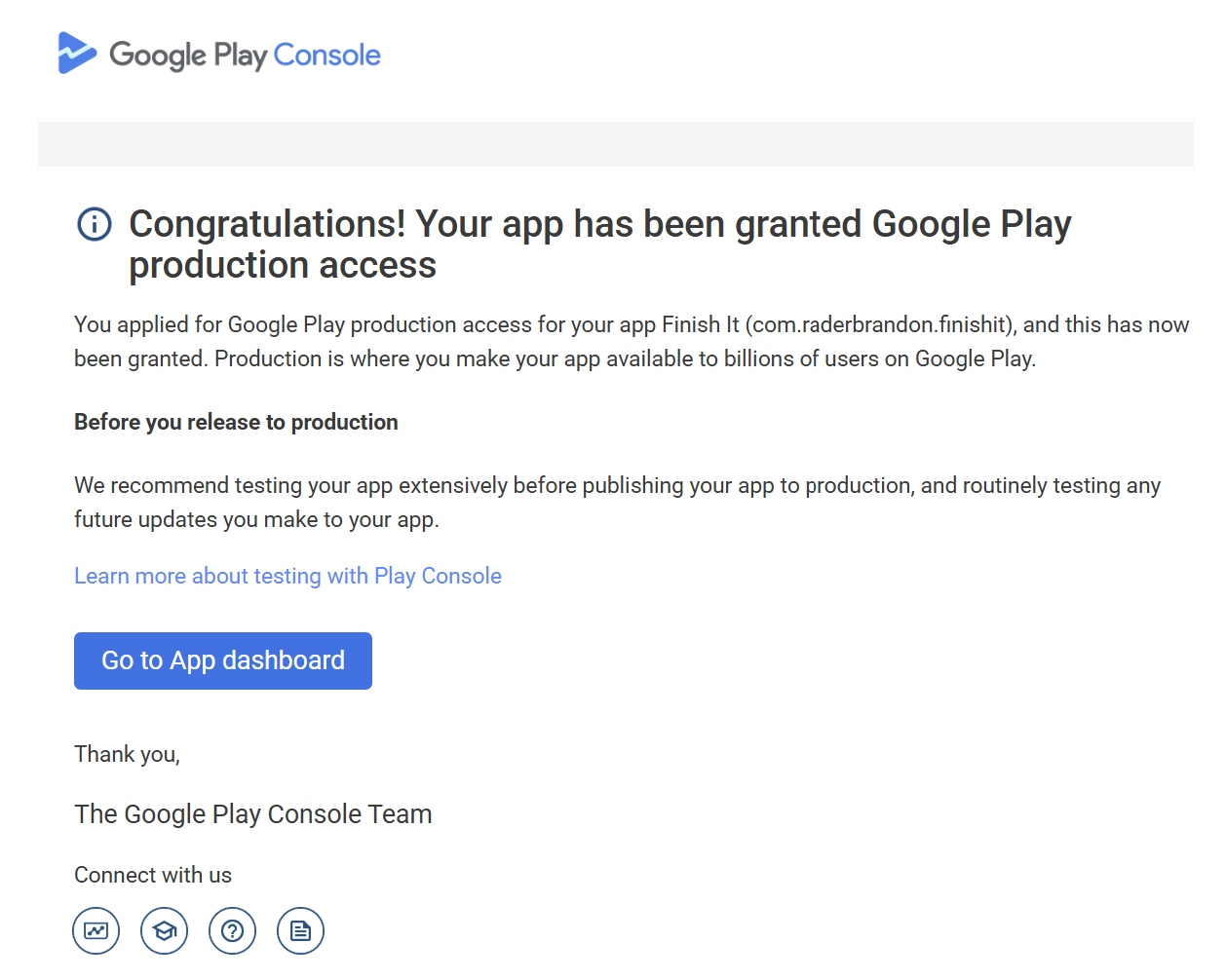
Verified Production Access
Quality QA Testing Reports
Clear, actionable reports with screenshots and evidence for every important issue found during testing.
Real Device Testing & Diagnostics
Real human testers use physical Android devices to test your app, verify real user flows, and provide clear testing evidence and professional QA reports.
Play Store Ready
Get your Android build approved on the first try. We create an audit-ready compliance profile that proves thorough quality assurance.
Affordable Compliance Cycles
Transparent plans built to satisfy Google Play Console guidelines for your Android build.
Loading Packages
Please wait while we fetch the best options for your region...
Frequently Asked Questions
Everything you need to know about passing your closed testing requirements.