Play Store testers for 14-day Android closed testing in Peru
Find real Play Store testers in Peru for Google Play closed testing. Fulfill Play Console requirements securely with 12 testers for 14 days.
Peru is not just a land of ancient ruins and world-class gastronomy. It is a rapidly digitizing economy where millions of users rely on smartphones for banking, shopping, and everyday communication. If you want your app to thrive in this vibrant South American market, you need to ensure it works perfectly for the people who live there. But before you can get your app into the hands of Peruvian users, you have to pass Google's strict requirements. You need to conquer the Google Play Closed Testing phase, and that means finding real, engaged testers.
Navigating the Play Console compliance can feel like climbing Machu Picchu without a map. Google demands that new developers secure dedicated testers for an extended period, and these individuals need to interact with your app genuinely. You cannot cut corners here. If you are targeting Peru, your testing phase must reflect real usage. This guide will walk you through securing authentic testers and passing the strict Google Play requirements without a hitch.
The Reality of Google Play Closed Testing Requirements
Google introduced mandatory testing periods to filter out low-quality apps and protect the Android ecosystem. For new developers, this means you cannot simply hit "publish" and hope for the best.
You must demonstrate that your app is stable, useful, and compliant. The Play Store Closed Testing process is a trial by fire. If Google detects automated scripts, inactive accounts, or suspicious behavior, your app will be rejected. You need real people opening your app daily, exploring its features, and keeping it installed. It is not just about the numbers, it is about proving your app's legitimacy in the eyes of Google's review team.
Authentic Testing Methods
- Real User Engagement: Testers actively use the app, mimicking natural daily behavior and exploring core features.
- Valid Device History: Testing occurs on real smartphones with genuine, long-standing Google accounts.
- Guaranteed Compliance: Meets all rigorous criteria for the 12 Testers for 14 Days or standard testing requirements.
- Actionable Feedback: You get real insights on how your app performs on actual networks and hardware.
Bot Networks and Fake Activity
- Zero Interaction: Accounts install the app once and never open it again, signaling fake engagement.
- Emulator Flags: Testing on emulators or newly created, blank Google accounts triggers Play Console security algorithms.
- High Rejection Risk: Automated systems easily detect and ban these attempts, risking your developer account.
- Wasted Time: You lose valuable time and have to start the testing phase all over again from day one.
Why Local Context and Genuine Engagement Matter
When launching an application targeted at any specific demographic, understanding the environment in which it operates is critical for long-term success. While Google's primary concern is app stability and policy compliance, ensuring your testers reflect real-world usage scenarios is paramount. If your application relies on specific regional payment gateways, location-based services, or localized content, having users who interact with these features naturally will surface bugs that automated tools or disconnected users might miss entirely.
Google's review algorithms are incredibly sophisticated. They do not just check if twenty Google accounts downloaded an APK. They analyze the cadence of interaction. Are these accounts acting like real humans? Do they browse different screens, pause to read text, and occasionally trigger error states? This is why high-quality, genuine testing is non-negotiable. If you try to game the system with low-quality testing farms, the Play Console will flag the abnormal activity. A legitimate Google Play Closed Testing phase builds a solid foundation of trust with Google, paving the way for a much smoother transition to the production track.
Struggling with the 14-Day Testing Requirement?
Skip the hassle of recruiting unreliable testers. Our professional fleet of real Android devices guarantees Google Play compliance in exactly 14 days. Zero bots. Zero emulators. 100% production approval guarantee.
How Testing Services Compare
Choosing the right approach to fulfill your Play Store Closed Testing requirement is a major decision that can dictate the timeline of your launch. You essentially have three paths: attempting to organize it yourself, hiring a professional compliance service, or taking a massive risk on cheap automated bots. Let us compare these approaches in detail.
| Feature | Professional Testing Service | DIY (Friends & Family) | Automated Bot Networks |
|---|---|---|---|
| Passes Google Play Review | Yes, highly reliable and designed for compliance | Usually, provided they actually stay active | No, extremely high risk of immediate rejection |
| Real Device Usage | Yes, utilizes genuine smartphones and tablets | Yes, uses their personal daily devices | No, relies primarily on server-side emulators |
| Time Investment Required | Minimal (The service manages the entire process) | High (Requires constant reminding and follow-ups) | Low (But ultimately wastes weeks upon rejection) |
| Overall Cost | Predictable, transparent upfront fee | Free financially, but costs your valuable time | Cheap initially, but costs your app's future |
| 14-Day Consistency | Guaranteed daily activity and retention | Very hard to enforce without being annoying | Automated but easily flagged as synthetic |
Comprehensive Pre-Launch Checklist
Before you invite a single tester to download your application, your software must be fully prepared for scrutiny. A rushed, buggy app will not only frustrate your testers but is highly likely to trigger red flags during the final Google review process. Your goal during the Closed Testing phase is to prove your app is production-ready, not to treat it as an early alpha build.
Application Quality and Core Functionality
Google Play Console Configuration
Technical and Policy Compliance
Your Comprehensive Roadmap to Production
Transitioning your application from a private development build to a live product in the Play Store is a highly structured, multi-step journey. Following this detailed roadmap will ensure a smooth transition through the Google Play Closed Testing phase and significantly increase your chances of a first-time approval.
Step 1: Finalize and Polish Your Release Build
Before uploading anything, make sure your app is thoroughly tested internally. Fix any glaring bugs, resolve layout issues on different screen sizes, and ensure it is ready for external users to interact with. Compile your final App Bundle (AAB) and prepare your release notes. This build should be as close to your intended production version as possible.
Step 2: Configure the Closed Testing Track
Log into your Google Play Console and navigate to the Closed Testing section under the Testing menu. Create a new release, upload your App Bundle, and carefully fill out the release details. You will need to create a dedicated email list for your testers and assign it to this specific track. Ensure the track is active and the release is fully rolled out to your testing group.
Step 3: Secure and Onboard Your Testers
Send out the opt-in link to your designated testers. They must click this link, accept the invitation to become a tester, and then download your application directly from the Google Play Store using the same Google account they were invited with. If you are using a professional testing service, this is the phase where they mobilize their network to opt-in and install your software on their real, active devices.
Step 4: The Crucial 14-Day Engagement Period
This is the most critical phase. For 14 continuous days, your testers must keep the application installed on their devices. More importantly, they need to engage with it. They should open the app daily, interact with various screens, test different functionalities, and generate natural, human-like usage data. The Play Console monitors this activity closely to ensure it is not a bot network or a group of inactive accounts.
Step 5: Apply for Production Access
Once the mandatory testing period has officially concluded (and the Play Console dashboard updates to reflect this), you will be prompted to apply for production access. This involves answering a detailed questionnaire about your testing methodology. You will need to explain how you recruited testers, what kind of feedback you received, and specifically what changes or improvements you made to the app based on that real-world feedback.
Step 6: Google Review and Launch
After submitting your production application, your app goes into Google's final review queue. This manual review process checks your app against all developer policies and scrutinizes the validity of your testing phase. If everything is in order, your app will be approved, and you can finally roll it out to the public production track, making it searchable and downloadable for everyone.
In-Depth Frequently Asked Questions
Understanding the intricate nuances of the Google Play Closed Testing policy is vital for a successful, stress-free launch. Below, we have compiled comprehensive answers to the most common and complex questions developers face when navigating this mandatory process.
Why does Google enforce this strict 14-day testing requirement for new developers?
Google implemented this mandatory rule to significantly elevate the baseline quality of applications entering the Play Store. In the past, the store was flooded with incomplete, buggy, or outright spam applications from new personal developer accounts. The 14-day period allows Google's automated systems and manual reviewers to monitor application stability over time and verify that the engagement is coming from real, active users. This filters out low-effort applications and protects the overall user experience within the Android ecosystem.
Do all my testers need to be physically located in Peru if that is my target market?
Google's official policy does not strictly mandate that your testing pool must reside in the specific country your application targets. However, from a practical standpoint, having local testers is incredibly valuable. They can verify that localized payment gateways function correctly, that regional API calls are responsive, and that the translation makes sense in context. While a geographically diverse testing pool is perfectly acceptable for passing compliance, incorporating users from your target demographic ensures a much higher quality final product.
What exactly happens if one of my testers uninstalls the application on day 10?
If a tester uninstalls your application before the full 14-day period has concluded, their participation becomes invalid, and they are subtracted from your total count of active testers. To successfully pass the requirement, you must have a minimum of 20 users who have opted-in, installed the app, and kept it installed continuously for the entire duration. This fragility is a primary reason why depending on friends and family can be risky, they often forget the rules and delete apps to clear storage space.
I keep seeing mentions of a '12 Testers for 14 Days' rule. Is this an alternative requirement?
No, the official, hardcoded Google Play requirement for new personal developer accounts created after November 2023 is explicitly 20 testers for 14 continuous days. While you might occasionally see outdated information or confusing phrasing like '12 Testers for 14 Days' in forums or older blog posts, you must absolutely adhere to the official 20-tester benchmark to unlock production access. Always rely on the guidelines presented directly within your own Google Play Console dashboard.
How detailed do I need to be when answering the final production questionnaire?
You need to be extremely thorough and transparent. When your testing period ends, the questionnaire asks you to describe your methodology. Vague answers like 'I tested it and it works' will likely result in a rejection. You must explicitly detail how you recruited your testers, summarize the specific feedback you received (both positive and negative), and clearly outline the tangible changes or bug fixes you implemented as a direct result of that feedback. This proves to Google that you actually utilized the testing phase properly.
Can I push updates to my application while the 14-day testing period is ongoing?
Yes, you absolutely can, and in many cases, you should. The entire purpose of the Play Store Closed Testing phase is to identify issues and fix them. If your testers report a significant bug on day three, you can compile a new build, upload it to the Closed Testing track, and have your users update their apps. Pushing an update does not reset your 14-day timer, provided that your testers remain opted-in and keep the application installed throughout the update process.
What should I do if Google rejects my application for production access after the 14 days?
If your application is rejected, Google will typically provide a reason via email and within the Policy Status section of the Play Console. The most common reasons are incomplete answers in the production questionnaire, detection of suspicious testing activity (like bot usage), or remaining policy violations within the app itself. You must carefully read the rejection reason, address the specific issues highlighted, and then you will usually be required to run another compliant Closed Testing phase before you can reapply.
Is it safe to use emulators to fulfill the testing requirements myself?
Absolutely not. Google's device fingerprinting and account analysis tools are incredibly sophisticated. If you attempt to fulfill the requirement by spinning up twenty Android emulators on your computer and creating fresh Google accounts, you will almost certainly be caught. This is considered manipulative behavior. Not only will your production application be denied, but you also risk having your entire Google Developer account permanently terminated for policy violation. Always use real devices and established Google accounts.
Our QA Process
Your journey to Google Play production access, simplified and automated.
Choose Package
Authenticate your account to initialize the 14-day QA fleet for your Android release.
Submit Link
Upload your testing link. We assign 12 verified users with real Android devices to download and test your Android release.
Active Testing
A dedicated testing supervisor is assigned to monitor progress while testers engage with your Android app and provide feedback throughout the testing period.
Get Approved
Our lab maintains active installations for two weeks straight, ensuring a clean track record and providing a QA compliance log for your release.
The Premium QA Advantage
Satisfy your Play Store Console testing obligations with our managed physical device fleet tailored for Android builds.
The 14-Day Production Guarantee
We complete the required 14-day closed testing process with real human testers and physical Android devices, while providing clear testing evidence and documentation throughout the process.
If Google specifically rejects production access due to insufficient testing engagement, you are covered by our free re-run or 100% refund guarantee, subject to our Refund Policy.
Verified Production Access
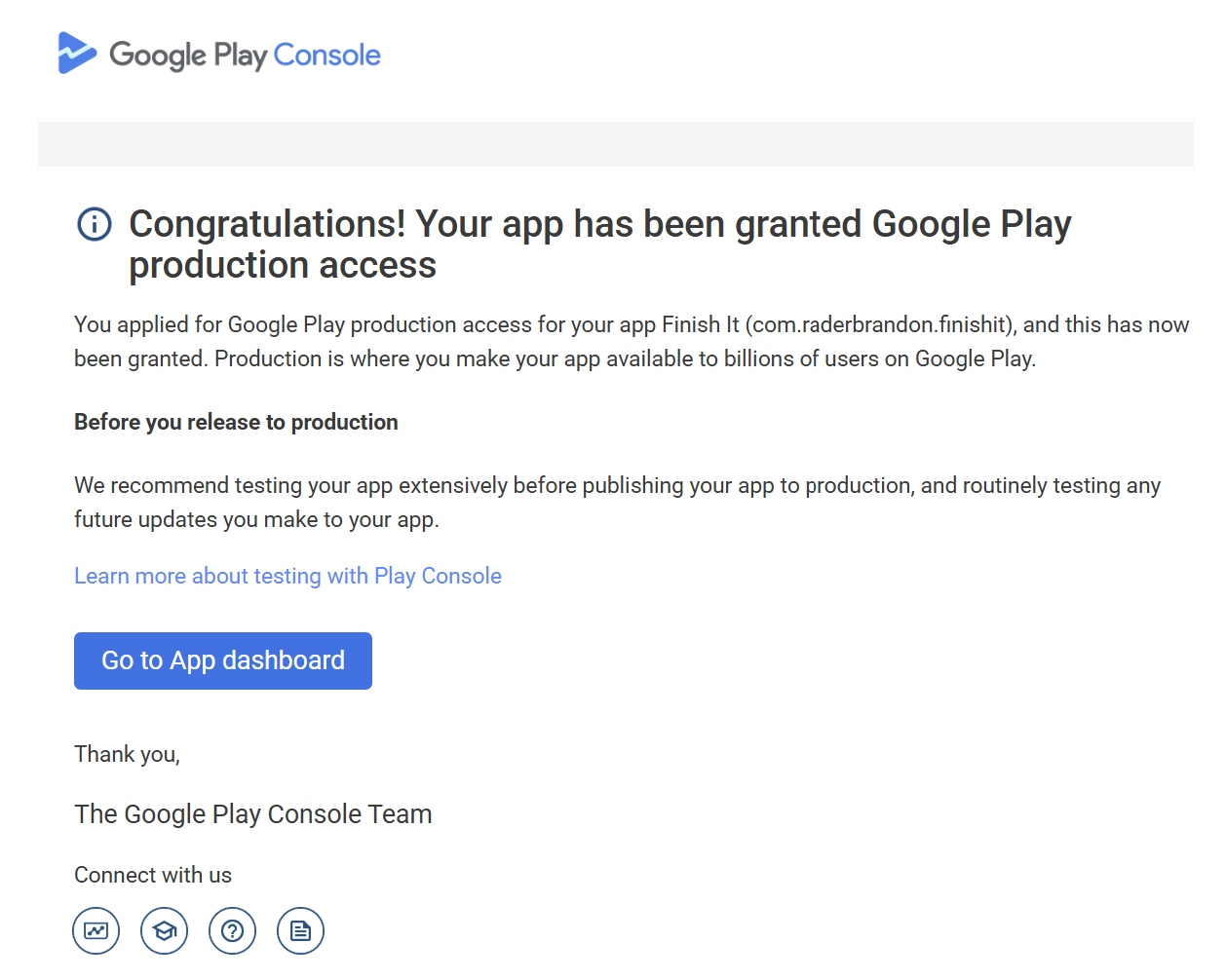
Quality QA Testing Reports
Clear, actionable reports with screenshots and evidence for every important issue found during testing.
Real Device Testing & Diagnostics
Real human testers use physical Android devices to test your app, verify real user flows, and provide clear testing evidence and professional QA reports.
Production Access Secured
Our structured 14-day closed testing process is designed to meet Google Play's production requirements for your Android release.
Simple Closed Testing Pricing
Select the plan that fits your Android app complexity.
Loading Packages
Please wait while we fetch the best options for your region...
Frequently Asked Questions
Everything you need to know about passing your closed testing requirements.