Play Store testers for 14-day Android closed testing in Poland
Find Play Store testers in Poland for 14-day Android closed testing. Pass Google Play Console requirements with 12 genuine testers and go live quickly.
Launching an Android application in Europe's dynamic tech hub is no longer just about writing flawless code. In Poland, where mobile-first consumer behavior is accelerating rapidly, developers face a specific bottleneck that has little to do with software architecture. Google's stringent requirement mandating 20 opted-in testers for a continuous 14-day closed testing period is transforming the final stretch of app deployment into an administrative labyrinth. This isn't merely a checkbox exercise; it is a critical proving ground. Google Play Closed Testing demands genuine engagement from real users, and failing to provide this authentic interaction often results in outright rejection, forcing teams back to the starting line just when they thought they were crossing the finish. Understanding the nuances of Play Store Closed Testing in a regional context like Poland requires shifting your perspective from traditional debugging to compliance-driven user engagement. The algorithm reviewing your production access application isn't just looking for crash reports; it's actively hunting for synthetic behavior, emulated devices, and unnatural usage patterns that suggest you haven't genuinely validated your product. Achieving the required 12 testers for 14 days (or the standard 20 testers for 14 days) means securing individuals who will organically install your app, keep it on their personal devices, and interact with it in a manner indistinguishable from organic post-launch behavior.
The Polish App Market and Compliance Reality
The digital landscape in Poland features high smartphone penetration and a discerning user base that expects localized, high-quality applications. When you enter this ecosystem, Google Play expects your closed testing phase to reflect the reality of your target audience. You cannot simply farm out your testing phase to automated scripts or disengaged gig workers. The integrity of your 14-day testing window is scrutinized through multiple data points, including session lengths, interaction depths, and even the geographical consistency of your tester cohort. If you are launching an app aimed at Polish users, having your testers physically located in Poland, or at least demonstrating behavior consistent with real human users, drastically increases your chances of passing the production access review.
Navigating Google Play's 20 testers policy is often a shock to first-time publishers. The mandate isn't just "find twenty people." It is "find twenty people who will opt-in, download your app, keep it installed, and interact with it for two solid weeks without fail." For developers without an existing community, this is a monumental task. Friends and family might help for a day or two, but maintaining that engagement over 14 consecutive days is a completely different proposition. If even one tester uninstalls the app or fails to check in, the integrity of your 14-day streak can be compromised, jeopardizing your hard-earned progress and delaying your launch indefinitely.
Authentic Polish Testers
Engaging real users for your Play Store Closed Testing provides undeniable benefits. Authentic testers use actual Android devices, generating genuine performance metrics and interaction data that Google's algorithms favor. They provide contextual feedback that can highlight usability issues specific to your target demographic, ensuring your application is truly ready for the Polish market. Furthermore, their natural usage patterns - opening the app at different times, navigating various screens, and occasionally triggering edge cases - create a robust testing profile that easily passes Google's production access review. This organic approach guarantees compliance and builds a solid foundation for your app's public debut.
Bot and Farm Networks
Resorting to automated bots or click farms to bypass the 14-day testing requirement is a high-risk gamble that frequently ends in disaster. Google Play Console utilizes sophisticated detection mechanisms designed specifically to identify emulated devices, VPN masking, and robotic interaction loops. When a testing cohort exhibits identical session durations, simultaneous login times, or lacks device diversity, flags are raised immediately. Using these illegitimate services almost guarantees rejection when applying for production access. Worse still, repeat offenses or egregious violations of the developer policy can lead to permanent account suspension, obliterating your entire portfolio and future prospects on the platform.
Why the 14-Day Requirement is Non-Negotiable
Google instituted the 20 testers for 14 days rule to fundamentally elevate the baseline quality of applications entering the Play Store. By enforcing a mandatory, extended evaluation period, the platform forces developers to shift away from rushing untested minimum viable products to the public. This two-week window is designed to surface latent bugs, expose memory leaks that only occur over sustained usage, and reveal fundamental flaws in user experience that might not be apparent during initial sandbox testing. In the context of Google Play Closed Testing, this period is your final opportunity to polish your product before it is subjected to the harsh realities of the open market and real user reviews.
For developers, especially those operating independently or within tight financial constraints in Poland, this requirement often feels like a penalty. However, reframing it as a vital quality assurance phase is necessary for long-term success. The data generated during these 14 days is invaluable. It provides insights into device compatibility across the fragmented Android ecosystem, battery consumption metrics, and user retention indicators. When you secure reliable Play Store testers for this period, you are not just ticking a compliance box; you are actively investing in the stability and market readiness of your application. The true value lies not in simply passing the review, but in the confidence gained from knowing your app has survived two weeks of real-world usage.
Struggling with the 14-Day Testing Requirement?
Skip the hassle of recruiting unreliable testers. Our professional fleet of real Android devices guarantees Google Play compliance in exactly 14 days. Zero bots. Zero emulators. 100% production approval guarantee.
Strategies for Sourcing Testers in Poland
Finding twenty dedicated individuals willing to commit to your closed testing phase requires a strategic approach. While leveraging personal networks is the most common starting point, it is rarely sufficient to sustain the full 14-day requirement. Expanding your search means tapping into local developer communities, online forums, and social media groups dedicated to technology and app development in Poland. Platforms like Reddit, specialized Facebook groups, and local Discord servers can be goldmines for finding enthusiastic beta testers. However, the challenge remains in incentivizing these individuals to stay engaged for the entire duration. Offering clear instructions, responding promptly to their feedback, and perhaps providing a small token of appreciation or premium access upon launch can significantly improve retention rates among volunteer testers.
Another viable strategy is reciprocal testing arrangements within developer communities. Engaging with other creators who are also facing the Play Store Closed Testing hurdle allows you to trade testing duties. You test their app for 14 days, and they do the same for yours. This mutually beneficial approach ensures that you are working with individuals who understand the critical nature of the requirement and are more likely to fulfill their obligations. However, managing these relationships and ensuring everyone follows through requires significant administrative overhead. You must actively track participation, send reminders, and verify that the app remains installed on all twenty devices throughout the required timeframe.
| Sourcing Method | Reliability | Effort Required | Cost | Risk of Non-Compliance |
|---|---|---|---|---|
| Friends & Family | Low to Medium | High | Free | High (Often forget to test) |
| Developer Forums | Medium | Very High | Free/Time Exchange | Medium (Variable commitment) |
| Reciprocal Testing | Medium to High | High | Time Exchange | Medium (Requires monitoring) |
| Paid Tester Services | High | Low | Paid | Low (If using reputable providers) |
| Bot/Farm Services | Zero | Low | Paid | Extreme (Guaranteed rejection) |
Preparing Your App for the Closed Testing Phase
Before you even begin recruiting your twenty testers, your application must be meticulously prepared for the closed testing environment. This is not the time for placeholder graphics or half-finished features. Your app should be in a "release candidate" state, meaning it is functionally complete and visually polished. Google reviewers will look at the build you submit for closed testing to gauge its overall quality and adherence to developer policies. Ensure that all core functionalities are working as intended, navigation is intuitive, and any explicit content is appropriately rated and gated. A buggy, incomplete app will not only frustrate your testers but also signal to Google that you are not taking the testing phase seriously, potentially jeopardizing your production access application.
Furthermore, setting up the Google Play Console correctly is paramount. You must create your closed testing track, properly configure your release, and accurately compile your list of tester email addresses. The process of opting-in testers requires clear communication. You must provide them with the specific opt-in link generated by the Play Console, and they must accept the invitation using the exact Google account associated with their Android device. Any mismatch here will result in the tester not being counted towards your twenty-person quota. Documenting this process and providing your testers with a simple, step-by-step guide can eliminate confusion and ensure that everyone is successfully onboarded on day one.
Pre-Testing Technical Requirements
Play Console Configuration
Tester Communication & Management
The 14-Day Roadmap: What to Expect and How to Manage It
Successfully navigating the 14-day Play Store Closed Testing period requires active management and a clear understanding of the milestones involved. This is not a "set it and forget it" process. From the moment your testers opt-in, the clock starts ticking, and every day is critical for establishing a history of authentic engagement. You must be prepared to monitor metrics, handle unexpected technical issues, and keep your testers motivated. The roadmap below outlines the key phases of this two-week journey, providing a structured approach to ensure you maximize the value of the testing period while strictly adhering to Google's compliance mandates.
Day 1-2: Onboarding and Initial Verification
The first 48 hours are focused entirely on getting all twenty testers opted-in and ensuring the app is successfully installed on their primary Android devices. You must actively follow up with any individuals who haven't accepted the invitation. Check your Play Console dashboard to confirm that the active tester count reflects your efforts. This is also when you'll likely receive the first wave of feedback regarding installation issues or initial UI impressions. Prompt responses are essential to establish trust and set the tone for the remaining testing period.
Day 3-7: Sustaining Engagement and Monitoring Stability
As the initial excitement wears off, the challenge becomes keeping your testers engaged. Send gentle reminders encouraging them to explore specific features or complete predefined tasks within the app. Closely monitor your crash reporting tools; this is the window where hidden bugs often surface. If a critical issue is discovered, you must decide whether to push an update to the closed testing track. Keep in mind that pushing an update does not restart the 14-day clock, provided the testers update the app and continue their engagement.
Day 8-12: Deep Dive Testing and Feedback Aggregation
By the second week, testers should be interacting with your app naturally, mimicking normal user behavior. Ask them to test edge cases, such as using the app on a slow network connection or interrupting processes with incoming calls. Begin aggressively aggregating the feedback you've received, categorizing it into bugs, usability enhancements, and feature requests. This organized data will be crucial when you write your production access application, demonstrating to Google that the testing phase yielded actionable insights.
Day 13-14: Final Verification and Application Prep
The final two days are critical for ensuring compliance. Verify one last time that all twenty testers still have the app installed and are considered active by the Play Console. Do not let anyone uninstall early. Simultaneously, begin drafting your responses for the production access application. You will need to explicitly detail how the closed testing phase improved your app, how you gathered feedback, and what changes were implemented. Having this information prepared will allow you to apply for production access immediately once the 14-day requirement is officially met.
Applying for Production Access: The Final Hurdle
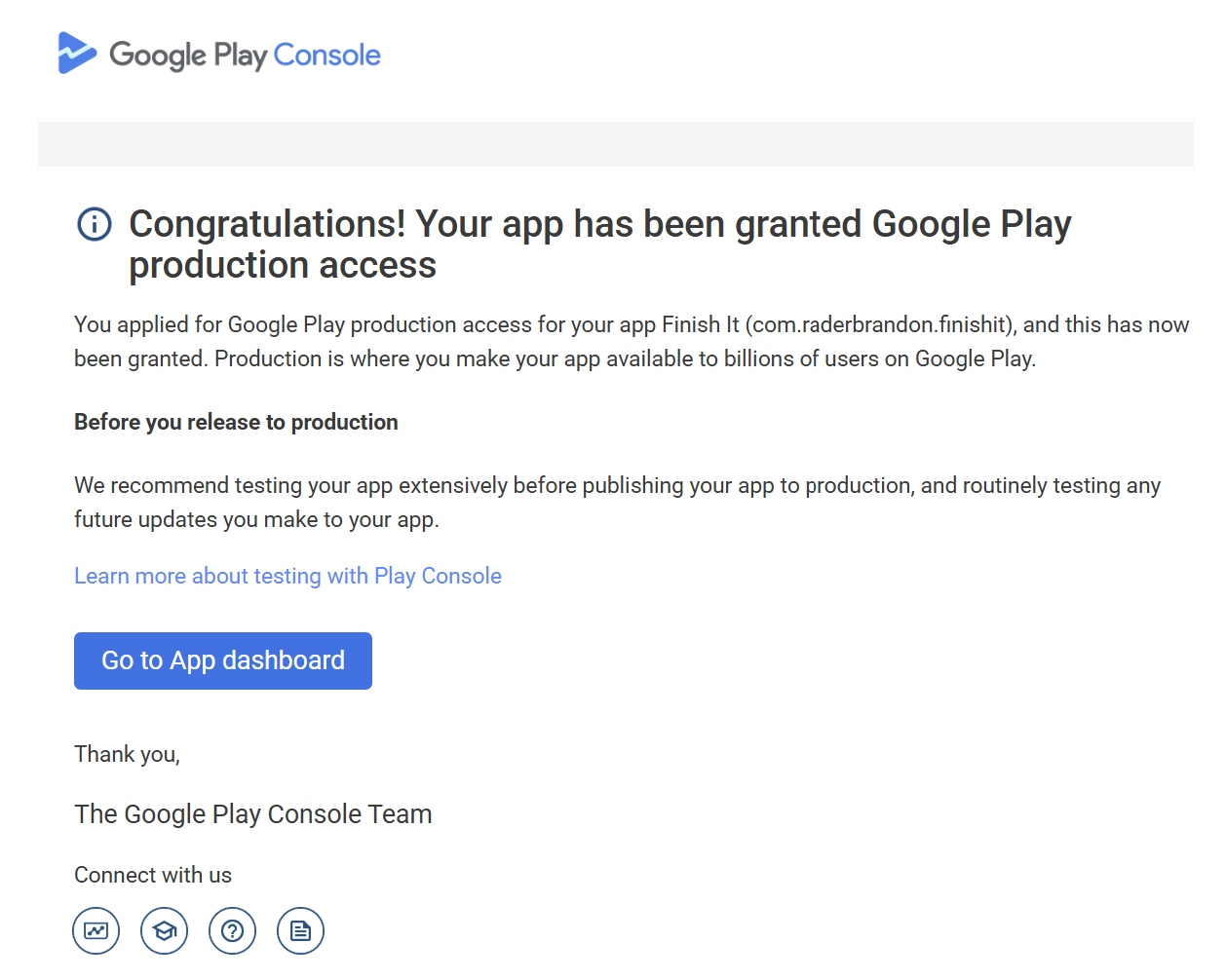
Once you have successfully maintained 20 active testers for 14 continuous days, the "Apply for Production" button will become available in your Google Play Console. This is a critical juncture. The application process requires you to answer a series of comprehensive questions detailing your testing methodology, the feedback you received, and the specific improvements you made based on that feedback. Google uses this information to determine whether your closed testing was a genuine exercise in quality assurance or a mere compliance check. Vague, superficial answers will almost certainly result in rejection. You must provide concrete examples, reference specific bugs that were fixed, and articulate how the testing phase demonstrably improved the user experience.
If your application is rejected, Google will typically provide a generic reason, often citing insufficient testing or failure to demonstrate a commitment to app quality. This means you must start the entire 14-day process over again with a fresh cohort of 20 testers. To avoid this costly setback, invest significant time in crafting your production access application. Treat it as a formal report summarizing two weeks of intense user research. Detail your communication channels, highlight the most valuable feedback received, and explain the technical refinements implemented. By proving that you actively utilized the Play Store Closed Testing phase to iterate and improve your application, you significantly increase your chances of securing the coveted production access and finally launching your app to the Polish market and beyond.
Does my 14-day closed testing period restart if I push a new update to the app?
No, pushing a new version of your application to the closed testing track does not restart the 14-day timer, provided your testers remain opted-in and update to the new version. In fact, releasing updates during the testing phase is often viewed positively by Google, as it demonstrates that you are actively responding to feedback and fixing issues discovered by your testers. Just ensure your testers actually install the update to maintain active engagement.
Do the 20 testers need to use the app every single day for 14 days?
While Google does not explicitly require testers to open the app every single day, they do require continuous "opt-in" status and genuine, organic interaction over the 14-day period. If testers download the app on day one and never open it again, Google's algorithms may flag the testing as synthetic or insufficient, leading to rejection. The goal is to simulate normal user behavior, which involves regular, albeit not necessarily daily, interaction.
Can testers uninstall the app once they have used it a few times?
Absolutely not. The most critical requirement of the Google Play Closed Testing policy is that the application must remain installed on the devices of all 20 opted-in testers for the entire, uninterrupted 14-day duration. If a tester uninstalls the application on day 12, they are no longer considered an active tester, and if your total drops below 20, your 14-day streak is broken, forcing you to start over.
What happens if my application for production access is rejected by Google?
If your application is rejected, you will not be allowed to publish your app to the public Play Store. Google will provide a reason, though it is often a broad statement about needing more testing. You will be required to recruit a new set of 20 testers (or re-engage the previous ones if possible) and complete another full 14-day closed testing period before you can reapply for production access.
How detailed do I need to be when answering the production access questionnaire?
You must be extremely detailed. Vague answers like "we fixed some bugs" will likely result in rejection. You need to provide specific examples of feedback you received (e.g., "Testers reported the login screen crashed on older Samsung devices"), how you addressed it (e.g., "We identified a memory leak in the authentication module and patched it in version 1.2"), and how the overall user experience was improved as a direct result of the closed testing phase.
Is it safe to use services that promise to provide 20 testers instantly for a low price?
It is highly risky and generally not recommended. Many "cheap" tester services rely on automated bots, device farms, or click scripts to simulate the 14-day engagement. Google's detection systems are incredibly sophisticated and easily identify this fraudulent activity. Using these services almost guarantees your production access will be denied, and it can put your entire Google Play Developer account at risk of suspension for policy violation. Always prioritize real, authentic users.
Our QA Process
A straightforward 4-step process to get your Android app approved.
Choose Package
Connect your Google account and choose your preferred closed testing package for your Android app.
Submit Link
Share your Play Store opt-in URL. We immediately deploy 12 real testers to launch and review your Android app daily.
Active Testing
Our crew initiates daily launch sessions on physical devices, verifying usability and logging crashes for your Android app.
Get Approved
We continuously perform closed app testing for 14 days to help you meet Google Play production requirements. We also provide a compliance report.
The Premium QA Advantage
Deploy your Android app onto real retail-grade handsets using our secure laboratory environment.
The 14-Day Production Guarantee
We complete the required 14-day closed testing process with real human testers and physical Android devices, while providing clear testing evidence and documentation throughout the process.
If Google specifically rejects production access due to insufficient testing engagement, you are covered by our free re-run or 100% refund guarantee, subject to our Refund Policy.
Verified Production Access
Quality QA Testing Reports
Clear, actionable reports with screenshots and evidence for every important issue found during testing.
Real Device Testing & Diagnostics
Real human testers use physical Android devices to test your app, verify real user flows, and provide clear testing evidence and professional QA reports.
Production Access Secured
Transition your Android app to public production access with confidence. We deliver verified session logs and compliant Console activity.
One Cycle. Complete Approval.
Choose the ideal closed testing cycle for your Android release.
Loading Packages
Please wait while we fetch the best options for your region...
Frequently Asked Questions
Everything you need to know about passing your closed testing requirements.