Play Store testers for 14-day Android closed testing in Qatar
Find Play Store testers in Qatar for 14-day Google Play closed testing. Fulfill Play Console requirements with 12 real testers and launch quickly.
Navigating Google Play Closed Testing Requirements in Qatar
Under Google Play policies, any personal developer account created after late 2023 cannot skip straight to production. You must publish your app release bundle to a dedicated closed testing track, onboard at least 12 opted-in testers, and keep them active for 14 straight days before you earn the right to apply for full production access.
Google Play Closed Testing is not merely a formality where you collect email addresses. Google Play Console evaluates real device telemetry, daily active sessions, opt-in retention, and qualitative bug reporting throughout the entire 14-day window. If testers install the build and immediately uninstall it, or if your opt-in count drops below the 12-tester baseline for even a few hours, the automated evaluation algorithm resets your 14-day clock back to day one. For developers in Qatar building bilingual Arabic and English experiences or integrating local payment gateways, securing vetted, real-device testers who actually run the app daily is essential to guarantee production approval on the first submission.
Why Devs in Doha and Across Qatar Face Testing Bottlenecks
Qatar is rapidly emerging as a regional technology powerhouse, backed by robust digital infrastructure, smart city initiatives, and high mobile device adoption. However, executing Play Store Closed Testing locally presents unique operational challenges for engineering teams and solopreneurs:
- Small Local Testing Pools: Mobilizing a dedicated group of 12 or more independent Android users outside your immediate workplace circle in Doha is difficult, especially when you need diverse hardware profiles across Samsung, Xiaomi, Google Pixel, and OnePlus devices.
- The Inevitable Friend-and-Family Dropoff: Relying on friends, colleagues, or family members usually starts well, but by day 5 or 6, people forget to open the app, clear background cache, or inadvertently uninstall the APK, breaking the continuous 14-day chain.
- Bilingual UI and RTL Formatting Checks: Apps targeting the Qatari market require thorough validation of Arabic Right-to-Left (RTL) layouts, localized numeric strings, and regional date pickers across multiple Android OS versions (from Android 11 up to Android 15).
- Payment Gateway and Telecom Sandboxes: Validating local checkout workflows, SMS OTP authentications across Ooredoo and Vodafone Qatar networks, and localized push notifications requires testers who interact with your app in genuine real-world environments.
- Strict Production Review Scrutiny: When you finally submit your 14-day testing report to Google Play review teams, you must answer detailed subjective questions about user feedback, bug discoveries, and architectural improvements implemented during the test phase.
Managed Real Device Testing
- 100% Genuine Physical Hardware: Real people using everyday consumer Android devices with active Google accounts.
- Guaranteed 14-Day Retention: Testers keep your app installed and open it regularly across the entire evaluation timeframe.
- Actionable Quality Feedback: Meaningful bug reports, ANR logs, and crash diagnostics collected through official Play Console channels.
- Zero Production Ban Risk: Complies fully with Google Play Developer Program Policies, ensuring clean account standing.
Emulator Farms and Bot Networks
- Automated Device Spoofing: Cloud virtual devices and scripted clicks easily detected by Google Play Integrity APIs.
- Abrupt Retention Drops: Automated instances shut down or cycle IP addresses, triggering automatic 14-day timer resets.
- Synthetic or Empty Logs: No natural touch gestures, network variation, or meaningful feedback submitted via Play Console.
- Severe Account Penalties: High risk of immediate production rejection, account flagging, or permanent developer account termination.
The Hidden Dangers of Bot Farms and Reciprocal Tester Groups
When deadlines press, many developers consider shortcuts such as cheap bot farms, automated device clouds, or reciprocal tester swap groups found on Reddit and Telegram. While these options may seem inexpensive or quick, they represent the single fastest way to get your Google Play developer account permanently flagged or rejected.
Google evaluates dozens of silent signals during the 14-day closed testing period. Their automated compliance algorithms monitor Android battery level fluctuations, device sensor readings, natural touch jitter, dynamic network switching (such as transitioning between Wi-Fi and 5G mobile data), and Play Store account history. Emulated environments or coordinated click farms produce identical, robotic interaction patterns that stand out instantly in Google Play Console backend analytics.
Reciprocal testing groups carry similar hidden pitfalls. In tester swap communities, developers trade app installs without genuine interest in testing. Most participants open the app once, leave a generic two-word review, and never launch it again. When Google Play review teams assess your production application questionnaire, they cross-reference your answers with internal telemetry. If your logs show zero active user engagement, flatlined session durations, and no bug reports, your production access will be declined, forcing you to start another 14-day cycle from scratch.
| Evaluation Metric | Professional Managed Testing | DIY Friends & Family | Cheap Bots / Emulators | Reciprocal Swap Groups |
|---|---|---|---|---|
| Active Testers | 20+ Guaranteed Real Testers | 12 to 15 Unreliable Users | 20+ Fake Virtual Devices | 12 to 15 Casual Swappers |
| 14-Day Continuity | 100% Guaranteed Active | High Drop-off Rate (Day 4-7) | High Risk of Reset | Very High Drop-off Rate |
| Device Diversity | Multiple OEM Brands & OS 11-15 | Limited Family Devices | Virtual / Emulated Hardware | Uncontrolled Random Specs |
| Play Console Feedback | Structured Logs & UX Notes | Minimal or Verbal Only | Automated Garbage Text | Generic / Low-Value Comments |
| Account Safety | Fully Policy-Compliant | Safe but Unreliable | High Risk of Account Ban | Moderate Risk of Rejection |
| Approval Probability | 99% First-Time Pass Rate | Below 45% Success Rate | Near 0% (High Flagging) | Below 30% Success Rate |
Struggling with the 14-Day Testing Requirement?
Skip the hassle of recruiting unreliable testers. Our professional fleet of real Android devices guarantees Google Play compliance in exactly 14 days. Zero bots. Zero emulators. 100% production approval guarantee.
Complete Technical Checklist Before Launching Your Closed Track
To ensure your Closed Testing track runs smoothly without administrative delays or build rejections from Google, complete this comprehensive technical checklist before distributing your initial internal or closed testing release.
Play Console Account & App Configuration
Binary Build Optimization & Target Architecture
Closed Track Opt-In & Tester Governance
Step-by-Step Roadmap to Production Access Approval
Passing the 14-day closed testing hurdle requires methodical execution. Follow this structured 5-step roadmap to guide your project from initial release setup to final Google Play Store production approval.
Track Configuration & Bundle Release
Upload your signed Android App Bundle (.aab) to a newly created Closed Testing Track in Google Play Console. Fill out release notes detailing the core test objectives, target regions including Qatar and global markets, and specific user workflows you want evaluated. Submit the track for initial Google automated review.
Tester Enrollment & Opt-In Confirmation
Distribute your official Google Play opt-in web link to your recruited testers. Every tester must accept the invitation using their primary Google Play account, download the app directly from the Play Store testing environment, and launch the application on their personal Android hardware.
14 Consecutive Days of Continuous Engagement
Maintain daily active usage across the entire 14-day testing period. Ensure testers interact with core application flows, test push notifications, execute search queries, and trigger localized features. Monitor Google Play Vitals daily to detect and resolve any unexpected crashes or ANR spikes immediately.
Feedback Gathering & Bug Remediation
Collect qualitative feedback and crash reports submitted by testers through the Play Console feedback portal. If critical UX flaws or device-specific bugs are found, deploy updated version bundles directly to the closed testing track to demonstrate active development to Google reviewers.
Production Access Application & Verification
Once the 14-day countdown concludes successfully, Google Play Console unlocks the Apply for Production button. Complete the detailed self-assessment questionnaire outlining your testing methodology, feedback collected, and technical refinements made. Submit for final review to publish your app publicly.
Mastering the Play Console Production Application Questionnaire
The final step between completing your 14-day closed testing period and getting your app published on the Google Play Store is the production access questionnaire. Google reviewers read your answers to evaluate whether your testing was genuine, comprehensive, and productive.
Here is how you should structure your answers to maximize your chances of immediate approval:
1. Describing Your Target Audience and Testing Recruitment
Explain clearly how you recruited your test group. State that you engaged a dedicated cohort of diverse Android users across relevant target markets, including Qatar and the GCC region, representing varied device manufacturers (Samsung, Xiaomi, Google Pixel) and OS versions (Android 11 through Android 15). Emphasize that your testers matched your app's intended demographic.
2. Detailing User Feedback and Discoveries
Avoid generic claims like "testers loved the app and found zero issues." Google expects real development insights. Detail specific UI/UX observations, such as adjustments made to Arabic font scaling, improvements to checkout button contrast, resolution of an edge-case crash during offline state transitions, or performance tuning on lower-spec hardware.
3. Summarizing App Updates and Iterations
Document the build updates you pushed to the closed testing track during the 14-day window. Showcasing that you published a revised bundle (e.g., advancing from version 1.0.0 to 1.0.2) to fix bugs reported by testers proves to Google that you ran an active, feedback-driven QA cycle rather than a passive timer-waiting exercise.
Why does Google Play require 12 testers for 14 continuous days?
Google introduced this policy for all personal developer accounts created after November 2023 to improve overall app quality on the Play Store. By enforcing a mandatory 14-day closed test with at least 12 real users, Google ensures that developers thoroughly test their apps for crashes, broken user flows, data safety compliance, and device compatibility before releasing them to the general public.
What happens if a tester uninstalls the app on day 8 of the test?
If your active opted-in tester count drops below the mandatory minimum of 12 testers at any point, Google Play automated monitoring may pause or completely reset your 14-day progress counter. To protect your timeline against unexpected uninstalls, it is best practice to enroll a buffer of at least 20 active testers throughout the entire testing duration.
Can developers in Qatar use testers located outside of Qatar?
Yes. Google Play Closed Testing allows you to recruit testers globally, provided you have configured your closed testing track availability to include the countries where your testers reside. However, if your application relies on Qatar-specific features like local SMS verification, Qatari phone formats, or regional payment gateways, having testers who can validate those regional workflows is highly recommended.
How does Google distinguish between real human testers and bot farms?
Google Play Console analyzes hundreds of behavioral signals collected directly via Google Play Services. These include natural touchscreen interactions, realistic battery discharge rates, accelerometer movement, genuine Google account usage history, varied network connectivity, and authentic session lengths. Automated bot farms and emulator scripts fail these telemetry checks, leading to rejection or account termination.
Can I push new updates to my app during the active 14-day testing window?
Yes, pushing updates to your closed track during the 14 days is not only allowed, but actively encouraged by Google. Releasing updated builds with bug fixes, performance improvements, or layout adjustments based on tester feedback demonstrates to Google reviewers that you are running a genuine, responsive quality assurance process.
What should I do if my production access application gets rejected?
If Google declines your initial application for production access, carefully review the feedback provided in Play Console. Common reasons include insufficient tester engagement, generic answers in the final questionnaire, or unaddressed crash vitals. You will need to address the highlighted issues, run another 14-day testing cycle with active engagement, and resubmit with detailed, transparent documentation of your improvements.
The Testing Pipeline
A straightforward 4-step process to get your Android app approved.
Sign In
Connect your Google account and choose your preferred closed testing package for your Android app.
Opt-In URL
Share your Play Store opt-in URL. We immediately deploy 12 real testers to launch and review your Android app daily.
Testing Begins
Our crew initiates daily launch sessions on physical devices, verifying usability and logging crashes for your Android app.
Compliance Complete
We continuously perform closed app testing for 14 days to help you meet Google Play production requirements. We also provide a compliance report.
Why Developers Trust Us
Deploy your Android app onto real retail-grade handsets using our secure laboratory environment.
The 14-Day Production Guarantee
We complete the required 14-day closed testing process with real human testers and physical Android devices, while providing clear testing evidence and documentation throughout the process.
If Google specifically rejects production access due to insufficient testing engagement, you are covered by our free re-run or 100% refund guarantee, subject to our Refund Policy.
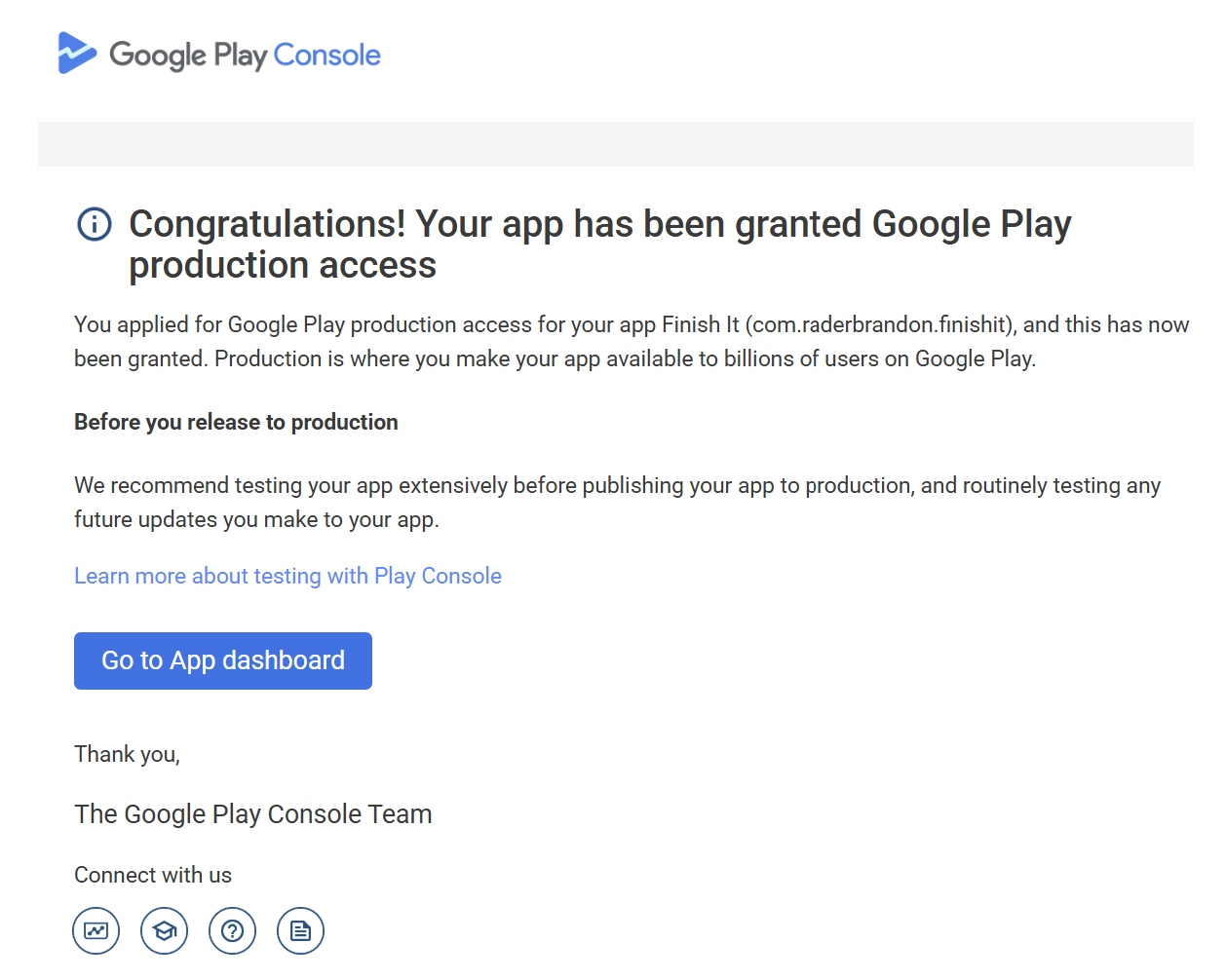
Verified Production Access
Quality QA Testing Reports
Clear, actionable reports with screenshots and evidence for every important issue found during testing.
Real Device Testing & Diagnostics
Real human testers use physical Android devices to test your app, verify real user flows, and provide clear testing evidence and professional QA reports.
Guaranteed App Approval
Transition your Android app to public production access with confidence. We deliver verified session logs and compliant Console activity.
One Cycle. Complete Approval.
Choose the ideal closed testing cycle for your Android release.
Loading Packages
Please wait while we fetch the best options for your region...
Frequently Asked Questions
Everything you need to know about passing your closed testing requirements.