Play Store testers for 14-day Android closed testing in Sweden
Find Play Store testers in Sweden for Android closed testing. Easily clear the Google Play 12 testers for 14 days requirement with real Play Console testers.
Did you know that launching a mobile app in Sweden is a lot like trying to bake a traditional Swedish Princess Cake? From the outside, it looks perfectly smooth, sweet, and incredibly easy to consume. But if you have ever tried to make one from scratch, you know that if you skip the mandatory chilling steps or rush the layers, the entire thing collapses into a messy disaster. For modern Android developers, that critical chilling step is Google's mandatory pre-launch evaluation phase. You have poured months of late-night coding, sweat, and endless cups of coffee into building your dream application. You have painstakingly squashed the bugs, polished the user interface, and now you are completely ready to share it with the world - specifically, the vibrant, highly tech-savvy market of Sweden. But suddenly, you hit a massive brick wall. Google Play throws a massive roadblock at you: you need a group of real people to use your app continuously before they even let you submit it for a public review.
Sweden is not just any market. It is a nation built on cutting-edge technology, blazing-fast internet speeds, and consumers who expect nothing short of digital perfection. When a Swedish user downloads an application, they expect a seamless onboarding process, flawless localization, and an interface that respects their time. If your app crashes, stutters, or feels like a cheap port from another region, they will uninstall it in a heartbeat and leave a review that will tank your store ranking. This is why testing your app locally is not just a regulatory hurdle; it is a fundamental business strategy. You cannot simply guess what a user in Stockholm or Gothenburg wants; you have to put your code directly into their hands and watch how they interact with it.
Historically, independent developers could simply bypass this rigorous user-testing phase. You could compile your code, upload the APK to the console, click a few buttons, and your app would be live for billions of potential users globally within a few hours. But those days are long gone. The modern app store is a vastly different landscape, crowded with millions of apps, many of which are low-quality clones, spam, or even malicious software. To protect their ecosystem and ensure that users only download high-quality software, Google has drastically changed the rules of the game for new personal developer accounts. They no longer want you to just upload and hope for the best. They demand proof that your app works, that people actually want to use it, and that it behaves correctly on a variety of real-world devices.
This brings us to the core of the challenge for independent creators. Finding people to critically evaluate your software is hard enough. Finding a dedicated group of users in a specific geographic region who are willing to commit their time to your unreleased software is a monumental task. It requires networking, marketing, and a lot of patience. But if you want to succeed in a premium market like Sweden, you have to play by these new rules and conquer the testing phase with flying colors.
Understanding Google Play Closed Testing
To truly appreciate the hurdle you are facing, we need to dive deep into what Google Play Closed Testing actually is and why it has become the ultimate gatekeeper for new Android applications. In late 2023, Google announced a massive policy shift that sent shockwaves through the indie developer community. To ensure that only high-quality apps make it to the digital shelves, they introduced a mandatory vetting process for all newly created personal developer accounts. This is not a suggestion or a best practice; it is a hard, unavoidable requirement.
Google Play Closed Testing is essentially a sandbox environment where your app is scrutinized by actual users on real Android devices before the general public is ever allowed to see it. Think of it as a dress rehearsal before the opening night of a play. The director (you) needs to see how the actors (your code) perform in front of a live, albeit small, audience. During this phase, you are expected to gather qualitative feedback, monitor crash logs, and prove to Google's automated systems that your application is stable, secure, and provides genuine value.
Why did Google do this? The answer is simple: quality control. For years, the Play Store was flooded with flashlight apps, cheap casino game clones, and apps that were nothing more than a web view wrapping a poorly optimized website. This ocean of digital garbage made it incredibly difficult for users to find genuinely useful applications, and it frustrated high-quality developers who saw their hard work buried under mountains of spam. By forcing developers to go through Google Play Closed Testing, Google ensures that anyone who wants to publish an app is serious about their craft. If you are a spammer trying to push out a hundred junk apps a day, you are not going to have the time, resources, or dedication to coordinate a multi-week testing phase with real human beings.
For a developer targeting Sweden, this testing phase is a golden opportunity disguised as an annoying roadblock. Swedish users are notoriously discerning. They are accustomed to world-class digital experiences from companies like Spotify, Klarna, and Mojang. If you can impress a group of Swedish testers during your closed beta, you can be highly confident that your app is ready for the broader European market. It forces you to look beyond your own bias as the creator and see your application through the eyes of the consumer. Does the navigation make sense? Are the translations accurate or do they sound like they were generated by a broken machine? Does the app drain the battery too quickly on a cold winter day in Malmö? These are the questions that can only be answered by real users in the real world.
The Critical Rule: 12 Testers for 14 Days
When developers start reading through the new console requirements, they often get hung up on the specific numbers. While the official Google documentation for many global developers stipulates 20 testers, many regional developers and tight-knit communities focus on the magic baseline of finding 12 Testers for 14 Days to ensure consistent, overlapping engagement. Whatever the exact number Google demands for your specific account region, the principle remains identically strict: you need a consistent, unbroken chain of user engagement over a two-week period.
Let us break down what the 12 Testers for 14 Days concept actually means in practice. It is not enough to simply have people download your app, open it once, and then forget about it. Google's sophisticated tracking algorithms are monitoring engagement. They want to see that these testers are actually launching the app, interacting with the user interface, navigating through different screens, and keeping the application installed on their primary devices for the entire fourteen-day duration. If a tester downloads your app on day one and uninstalls it on day three because it crashed or bored them, that tester no longer counts toward your continuous testing goal.
This is where the nightmare begins for a lot of solo developers. You might be able to convince your mom, your best friend, and your dog walker to download your app. That might get you a handful of testers. But can you convince them to open it every other day for two weeks? Can you convince them to actually tap around and look for bugs? And more importantly, if you are building an app for the Swedish market, are your local friends going to be able to provide the culturally relevant feedback you need? Probably not.
The requirement for continuous testing over a two-week period is designed to simulate a miniature launch. It gives the developer time to release updates, fix critical bugs that only appear in edge cases, and prove that they are actively maintaining the software. It separates the hobbyists who just want to upload an APK and walk away from the dedicated professionals who are committed to providing a great user experience. Managing these 12 Testers for 14 Days requires constant communication, gentle nudging, and a well-structured feedback loop. You need to remind your testers to use the app, ask them specific questions about their experience, and thank them for their time. It is a part-time job in itself, and it is a job that many developers are completely unprepared for.
Real Swedish Testers
- Actual human beings using your app on real daily-driver devices.
- Provide genuine, localized feedback on your UI and UX design.
- Discover bizarre edge-case bugs that automation completely misses.
- Satisfy Google's strict policy requirements safely and legally.
- Build early traction, loyalty, and word-of-mouth in the Swedish market.
Fake Bot Accounts
- Automated scripts that just ping the Play Store server blindly.
- Zero qualitative feedback on how the app actually feels or looks.
- Extremely high risk of getting your entire developer account permanently banned.
- Cannot test complex, real-world user flows or localized payment gateways.
- A complete waste of your time, money, and development effort in the long run.
Why Bot Testing Will Destroy Your Developer Dreams
When faced with the daunting task of finding real people to test their apps, many developers panic and turn to the dark side of the internet. A quick search will reveal dozens of shady services offering to provide instant testers for a few dollars. These services use automated server farms, emulators, and bot accounts to artificially inflate your tester count. They promise a quick, painless way to bypass Google's rules. Do not fall for it. Using bots is the fastest way to destroy your developer dreams.
Google is not a small, naive company. They employ some of the smartest engineers in the world, and they have built incredibly sophisticated machine learning models designed specifically to detect fraudulent activity. They know the difference between a real human swiping through an app on a Samsung Galaxy in Stockholm and a script running on an emulator in a server farm halfway across the world. When Google catches you using fake accounts - and they almost certainly will - the consequences are severe. They will not just reject your app; they can permanently terminate your developer account. All your hard work, your registration fees, and your future potential on the platform will be wiped out in an instant. It is a risk that is never, ever worth taking.
Struggling with the 14-Day Testing Requirement?
Skip the hassle of recruiting unreliable testers. Our professional fleet of real Android devices guarantees Google Play compliance in exactly 14 days. Zero bots. Zero emulators. 100% production approval guarantee.
Comparing Your Testing Options
So, if bots are out of the question, how do you actually get this done? Let us take a look at the three main paths developers take when trying to conquer this requirement, and see how they stack up against each other in the real world.
| Feature | Professional Service | DIY (Friends & Family) | Bots & Emulators |
|---|---|---|---|
| Account Safety | 100% Safe & Compliant | Usually Safe | Extremely Risky |
| Speed to Start | Immediate & Scheduled | Slow & Frustrating | Fast but useless |
| Feedback Quality | High & Constructive | Biased / Very Low | None |
| Time Commitment | Minimal for Developer | Huge time drain | Low |
| Localization | Targeted (e.g., Sweden) | Random / Local | Spoofed IPs |
As you can see, trying to wrangle your own network of friends and family is a massive time drain that rarely yields the quality of feedback you actually need. Professional services, on the other hand, provide a streamlined, safe, and highly effective way to get your app into the hands of real, targeted users without the headache.
Pre-Launch Preparation: Getting Ready for Play Store Closed Testing
Before you invite a single tester to try your application, you need to make sure your house is in order. Play Store Closed Testing is not the place for half-baked, broken prototypes. Your app should be as close to feature-complete as possible. If testers open your app and it immediately crashes, they are going to uninstall it, and you will fail the fourteen-day requirement. Here is a comprehensive checklist to ensure you are fully prepared for the evaluation phase.
Phase 1: App Polish and Localization
Phase 2: Console Setup and Onboarding
If you skip these steps, you are setting yourself up for failure. The testing phase is a precious window of opportunity; do not waste it by making testers point out obvious flaws that you should have caught yourself.
Your Roadmap to Production
The journey from a finished codebase to a live application in the Google Play Store is a multi-step process. It requires patience, attention to detail, and a clear understanding of the rules. Let us map out the exact user journey you will take as you navigate this mandatory phase.
Step 1: Upload your App Bundle
Compile your final Android App Bundle (AAB) and upload it to the designated track in the Play Console. Ensure all store listing details are filled out accurately.
Step 2: Onboard Swedish Testers
Distribute your opt-in link to your curated group of real users in Sweden. Monitor the console to confirm they have successfully downloaded and installed the application.
Step 3: The 14-Day Wait
This is the most critical phase. Testers must keep the app installed and actively use it for the full duration. You must remain on standby to push hotfixes if critical bugs are discovered.
Step 4: Analyze Feedback
Review the crash logs in the console and read through the qualitative feedback provided by your users. Make any necessary adjustments to improve the user experience.
Step 5: Apply for Production
Once the mandated time has passed and you have met all engagement criteria, submit your final application to Google for a comprehensive production release review.
By following this roadmap, you transform a stressful, confusing requirement into a structured, predictable process.
Mastering the Final Review
After you have successfully navigated the two-week gauntlet and your Swedish testers have provided their feedback, you might think you are finally at the finish line. However, the final application for production access is a crucial step that requires careful attention. When you apply for production, Google is going to ask you a series of questions about your Closed Testing experience. This is not a formality; it is a vital part of the review process.
You will need to articulate exactly how you gathered your testers, what kind of feedback they provided, and most importantly, what changes you made to the application based on that feedback. Google wants to see that you actually engaged with the process and used the testing phase to improve your software. If you simply write "the app is good" in the questionnaire, your application will likely be rejected. You need to be detailed. Explain how a tester in Stockholm found a bug in your checkout process, and how you pushed an update on day four to resolve it. Detail how user feedback helped you refine your Swedish translations.
This final review is Google's way of verifying that the entire process was legitimate and valuable. By working with real, localized users, you will have a wealth of genuine data and stories to share in this questionnaire. You will be able to prove, without a shadow of a doubt, that your app is ready for the world stage. It takes a bit of extra effort to document the journey, but it is the final key that unlocks the door to the global market.
Frequently Asked Questions
Navigating the complexities of app store policies can be incredibly confusing, especially when those policies are constantly evolving. Here are some of the most common questions developers have when trying to launch their apps in the Swedish market.
Why do I need specific testers from Sweden?
While Google technically only requires testers from anywhere in the world, having local users is crucial for your app's success. If your app is designed for the Swedish market, local testers provide invaluable insights into cultural nuances, local payment gateway functionality, and language accuracy that foreign testers simply cannot provide.
Can I just use my old developer account to skip this?
The new mandatory testing policy strictly applies to personal developer accounts created after November 13, 2023. If you have an older account, you might be technically exempt from the hard requirement, but running a thorough beta test is still highly recommended for ensuring app quality.
What happens if a tester uninstalls the app early?
If testers drop out or uninstall the application before the mandatory two-week period is completely over, you risk failing the automated evaluation. You need committed users who will keep the app installed, which is why relying on casual friends is often a recipe for failure.
Is this different from internal testing?
Yes, absolutely. Internal testing is designed for your immediate development team and has a limit of up to 100 testers, but it does not satisfy the strict requirements for moving a new app to a production release. You must specifically use the closed testing track to meet Google's new policy mandates.
How We Deliver 12 Testers
How we deploy real devices and guarantee compliance for your release.
Connect Account
Sign in with Google to configure the closed testing environment for your Android build.
Assign Testers
Submit your Google Play Console testing link, and our team will assign qualified testers from our testing network to join your Android closed testing release.
Daily QA Runs
A QA supervisor monitors daily check-ins, ensuring 12 unique Android users engage with your Android build every single day.
Launch Ready
We guarantee 14 consecutive days of active user check-ins to satisfy Google's compliance policies, delivering an audit-ready PDF feedback report.
Our Testing Infrastructure
Experience a next-generation testing infrastructure built for Google Play compliance for your Android release.
The 14-Day Production Guarantee
We complete the required 14-day closed testing process with real human testers and physical Android devices, while providing clear testing evidence and documentation throughout the process.
If Google specifically rejects production access due to insufficient testing engagement, you are covered by our free re-run or 100% refund guarantee, subject to our Refund Policy.
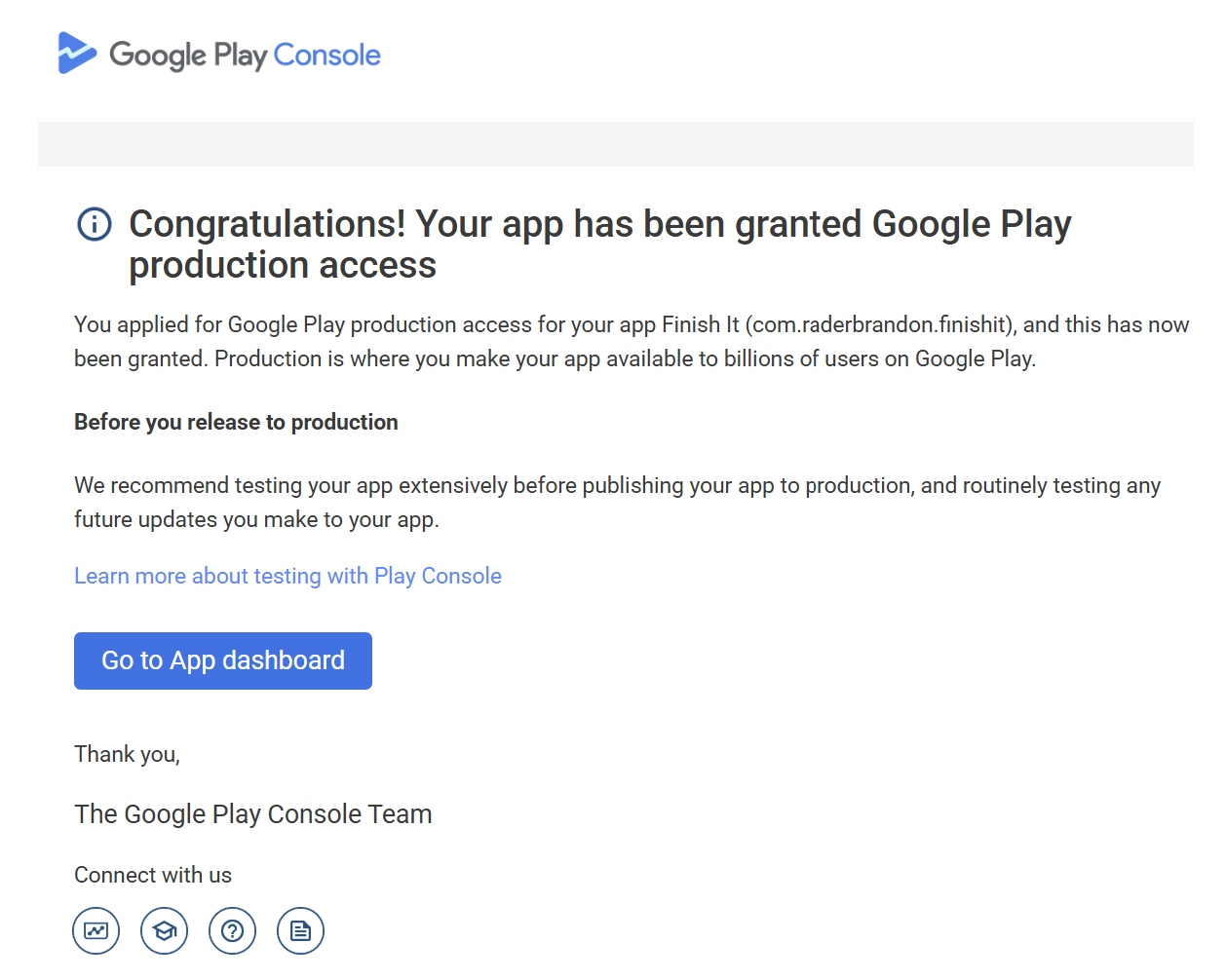
Verified Production Access
Quality QA Testing Reports
Clear, actionable reports with screenshots and evidence for every important issue found during testing.
Real Device Testing & Diagnostics
Real human testers use physical Android devices to test your app, verify real user flows, and provide clear testing evidence and professional QA reports.
Compliance Audit Passed
Get your Android build approved on the first try. We create an audit-ready compliance profile that proves thorough quality assurance.
Affordable Compliance Cycles
Transparent plans built to satisfy Google Play Console guidelines for your Android build.
Loading Packages
Please wait while we fetch the best options for your region...
Frequently Asked Questions
Everything you need to know about passing your closed testing requirements.