Play Store testers for 14-day Android closed testing in Switzerland
Need Play Store testers in Switzerland? Pass Google Play closed testing with 12 testers for 14 days. Expert Play Console testers for your Android app.
Everyone thinks launching an app in Switzerland is just about translating it into German, French, and Italian, and slapping a high price tag on the premium version. But before your application can even glimpse the home screens of users from Zurich to Geneva, it has to survive the infamous Google Play Closed Testing gauntlet. If you are a solo developer or an ambitious startup, scraping together a reliable crew to poke holes in your app every day for two straight weeks is like trying to find an empty ski lift in St. Moritz during peak season. You need real people, not just numbers on a screen, to ensure your software is ready for the precision-obsessed Swiss market.
Building an app is only half the battle. The other half is proving to Google that your creation is stable, secure, and user-friendly. In the past, you could just upload an APK, click publish, and hope for the best. Today, the landscape is entirely different. Google wants evidence of quality, and they demand it through rigorous testing phases. You might have heard whispers in developer forums about needing 12 Testers for 14 Days, but the reality is often stricter, requiring a full cohort of engaged individuals who will actively use your app and provide meaningful feedback.
This is where many developers hit a wall. Finding people willing to commit their time for a fortnight is difficult enough, but finding testers who actually represent the Swiss demographic is a monumental task. The Swiss digital ecosystem is unique. Users here expect flawless functionality, strict privacy standards, and seamless localized experiences. If your testers are just clicking randomly without understanding the context of the app, their feedback is worse than useless - it is actively misleading. You need a testing strategy that aligns with the high expectations of your future users.
The Alpine Climb of Google Play Closed Testing
When you first initiate your Google Play Closed Testing track, the dashboard can feel intimidating. It is not merely a waiting room before your app goes live; it is a proving ground. Google monitors tester engagement, crash rates, and overall stability during this period. If your testers install the app on day one and then never open it again, the algorithm notices. If they encounter fatal errors and simply uninstall instead of reporting them, your app's reputation score takes a invisible hit before it even reaches the public store.
The purpose of this rigorous process is to filter out low-quality software and protect the Android ecosystem. Google has realized that relying solely on automated checks is insufficient. Real human interaction uncovers edge cases that emulators simply cannot replicate. How does your app behave when a user switches from Wi-Fi to a spotty 4G connection while riding a train through the Gotthard Base Tunnel? What happens when someone switches their device language from French to Romansh mid-session? These are the kinds of scenarios that only genuine human interaction can uncover.
Navigating this requirement means you cannot rely on shortcuts. You must gather a dedicated group of individuals who will open your app daily, navigate through its core features, intentionally try to break things, and submit constructive reports. This 14-day window is your opportunity to iterate rapidly, fixing bugs and refining the user interface based on actual human frustration or delight. It is a sprint, and you need a team of sprinters who know how to pace themselves over two weeks of continuous testing.
The Truth About App Testing in Switzerland: Real Humans vs. Synthetic Bots
In desperation, some developers turn to shady online forums promising overnight success with automated testing scripts. They think they can bypass the Play Store Closed Testing requirements by purchasing bot traffic. This is a catastrophic mistake. Google's detection algorithms are sophisticated and continuously evolving. They analyze device fingerprints, network patterns, and interaction heuristics. A bot tapping the exact center of a button every three seconds is instantly flagged, and the consequence is often a permanent ban on your developer account.
Authentic Swiss Testers
Real human testers bring invaluable context to your app. They notice when a translation feels robotic or culturally inappropriate. They get frustrated when a checkout process is too convoluted, and they tell you exactly why they abandoned their cart. Their devices are filled with real-world clutter, varying battery levels, and conflicting background processes.
When you invest in authentic testing, you are buying peace of mind. You know that the engagement metrics appearing in your Google Play Console are genuine. More importantly, the feedback you receive allows you to polish your app into a product that Swiss users will actually want to keep on their phones. It is an investment in your app's long-term viability and reputation.
Automated Bot Scripts
Bots do not care about your user interface. They cannot tell you if your color scheme is harsh on the eyes or if your value proposition is confusing. They simply execute a predefined sequence of actions, generating synthetic data that might fool a basic counter but will never pass a deeper algorithmic audit.
Relying on artificial engagement is playing Russian roulette with your developer account. Even if you manage to slip past the initial checks and secure a public release, your app will be fundamentally flawed. Without real user feedback during the testing phase, your true testing will happen post-launch, resulting in one-star reviews, massive uninstall rates, and a ruined brand reputation in the Swiss market.
Preparing Your Codebase for the 14-Day Sprint
Before you invite a single tester into your environment, your house must be in order. The Closed Testing phase is not for debugging fundamental architectural flaws; it is for polishing a near-finished product. If your app crashes on the launch screen, you are wasting your testers' time and your own money. Proper preparation ensures that every day of the two-week period yields actionable, high-value insights.
You need to establish clear objectives for your testers. What specific flows do you want them to focus on? Are there new features you are particularly worried about? Creating a structured testing guide helps testers provide the exact type of feedback you need. Additionally, you must have your analytics and crash reporting tools properly integrated and configured. If a tester experiences a crash, you need the stack trace immediately, without having to ask them to manually describe what happened.
Technical Readiness
Ensure Firebase Crashlytics or Sentry is properly implemented to catch unhandled exceptions automatically.
Configure tools to monitor network request times, database query speeds, and UI rendering delays.
Verify that your testing environment connects to a staging database, not your live production data.
Tester Onboarding Materials
Create a simple, jargon-free guide explaining what the app does and what specific features need the most attention.
Set up an easy way for testers to report bugs, such as an in-app feedback button or a dedicated Discord channel.
Struggling with the 14-Day Testing Requirement?
Skip the hassle of recruiting unreliable testers. Our professional fleet of real Android devices guarantees Google Play compliance in exactly 14 days. Zero bots. Zero emulators. 100% production approval guarantee.
The Roadmap to a Flawless Swiss Release
Navigating the complexities of Google Play Closed Testing does not have to be a solo expedition. Our service provides a structured, predictable path from your final beta build to a successful public launch in the Swiss Play Store. We handle the logistics of sourcing, managing, and monitoring testers, allowing you to focus entirely on writing code and improving your product based on real-time feedback.
Our process is designed to maximize the value of the 14-day requirement. We do not just provide installs; we provide sustained engagement. Our testers are real people who understand the importance of exploring every menu, testing every form field, and pushing the app to its limits. We guide you through each stage, ensuring that you meet all of Google's criteria for production access.
Initial App Assessment
We review your application to ensure it meets baseline stability requirements. We check for common rejection reasons and ensure your store listing is properly configured for the closed testing track. This preliminary audit saves you from wasting time on a testing phase that is doomed to fail from the start.
Tester Allocation and Onboarding
Once your app is ready, we assign a dedicated group of real human testers to your project. We handle all the logistics of adding their email addresses to your Google Play Console, distributing the opt-in links, and ensuring they successfully install the application on their personal devices.
The 14-Day Engagement Phase
This is the core of our service. For two full weeks, our testers will actively engage with your app on a daily basis. They will navigate through different screens, test various functionalities, and simulate real-world usage patterns. We monitor their activity to ensure consistent engagement throughout the entire period.
Comprehensive Feedback Delivery
As the testing progresses, we compile and deliver detailed feedback reports. These reports include bug descriptions, usability suggestions, and device-specific performance notes. You receive actionable data that you can use to immediately patch vulnerabilities and improve the overall user experience.
Production Access Application
After the 14 days are complete and the engagement metrics have been securely logged by Google, we guide you through the final step of applying for production access. We help you answer the required questions about your testing process to maximize the chances of a swift approval from the Play Store review team.
Comparing Your Testing Options
When deciding how to approach the testing requirement, you generally have three paths: attempting a DIY approach by begging friends and family, risking your account with automated bot services, or partnering with a professional testing provider. Each option carries vastly different costs, risks, and potential rewards.
The DIY route often seems appealing at first because it is ostensibly free. However, the hidden cost is the immense amount of time you will spend hounding your acquaintances to open the app every day. Friends are notoriously unreliable testers; they want to be supportive, so they often ignore glaring flaws to avoid hurting your feelings. Furthermore, gathering a diverse enough group of devices and Android versions from your immediate social circle is highly unlikely.
| Feature | Professional Service | DIY (Friends & Family) | Automated Bots |
|---|---|---|---|
| Account Safety | 100% Safe | Generally Safe | Extremely High Risk |
| Feedback Quality | Detailed, actionable insights | Vague, overly polite | Non-existent |
| Engagement Consistency | Guaranteed daily usage | Sporadic, rapidly declining | Perfectly robotic (suspicious) |
| Device Diversity | Wide range of real devices | Limited to your social circle | Emulators with fake hardware IDs |
| Time Investment Required | Minimal | Extremely High | Low initially, high when banned |
| Swiss Market Alignment | High | Variable | Zero |
Partnering with a professional service guarantees that the engagement metrics Google demands are met consistently. You eliminate the stress of managing testers and avoid the catastrophic risks associated with bot traffic. It is the most reliable way to ensure your app transitions smoothly from development to a successful, public Swiss launch.
Navigating the Nuances of the Swiss App Ecosystem
Switzerland is a multifaceted market that demands a nuanced approach to app development and testing. With four national languages - German, French, Italian, and Romansh - and a highly discerning user base, a one-size-fits-all strategy rarely succeeds here. Your application needs to feel native to a user in Geneva just as much as it does to a user in Basel. This goes beyond simple translation; it involves cultural adaptation and a deep understanding of local user behavior.
During the Closed Testing phase, localized feedback is crucial. A date format that looks perfectly normal to an American developer (MM/DD/YYYY) will cause instant confusion for a Swiss user accustomed to DD.MM.YYYY. Currency formatting for the Swiss Franc (CHF) has specific conventions that must be adhered to. Even the tone of your copy matters; Swiss users generally prefer clear, concise, and professional language over overly casual or colloquial phrasing. If you skip thorough testing with real people, these subtle but critical errors will make your app feel foreign and untrustworthy.
Furthermore, the Swiss have stringent expectations regarding data privacy and security. The legacy of Swiss banking secrecy extends into the digital realm. Users are highly conscious of what permissions an app requests and how their personal data is handled. If your app unnecessarily demands access to the camera or location services, Swiss testers will flag it immediately. Addressing these privacy concerns during the testing phase prevents negative reviews and high uninstallation rates once the app is publicly available on the Play Store.
Frequently Asked Questions
Why is the 14-day continuous testing period so strictly enforced by Google?
Google enforces this period to ensure that developers are genuinely testing their apps over time, rather than just generating a quick spike of installs. Continuous usage reveals memory leaks, battery drain issues, and long-term stability problems that a single session could never uncover. It proves that your app can handle sustained real-world usage.
Can I use emulators instead of physical Android devices for my closed test?
While you can use emulators for your own internal debugging, relying on them for the official closed testing phase is highly discouraged. Google's algorithms can easily distinguish between emulators and real physical devices. Using emulators heavily can trigger fraud detection systems and result in your production access being delayed or denied.
What happens if a tester misses a day of testing during the two weeks?
Occasional missed days by individual testers are normal and expected in real-world scenarios. However, if there is a significant, consistent drop in overall engagement across your entire testing cohort, Google may determine that your testing phase was insufficient. Our service manages the cohort to ensure the aggregate engagement remains high enough to satisfy Google's requirements.
How detailed does the feedback need to be to satisfy the Play Store reviewers?
When you apply for production access, Google will ask you to summarize the feedback you received and how you acted upon it. Vague answers like "the app is good" are red flags. You need specific examples, such as "Testers reported the checkout button was unresponsive on Android 12 devices, which we resolved in version 1.0.4." Real testing generates this kind of specific, actionable data.
Is it really necessary to localize my app for Switzerland if most people speak English?
While English proficiency is high in Switzerland, especially in business contexts, users overwhelmingly prefer apps in their native language (Swiss Standard German, French, or Italian). Offering a localized experience significantly increases user trust, engagement, and retention. Testing helps ensure your translations are contextually accurate and culturally appropriate.
How It Works
A straightforward 4-step process to get your Android app approved.
Get Started
Connect your Google account and choose your preferred closed testing package for your Android app.
App Submission
Share your Play Store opt-in URL. We immediately deploy 12 real testers to launch and review your Android app daily.
14-Day Cycle
Our crew initiates daily launch sessions on physical devices, verifying usability and logging crashes for your Android app.
Production Access Approval
We continuously perform closed app testing for 14 days to help you meet Google Play production requirements. We also provide a compliance report.
Why Choose AppConsoleLab
Deploy your Android app onto real retail-grade handsets using our secure laboratory environment.
The 14-Day Production Guarantee
We complete the required 14-day closed testing process with real human testers and physical Android devices, while providing clear testing evidence and documentation throughout the process.
If Google specifically rejects production access due to insufficient testing engagement, you are covered by our free re-run or 100% refund guarantee, subject to our Refund Policy.
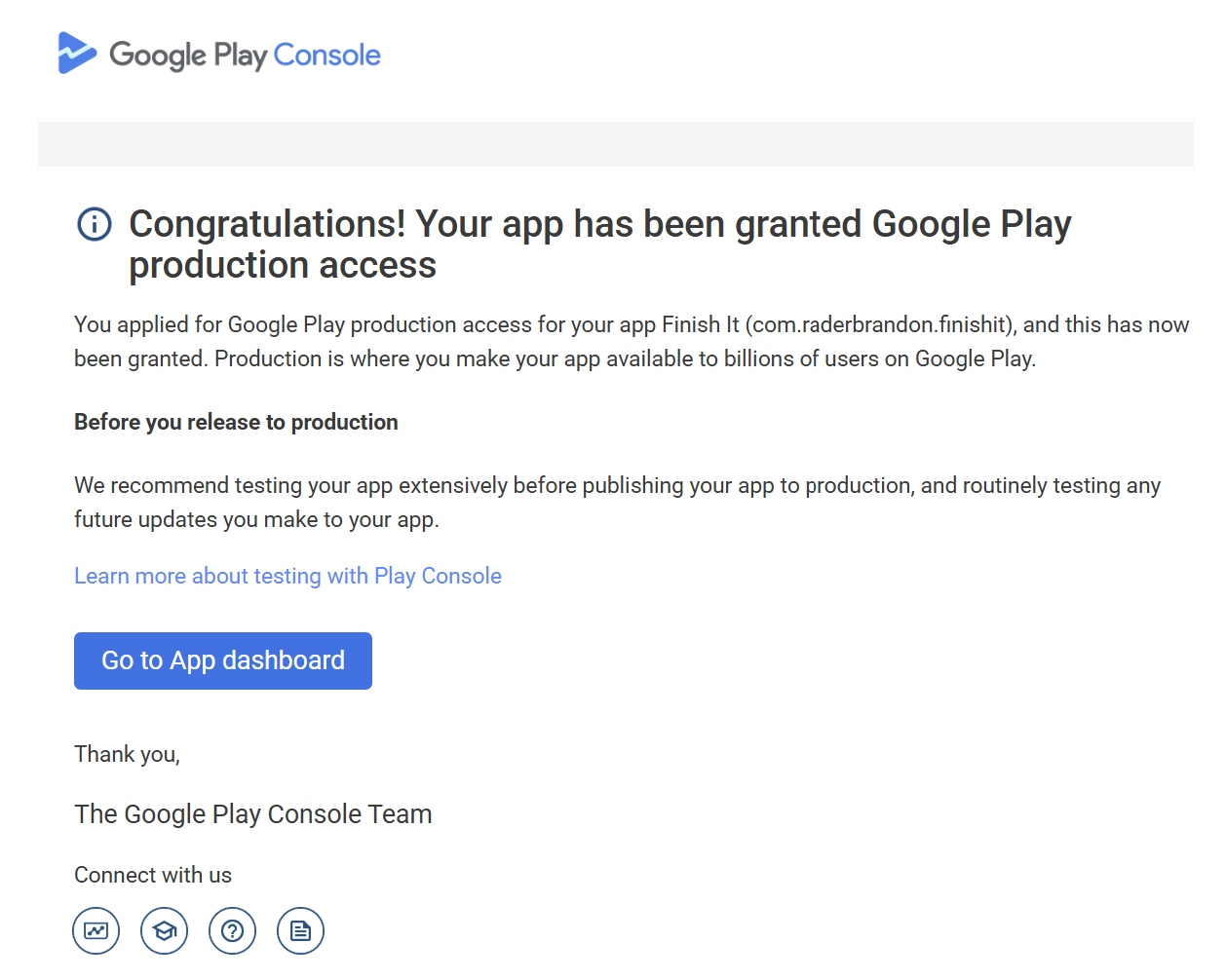
Verified Production Access
Quality QA Testing Reports
Clear, actionable reports with screenshots and evidence for every important issue found during testing.
Real Device Testing & Diagnostics
Real human testers use physical Android devices to test your app, verify real user flows, and provide clear testing evidence and professional QA reports.
Play Store Ready
Transition your Android app to public production access with confidence. We deliver verified session logs and compliant Console activity.
One Cycle. Complete Approval.
Choose the ideal closed testing cycle for your Android release.
Loading Packages
Please wait while we fetch the best options for your region...
Frequently Asked Questions
Everything you need to know about passing your closed testing requirements.