Play Store testers for 14-day Android closed testing in Tanzania
Find Play Store testers in Tanzania for 14-day Google Play closed testing. Fulfill Play Console requirements with 12 real testers and launch quickly.
Understanding Google Play Closed Testing for the Tanzanian Market
The Google Play Closed Testing policy is designed to evaluate both software stability and developer diligence before apps reach general consumers. Under these guidelines, developers must invite opted-in participants through a private testing track, verify that at least 12 qualified individuals install the build, and maintain active opt-ins for a minimum of 14 consecutive days without interruption.
For apps tailored to Tanzania, localized real-world testing carries unique engineering significance. A substantial portion of the Tanzanian market operates on entry-level and mid-tier Android devices from manufacturers like Tecno, Infinix, itel, Xiaomi, and Samsung, running varied Android OS versions and custom OEM skins. Furthermore, mobile applications frequently integrate regional mobile financial services such as Vodacom M-Pesa, Tigo Pesa, and Airtel Money, or display pricing in Tanzanian Shillings (TZS). Verifying that your checkout flows, USSD handoffs, SMS OTP verification listeners, and data-caching mechanisms function seamlessly across variable cellular networks like Vodacom, Tigo, Airtel, and Halotel is critical. Play Store Closed Testing serves as your essential live proving ground.
The Pitfalls of Fake Bots vs. Authentic Android Testers
When facing the 14-day timeline, some developers look for shortcuts, attempting to use automated bot networks, emulator farms, or low-cost gig workers who download an app once and immediately discard it. Google's automated compliance algorithms inspect deep telemetry metrics, including hardware sensor data, Google Play account longevity, network telemetry, and app lifecycle sessions. Faking your closed test carries catastrophic risks.
Genuine Human Testers in Tanzania
Real human testers download your build directly from Google Play onto authentic physical Android smartphones. They interact naturally across local carrier connections, authenticate sessions, trigger background tasks, and generate authentic crash-free and telemetry logs. Real users navigate edge cases, test local payment redirects like Vodacom M-Pesa or Tigo Pesa, test low-bandwidth caching, and leave valuable private feedback in the Play Console. This verifiable human activity proves to Google's review system that your application is production ready.
Bot Farms and Automated Emulators
Automated scripts, headless cloud emulators, and synthetic click farms reuse recycled device IDs and data center IP addresses. They lack natural human touch latency, sensor telemetry, and authentic Google account activity histories. Google's anti-fraud systems easily flag sudden identical opt-ins that show zero subsequent daily sessions or unnatural synthetic background patterns. Falling into this trap results in immediate production rejections, mandatory 14-day test resets, or permanent developer account termination.
Comparing Testing Methods for Google Play Compliance
To ensure your app passes production access review on the first attempt, consider how different testing strategies perform across critical Play Console evaluation benchmarks:
| Evaluation Criteria | Managed Testing Service (Recommended) | DIY Organic Outreach | Bot & Emulator Farms |
|---|---|---|---|
| Guaranteed Tester Retention | 100% active opt-in maintained for full 14+ days | High drop-off risk (testers uninstall early) | Inactive after automated script ends |
| Device & Hardware Diversity | Real physical phones across multiple Android OS versions | Limited to friends' and relatives' personal devices | Cloned emulator instances with identical fingerprints |
| Real User Engagement | Daily organic opens, navigations, and telemetry | Irregular usage; requires constant manual reminders | Zero realistic behavioral engagement |
| Play Console Feedback | Authentic private feedback reports submitted | Rare or unstructured feedback via chat apps | No actionable or human feedback provided |
| Risk of Production Rejection | Lowest; meets all algorithmic and human review standards | Moderate; high risk if opt-ins dip below threshold | Extreme; high risk of account suspension |
| Developer Time Investment | Minimal; fully organized and monitored | Substantial; days spent chasing individual testers | Wasted effort when test is flagged and reset |
Preparing Your App for Play Store Closed Testing in Tanzania
Before rolling out your closed testing track and onboarding testers, you must audit your software architecture, build settings, and store assets to ensure seamless onboarding.
Technical Architecture and Performance
Play Console Configuration and Store Listing
Tester Management and Feedback Channels
Struggling with the 14-Day Testing Requirement?
Skip the hassle of recruiting unreliable testers. Our professional fleet of real Android devices guarantees Google Play compliance in exactly 14 days. Zero bots. Zero emulators. 100% production approval guarantee.
Step-by-Step Roadmap to Production Access
Navigating the 14-day closed testing process requires meticulous execution from your initial build release to your final production application questionnaire.
Step 1: Release Closed Testing Build to Track
Create a new release in your Google Play Console Closed Testing track. Upload your signed Android App Bundle (AAB), specify rollout release notes, and submit the build for preliminary Google review. Once approved by Google, the track becomes live for your designated tester group.
Step 2: Onboard and Verify 12+ Active Testers
Distribute the opt-in URL to your verified human tester group. Ensure that at least 12 testers (we recommend targeting 15 to 20 for safety) accept the invite via Google Play and download the application directly onto their active physical Android devices.
Step 3: Maintain 14 Consecutive Days of Continuous Engagement
Keep all testers opted in for a full 14-day window. During this phase, testers should open the app periodically, interact with primary features, test UI responsiveness, and generate natural usage sessions. Push incremental update builds if bugs or crashes are uncovered.
Step 4: Collect Actionable Private Feedback
Gather detailed feedback through Google Play Console's private feedback channel. Document tester observations regarding user interface navigation, localized payment gateways, device performance, and responsiveness under varying cellular speeds.
Step 5: Apply for Production Access and Submit Review Questionnaire
Once the 14-day requirement counter completes successfully, click the 'Apply for Production' button in Play Console. Complete the mandatory questionnaire by detailing your testing methodology, target audience, tester feedback received, and software improvements made during the test.
Mastering the Play Console Production Application Questionnaire
After successfully maintaining 12 or more testers for 14 continuous days, you must complete Google's detailed Production Access Application. Google's review team uses this questionnaire to determine whether your testing was genuine or merely a superficial checkmark. Answering these questions with specific, data-backed technical details is the difference between immediate approval and an outright rejection.
1. Describing Your Target Audience and User Value
Google asks you to define who your app is built for and what core problem it solves. Avoid generic statements like "This app is for anyone who wants an easier life." Instead, provide precise context:
- Define your specific user persona (e.g., "Independent merchants and service providers in Dar es Salaam and Arusha managing mobile money transactions and invoicing").
- Explain the real-world utility of your application and why mobile smartphone access is necessary.
- Outline the unique regional value proposition, such as offline ledger support or multi-operator mobile money reconciliation.
2. Detailing Your Tester Recruitment Strategy
Google scrutinizes how you sourced your testing cohort. Claiming that you recruited hundreds of random strangers from social media or unknown websites raises immediate red flags.
- Explain that you selected a dedicated cohort of real Android smartphone owners representing your target market demographic.
- Highlight the diversity of hardware used during testing (e.g., varying RAM capacities from 2GB to 8GB across Android 10 through Android 15).
- Mention that testers were onboarded through structured opt-in lists with clear instructions to test core workflows and edge cases.
3. Summarizing Feedback Received and Product Changes Implemented
This is the most critical question in the application. If you claim that your app had zero bugs and received only "great app" reviews, Google will suspect that no meaningful testing occurred.
- Detail 2 to 3 specific technical or UX issues reported by your testers during the 14-day period.
- Examples include UI rendering overlap on smaller screen resolutions, slow image rendering over 3G networks, or an unhandled exception during network timeout on mobile money status callbacks.
- Explain the exact fixes deployed in subsequent update builds during the test (e.g., "Released version 1.0.2 to optimize database indexing and implement automatic exponential backoff for network retries").
Frequently Asked Questions
Why does Google Play require 12 testers for 14 days for personal accounts?
Google instituted this policy in November 2023 to raise the overall quality and security standards of apps distributed via the Play Store. By requiring developers with personal accounts to complete a mandatory 14-day closed test with at least 12 opted-in testers, Google ensures that developers thoroughly test their software on real hardware, identify critical crashes, and collect meaningful user feedback prior to exposing the general public to potential security vulnerabilities or low quality software.
Can my testers be located outside of Tanzania if my app is built for the Tanzanian market?
Yes, Google Play allows testers from any country to participate in your closed test as long as their Google Play account country matches the track availability settings configured in your Play Console. However, if your app includes region-specific features - such as integration with Tanzanian mobile payment operators (Vodacom M-Pesa, Tigo Pesa, Airtel Money) or TZS currency formatting - having testers who can evaluate these specific workflows on local network conditions provides far superior validation and realistic feedback.
What happens if a tester uninstalls the app or opts out during the 14-day testing period?
If your active opted-in tester count drops below the mandatory threshold of 12 testers at any point during the 14-day window, Google Play Console may pause or reset the 14-day countdown timer. To prevent this setback, it is strongly recommended to recruit a safety buffer of 15 to 20 testers. A managed testing service actively monitors opt-in statuses throughout the entire testing lifecycle to ensure your compliant count never drops below requirements.
Can I release updates or push new app builds while the 14-day test is actively running?
Yes, pushing updates to your Closed Testing track during the 14 days is not only permitted, but actively encouraged by Google. Releasing updated builds (e.g., bumping your versionCode from 1 to 2 or 3) to fix bugs reported by testers proves to Google's evaluation team that you are actively maintaining the software and using the testing period for legitimate quality improvements. Updates do not reset your 14-day counter as long as testers remain opted in.
How does Google distinguish between genuine human testers and automated bot farms?
Google monitors a comprehensive array of behavioral and hardware telemetry data. Genuine testers run apps on physical devices with unique hardware configurations, realistic battery and sensor data, variable network latencies, and authentic Google Play account histories. In contrast, bot farms utilize cloud data centers, repetitive IP addresses, and headless emulators with identical hardware identifiers. Bot interactions produce abnormal usage patterns that trigger automated fraud detection algorithms, leading to production rejection or account bans.
What should I do if my Google Play production access application is rejected?
If Google denies your production access request, carefully review the specific feedback provided in the Play Console notification. Typically, rejections occur due to insufficient tester engagement, lack of meaningful feedback, or inadequate answers on the production questionnaire. You will need to run an additional closed testing cycle, gather detailed feedback from active testers, resolve identified defects, and submit a comprehensive, revised questionnaire clearly highlighting the concrete improvements made.
How We Deliver 12 Testers
A straightforward 4-step process to get your Android app approved.
Connect Account
Connect your Google account and choose your preferred closed testing package for your Android app.
Assign Testers
Share your Play Store opt-in URL. We immediately deploy 12 real testers to launch and review your Android app daily.
Daily QA Runs
Our crew initiates daily launch sessions on physical devices, verifying usability and logging crashes for your Android app.
Launch Ready
We continuously perform closed app testing for 14 days to help you meet Google Play production requirements. We also provide a compliance report.
Our Testing Infrastructure
Deploy your Android app onto real retail-grade handsets using our secure laboratory environment.
The 14-Day Production Guarantee
We complete the required 14-day closed testing process with real human testers and physical Android devices, while providing clear testing evidence and documentation throughout the process.
If Google specifically rejects production access due to insufficient testing engagement, you are covered by our free re-run or 100% refund guarantee, subject to our Refund Policy.
Verified Production Access
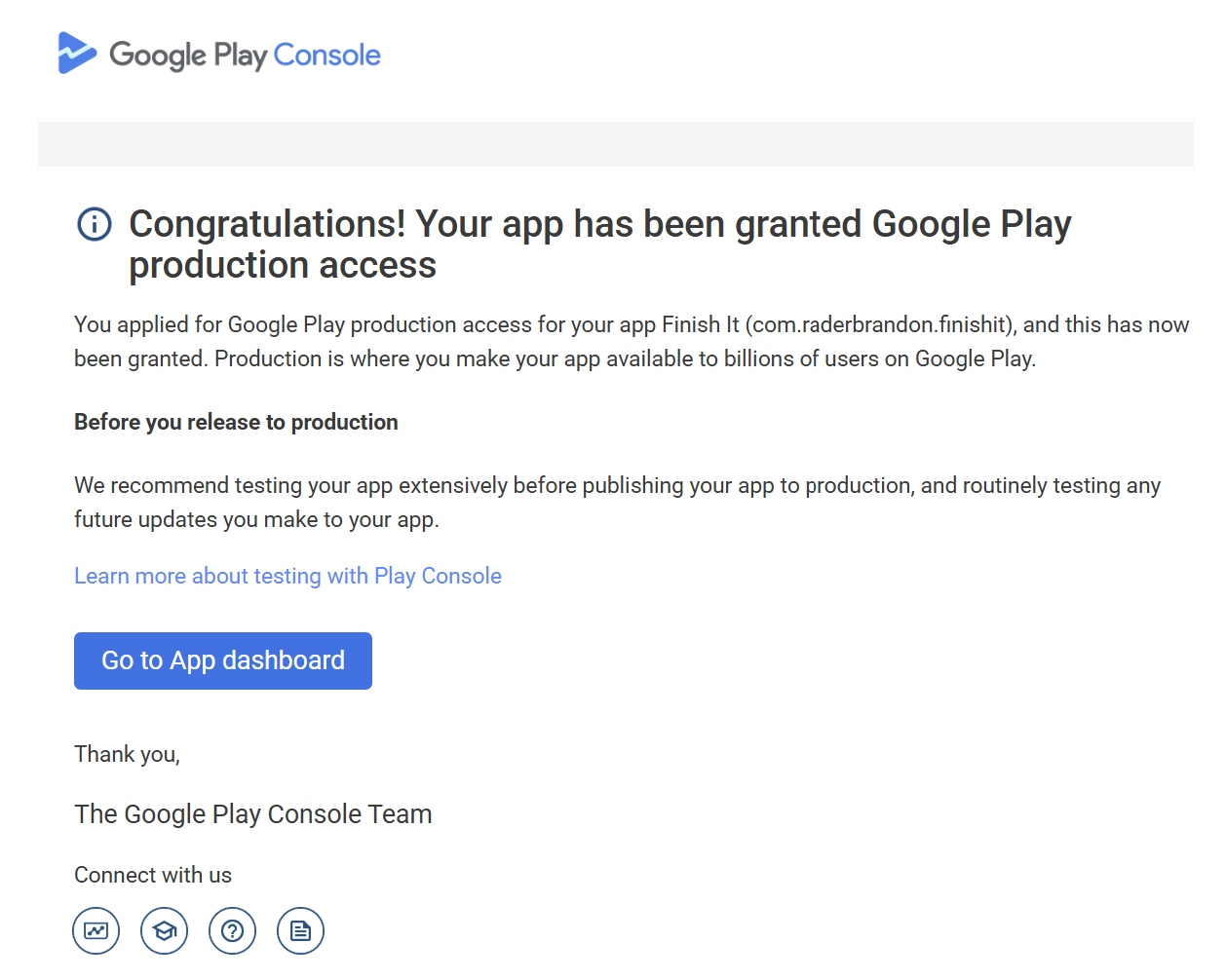
Quality QA Testing Reports
Clear, actionable reports with screenshots and evidence for every important issue found during testing.
Real Device Testing & Diagnostics
Real human testers use physical Android devices to test your app, verify real user flows, and provide clear testing evidence and professional QA reports.
Compliance Audit Passed
Transition your Android app to public production access with confidence. We deliver verified session logs and compliant Console activity.
One Cycle. Complete Approval.
Choose the ideal closed testing cycle for your Android release.
Loading Packages
Please wait while we fetch the best options for your region...
Frequently Asked Questions
Everything you need to know about passing your closed testing requirements.