Play Store testers for 14-day Android closed testing in Tunisia
Find Play Store testers in Tunisia for 14-day Google Play closed testing. Fulfill Play Console requirements with 12 real testers and launch quickly.
Understanding Google Play Closed Testing Mandates
The Google Play closed testing mandate was established to elevate app stability, improve security, and reduce early uninstalls across the global Android ecosystem. Google requires developers to run a closed testing track with at least 12 opted-in testers who maintain active engagement for 14 consecutive days. Rather than merely confirming that an email list was added to the Play Console, Google automated systems evaluate whether real people downloaded the build, kept it installed, and interacted with its features across distinct user sessions.
For engineering teams working in Tunisia or building products tailored to North African and European markets, running a compliant closed testing process provides vital early feedback. Testing on genuine hardware across regional networks such as Tunisie Telecom, Ooredoo Tunisia, and Orange Tunisie ensures your app handles network handovers, varying bandwidth conditions, and regional device form factors smoothly before your public release.
The Realities and Friction of DIY Closed Testing
Many independent developers and small startup teams in Tunisia initially attempt to satisfy the 12 testers for 14 days rule by enlisting friends, colleagues, or student peers. While volunteer testers may readily accept the initial invitation and install the application on day one, engagement frequently drops off by day four or five. People forget to open the app, clear storage space, or accidentally uninstall the build, quietly breaking your continuous testing streak.
When active tester participation falls below the mandatory threshold of 12 active devices at any point in the 14-day window, the Play Console automated tracker pauses or resets your progress. In many cases, developers wait out the two weeks only to discover their production access application is rejected due to insufficient testing engagement. Attempting to organize and chase down volunteer testers wastes valuable sprint time. Partnering with a dedicated testing network eliminates administrative headaches by delivering consistent daily active usage with verified backup coverage.
What Google Play Evaluates During the 14-Day Closed Testing Track
Navigating Google Play closed testing requires a clear understanding of the quantitative and qualitative data points that Google Play Console monitors throughout the 14-day testing period. Google uses automated telemetry analysis combined with human reviewer evaluations to assess whether an application is genuinely prepared for commercial store distribution.
1. Daily Active Engagement and Session Depth
Google Play Console telemetry logs how frequently opted-in testers launch your build, how long each session lasts, and how deeply users navigate through your screen hierarchies. Automated evaluation models check for realistic user interactions, including button taps, form inputs, scrolling gestures, and screen transitions. If an application sits idle on a phone without regular session launches, Google records the installation as inactive, which can prevent the production access gate from opening.
2. Stability Metrics and Android Vitals
Every crash, unhandled runtime exception, and Application Not Responding (ANR) error is captured by Android Vitals. Google compares your app crash rates and ANR rates against established industry benchmarks. If an app regularly freezes or crashes on specific Android OS versions or chipsets, Play Console flags the build as unstable. Achieving zero critical crashes during closed testing is essential for a fast production approval.
3. Hardware Diversity and OS Distribution
Authentic closed testing requires a balanced distribution of physical devices. Google Play algorithms examine the variety of device models, screen densities, GPU drivers, and Android OS versions (from Android 8 up to Android 16). Relying on a single device model or identical emulated environments raises automated quality flags in the Play Console backend.
4. Qualitative User Feedback and Developer Responsiveness
Google asks developers to summarize the feedback collected during closed testing when submitting the production access questionnaire. Play Store reviewers want to see that testers submitted private feedback through the Play Store or testing forms, and that the development team pushed iterative bug fixes and minor updates during the testing track. Demonstrating an active feedback loop provides strong evidence of developer maturity.
The Serious Dangers of Bots and Fake Tester Services
Faced with the challenge of gathering 12 testers for 14 days, some developers consider shortcuts such as automated click bots, device emulator farms, or low-cost synthetic testing services. Using synthetic or automated testing accounts is one of the most hazardous decisions a developer can make.
Google employs sophisticated machine learning systems that inspect hardware telemetry, network routing, and behavioral patterns. Bot networks typically run on virtual server farms, share identical IP ranges, and produce repetitive, scripted input gestures with zero organic variance. When Google detects synthetic activity on a closed testing track, the consequences extend far beyond a rejected production request. Google frequently suspends developer accounts permanently for deceptive behavior, blacklisting the associated identity, payment methods, and connected console accounts across the entire Play ecosystem.
Choosing verified human testers is the only secure, policy-compliant approach to unlocking production access while protecting your developer reputation.
Why Professional Managed Closed Testing Is the Smarter Choice
Partnering with a professional testing provider turns closed testing from an unpredictable roadblock into an organized, stress-free milestone. Our managed testing solution provides verified human testers who install your app through official Google Play opt-in links, test your features daily, and supply structured feedback.
We assign surplus testers to every testing cohort, ensuring that your active tester count consistently exceeds the 12-tester threshold every single day of the 14-day cycle. You also receive detailed bug reports covering layout edge cases, network timeout errors, and hardware compatibility issues, giving you actionable insights to refine your app and answer Google production questionnaire with total confidence.
| Operational Dimension | Managed Testing Cohort | Informal DIY / Volunteer Group | Bot Scripts & Click Farms |
|---|---|---|---|
| Production Access Success | Guaranteed compliance and readiness | Frequent delays and progress resets | Account termination and permanent ban |
| Active Daily Usage | Verified 14-day continuous interaction | High drop-off after 3 to 5 days | Fake scripted clicks easily detected |
| Hardware Fleet Diversity | 20+ real physical Android devices | Limited to available peer devices | Cloud server virtual instances |
| Actionable QA Feedback | Structured bug reports and logs | Casual, unstructured, or absent | Zero meaningful testing insights |
| Developer Time Saved | 100% hands-off testing coordination | Constant reminder messages and stress | Minimal effort, catastrophic risk |
Authentic Human Testing in Tunisia
Real human testers install your app directly through the Google Play Store closed testing track. They use authentic Android smartphones running Android versions 8 through 16 across real mobile networks. Their organic daily session activity creates reliable telemetry that satisfies Google retention requirements and passes Play Console review.
Automated Scripts & Device Emulators
Bot farms and emulator scripts simulate clicks through automated loops on cloud virtual machines. Google detection algorithms quickly recognize repetitive gesture timing, data center IP origins, and artificial device fingerprints, triggering automatic production rejection and potential account closure.
Struggling with the 14-Day Testing Requirement?
Skip the hassle of recruiting unreliable testers. Our professional fleet of real Android devices guarantees Google Play compliance in exactly 14 days. Zero bots. Zero emulators. 100% production approval guarantee.
Step-by-Step Pre-Testing Checklist for Play Console
Play Console Account & Store Setup
Ensure your Google Play Developer registration, contact email, business address, and identity verification are fully approved by Google.
Upload your high-resolution app icon, 1024x500 feature graphic, comprehensive app descriptions, and at least 4 clear screenshots representing real app screens.
Fill out the Data Safety form, Advertising ID declaration, Target Audience age brackets, Government Apps declaration, and Content Rating questionnaire.
Build Configuration & Closed Track Release
Build and sign an optimized release .aab targeting the latest required Android API level, ensuring ProGuard or R8 rules are configured correctly.
Host a comprehensive, transparent privacy policy on a publicly accessible web domain detailing all data collection, third-party SDKs, and user privacy rights.
Configure a closed testing track in Play Console, link our dedicated tester email group, roll out the release to 100%, and copy the opt-in web and Android join URLs.
Your 5-Step Roadmap to Google Play Production Approval
Step 1: Track Setup and Tester Group Integration
Create your closed testing track inside Google Play Console, set country availability to include all required regions, add our dedicated tester email list, and share your opt-in web link with our coordination team.
Step 2: Official Opt-in and Play Store Installation
Our vetted human testers in Tunisia and international partner networks accept your closed testing invitation through Google Play and install the build directly onto their physical Android smartphones.
Step 3: 14 Consecutive Days of Continuous Testing
Testers launch the application every day for 14 continuous days, navigating through user workflows, exploring key features, testing offline and online states, and generating organic telemetry.
Step 4: Quality Assurance and Feedback Collection
Our QA team monitors crash logs, checks Android Vitals, compiles user feedback, and provides structured diagnostic summaries highlighting any UI anomalies, network bottlenecks, or edge-case bugs.
Step 5: Apply for Production Access and Publish
Once the 14-day testing period completes, the Play Console enables the 'Apply for Production' button. Use our customized response guide to answer Google questions regarding testing methodology, feedback integration, and release readiness.
Frequently Asked Questions
Why does Google Play require 12 testers for 14 continuous days for personal accounts?
Google introduced the mandatory 12 testers for 14 days policy for all personal developer accounts created after November 13, 2023. The requirement is designed to prevent low-quality, untested, or malicious apps from reaching public store listings. By mandating two weeks of active closed testing on real hardware, Google verifies that developers can collect real feedback, fix unexpected crashes, and ensure their applications meet basic Android Vitals quality benchmarks before opening access to global users.
Can developers in Tunisia use international testers for Play Store closed testing?
Yes, Google Play allows developers in Tunisia to recruit closed testers from any country, provided those countries are enabled in your closed track settings. However, having testers who understand your app localization, language support (such as French, Arabic, or English), and regional network behaviors ensures your testing data is meaningful. Our testing cohorts include real Android users who test thoroughly across diverse device types and network environments.
What happens if a tester uninstalls the app during the 14-day closed testing cycle?
If the number of actively installed and engaged testers falls below 12 at any point during the 14 days, Google automated tracking system may pause or reset the 14-day counter. This is why DIY testing with friends frequently fails. Our managed service solves this issue by deploying extra backup testers to every project, keeping your active tester count comfortably above the required minimum every day without interruption.
Will feedback or reviews submitted during closed testing affect my public Play Store rating?
No. All reviews, star ratings, and written comments submitted by users during a closed testing track are completely private and visible only to you within the Google Play Console. They do not appear on your public store listing and have zero impact on your public Play Store rating once your app is published to production.
What physical devices and Android versions are used during the testing process?
Our managed testing fleet consists of authentic physical smartphones from leading manufacturers, including Samsung Galaxy, Xiaomi, Google Pixel, Motorola, Realme, and Oppo. The testing devices run across a broad spectrum of operating systems, from Android 8 up through the latest Android 16 releases, ensuring thorough compatibility and layout validation across multiple screen sizes, aspect ratios, and chipset architectures.
How should I answer Google Play Console questions when applying for production access?
When you complete the 14-day testing cycle and click 'Apply for Production', Google presents a questionnaire asking about your target audience, how you recruited testers, what feedback you received during closed testing, and what technical changes you made to improve the app. We provide comprehensive, customized answer templates tailored to your app real testing data, enabling you to submit confident, policy-compliant responses that help secure prompt production approval.
How It Works
Your journey to Google Play production access, simplified and automated.
Get Started
Authenticate your account to initialize the 14-day QA fleet for your Android release.
App Submission
Upload your testing link. We assign 12 verified users with real Android devices to download and test your Android release.
14-Day Cycle
A dedicated testing supervisor is assigned to monitor progress while testers engage with your Android app and provide feedback throughout the testing period.
Production Access Approval
Our lab maintains active installations for two weeks straight, ensuring a clean track record and providing a QA compliance log for your release.
Why Choose AppConsoleLab
Satisfy your Play Store Console testing obligations with our managed physical device fleet tailored for Android builds.
The 14-Day Production Guarantee
We complete the required 14-day closed testing process with real human testers and physical Android devices, while providing clear testing evidence and documentation throughout the process.
If Google specifically rejects production access due to insufficient testing engagement, you are covered by our free re-run or 100% refund guarantee, subject to our Refund Policy.
Verified Production Access
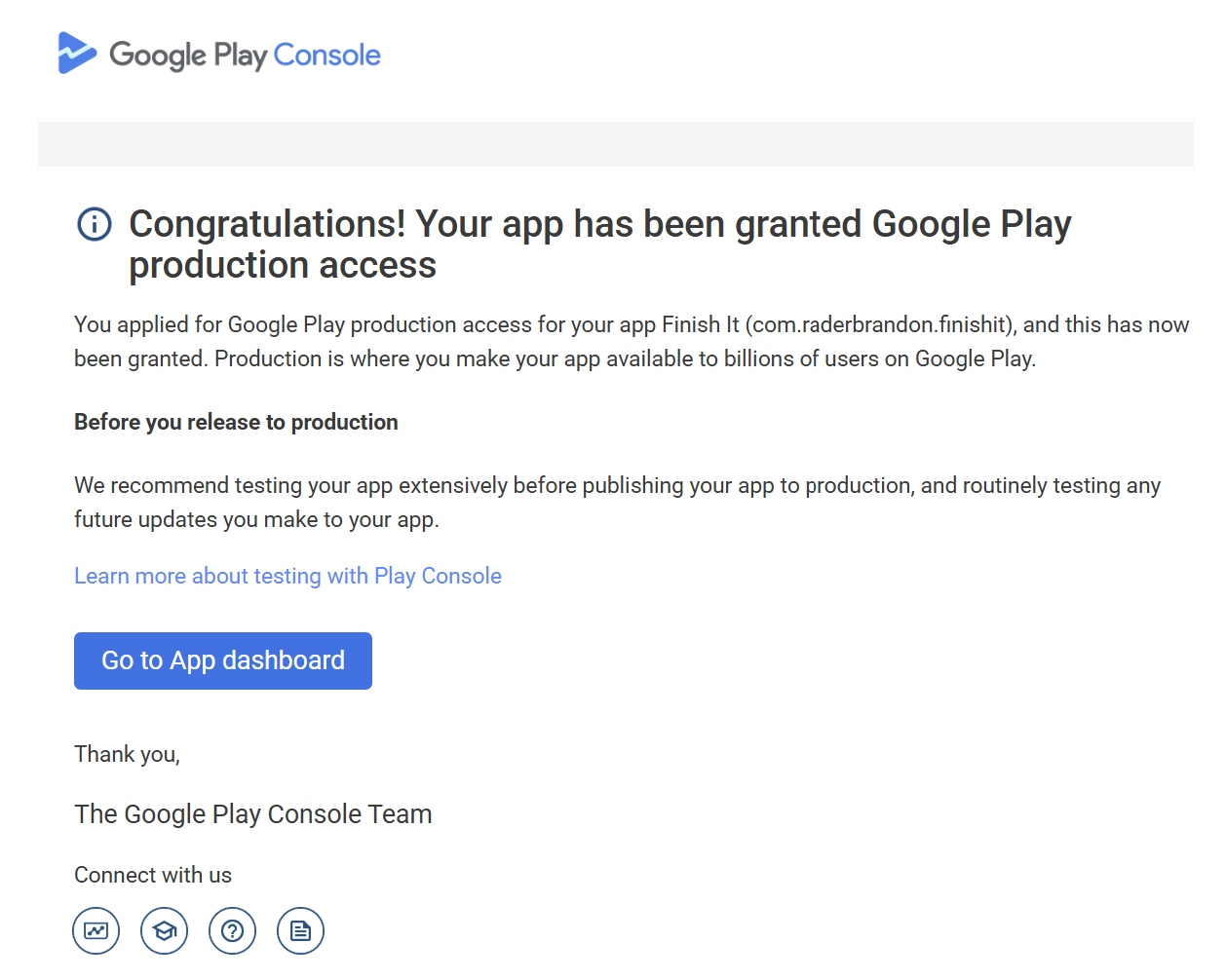
Quality QA Testing Reports
Clear, actionable reports with screenshots and evidence for every important issue found during testing.
Real Device Testing & Diagnostics
Real human testers use physical Android devices to test your app, verify real user flows, and provide clear testing evidence and professional QA reports.
Play Store Ready
Our structured 14-day closed testing process is designed to meet Google Play's production requirements for your Android release.
Simple Closed Testing Pricing
Select the plan that fits your Android app complexity.
Loading Packages
Please wait while we fetch the best options for your region...
Frequently Asked Questions
Everything you need to know about passing your closed testing requirements.