Play Store testers for 14-day Android closed testing in Uganda
Find Play Store testers in Uganda for 14-day Google Play closed testing. Fulfill Play Console requirements with 12 real testers and launch quickly.
Why Closed Testing in Uganda Demands Real Local Devices
Testing an app targeting Ugandan users requires validation across hardware and networks typical of the region. A workstation running high-speed fiber in Kampala cannot replicate the experience of an entry-level smartphone connected to mobile data in Jinja, Gulu, or Mbarara.
Real testing across Uganda surfaces device-specific issues that automated simulators and cloud emulator farms miss:
- Telecom and Payment Resilience: Testing network handoffs, fluctuating 3G/4G connectivity on MTN Uganda and Airtel Uganda, and USSD or webhook callbacks during UGX mobile money checkout flows.
- Low-Memory Compatibility: Detecting memory leaks, background kills, and UI rendering lag on devices with 2GB to 3GB RAM popular across East Africa, such as Tecno, Infinix, and Itel.
- Battery and Data Efficiency: Measuring background battery consumption and data usage when users navigate map views or media-heavy screens.
- Android OS Diversity: Ensuring backward compatibility across varied Android versions active throughout Uganda alongside newer releases.
The Risks of Using Bot Farms vs. Real Testers
When developers struggle to recruit enough reliable participants for the full 14-day window, some consider shortcuts like bot farms or emulator scripts. These shortcuts introduce severe risks that can permanently jeopardize your developer account.
Bot Farms and Emulator Services
- Automated Synthetic Behavior: Scripts launch and close apps in predictable loops, producing zero organic touch events or natural session lengths.
- Shared IP and Device Fingerprints: Bot networks use recycled emulators and data center IPs that Google fraud algorithms detect quickly.
- High Risk of Production Rejection: When Google evaluates your production access questionnaire, lack of real user logs leads to rejection.
- Permanent Account Termination: Artificially inflating installs violates Google Play policies, risking immediate account termination.
Managed Real Human Testers
- Authentic Device Interaction: Real users install your build directly from Google Play and test features on personal smartphones.
- Natural Engagement Metrics: Varied daily active times, authentic navigation flows, screen rotations, and genuine telemetry in Play Console.
- Reliable 14-Day Retention: Testers keep your app installed and actively test throughout the full 14-day window without dropouts.
- Compliance-Ready Feedback: Real qualitative feedback on bugs, UI clarity, and payment flows to support your production application.
Preparing Your App for Play Store Closed Testing in Uganda
Before initiating your Google Play Closed Testing track, completing a thorough pre-launch audit ensures that testers experience minimal friction and provide meaningful feedback.
Core Architecture and Mobile Money Integrations
Play Console Configuration and Privacy Policies
Struggling with the 14-Day Testing Requirement?
Skip the hassle of recruiting unreliable testers. Our professional fleet of real Android devices guarantees Google Play compliance in exactly 14 days. Zero bots. Zero emulators. 100% production approval guarantee.
Step-by-Step Roadmap to Production Access
Achieving approval for production access on Google Play is a structured process. Following this roadmap ensures you collect valid testing telemetry and submit a strong production application.
1. Build Preparation and Internal Validation
Compile your signed Android App Bundle (AAB) with production ProGuard/R8 obfuscation. Conduct an internal test track release with your core team in Uganda to eliminate obvious layout bugs, authentication glitches, and broken links before onboarding external participants.
2. Closed Testing Track Setup
Create a new release under the Closed Testing track in Google Play Console. Define your tester group using an opt-in Google Group or email list, upload your production-ready AAB, publish release notes in English, and submit the release for Google's automated pre-launch review.
3. Tester Opt-in and Continuous 14-Day Engagement
Distribute the opt-in web or Android test URL to your designated testers. Ensure at least 12 testers explicitly opt in, download the build directly from the Play Store, and interact with core features on their devices continuously across the 14-day window.
4. Active Monitoring and Mid-Test Iterations
Monitor Android Vitals, Crashlytics, and ANR rates daily in Play Console. If testers uncover defects, push an incremental update to the closed test track. Releasing bug fixes during the test cycle demonstrates proactive app maintenance to Google's evaluation system.
5. Production Application Submission
Once the 14 consecutive days of continuous testing are complete, access the Apply for Production section in your Play Console. Complete the detailed questionnaire explaining your testing methodology, feedback channels, bug fixes deployed, and your readiness to manage live users.
Comparing Closed Testing Strategies for Ugandan Developers
Selecting the right strategy to fulfill the 12 Testers for 14 Days mandate impacts both project timelines and account security:
| Feature / Criteria | Managed Professional Testing Service | DIY Community & Peer Swaps | Automated Emulator / Bot Farms |
|---|---|---|---|
| Tester Reliability | Guaranteed 100% opt-in retention for all 14 days | High dropout rate as friends forget to open app | Predictable script runs, zero human input |
| Device Hardware Variety | Diverse physical Android smartphones across OS versions | Limited to whatever devices your friends own | Emulated virtual devices on shared server racks |
| Real Network Testing | Tested on genuine cellular data and Wi-Fi connections | Mixed local Wi-Fi, irregular mobile data usage | Data center IP addresses, no cellular testing |
| Play Console Telemetry | Genuine organic sessions, taps, and engagement depth | Erratic, sparse sessions with low engagement scores | Repeated identical session durations and zero taps |
| Account Safety & Compliance | 100% compliant with Google Play closed testing policies | Fully compliant, but vulnerable to timing resets | Severe risk of developer account ban and blacklisting |
| Production Approval Rate | Exceptionally high with robust feedback documentation | Moderate; frequent delays due to tester attrition | Extremely low; high rejection rate on review |
Mastering the Play Console Production Application
Completing the 14-day testing window is only half the battle. When the timer ends, Google Play Console requires you to submit answers to a comprehensive production access questionnaire. Your responses must be clear, detailed, and backed by the actual testing data collected during the 14 days.
Reviewers at Google focus on three core areas:
- Tester Recruitment Strategy: Explain how you sourced your testers. Documenting that you used a professional developer testing service or a curated community testing cohort gives credibility. Claiming you shared a link casually on social media often raises questions about engagement quality.
- Feedback Collection Channels: Describe the exact mechanisms used to gather user sentiment and bug reports. Mention private Play Store feedback, structured survey forms, developer email support, or communication channels where testers reported UI quirks or payment processing edge cases.
- Product Iteration & Bug Resolution: Detail specific improvements made to the app based on tester feedback. Provide concrete examples, such as optimizing image asset loading to reduce data consumption on mobile networks in Uganda, fixing a crash on Android 11 devices, or simplifying your onboarding flow.
Submitting clear, professional, and well-documented answers demonstrates to Google that your development process is mature and that your application is genuinely prepared for a public audience.
Frequently Asked Questions About Closed Testing in Uganda
Why does Google Play require 12 testers for 14 days for new developer accounts?
Google introduced the mandatory 12 Testers for 14 Days closed testing policy in late 2023 for all newly registered personal developer accounts. The primary goal is to elevate app quality on the Play Store, reduce broken software, and verify that creators are committed to maintaining their applications. By requiring continuous testing with real human users before granting production rights, Google ensures that apps are evaluated for crashes, battery efficiency, and usability under realistic conditions.
Can my testers in Uganda test features involving MTN Mobile Money or Airtel Money?
Yes, testers can interact with payment flows either using sandbox credentials in your test build or through micro-transactions on live gateways if you are validating live checkout integrations in Uganda. When testing real money flows, make sure your instructions guide testers on how to test payment interfaces safely. Gathering feedback on payment success screens and OTP receipt times is invaluable for local fintech and e-commerce apps.
What happens if a tester uninstalls the app before the 14 days finish?
If a tester opts out or deletes the application before the 14-day testing duration is completed, the number of active opted-in testers tracked by Google Play Console drops. If your total count falls below the required threshold of 12 active testers, your progress can stall, and the 14-day counter may pause or reset. To prevent this risk, it is recommended to recruit extra testers (such as 15 to 20 testers) to maintain a reliable safety margin throughout the entire testing period.
Can I push new updates to my app during the active 14-day testing period?
Yes, updating your app during closed testing is strongly encouraged by Google. When your testers discover layout bugs, API errors, or performance hitches, you can upload a new AAB to the closed track. Pushing updates demonstrates that you are actively responding to feedback, fixing bugs, and improving your software. Google's evaluation teams look favorably on active maintenance and version updates during the testing phase.
Do testers need to leave public reviews on the Play Store?
No. During closed testing, testers cannot leave public star ratings or written reviews that would impact your public Play Store score. Instead, any feedback testers submit through the Google Play testing interface is delivered privately to your developer console. This gives you a safe environment to identify crashes, fix navigation friction, and polish your application without worrying about negative public ratings damaging your app reputation prior to launch.
What should I do if Google rejects my initial application for production access?
If Google declines your request for production access after completing the 14-day test, carefully read the feedback provided in the Play Console notification. Rejections typically stem from low tester engagement, insufficient crash reporting data, or vague answers on the production questionnaire. To resolve this, keep your closed testing track active, invite an engaged group of real human testers, ensure they interact with your build regularly for an additional 14 days, push iterative improvements, and resubmit your application with thorough explanations of your bug fixes.
Our QA Process
A straightforward 4-step process to get your Android app approved.
Choose Package
Connect your Google account and choose your preferred closed testing package for your Android app.
Submit Link
Share your Play Store opt-in URL. We immediately deploy 12 real testers to launch and review your Android app daily.
Active Testing
Our crew initiates daily launch sessions on physical devices, verifying usability and logging crashes for your Android app.
Get Approved
We continuously perform closed app testing for 14 days to help you meet Google Play production requirements. We also provide a compliance report.
The Premium QA Advantage
Deploy your Android app onto real retail-grade handsets using our secure laboratory environment.
The 14-Day Production Guarantee
We complete the required 14-day closed testing process with real human testers and physical Android devices, while providing clear testing evidence and documentation throughout the process.
If Google specifically rejects production access due to insufficient testing engagement, you are covered by our free re-run or 100% refund guarantee, subject to our Refund Policy.
Verified Production Access
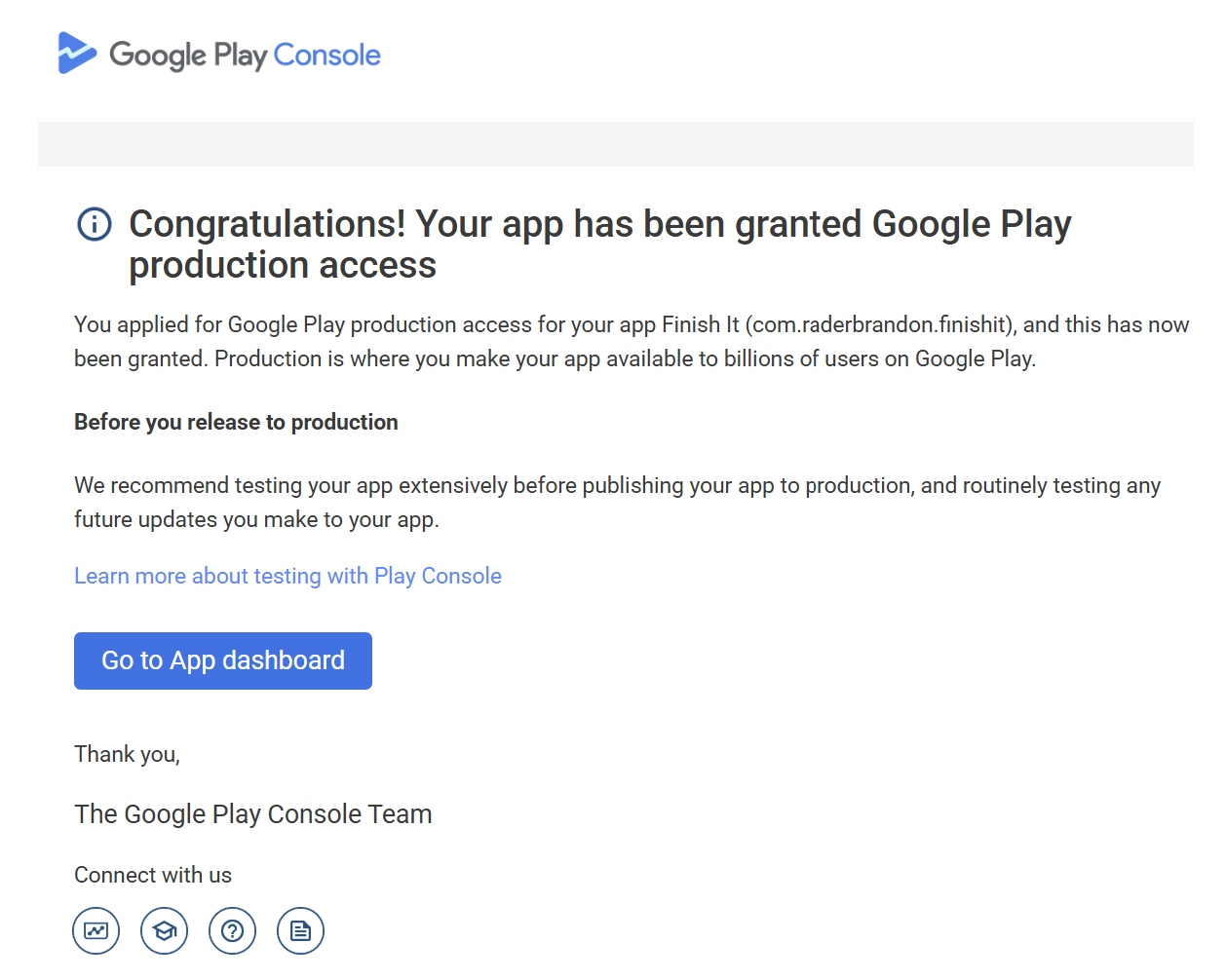
Quality QA Testing Reports
Clear, actionable reports with screenshots and evidence for every important issue found during testing.
Real Device Testing & Diagnostics
Real human testers use physical Android devices to test your app, verify real user flows, and provide clear testing evidence and professional QA reports.
Production Access Secured
Transition your Android app to public production access with confidence. We deliver verified session logs and compliant Console activity.
One Cycle. Complete Approval.
Choose the ideal closed testing cycle for your Android release.
Loading Packages
Please wait while we fetch the best options for your region...
Frequently Asked Questions
Everything you need to know about passing your closed testing requirements.