Play Store testers for 14-day Android closed testing in Uruguay
Find Play Store testers in Uruguay for 14-day Google Play closed testing. Fulfill Play Console requirements with 12 real testers and launch quickly.
Mastering Google Play Closed Testing in Uruguay
Publishing an Android app successfully requires proving to Google that your software is stable, intuitive, and genuinely vetted by real people. The Play Store Closed Testing framework requires you to invite at least 12 testers who must remain continuously opted in for 14 consecutive days.
Many developers in Montevideo and across South America assume they can simply invite a few close colleagues or family members to satisfy the count. While this works in theory, human error frequently ruins the process. Friends forget to open the app, mute testing notifications, or accidentally uninstall the build after a couple of days. The moment your active tester count drops below 12, Google's internal 14-day timer resets back to day zero.
Furthermore, Google's automated telemetry monitors active engagement metrics. The Play Console tracks session frequency, crash rates, ANR (Application Not Responding) occurrences, and feedback submissions. If your test pool generates zero telemetry or shows suspicious synchronized activity, your eventual application for production access will be rejected with a request for more testing.
To navigate this process smoothly in Uruguay, your closed testing strategy must mirror authentic user behavior. Testers need to install the build via Play Store redeem links, open the app across distinct network connections, interact with core user flows, and report bugs through the official feedback channel.
Real Testers vs Automated Bots - The Ultimate Showdown
When searching for ways to fulfill the 12 testers for 14 days requirement, developers often encounter cheap automated bot services promising instant verification for a few dollars. Taking this shortcut is one of the most dangerous decisions you can make for your Google Play developer reputation. Google deploys sophisticated anti-fraud algorithms that analyze device fingerprints, Android OS telemetry, Google account trust scores, and interaction heuristics.
When a bot farm uses emulated devices, cloned Google accounts, and repetitive tap scripts, Google flags the activity almost immediately. The penalty is severe: your production request is denied instantly, and in many cases, your entire Google Play Console developer account is terminated for deceptive behavior, blacklisting your payment profile and associated developer credentials.
Evaluating the operational differences between genuine human testers and simulated bot services makes the safe choice clear.
Real Human Testers in Uruguay
Real testers install your Android App Bundle directly from Google Play onto authentic, everyday hardware from brands like Samsung, Xiaomi, Motorola, and Google Pixel. Each tester possesses an established Google account with genuine search history, verified payment profiles, and realistic daily device patterns.
When human testers explore your build, they interact naturally - scrolling through menus, testing navigation drawers, verifying biometric logins, and triggering background tasks. They provide qualitative bug reports on visual glitches, awkward Spanish UI copy, and localized edge cases. Most importantly, their authentic engagement generates clean telemetry in the Play Console, allowing your 14-day evaluation period to finish cleanly without triggering security red flags.
Automated Bot Networks
Bot operations rely on virtualized Android emulators running on data center servers. These virtual machines lack realistic hardware sensor data, battery state changes, and natural network latency shifts. They operate using batch-generated Gmail accounts created without genuine usage footprints.
Scripts execute programmatic tap sequences at rigid millisecond intervals, producing synthetic engagement graphs that Google's machine learning models detect with high accuracy. Bots cannot provide actionable feedback, discover UX bottlenecks, or confirm local payment gateways. Utilizing bots risks catastrophic account termination, wasted development budgets, and permanent rejection from the Google Play ecosystem.
Comprehensive Comparison: Testing Methods Evaluated
Selecting the right strategy to complete your Google Play Closed Testing requirements determines how fast your Android app reaches the market. Here is a breakdown of how managed testing services, DIY friend networks, and bot services compare across critical engineering and compliance metrics.
| Feature & Metric | Professional Managed Testing | DIY Friends & Family | Automated Bot Services |
|---|---|---|---|
| Real Physical Hardware | 100% genuine Android devices | Mixed personal devices | Virtual cloud emulators |
| 14-Day Continuous Retention | Guaranteed 24/7 opt-in status | High drop-off and uninstalls | Automated script sessions |
| Google Account Trust Score | Aged, active Google accounts | Real personal accounts | Fresh disposable accounts |
| Console Telemetry Quality | Natural sessions & organic taps | Irregular or zero usage | Identical robotic patterns |
| Actionable Bug Feedback | Structured qualitative feedback | Vague verbal comments | None / automated gibberish |
| Play Console Policy Safety | 100% compliant with rules | Fully compliant | High risk of permanent ban |
| Production Access Approval | High first-time pass rate | Frequently delayed or reset | Guaranteed rejection / ban |
| Developer Time Investment | Zero management overhead | 10 to 20 hours following up | High risk troubleshooting |
Struggling with the 14-Day Testing Requirement?
Skip the hassle of recruiting unreliable testers. Our professional fleet of real Android devices guarantees Google Play compliance in exactly 14 days. Zero bots. Zero emulators. 100% production approval guarantee.
Step-by-Step Roadmap to Play Store Production Access
Navigating the Google Play Console testing tracks requires a methodical, step-by-step workflow. By executing each phase systematically, developers in Uruguay can ensure their closed test runs smoothly from the initial release upload to final production approval.
Prepare Your Production-Ready Release
Before creating your closed testing track, verify that your Android App Bundle (AAB) is signed with your production upload key and built against the latest Android target API levels. Complete your Store Listing details, including high-resolution app icons, feature graphics, localized screenshots, and a complete privacy policy URL. Google reviews your store listing metadata even during closed testing phases.
Configure Closed Testing Track & Tester Lists
Navigate to the 'Closed testing' section under the 'Testing' menu in your Google Play Console. Create a new closed testing track, configure your release name, and upload your signed AAB. Under the 'Testers' tab, select 'Create email list' and input the verified Google account addresses of your 12+ testers. Save the changes and roll out the release to closed testing for Google's initial review.
Distribute Opt-In Links & Verify Downloads
Once Google approves the closed test build (typically 24 to 48 hours), copy the web opt-in link and Android opt-in link provided in the console. Distribute these links to your testing team. Each tester must open the link, click 'Become a Tester', and install the build directly from the Play Store on their physical Android device. Verify in your console that your opted-in tester count shows at least 12 active participants.
Maintain 14 Days of Active Engagement
Monitor your closed testing dashboard continuously for 14 full consecutive days. Ensure your testers open the application, interact with core functionalities, and keep the build installed on their devices. Use this period to review Android vitals, monitor crash rates, and collect constructive feedback regarding performance, UI responsiveness, and regional usability.
Apply for Production Access
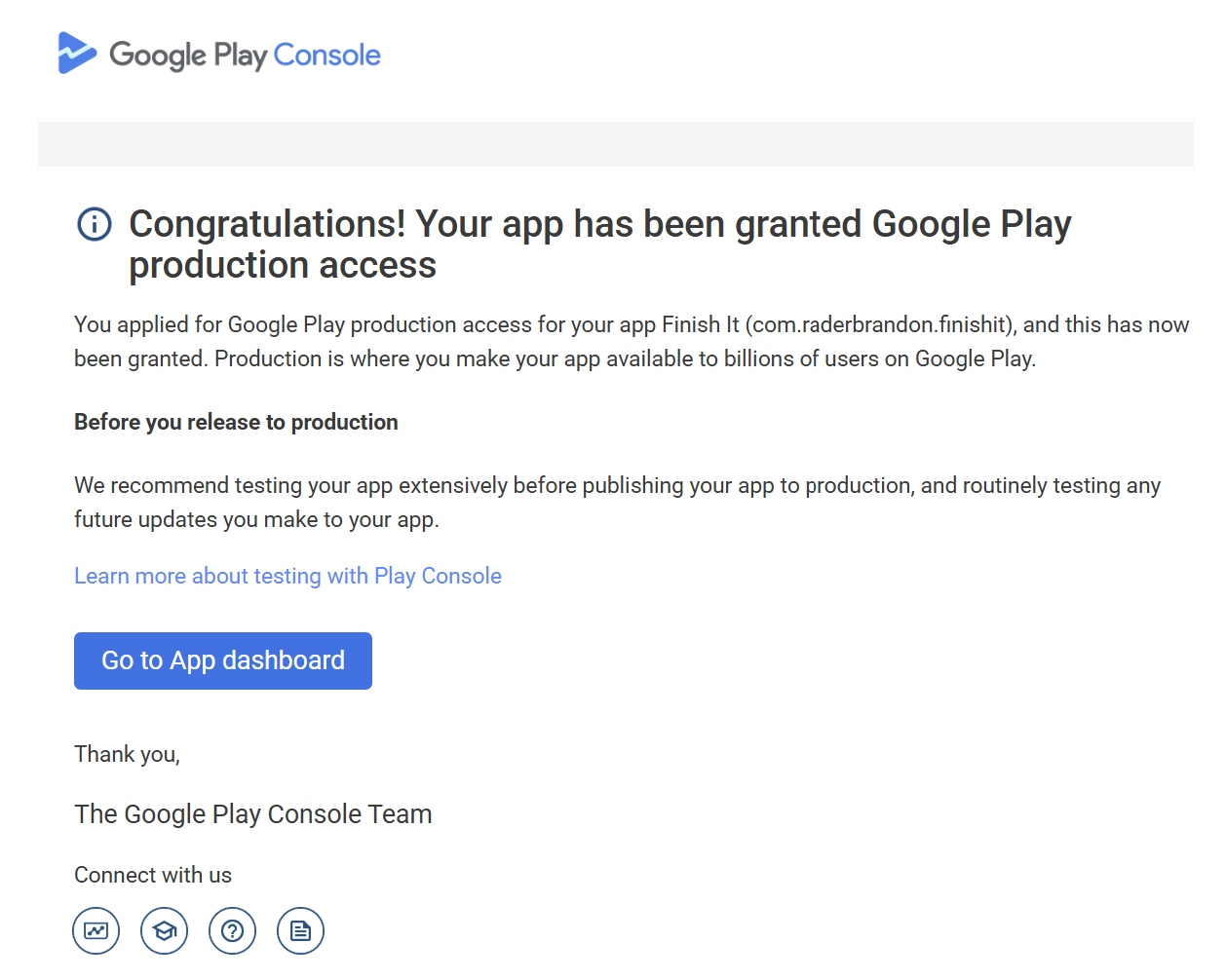
Once the 14-day timer finishes and your 12 active testers have completed their testing cycle, the 'Apply for production' button will activate in your Google Play Console dashboard. Fill out Google's mandatory production access questionnaire with detailed, honest answers explaining your testing methodology, feedback gathered, and bug fixes implemented during the test.
Launch to Google Play Production
Google's review team evaluates your application and closed testing telemetry. Upon approval, production access is granted to your developer account. You can now promote your closed testing build directly to the Production track, set your rollout percentages, and distribute your app to users across Uruguay and international markets.
Pre-Launch Closed Testing Verification Checklist
Before you submit your Android application for production review, run through this comprehensive pre-launch checklist to make sure your build, telemetry, and console setup meet all Google Play developer criteria.
Technical Build & Performance Standards
Target API level is set to the latest Android SDK requirement with 64-bit architecture support enabled.
App crash rate remains well below Google's 1.09% bad behavior threshold across all supported screen sizes.
ANR (Application Not Responding) rate is strictly below 0.47% during peak test sessions.
Deep links, push notifications, and background sync services execute without memory leaks.
Release bundle is obfuscated with R8/ProGuard and all debug logs are stripped.
Google Play Console & Policy Compliance
Privacy Policy URL is live, accessible, and accurately describes all data collection practices.
Data Safety section in the Play Console is filled out completely and matches actual runtime SDK permissions.
App content ratings questionnaire is completed for all target geographic regions.
Closed testing track has maintained 12 or more active opted-in testers for at least 14 uninterrupted days.
Production access questionnaire answers are drafted with specific technical details regarding feedback collected.
Frequently Asked Questions
Why does Google Play require 12 testers for 14 days for personal developer accounts?
In late 2023, Google updated its developer policies to elevate app quality, reduce malware, and protect end users from buggy releases. Personal developer accounts registered after November 2023 are mandated to complete a closed testing phase with at least 12 real testers who remain opted in continuously for 14 consecutive days. This requirement ensures that indie developers thoroughly test their software on physical hardware, gather feedback, and eliminate critical bugs before distributing their applications to the wider public on the Play Store.
What happens if a tester uninstalls the app or opts out on day 10?
If a tester opts out or uninstalls the application, causing your total active tester count to drop below the required 12, Google's automated counter will pause or reset the 14-day evaluation clock. You will need to recruit replacement testers immediately to bring your opted-in number back up to 12 or more, and the 14-day duration will restart from the day that threshold is restored. This is why working with a professional testing service that maintains surplus backup testers is the safest way to prevent costly project delays.
Can developers in Uruguay use international testers for closed testing?
Yes, Google Play allows closed testers to be located in any country where your closed testing track is made available. When configuring your closed testing release in the Google Play Console, you can select 'All countries and regions' or specific target markets like Uruguay, Argentina, Brazil, the United States, or Europe. As long as the testers have active Google accounts and install the app in an enabled country, their participation counts toward your 14-day requirement.
Do testers need to open and interact with the application every single day?
While Google's official documentation states that testers must remain opted in for 14 days, Play Console review systems closely monitor user telemetry, session duration, and app interactions. If all 12 testers simply download the app on day one and never open it again, Google reviewers may determine that the test was insufficient to evaluate real-world stability and reject your application for production access. Authentic, periodic app launches and natural user engagement are critical to passing the review.
Can I release updates and fix bugs while the 14-day closed test is running?
Yes, you can and should upload new builds to your closed testing track during the 14-day period. Pushing updates to fix crashes, enhance UI elements, or address tester feedback demonstrates active development. When you upload a new release to the closed testing track, your testers receive the update automatically through Google Play without resetting the 14-day opt-in timeline. In fact, demonstrating that you resolved issues during testing strengthens your production access application.
What should I write in the Play Console production access questionnaire?
When applying for production access, Google presents a questionnaire asking about your closed testing process, the nature of your feedback, and how you improved your application. Avoid generic, one-sentence answers. Provide concrete details: explain how you recruited your testing group, highlight specific bugs or usability issues discovered by testers (such as a layout rendering issue on specific screen aspect ratios), describe the code updates you deployed to resolve those issues, and summarize your app's core value proposition. Detailed, transparent responses show Google that your app is thoroughly tested and ready for production.
How We Deliver 12 Testers
How we deploy real devices and guarantee compliance for your release.
Connect Account
Sign in with Google to configure the closed testing environment for your Android build.
Assign Testers
Submit your Google Play Console testing link, and our team will assign qualified testers from our testing network to join your Android closed testing release.
Daily QA Runs
A QA supervisor monitors daily check-ins, ensuring 12 unique Android users engage with your Android build every single day.
Launch Ready
We guarantee 14 consecutive days of active user check-ins to satisfy Google's compliance policies, delivering an audit-ready PDF feedback report.
Our Testing Infrastructure
Experience a next-generation testing infrastructure built for Google Play compliance for your Android release.
The 14-Day Production Guarantee
We complete the required 14-day closed testing process with real human testers and physical Android devices, while providing clear testing evidence and documentation throughout the process.
If Google specifically rejects production access due to insufficient testing engagement, you are covered by our free re-run or 100% refund guarantee, subject to our Refund Policy.
Verified Production Access
Quality QA Testing Reports
Clear, actionable reports with screenshots and evidence for every important issue found during testing.
Real Device Testing & Diagnostics
Real human testers use physical Android devices to test your app, verify real user flows, and provide clear testing evidence and professional QA reports.
Compliance Audit Passed
Get your Android build approved on the first try. We create an audit-ready compliance profile that proves thorough quality assurance.
Affordable Compliance Cycles
Transparent plans built to satisfy Google Play Console guidelines for your Android build.
Loading Packages
Please wait while we fetch the best options for your region...
Frequently Asked Questions
Everything you need to know about passing your closed testing requirements.