Play Store testers for 14-day Android closed testing in Uzbekistan
Find Play Store testers in Uzbekistan for 14-day Google Play closed testing. Fulfill Play Console requirements with 12 real testers and launch quickly.
Why Android Developers in Uzbekistan Face Strict Closed Testing Barriers
Building Android software in Central Asia has entered a rapid golden era. From startups working inside Tashkent IT Park to remote engineering squads operating out of Samarkand and Bukhara, Uzbekistan is producing remarkable digital solutions. Local developers are launching high-traffic utility tools, localized e-commerce experiences, and integrations designed to work smoothly with regional ecosystems like Uzum, Click, and Payme. However, turning a finished Android Package Kit (APK) or Android App Bundle (AAB) into an approved production release on the Google Play Store requires passing an uncompromising quality filter: the mandatory 14-day closed testing policy for personal developer accounts.
For engineering teams based in Uzbekistan, fulfilling Google Play Closed Testing demands more than simply circulating an internal test link among colleagues. Google requires developers with personal accounts created after November 2023 to recruit at least 12 testers who remain actively opted-in for a minimum of 14 consecutive days. When teams attempt to cut corners by using bot farms, emulators, or inactive peer rings across social channels, Google automated review algorithms immediately detect the lack of real telemetry. To earn production access on the first attempt, Uzbek developers need authentic, active testers who simulate everyday usage across diverse Android hardware and real local carrier connections like Beeline Uzbekistan, Ucell, and Mobiuz.
The Google Play 14-Day Closed Testing Rule Explained
Google designed the 14-day closed testing protocol to reduce the volume of buggy, incomplete, or malicious apps flooding the Play Store. Under these rules, personal developer accounts cannot apply for production access until their app bundle undergoes continuous evaluation by authentic end users.
+-----------------------------------------------------------------------+
|                 14-Day Google Play Closed Testing Cycle               |
+-----------------------------------------------------------------------+
|  [Day 0: Setup]                                                       |
|   - Configure Closed Testing Track in Google Play Console             |
|   - Link Google Group with 12+ opt-in email addresses                 |
|   - Submit Track for Initial Review & Approval                        |
+-----------------------------------+-----------------------------------+
                                    |
                                    v
+-----------------------------------+-----------------------------------+
|  [Days 1 - 14: Active Evaluation]                                     |
|   - Testers download build via Play Store Web/Android link            |
|   - Real daily device telemetry generated (foreground sessions)      |
|   - Hardware diversity: low-end to flagship chipsets                  |
|   - Crash, ANR, and Android Vitals logged directly to Console         |
|   - Iterative hotfixes pushed without resetting the 14-day clock      |
+-----------------------------------+-----------------------------------+
                                    |
                                    v
+-----------------------------------+-----------------------------------+
|  [Day 14+: Production Application]                                    |
|   - Complete the 20-question Production Access Questionnaire          |
|   - Showcase real user feedback, bug resolutions, and testing depth   |
|   - Google manual & algorithmic review grants Production Status       |
+-----------------------------------------------------------------------+
During this two-week window, automated systems inside Google Play Console continuously monitor testing data. If testers never open the app, if they uninstall the app within hours, or if testing traffic originates from data centers or emulated environments, Google will either reject the production application or reset the 14-day timer. Passing this requirement demands genuine human interaction on physical hardware.
Critical Technical Telemetry: What Play Console Evaluates
Google evaluation pipeline does not merely check if 12 email accounts accepted an invite. The backend analyzes deeply granular Android Vitals and engagement signals collected during the 14-day period.
+-----------------------------------------------------------------------+
|                Google Play Review Telemetry Checkpoints                |
+-----------------------------------------------------------------------+
| 1. Crash Rate Threshold          | Target: < 1.09% (User-perceived)   |
+----------------------------------+------------------------------------+
| 2. ANR (Application Not Responding)| Target: < 0.47% (User-perceived) |
+----------------------------------+------------------------------------+
| 3. Hardware Diversity            | Mali, Adreno, PowerVR, Tensor GPUs |
+----------------------------------+------------------------------------+
| 4. OS Version Matrix             | Android 10, 11, 12, 13, 14, 15     |
+----------------------------------+------------------------------------+
| 5. Interaction Patterns          | Tap depth, session length, scrolls |
+----------------------------------+------------------------------------+
| 6. Network Variability           | LTE, 5G, Wi-Fi, high-latency pings |
+-----------------------------------------------------------------------+
1. User-Perceived Crash and ANR Thresholds
Google Play sets strict performance standards. If your app exceeds a user-perceived crash rate of 1.09% or an Application Not Responding (ANR) rate of 0.47%, your app falls below the bad behavior threshold. This instantly flags your account during production review. Authentic testing helps identify edge-case exceptions, memory leaks on low-RAM handsets, and background service crashes before Google reviewers examine your build.
2. Physical Device Diversity
In Uzbekistan, the consumer mobile market is heavily distributed across entry-level and mid-range devices from Xiaomi (Redmi series), Samsung (Galaxy A-series), Realme, and Tecno, alongside premium flagship devices. Testing solely on a developer personal Google Pixel or an Android Studio emulator fails to reveal memory allocation bottlenecks, GPU rendering glitches on low-end Mali or PowerVR chipsets, or manufacturer-specific background task killers common in custom skins like MIUI, HyperOS, and One UI.
3. Realistic Network and Locale Conditions
Apps built for the local market often process transactions in Uzbek Som (UZS), interface with SMS gateways for one-time passwords, or communicate with regional APIs. Testing on real networks - such as Beeline Uzbekistan, Ucell, Mobiuz, or home fiber connections - ensures that network timeout handling, offline caching, and SSL certificate handshakes operate reliably under real-world latency.
Authentic Human Testing
- 100% Physical Hardware: Runs on genuine Android devices across diverse screen resolutions, CPU architectures, and RAM configurations.
- Continuous Telemetry: Real daily engagement, organic session durations, screen navigations, and valid Play Console vitals.
- Constructive Feedback: Testers report actual UI glitches, text cutoffs, locale formatting issues, and payment flow errors.
- Guaranteed Compliance: Meets and exceeds Google Play Console 12 testers for 14 days baseline for production clearance.
Bot Farms and Fake Networks
- Emulated Virtual Devices: Scripted headless instances running on cloud servers that get flagged instantly by Google SafetyNet and Play Integrity.
- Zero Meaningful Telemetry: Flatline engagement curves, identical IP subnets, and missing sensor data trigger automated rejection.
- Account Penalties: High risk of developer account termination, associated account bans, or indefinite closed testing loops.
- Wasted Time & Capital: Failed production applications force teams to restart the full 14-day cycle from scratch.
Comparing Testing Approaches for Uzbek Developers
Choosing the right testing strategy determines whether your app launches on schedule or gets trapped in repeated rejection cycles. Below is a breakdown of how professional managed testing compares against informal DIY outreach and illicit automation services.
| Evaluation Metric | Professional Managed Testing | Informal DIY Testing (Friends / Groups) | Cloud Emulators & Bot Farms |
|---|---|---|---|
| Tester Retention (14 Days) | Guaranteed 100% active retention | Low (friends forget or uninstall after 2 days) | High (automated but detected as fraudulent) |
| Hardware Breadth | Dozens of distinct physical models & chipsets | Limited to 3 - 5 familiar devices | Virtualized cloud instances with identical fingerprints |
| Android Vitals Generation | Authentic, diverse telemetry data | Very low volume, intermittent sessions | Artificial, uniform data flagged by Play algorithms |
| Feedback Quality | Structured bug logs, UX notes, crash dumps | Subjective comments with little technical depth | Zero actionable human feedback |
| Play Integrity Safety | Fully compliant with Google Play guidelines | Compliant but high risk of tester drop-out | Severe violation of Google Developer Distribution Agreement |
| Production Approval Rate | Exceptionally high on first submission | Moderate to low (often rejected for low engagement) | Near zero (automatic disqualification or ban) |
Struggling with the 14-Day Testing Requirement?
Skip the hassle of recruiting unreliable testers. Our professional fleet of real Android devices guarantees Google Play compliance in exactly 14 days. Zero bots. Zero emulators. 100% production approval guarantee.
Step-by-Step Preparation Checklist Before Launching Closed Testing
Before you invite your 12 testers, you must ensure your build, store listing, and testing infrastructure are properly prepared. Skipping fundamental configuration steps leads to unnecessary track rejections before the 14-day clock even begins.
Play Console Configuration & Compliance
Technical Build Hardening & Quality Checks
The Roadmap to Play Store Production Approval
Navigating the Google Play closed testing workflow requires a disciplined sequence of actions. Following this structured roadmap guarantees that every milestone - from initial setup to production release - meets Google review standards.
Track Setup & Tester Group Assignment
Set up your closed testing track within Google Play Console. Create a centralized Google Group, populate it with your 12+ qualified human testers, and attach the group to your release track. Submit the initial release for review. Once Google approves the track, distribute the opt-in web and Android join links to all participants.
Opt-In Verification & Initial Install Wave
Confirm that all 12+ testers click the invitation URL, opt into the testing program via their personal Google accounts, and download the build directly from the Play Store onto their physical Android devices. Verify inside Google Play Console that the 'Active Testers' count reflects full participation.
14 Days of Continuous Active Testing & Telemetry
Maintain daily active usage across the entire two-week window. Testers execute typical user journeys, test core functionality, rotate through screen configurations, and trigger foreground network activity. If crashes occur, push hotfix updates through the closed track; subsequent builds update seamlessly without resetting your 14-day progression.
Production Questionnaire & Final Store Clearance
Upon reaching Day 14 with continuous opt-in, unlock the 'Apply for Production' button in Google Play Console. Complete the 20-question review questionnaire with detailed, honest insights regarding your testing methodology, feedback collected, and technical improvements made. Submit for final review and achieve production status.
Mastering the 20-Question Production Access Application
Once your 14-day closed testing period concludes, Google presents a comprehensive questionnaire that determines whether your account earns production publishing rights. This is where many independent developers and startups stumble. Google review engineers evaluate your written answers against the actual telemetry logged in Play Console.
+-----------------------------------------------------------------------+
|             Google Play Production Access Evaluation Pillars          |
+-----------------------------------------------------------------------+
| 1. Recruitment Strategy     | How did you find your testers?          |
|                             | (Must reflect authentic outreach)       |
+-----------------------------+-----------------------------------------+
| 2. Engagement & Feedback    | What feedback did testers provide?      |
|                             | (Detailed UX, bug, and feature notes)   |
+-----------------------------+-----------------------------------------+
| 3. Technical Iteration      | What updates were made during testing?  |
|                             | (Changelogs, crash fixes, optimizations)|
+-----------------------------+-----------------------------------------+
| 4. Production Readiness     | Why is your app ready for public launch?|
|                             | (Target audience, quality assurance)    |
+-----------------------------------------------------------------------+
When answering these questions, avoid generic one-sentence responses such as "My friends tested it and found no bugs." Provide concrete examples:
- Explain how testers on budget Android devices reported layout clipping on smaller screen dimensions (such as 720p displays), and detail how you adapted ConstraintLayout constraints to resolve it.
- Describe how testers on unstable mobile networks (like fluctuating 3G/LTE connections) experienced network call timeouts, leading your team to implement exponential backoff policies and offline Room database caching.
- Document the specific versions released to the closed track during the test period, detailing the bug fixes and UI polish introduced in each iteration.
Demonstrating this level of engineering rigor proves to Google that your testing process was genuine, thorough, and effective.
Frequently Asked Questions (FAQ)
Why does Google Play require 12 testers for 14 days for personal developer accounts?
In late 2023, Google updated its developer policies to ensure that all new personal developer accounts demonstrate comprehensive quality assurance before publishing apps publicly. By requiring a minimum of 12 distinct testers to remain opted in for 14 continuous days, Google ensures the software undergoes real-world usability testing, bugs are caught early, and the app does not present stability, privacy, or security risks to the broader Android ecosystem.
Can I test my app using Android Studio emulators or cloud virtual devices?
No. Google Play Console collects detailed hardware and runtime metrics through Google Play Services and Play Integrity APIs. Emulated environments, cloud browser instances, and headless virtual devices are easily identified by automated review systems. If Google detects that testing activity originates from non-physical hardware, your closed testing progress will be rejected, and your production application will be denied.
What happens if a tester uninstalls the app or leaves the Google Group during the 14 days?
If a tester opts out or uninstalls the app and your active tester count drops below the mandatory threshold of 12, Google Play Console pauses the 14-day progress counter. To prevent disruptions, professional testing services typically provision 15 to 20 testers to maintain a comfortable safety margin, ensuring that the 14-day requirement runs continuously without resetting.
Can developers in Uzbekistan use testers located in other countries?
Yes. Google Play closed testing does not restrict tester locations unless you specifically limit your closed testing track to specific country availability settings within Google Play Console. Having a geographically diverse testing group often provides a wider variety of device models, Android operating system versions, and network carrier behaviors, which strengthens your testing telemetry profile.
If I publish a bug fix or new build during testing, does the 14-day timer restart?
No. Pushing updates, fixing crashes, or releasing new app bundles (AABs) to the active closed testing track does not reset your 14-day timer. In fact, releasing incremental updates during the testing phase is viewed favorably by Google review algorithms because it proves you are actively resolving bugs and improving software quality based on incoming tester data.
How should I answer the 20-question production application questionnaire after testing?
Provide specific, detailed, and technically accurate descriptions of your testing methodology. Detail how you gathered your tester group, summarize real user feedback regarding navigation, layout, or feature performance, and explain the specific code changes, optimizations, or bug fixes implemented during the 14-day cycle. Aligning your written answers with the telemetry data logged in your Play Console dashboard is critical for immediate approval.
Our QA Process
A straightforward 4-step process to get your Android app approved.
Choose Package
Connect your Google account and choose your preferred closed testing package for your Android app.
Submit Link
Share your Play Store opt-in URL. We immediately deploy 12 real testers to launch and review your Android app daily.
Active Testing
Our crew initiates daily launch sessions on physical devices, verifying usability and logging crashes for your Android app.
Get Approved
We continuously perform closed app testing for 14 days to help you meet Google Play production requirements. We also provide a compliance report.
The Premium QA Advantage
Deploy your Android app onto real retail-grade handsets using our secure laboratory environment.
The 14-Day Production Guarantee
We complete the required 14-day closed testing process with real human testers and physical Android devices, while providing clear testing evidence and documentation throughout the process.
If Google specifically rejects production access due to insufficient testing engagement, you are covered by our free re-run or 100% refund guarantee, subject to our Refund Policy.
Verified Production Access
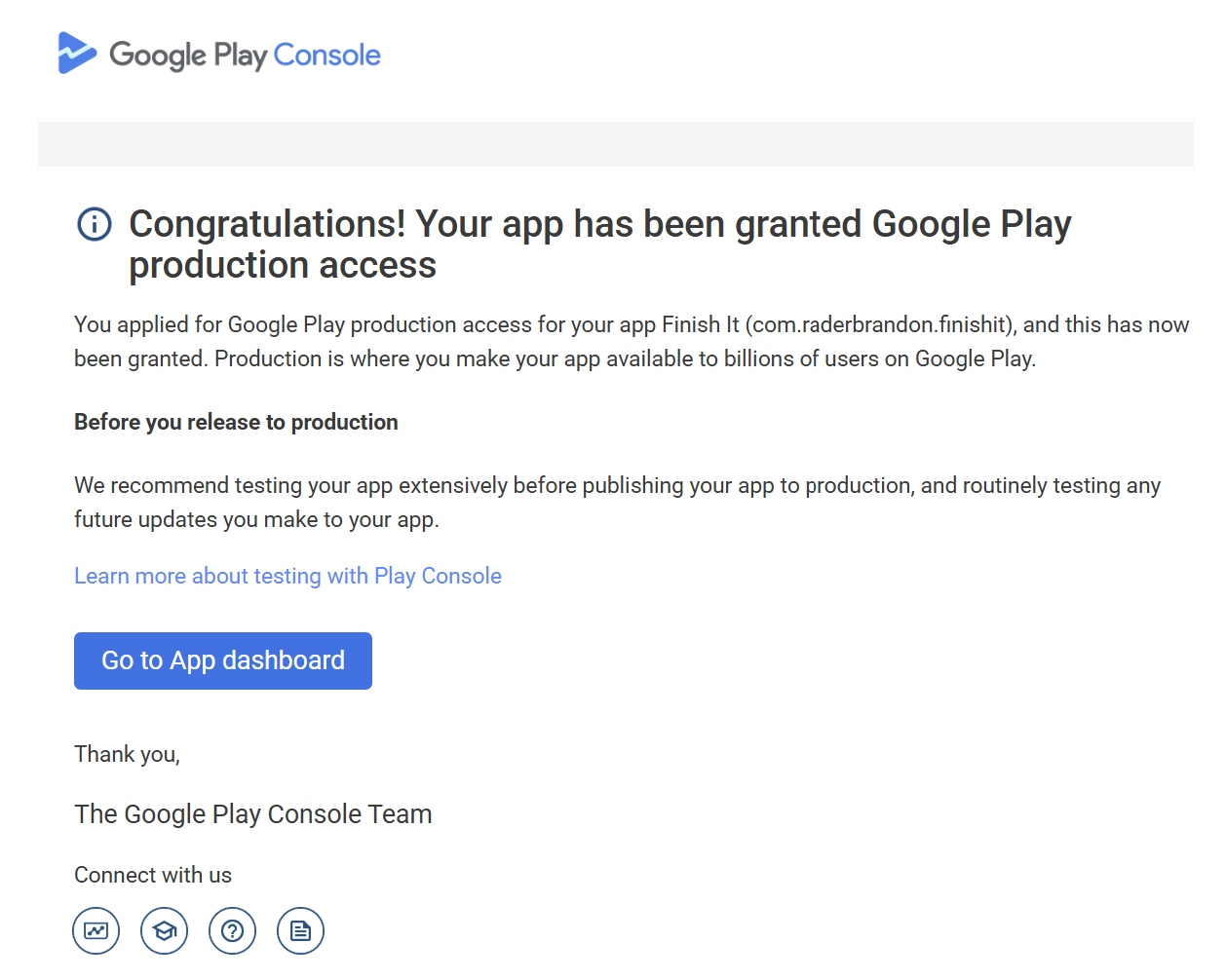
Quality QA Testing Reports
Clear, actionable reports with screenshots and evidence for every important issue found during testing.
Real Device Testing & Diagnostics
Real human testers use physical Android devices to test your app, verify real user flows, and provide clear testing evidence and professional QA reports.
Production Access Secured
Transition your Android app to public production access with confidence. We deliver verified session logs and compliant Console activity.
One Cycle. Complete Approval.
Choose the ideal closed testing cycle for your Android release.
Loading Packages
Please wait while we fetch the best options for your region...
Frequently Asked Questions
Everything you need to know about passing your closed testing requirements.