Play Store testers for 14-day Android closed testing in Vietnam
Find real Play Store testers in Vietnam for Google Play closed testing. Fulfill Play Console requirements securely with 12 testers for 14 days.
Motorbikes weaving through Hanoi traffic, QR code payments scanning at every street food stall, and a booming smartphone penetration rate all point to one undeniable fact. Vietnam is one of the most exciting mobile app markets in Southeast Asia. But launching an Android app here is not just about translating your interface into Vietnamese or integrating local payment gateways. Before you can reach millions of eager users, you must clear a major quality control hurdle set by Google. To protect its ecosystem from buggy software, developers must successfully complete Google Play Closed Testing. This means finding real, opted-in individuals who will actively install and use your app over a specific period. It is not a mere suggestion, it is a strict, algorithmic requirement. If your testing data looks synthetic, rushed, or irrelevant, your app will be rejected. You need authentic engagement from real devices connecting through local networks.
The Testing Requirements Demystified
Navigating the rules for Play Store Closed Testing can feel like reading a complicated legal document. For new personal developer accounts created after November 2023, Google strictly requires at least 20 testers to be opted-in to your test for 14 consecutive days. Some outdated developer forums or older guides might still casually mention finding 12 Testers for 14 Days, but you must adhere to the current 20-tester minimum to avoid immediate rejection. Getting this right in a hyper-connected market like Vietnam means sourcing local users who understand the context of your application.
Why Automated Bots Will Ruin Your Launch
Google monitors your testing phase with highly sophisticated algorithms. If you try to bypass the system by using automated bot farms, cheap click services, or emulators, the Play Console will flag your account for suspicious activity. Real Closed Testing requires a variety of device models, different battery depletion rates, varied network conditions across regions like Ho Chi Minh City or Da Nang, and genuine user interactions. Cutting corners here will only lead to permanent account bans and wasted development time.
The Real vs. Fake Testing Dilemma
When sourcing testers in Vietnam, developers often face a choice between hiring real local users or falling for cheap, automated services promising instant results. The difference in quality and safety is massive.
Authentic Local Testers
Using real testers based in Vietnam ensures that your app is evaluated under true market conditions. Real users connect via local telecom providers like Viettel or Mobifone, producing authentic network logs. They interact with your app at natural times of the day, pausing to read text, clicking organically, and generating varied session lengths. This genuine activity signals to Google that your app is providing real value, dramatically increasing your chances of a smooth production rollout.
Bot Farms and Fake Accounts
Automated testing services often rely on device farms or virtual machines located in massive data centers. These bots install your app, open it for exactly three seconds, and close it. They do not simulate human behavior. Google's security systems can easily detect when twenty devices with identical screen resolutions and IP addresses access an app simultaneously. Relying on these fake services is the fastest way to get your Google Play developer account suspended indefinitely.
Essential Pre-Launch Checklist for Vietnam
Before you invite a single tester to your Google Play Closed Testing track, you must ensure your app and your Play Console listing are fully prepared. Skipping any of these steps can lead to delays, frustrated testers, or rejection from the review team.
Technical Readiness
While high-end devices are popular, a significant portion of the Vietnamese market uses mid-tier Android phones. Ensure your app performs smoothly on devices with limited RAM and older processors. Profile your app for memory leaks and optimize image assets to keep the download size manageable for users on cellular data.
Test your backend API endpoints for latency when accessed from Vietnamese IP addresses. If your servers are located far away, users might experience frustrating delays. Implement robust error handling for intermittent network connections, which are common when users are commuting or traveling between cities.
Integrate tools like Firebase Crashlytics or Sentry before distributing your app. During the 14-day testing period, you need granular insights into exactly where and why your app might be failing. Silent crashes that go unlogged will frustrate your testers and prevent you from fixing critical bugs.
Set up basic event tracking to monitor how testers are interacting with your core features. You need to know if users are successfully completing onboarding, exploring the main navigation, or abandoning the app early. This data is invaluable for proving active engagement during your testing phase.
Play Console Configuration
Google takes user privacy very seriously. You must accurately fill out the Data Safety section in the Play Console, detailing exactly what user data your app collects, how it is encrypted, and whether it is shared with third parties. Failure to provide accurate privacy information will block your app from being reviewed.
Even in a closed test, testers will see your store listing. Create compelling app icons, clear screenshots, and a descriptive title in Vietnamese. A professional store presence builds trust with your testers and encourages them to actually install and use the application.
Navigate to the testing section in the Play Console and create a new closed release. Carefully upload your signed App Bundle (AAB). Ensure you have selected the correct countries, specifically targeting Vietnam, so your local testers can actually access the download link without encountering regional blocks.
Decide how you want your testers to report bugs. Will you use the built-in Play Console feedback mechanism, a dedicated email address, or a community Discord server? Clear communication channels are vital for gathering qualitative feedback during the 14-day period.
Struggling with the 14-Day Testing Requirement?
Skip the hassle of recruiting unreliable testers. Our professional fleet of real Android devices guarantees Google Play compliance in exactly 14 days. Zero bots. Zero emulators. 100% production approval guarantee.
The 14-Day Roadmap to Production
Successfully completing the testing phase requires more than just waiting for two weeks. It demands active management, rapid iteration, and consistent monitoring. Here is a day-by-day roadmap for managing your testers in Vietnam.
Days 1 to 3: Onboarding and Initial Impressions
The first 72 hours are critical. Once you distribute your opt-in link, monitor your analytics dashboard closely to verify that all 20 testers have successfully installed the app. Look out for immediate crash reports, as critical bugs during onboarding will cause testers to abandon the app. Send a welcome message if you are using a direct communication channel, thanking them for participating and providing clear instructions on what features to focus on first.
Days 4 to 7: Deep Exploration and Bug Hunting
As testers settle into using your app, encourage them to explore secondary features and edge cases. This is the period where hidden bugs usually surface. Are they having trouble with localization formatting, such as currency displays in Vietnamese Dong? Is the user interface breaking on specific screen sizes? Start compiling these bug reports into a prioritized list. Do not push an update just yet unless there is a completely game-breaking issue blocking all progress.
Days 8 to 10: The Mid-Point Update
By the second week, you should have enough qualitative and quantitative data to address the most glaring issues. Prepare a new release candidate with bug fixes and minor optimizations. Upload this new App Bundle to your existing Closed Testing track. Pushing an update demonstrates to Google that you are actively maintaining the app and responding to tester behavior. Notify your users to update the app and ask them to verify if the previous bugs are resolved.
Days 11 to 13: Sustaining Engagement
The biggest challenge in the final days is tester fatigue. Users might forget to open the app or simply lose interest. To satisfy the engagement requirements for Google Play Closed Testing, you need continuous activity. Send a polite reminder or ask a specific question about a newly updated feature to prompt them to open the app again. Monitor your daily active user metrics to ensure nobody has uninstalled the application prematurely.
Day 14 and Beyond: Final Review and Production Application
Once the 14 consecutive days have passed and your dashboard confirms consistent participation from your 20 testers, you can finally apply for production access. Take the time to thoughtfully answer the questions in the production application form. Detail exactly how you sourced your testers, what feedback you received, and how you improved the app based on that feedback. A well-documented application greatly increases your chances of immediate approval.
Comparative Analysis: Getting Testers
Finding reliable users in Vietnam can be approached in several different ways. Each method carries its own risks and rewards. Here is a breakdown of the most common strategies developers use.
| Sourcing Method | Speed | Quality of Feedback | Compliance Risk | Cost |
|---|---|---|---|---|
| Professional Testing Services | Very Fast | High | Low | Moderate |
| Friends and Family | Slow | Low (Biased) | Low | Free |
| Social Media Groups (Facebook/Zalo) | Medium | Variable | Medium | Time-Intensive |
| Automated Bot Farms | Instant | None | Extremely High | Cheap (but leads to bans) |
Using a professional service dedicated to supplying real, vetted users ensures that you meet Google's rigorous standards without burning out your personal network or risking an algorithmic ban from cheap bot traffic.
Comprehensive FAQ for Play Store Closed Testing in Vietnam
Navigating the testing phase brings up many specific questions, especially when targeting a dynamic market like Vietnam. Here are the most frequently asked questions and detailed answers to help you succeed.
Why does Google require 20 testers instead of the 12 Testers for 14 Days I read about?
The mobile app ecosystem is constantly evolving. In late 2023, Google updated its policies for newly created personal developer accounts to demand a higher standard of quality control. The old rumor of 12 Testers for 14 Days is no longer accurate or sufficient. You now must have a minimum of 20 opted-in testers for 14 consecutive days. This stricter rule ensures that only well-tested, stable applications make it to the production environment, reducing the number of low-quality apps that frustrate end users.
Do all 20 testers have to be located in Vietnam?
No, Google does not strictly require all testers to be physically located in your target launch country. However, if your application is entirely localized in Vietnamese and relies on local services, having testers from Vietnam is highly recommended. Real local testers provide authentic feedback on localization accuracy, cultural relevance, and local network performance. If you mix international testers with local ones, just ensure they all actively engage with the app daily.
What happens if a tester uninstalls the app on day 10?
If a tester opts out or uninstalls your application before the full 14-day period is complete, they will no longer count towards your required minimum of 20 concurrent testers. If your total number drops below 20, the 14-day timer may reset, forcing you to start the entire process over again. This is why it is incredibly important to recruit slightly more than 20 testers as a buffer, and to ensure your app is stable enough that people do not uninstall it in frustration.
Can I update my app during the 14-day testing period?
Yes, you absolutely can, and it is actually encouraged. Pushing an update to fix bugs reported by your testers shows Google that you are running a legitimate testing phase and actively responding to feedback. When you upload a new version to the Closed Testing track, your testers will receive the update through the Play Store just like a normal app update. It does not reset your 14-day timer, provided the testers remain opted-in and continue using the app.
How does Google know if my testers are real humans or automated bots?
Google utilizes advanced machine learning models and device fingerprinting to analyze user behavior. They look at metrics such as session duration, interaction patterns, device hardware profiles, battery usage, and network origin. If twenty identical virtual machines from a single IP block in a data center install your app and open it for exactly five seconds every day, Google's systems will instantly flag the activity as artificial. Real humans exhibit varied, unpredictable behavior that bots cannot convincingly replicate.
Is it safe to pay people directly to test my app?
Paying random people on the internet can be very risky. Many individuals who offer to test apps for cash are running multiple emulator accounts to game the system, which will negatively impact your developer reputation. It is much safer to use a reputable testing service that guarantees real devices and genuine engagement, or to recruit enthusiastic members of your target audience who are genuinely interested in what you are building.
How long does it take for Google to review my application for production access?
Once you successfully complete the 14-day period and submit your application for production access, the review process typically takes anywhere from 2 to 7 business days. The timeline depends heavily on the thoroughness of your answers in the final questionnaire. If you provide detailed, well-documented explanations of your testing methodology, the bugs you found, and the improvements you made, the review team is more likely to approve your application quickly. Vague or one-sentence answers often lead to follow-up questions and delays.
What should I do if my production application gets rejected after the 14 days?
If your application is rejected, Google will usually provide a specific reason in an email and on the Play Console dashboard. Common reasons include insufficient tester engagement, incomplete Data Safety forms, or a lack of detail in your post-test questionnaire. Do not panic. Read their feedback carefully, address the specific issues they mentioned, and you may need to run another round of testing to gather more data and prove that your app meets their quality standards before reapplying.
Do my testers need to leave public reviews on the Play Store?
No, during the Closed Testing phase, tester reviews remain completely private. Any feedback or star ratings they leave will only be visible to you inside the Google Play Console. This allows users to be brutally honest about bugs and design flaws without damaging your app's public reputation before it even officially launches. Once you move to production, these private reviews will not carry over to the public listing.
Why is localizing the store listing important for a closed test?
Even though the test is closed, your invited users still have to download the app through the standard Google Play Store interface. A fully localized, professional-looking store page with Vietnamese text, high-quality screenshots, and a clear description makes your project look legitimate. If the store page looks unfinished or uses broken language, potential testers might assume it is spam or malware and refuse to install it, causing you to fail the 20-tester requirement right at the start.
How It Works
Your journey to Google Play production access, simplified and automated.
Get Started
Authenticate your account to initialize the 14-day QA fleet for your Android release.
App Submission
Upload your testing link. We assign 12 verified users with real Android devices to download and test your Android release.
14-Day Cycle
A dedicated testing supervisor is assigned to monitor progress while testers engage with your Android app and provide feedback throughout the testing period.
Production Access Approval
Our lab maintains active installations for two weeks straight, ensuring a clean track record and providing a QA compliance log for your release.
Why Choose AppConsoleLab
Satisfy your Play Store Console testing obligations with our managed physical device fleet tailored for Android builds.
The 14-Day Production Guarantee
We complete the required 14-day closed testing process with real human testers and physical Android devices, while providing clear testing evidence and documentation throughout the process.
If Google specifically rejects production access due to insufficient testing engagement, you are covered by our free re-run or 100% refund guarantee, subject to our Refund Policy.
Verified Production Access
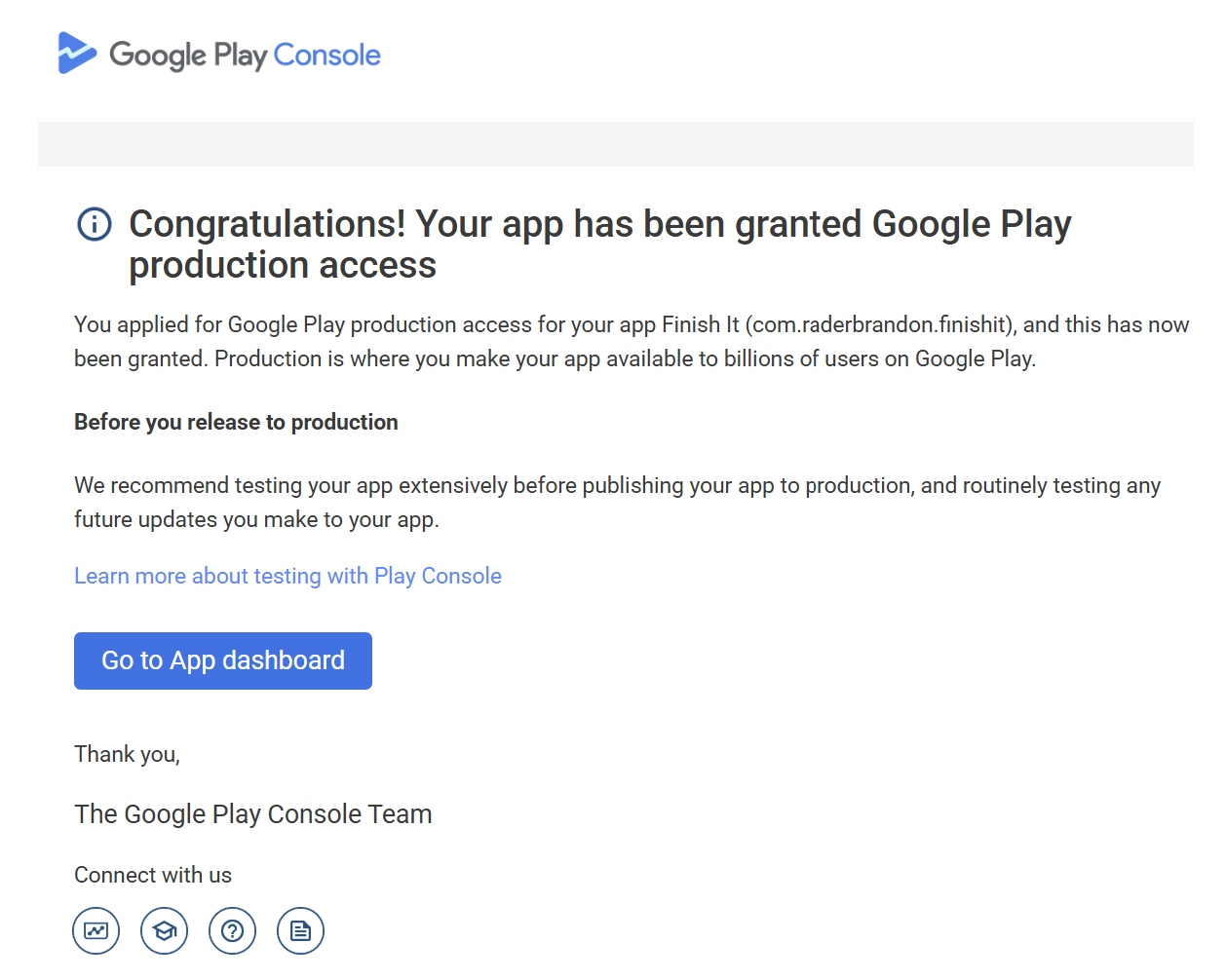
Quality QA Testing Reports
Clear, actionable reports with screenshots and evidence for every important issue found during testing.
Real Device Testing & Diagnostics
Real human testers use physical Android devices to test your app, verify real user flows, and provide clear testing evidence and professional QA reports.
Play Store Ready
Our structured 14-day closed testing process is designed to meet Google Play's production requirements for your Android release.
Simple Closed Testing Pricing
Select the plan that fits your Android app complexity.
Loading Packages
Please wait while we fetch the best options for your region...
Frequently Asked Questions
Everything you need to know about passing your closed testing requirements.