Play Store testers for 14-day app closed testing in Indonesia
Secure active Play Store testers in Indonesia for Google Play closed testing. Meet Play Console guidelines easily with 12 testers for 14 days.
Imagine trying to sell heavy snow boots in the middle of a sweltering Jakarta heatwave. That is exactly what launching an untested, unoptimized app feels like in Indonesia's hyper-competitive digital jungle. You might possess the most elegant code and the most innovative features on the planet, but if you ignore the distinct local nuances, your app will melt under the intense pressure of real-world usage. Indonesia is not just a standard market on a spreadsheet; it is a sprawling, vibrant archipelago composed of diverse user behaviors, heavily fluctuating internet speeds, and incredibly unique cultural expectations. This is the precise moment where the strict, seemingly annoying rules of Google Play Closed Testing become your absolute greatest ally, rather than a mere bureaucratic hurdle you have to jump over. By securing authentic Play Store testers for 14-day app closed testing in Indonesia, you are not simply ticking a mandatory compliance box for Google - you are vigorously stress-testing your digital product in a fierce, mobile-first ecosystem.
Google's strict requirement of 12 Testers for 14 Days acts as the ultimate industry filter. It purposefully separates the serious, long-term developers from the fleeting, unprepared dreamers. Countless creators view this as an irritating roadblock, but the smart, strategic developers see it as a vital 14-day incubator for success. When you conduct your testing specifically within Indonesia, you gather critical, on-the-ground data. This data tells you exactly if your app can actually survive the wildly fluctuating 4G network connections found in rural Java, or if it can handle the rapid-fire, intense multitasking demanded by modern urban users in Jakarta. It is the proving ground your app desperately needs before it faces the harsh light of the public store.
Why Indonesia's Mobile-First Culture Demands Rigorous Play Store Closed Testing
It is a well-known fact that Indonesia essentially skipped the desktop computing era almost entirely. The vast majority of people here live, work, socialize, and play entirely on their mobile smartphones. Because of this deeply ingrained habit, your app must be absolutely flawless from the very first tap on the screen. If your application lags slightly, crashes unexpectedly during a crucial moment, or drains battery life faster than normal, it will be aggressively uninstalled faster than you can even type out the words "bug fix patch". Google Play Closed Testing acts as a protective barrier, ensuring that these critical, fatal flaws are successfully caught and fixed long before you ever have to face the brutal wrath of negative public reviews.
Furthermore, the Play Console compliance rules are intricately designed to protect the end users, and by direct extension, your app's fragile early reputation. When you take the time to run a proper, thoroughly monitored 14-day cycle with real, breathing Indonesian users, you align your project perfectly with Google's high quality standards. The review team at Google wants to see genuine, natural engagement patterns, consistent daily app opens, and actual, meaningful feedback left by humans. Resorting to fake engagement or automated bots will immediately trigger complex security alarms, ultimately leading to a swift and frustrating rejection of your hard work.
Struggling with the 14-Day Testing Requirement?
Skip the hassle of recruiting unreliable testers. Our professional fleet of real Android devices guarantees Google Play compliance in exactly 14 days. Zero bots. Zero emulators. 100% production approval guarantee.
Real Humans vs. The Bot Army: A Dangerous Game
When you are rushing to meet the requirement for 12 Testers for 14 Days, the temptation to cut corners is incredibly strong. The internet is flooded with shady services offering instant approvals using automated bots. However, Google's detection algorithms are smarter than ever. Let us break down exactly why choosing real humans over a bot army is the only logical choice for your Closed Testing phase.
Authentic Human Testers
Real human testers provide the chaotic, unpredictable interaction that your app actually needs to improve. They tap the wrong buttons, they swipe when they should scroll, and they try to use your app while walking down a busy street in Bali with a weak signal. This genuine behavior uncovers hidden UI flaws and obscure bugs that a perfectly programmed script would completely ignore. Furthermore, real users leave authentic, nuanced feedback in the Play Console. They tell you if the colors hurt their eyes, or if the translation sounds unnatural in Bahasa Indonesia. Most importantly, engaging real people ensures full compliance with Google Play Closed Testing policies, guaranteeing a smooth transition to the production track without the looming fear of a sudden ban.
Automated Bot Farms
Bot farms offer a seductive promise: fast, cheap, and effortless testing. They use emulators to simulate the required daily opens, mechanically fulfilling the base criteria of the 14-day rule. However, this is a massive, highly dangerous trap. Bots follow predictable, linear paths. They do not get confused, they do not experience battery drain issues in the same way a physical phone does, and their network conditions are usually artificially stable. When Google analyzes the testing data, a lack of varied, human-like interaction raises immediate red flags. The Play Console's machine learning models are specifically trained to hunt down this exact type of artificial engagement. If caught - and you likely will be - your developer account faces severe penalties, including permanent suspension, wiping out months of hard work in an instant.
The Blueprint for Success: Your 14-Day Roadmap
Successfully navigating the 14-day testing period requires much more than just hitting a start button and hoping for the best. You need a structured, proactive approach to ensure every single day counts toward your final goal of production approval. Here is the step-by-step journey to mastering your Play Store Closed Testing in the Indonesian market.
Day 1 to 3: The Initial Onboarding and Stability Check
The first three days are the most critical for retention. Your 12 testers will install the app and perform their very first run. During this phase, you must monitor your crashlytics dashboard like a hawk. Are testers in Indonesia experiencing immediate force closes upon launch? Is the initial loading screen taking too long on mid-range devices commonly used in the region? This is not the time to worry about complex features; this is the time to ensure the app simply turns on and stays on.
Day 4 to 7: Deep Dive into Core Functionality
Now that the app is stable, testers will begin to explore the primary features. If you have an e-commerce app, they will try adding items to a cart. If it is a game, they will play the first few levels. You should actively encourage your testers to try specific tasks. Look closely at the session durations in the Play Console. Are users spending enough time to actually experience the core value of your app, or are they bouncing after thirty seconds? Genuine engagement here is vital for compliance.
Day 8 to 10: Pushing the Limits and Edge Cases
It is time to stress the system. Ask your testers to use the app under less-than-ideal conditions. How does the app handle a sudden drop from 4G to 3G? What happens if a phone call interrupts a critical transaction within the app? Indonesian users frequently deal with fluctuating network environments, so gathering data on these edge cases is incredibly valuable. This is where you find the obscure bugs that automated tests always miss.
Day 11 to 13: Gathering Qualitative Feedback
While the Play Console tracks the quantitative data - like crash rates and session lengths - you also need the qualitative human element. Reach out to your testers and ask for specific, written feedback. Is the user interface intuitive? Is the localized text accurate and culturally appropriate for Indonesia? This feedback is not just for your own improvement; Google wants to see a history of developer-tester communication to verify the authenticity of the test.
Day 14: Final Review and Production Preparation
The final day is a time for comprehensive review. Ensure that all 12 testers have maintained their opt-in status and have actively used the app throughout the period. Compile all the bug reports, fix the critical issues, and prepare your final release notes. When you apply for production access, you will need to answer specific questions from Google about what you learned during this Closed Testing phase. Having a detailed record of the past 14 days will make answering these questions a breeze.
DIY Testing vs. Professional Services
When it comes to sourcing your 12 testers, you generally have three distinct paths: doing it yourself by begging friends and family, hiring a professional service that specializes in the Indonesian market, or falling into the trap of cheap bot providers. Let us compare these options side-by-side to see which truly offers the best path to success.
| Feature / Aspect | Professional Service (Real Users) | DIY (Friends and Family) | Cheap Bot Farms |
|---|---|---|---|
| Compliance Guarantee | Extremely High - strict adherence to Play Console rules. | Moderate - friends often forget to open the app daily. | Very Low - highly likely to trigger Google's spam filters. |
| User Demographics | Targeted - genuine users from Indonesia with varied devices. | Limited - restricted to your immediate social circle's devices. | Non-existent - simulated devices located in random server farms. |
| Feedback Quality | Excellent - detailed, objective, and actionable insights. | Poor - friends are often too polite to point out major flaws. | Zero - bots do not write constructive criticism or fill out surveys. |
| Time Investment | Low - the service manages the users and tracks the 14 days. | Very High - you must constantly remind and manage every person. | Low - but the time saved is lost when your account is banned. |
| Overall Peace of Mind | Maximum - you can focus on coding while the test runs smoothly. | Stressful - constantly worrying if someone accidentally uninstalled. | Terrifying - waiting for the inevitable rejection email from Google. |
The Ultimate Pre-Launch Checklist for the Indonesian Market
Before you even think about hitting that button to start your 14-day clock, you need to ensure your app and your Play Console listing are fully prepared. Failing to prepare is preparing to fail, especially under the watchful eye of Google's review team. Use this comprehensive checklist to secure your launch strategy.
App Localization and Performance
Verify that all in-app text has been professionally translated into localized Bahasa Indonesia, avoiding robotic or awkward phrasing that turns users away.
Optimize your app's total file size; many Indonesian users have limited storage capacity on their devices and are hesitant to download massive files.
Implement robust offline capabilities or graceful error handling for moments when network connectivity inevitably drops out during use.
Test your app on popular mid-range Android devices that dominate the local market, ensuring smooth performance without excessive battery drain.
Play Console Configuration
Complete every single required section of the App Content page, including the privacy policy URL, data safety form, and target audience declarations.
Prepare highly engaging, localized promotional screenshots and a compelling description for your store listing to attract your testers.
Set up an active, easily accessible feedback channel - such as a dedicated email address or a Discord server - for testers to report their findings.
Ensure your developer account is fully verified with up-to-date identity and payment information to prevent any unexpected administrative delays.
Tester Management Strategy
Confirm you have a reliable source to recruit at least 12 testers, aiming for 15 to 20 to act as a buffer in case someone drops out unexpectedly.
Draft a clear, friendly welcome email or message that explains exactly what you need the testers to do during the 14-day app closed testing phase.
Plan a daily monitoring schedule to check the Play Console statistics, ensuring testers are actually opening the app and generating valid session data.
Prepare a final survey to send out on day 14, gathering the specific qualitative feedback you will need to summarize for Google's final production review.
Frequently Asked Questions (FAQ)
Navigating the complexities of Google Play Closed Testing often brings up a lot of questions. We have compiled the most detailed answers to help you understand exactly what is required to succeed, particularly when targeting the Indonesian market.
Why does Google specifically require 12 testers for 14 days?
Google introduced the requirement of 12 Testers for 14 Days to drastically improve the overall quality of apps entering the Play Store. In the past, developers could instantly publish untested, buggy apps, which ruined the user experience. By forcing a 14-day closed testing period, Google ensures that apps are actually usable, stable, and have received at least a baseline level of human interaction. The number 12 is small enough to be manageable for independent developers, but large enough to provide diverse device data and meaningful usage metrics. This process filters out low-effort spam and protects the integrity of the store.
What happens if one of my testers uninstalls the app on day 10?
If a tester uninstalls the app before the full 14-day cycle is complete, they no longer count towards your active tester pool. If your total number of active, opted-in testers drops below the mandatory threshold of 20 (or 12, depending on the specific track and account age rules applied to your console), the 14-day clock will completely reset. This is a massive setback. This is exactly why it is highly recommended to recruit significantly more than the minimum requirement. Starting with 25 or 30 testers provides a vital safety net, ensuring that even if a few people drop out, your testing period continues uninterrupted.
Can I just use my friends and family in the United States to test my app meant for Indonesia?
Technically, Google does not strictly enforce geographic restrictions on where your testers are located during the closed testing phase. However, using testers in the US for an app designed for Indonesia completely defeats the primary purpose of testing. US users will not experience the same network conditions, they will not understand the localized Bahasa Indonesia text, and they will not interact with the app in a culturally relevant way. Furthermore, if your app relies on specific regional APIs or local payment gateways, foreign testers cannot effectively test them. For genuine, actionable feedback, you must use real Indonesian testers.
How does Google know if I am using real humans or automated bots?
Google employs incredibly sophisticated machine learning algorithms within the Play Console to monitor user behavior. These systems analyze a vast array of data points, including tap intervals, scroll speeds, session durations, screen navigation patterns, and even device hardware signatures. Automated bots generally interact with apps in a highly predictable, linear, and robotic manner that lacks the chaotic randomness of genuine human interaction. If the algorithms detect artificial engagement patterns, your testing phase will be invalidated, and your developer account will be flagged for policy violations, potentially leading to a lifetime ban.
Do the testers need to open the app every single day for all 14 days?
While testers do not strictly need to open the app every single consecutive day, Google expects to see a pattern of regular, natural engagement throughout the entire 14-day period. If all of your testers open the app on day one for five minutes, and then absolutely no one touches it for the next 13 days, Google's reviewers will likely view this as a low-quality test and reject your application for production access. You should actively encourage your testers to explore different features over the two weeks, generating consistent, organic session data that proves the app holds sustained interest.
What kind of questions will Google ask me when I apply for production access?
After successfully completing the 14-day app closed testing phase, you must submit an application to transition your app to the production track. Google will ask several detailed, mandatory questions about your testing process. You will need to summarize the core feedback you received from your testers, explain exactly how you incorporated that feedback into your latest app update, and describe how the testing phase helped you improve the overall user experience. If you used fake testers or did not actively gather feedback, answering these questions convincingly will be nearly impossible, leading to a swift rejection.
Is it better to test a fully finished app, or an early beta version?
You should ideally test a version of your app that is feature-complete and essentially ready for the public, often referred to as a Release Candidate. The Google Play Closed Testing phase is not meant to be an early alpha test where core features are still missing or completely broken. It is a final stress test to find obscure bugs, verify stability across different devices, and ensure polish. If you submit an app that crashes constantly or lacks advertised functionality, your testers will have a terrible experience, and Google will likely determine that your app is simply not ready for the rigors of the production environment.
Can I update my app during the 14-day testing period?
Yes, absolutely. In fact, updating your app during the testing period based on the initial feedback you receive is highly encouraged. It demonstrates to Google that you are actively monitoring the test and actively working to improve the user experience. If testers report a major bug on day three, you should immediately patch it and roll out an update to the closed testing track. However, be cautious not to introduce massive, sweeping changes that completely alter the app's core functionality halfway through the test, as this can confuse your testers and skew your final analytical data.
How much does it typically cost to hire professional Play Store testers in Indonesia?
The cost of hiring professional testers can vary significantly based on the service provider, the complexity of your app, and the specific requirements you have. However, investing in a reputable service that guarantees real, authentic human testers is generally much more cost-effective in the long run than wasting weeks of your own time managing unreliable friends, or risking a permanent account ban by using cheap, fraudulent bot services. Consider it a necessary marketing and quality assurance investment that practically guarantees a smooth, stress-free path to final production approval.
What should I do if Google rejects my production application after the 14 days?
If Google rejects your application for production access, do not panic. They will typically provide a specific reason for the rejection, such as a lack of meaningful tester engagement, unresolved policy violations in your app content, or insufficient answers to the mandatory post-test questions. Carefully read their feedback, address the core issues they highlighted, make the necessary improvements to your app or your store listing, and then you will need to run another compliant closed testing cycle. Learning from the rejection and making genuine improvements is the only way to successfully move forward.
How We Deliver 12 Testers
How we deploy real devices and guarantee compliance for your release.
Connect Account
Sign in with Google to configure the closed testing environment for your Android build.
Assign Testers
Submit your Google Play Console testing link, and our team will assign qualified testers from our testing network to join your Android closed testing release.
Daily QA Runs
A QA supervisor monitors daily check-ins, ensuring 12 unique Android users engage with your Android build every single day.
Launch Ready
We guarantee 14 consecutive days of active user check-ins to satisfy Google's compliance policies, delivering an audit-ready PDF feedback report.
Our Testing Infrastructure
Experience a next-generation testing infrastructure built for Google Play compliance for your Android release.
The 14-Day Production Guarantee
We complete the required 14-day closed testing process with real human testers and physical Android devices, while providing clear testing evidence and documentation throughout the process.
If Google specifically rejects production access due to insufficient testing engagement, you are covered by our free re-run or 100% refund guarantee, subject to our Refund Policy.
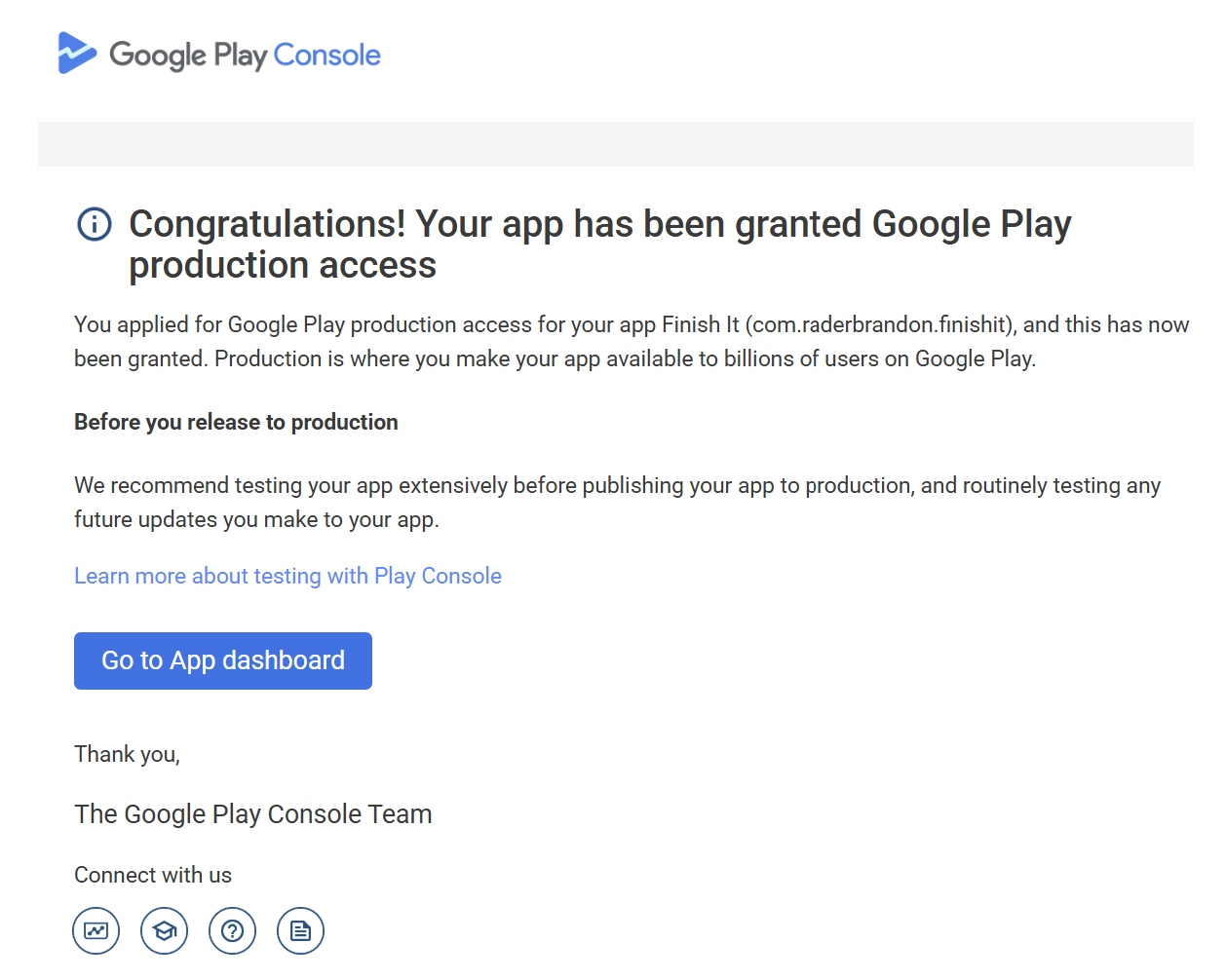
Verified Production Access
Quality QA Testing Reports
Clear, actionable reports with screenshots and evidence for every important issue found during testing.
Real Device Testing & Diagnostics
Real human testers use physical Android devices to test your app, verify real user flows, and provide clear testing evidence and professional QA reports.
Compliance Audit Passed
Get your Android build approved on the first try. We create an audit-ready compliance profile that proves thorough quality assurance.
Affordable Compliance Cycles
Transparent plans built to satisfy Google Play Console guidelines for your Android build.
Loading Packages
Please wait while we fetch the best options for your region...
Frequently Asked Questions
Everything you need to know about passing your closed testing requirements.