Qualified Google Play Closed Testing Service for Android Apps
Pass Google Play closed testing compliance requirements for your Unity app using 12 testers to generate genuine daily activity on physical Android handsets and genuine 14-day QA activity to guarantee production access clearance.
12 testers for google play on Unity applications
Google Play now requires new personal developer accounts to run a closed test with at least 12 testers for 14 consecutive days. Only after you complete this can you apply to publish your app for everyone. This rule is a common roadblock for many developers. The simplest way to clear this hurdle is by using a qualified Google Play closed testing service.
This guide explains the requirement, the challenges, and how a dedicated service makes the process smooth and successful.
What Exactly is Google's 12 testers, 14-Day Rule?
Google introduced this policy to improve the quality of apps on the Play Store. They want to make sure real people have tested an app before it goes live. This helps filter out spam, malware, and very low-quality applications.
Here’s the rule broken down into two simple parts:
- 12+ Opted-in Testers: You need a minimum of 12 individual people to agree to become testers for your app. They must officially "opt-in" through Google Play.
- 14 Consecutive Days: These 12+ testers must remain opted-in for 14 days in a row. If someone leaves on day 5, the clock might reset or pause for that "slot." The key is consistency.
This applies specifically to personal developer accounts created after November 13, 2023. If you have an older account or a business account, you might not see this requirement. For new developers, however, it's a mandatory step.
The Big Headache: Why Finding 12 Reliable Testers is So Hard
On the surface, finding 12 people sounds easy. In reality, it's a major challenge for independent developers.
The "Friends and Family" Problem
Your first thought is probably to ask friends and family. This sounds great, but it rarely works out. People are busy. They might agree to help but forget to opt-in. They might install the app and then uninstall it a day later. Or, they might opt-out by accident. Managing 12 people you know personally, reminding them to stay in the test, and making sure they don't leave is exhausting. It's an unreliable method that often fails to meet the 14-day continuous requirement.
The "Social Media" Gamble
What about asking for testers on Reddit, Facebook, or Twitter? This is a total gamble. You might get some interest, but you have no control over who these people are. Many will opt-in just to see what your app is, then opt-out an hour later. This completely breaks the 14-day rule. You also risk getting unhelpful feedback or even people trying to steal your app idea. It’s impossible to maintain a stable group of 12 testers this way.
The "Fiverr Bot" Trap
Some developers turn to cheap services on platforms like Fiverr that promise 12 testers instantly. This is the most dangerous option. These services almost always use bots or fake accounts running on emulators. Google's systems are very good at detecting this kind of fake activity. If you get caught, your app could be rejected, and your entire developer account could be suspended permanently. It's a huge risk that can end your app development journey before it even begins.
How a Qualified Google Play Closed Testing Service Solves Everything
A professional testing service is built specifically to solve this problem. Instead of you spending weeks trying to find and manage people, the service does it all for you.
Here’s what a good service provides:
- A Network of Real Testers: They have a community of real people with genuine Google accounts and Android devices.
- Guaranteed Opt-in Period: They ensure that at least 12 testers opt-in and, most importantly, stay opted-in for the full 14 days.
- Policy Compliance: Reputable services operate within Google's guidelines. They don't use bots or fake accounts, so your developer account stays safe.
- Time and Stress Savings: You can focus on improving your app instead of chasing down testers. You submit your app, and they handle the rest.
It turns a major roadblock into a simple, hands-off process.
Choosing Your Path: A Quick Comparison
| Feature | AppConsoleLab's Service | Finding Testers Yourself | Fiverr Bots |
|---|---|---|---|
| Tester Reliability | High. Vetted, real users who understand the process. | Low. Friends forget, strangers are unpredictable. | Extremely Low. Not real users. |
| 14-Day Guarantee | Yes. They guarantee the 14-day continuous opt-in. | No. It's a constant struggle to keep people in. | No. Bots get detected and removed. |
| Google Policy Compliance | High. Designed to be compliant and safe. | High. As long as they are real people. | Extremely Low. High risk of account ban. |
| Time Investment | Low. Set it up once and you're done. | Very High. Requires constant management and follow-up. | Low. But the risk isn't worth it. |
| Risk of Ban | Very Low. Uses legitimate methods. | Low. No risk if you use real people. | Very High. This is a black-hat technique. |
| Success Rate | Very High. Over 99% success. | Low. Many developers fail and have to restart. | Extremely Low. Often leads to failure and bans. |
Submit Your App Details
Service Onboarding
Tester Invitation & Opt-in
The 14-Day Test Period
Verification and Confirmation
Apply for Production
Method 1: Public Opt-in Link
Method 2: Email Lists / Google Groups
Struggling with the 14-Day Testing Requirement?
Skip the hassle of recruiting unreliable testers. Our professional fleet of real Android devices guarantees Google Play compliance in exactly 14 days. Zero bots. Zero emulators. 100% production approval guarantee.
Your Step-by-Step Guide to Setting Up a Closed Test
Whether you use a service or find testers yourself, the setup process in the Google Play Console is the same. Here’s how you do it.
Step 1: Prepare Your App in Google Play Console
Before you can even think about testers, your app needs to be set up.
- Create App: Log in to your Google Play Console and click 'Create app.' Fill out the initial details like app name, language, and whether it's an app or a game.
- Initial Setup: Go to the 'Dashboard' for your new app. You'll see a list of initial setup tasks. You need to complete sections like 'Set up your app's listing' (short/long description, screenshots), 'App content' (privacy policy, ads, age rating), and more.
- Upload Your App Bundle: You need a signed App Bundle (AAB) file, not an APK. This is the modern format Google uses.
Step 2: Configure the Closed Testing Track
This is where you'll create the test itself.
- Navigate to Testing -> Closed testing in the left-hand menu.
- Click Manage track. If it's your first time, you might need to click 'Create track.'
- Create a New Release: Click 'Create new release' in the top right corner.
- Upload Your AAB: Upload the App Bundle file you prepared earlier. Add some release notes explaining what this version of the app is for.
- Click Save, then Review release. Finally, click Start rollout to Closed testing. Your app is now available for testing, but nobody can access it yet.
Step 3: Manage Your Testers
After creating the release, go back to the 'Closed testing' page and click the Testers tab. This is where you decide how people can join.
- Choose a Method: You can either create an email list or use a public opt-in link. For use with a service, the link is the best option.
- Get the Link: Select the option to use a link. Google will generate a unique 'Join on Android' or 'Join on web' link.
- Share the Link: Copy this link. This is what you will provide to your testing service or share with your group of testers. They will click it to officially opt-in.
Step 4: The Waiting Game - What to Do During the 14 Days
Once your 12 testers have opted in, the waiting begins. The most important rule is: do not change the tester list. Adding or removing people can reset the clock.
During this time, you can still work on your app. You can even upload new app bundles to the same closed testing track if you find bugs or want to add features. The testers will get an update, but as long as they stay opted-in, the 14-day timer keeps running.
Phase 1: Pre-Test Setup Checklist
Phase 2: Active Test Management Checklist
Common Mistakes to Avoid During Your Closed Test
Many developers stumble during this process. Here are some common mistakes to avoid:
- Changing the Tester List: This is the biggest error. If you remove a tester or add new ones mid-way, Google's system might see this as an unstable test group and reset your 14-day progress. Set your list and leave it alone.
- Using an Unstable App: If your app crashes on launch, testers can't use it. While Google doesn't strictly monitor usage, a completely broken app is a bad look and might cause testers to leave. Make sure your test build is at least functional.
- Trying to Rush It: There is no way to speed up the 14-day requirement. It is a hard-coded waiting period. Be patient and let the process run its course.
- Choosing the Wrong Service: Not all testing services are equal. Avoid any that seem suspiciously cheap or promise instant results. Stick with reputable providers who are transparent about their process. For a detailed comparison, check out this guide on the Best Google Play Closed Testing Services Compared (2026).
What Happens After the 14 Days?
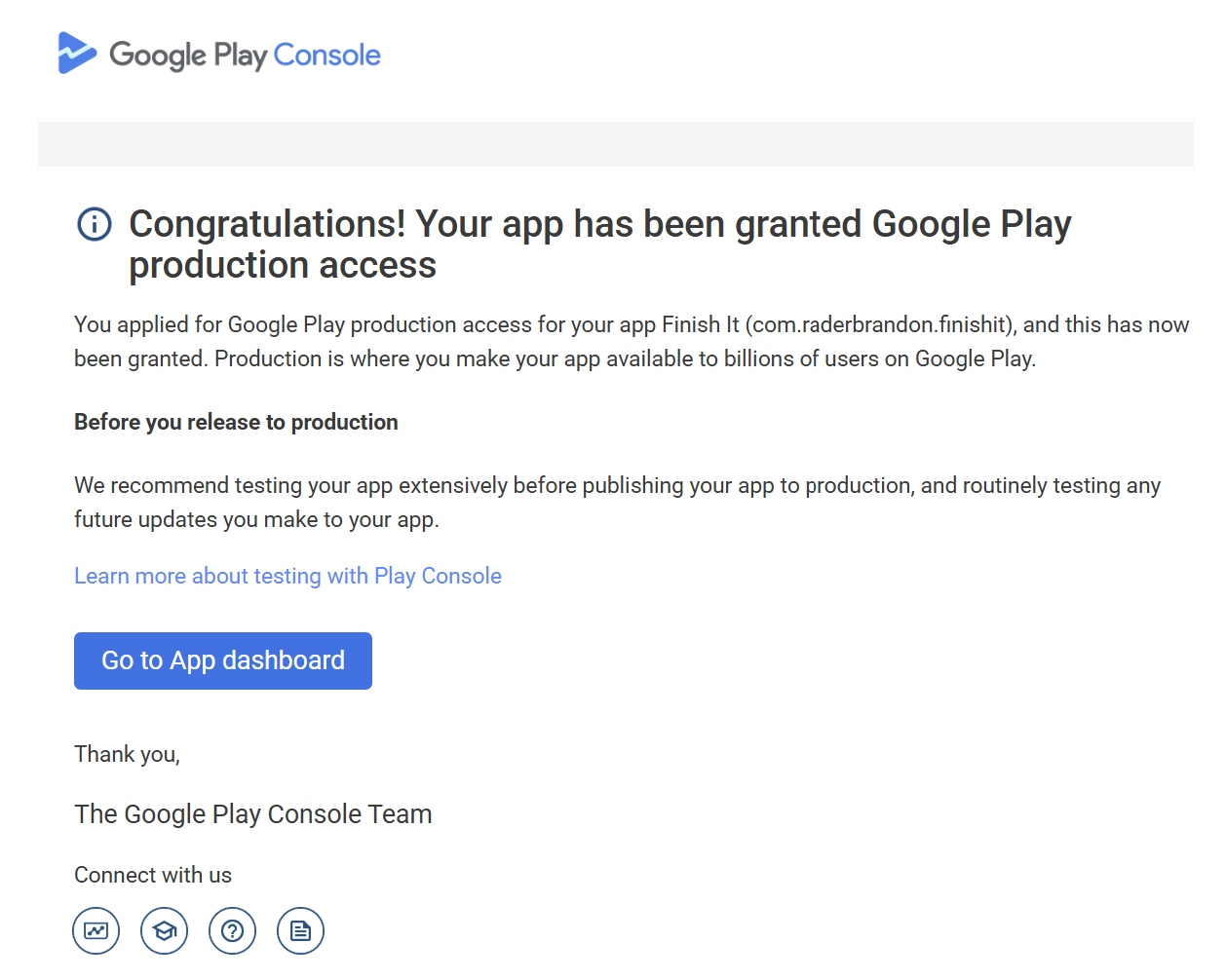
Once your app has been tested by 12 people for 14 days, you've cleared the main hurdle. A new section will appear on your main Dashboard in the Google Play Console, prompting you to 'Apply for production.'
You will need to answer a series of questions about your app, its functionality, and how it's been tested. Be honest and thorough in your answers. After you submit this, your app will go into a final review queue. This review can take a few days or longer, depending on Google's workload.
If your app complies with all policies, it will be approved and published on the Google Play Store for everyone to download.
Meeting Google's closed testing requirement doesn't have to be a source of stress. While finding 12 reliable testers on your own is difficult and risky, using a qualified service transforms it into a simple, automated step. It's a small investment that protects your developer account, saves you weeks of effort, and gets your app on the path to a successful launch.
Can I use testers from different countries?
What if a tester opts out during the 14 days?
Does Google know Im using a testing service? Is it allowed?
Do I need to provide feedback forms or anything for the testers?
How long does it take to get production access *after* the 14-day test is complete?
Can I update my app build during the 14-day testing period?
The Testing Pipeline
A straightforward 4-step process to get your Unity app approved.
Sign In
Connect your Google account and choose your preferred closed testing package for your Unity app.
Opt-In URL
Share your Play Store opt-in URL. We immediately deploy 12 real testers to launch and review your Unity app daily.
Testing Begins
Our crew initiates daily launch sessions on physical devices, verifying usability and logging crashes for your Unity app.
Compliance Complete
We continuously perform closed app testing for 14 days to help you meet Google Play production requirements. We also provide a compliance report.
Why Developers Trust Us
Deploy your Unity app onto real retail-grade handsets using our secure laboratory environment.
The 14-Day Production Guarantee
We complete the required 14-day closed testing process with real human testers and physical Android devices, while providing clear testing evidence and documentation throughout the process.
If Google specifically rejects production access due to insufficient testing engagement, you are covered by our free re-run or 100% refund guarantee, subject to our Refund Policy.
Verified Production Access
Quality QA Testing Reports
Clear, actionable reports with screenshots and evidence for every important issue found during testing.
Real Device Testing & Diagnostics
Real human testers use physical Android devices to test your app, verify real user flows, and provide clear testing evidence and professional QA reports.
Guaranteed App Approval
Transition your Unity app to public production access with confidence. We deliver verified session logs and compliant Console activity.
One Cycle. Complete Approval.
Choose the ideal closed testing cycle for your Unity release.
Loading Packages
Please wait while we fetch the best options for your region...
Frequently Asked Questions
Everything you need to know about passing your closed testing requirements.